from Feb. 12, 1928
"Tragedy of Lincoln's Death Halted Feast of Rejoicing"
-
Full Title
"Tragedy of Lincoln's Death Halted Feast of Rejoicing"
-
Description
In 1928, Robert Brown recounted his childhood as the son of White House butler and waiter Peter Brown. Peter Brown, a formerly enslaved man, worked in the Lincoln White House. In the interview, Robert Brown discussed his early childhood in Virginia, his family's move to Washington, getting to know President Lincoln and his children, and learning of Lincoln's assassination. The newspaper page also includes other articles about Lincoln.
-
Transcription
[interviewer:] "Where were you on the night of the assassination?"
[Brown:] "I was home on Twelfth street., between O and H. about three or four blocks from Ford's. It was about half past 10 and I was taking off my clothes to go to bed. My father had just left the house, saying he had orders to return to the Executive Mansion about 11 and help with a supper they intended to have, and he would be beck when he could, but he didn't say what time. He went out and I was just ready to crawl into bed when I heard a big commotion in the street, men running this way and that, people shouting, military giving orders, horses dashing by. When I stuck my head out the door some one ran up, saying Mr. Lincoln was shot at the theater. My mother pulled me back in the house and made me stay in bed. She said it was dangerous to be out, and we should stay in. We kept awake till my father returned and told us of the excitement over at the White House. He stayed over there trying to comfort Tad, but after putting him to bed there wasn't anything he could do, so he locked up after a while and came home. Then I fell asleep."
[interviewer:] "Who was to have made up the party over at the White House?"
[Brown:] "That I couldn't say. My father just said they were to have some kind of supper after the performance, and he was needed there."
[interviewer:] "How many were invited?"
[Brown:] "That I don't know, sir. You see, my father wasn't the steward, otherwise he would have known how many. He only helped wait on the table in emergencies, and I can't say whether he was to do table duty that night."
[interviewer:] "Were the guests coming from Ford's Theater with the Lincolns or from elsewhere?"
[Brown:] "That, sir, is beyond me." -
Source
Chronicling America: Historic American Newspapers, Library of Congress
-
Rights
This item is in the public domain.
-
Tags
-
Cite this Item
George M. Battey, Jr.. ""Tragedy of Lincoln's Death Halted Feast of Rejoicing"". The Washington Star. Remembering Lincoln. Web. Accessed May 4, 2026. https://rememberinglincoln.fords.org/node/1214
-
Creator
George M. Battey, Jr.
-
Publisher
The Washington Star
-
Date
February 12, 1928
from Feb. 12, 1928
"Tragedy of Lincoln's Death Halted Feast of Rejoicing"

-
Description
In 1928, Robert Brown recounted his childhood as the son of White House butler and waiter Peter Brown. Peter Brown, a formerly enslaved man, worked in the Lincoln White House. In the interview, Robert Brown discussed his early childhood in Virginia, his family's move to Washington, getting to know President Lincoln and his children, and learning of Lincoln's assassination. The newspaper page also includes other articles about Lincoln.
-
Source
Chronicling America: Historic American Newspapers, Library of Congress
-
Rights
This item is in the public domain.
-
Creator
George M. Battey, Jr.
-
Publisher
The Washington Star
-
Date
February 12, 1928
from May. 1, 1865
Excerpt from The Diary of Michael Shiner
-
Full Title
Excerpt from The Diary of Michael Shiner
-
Description
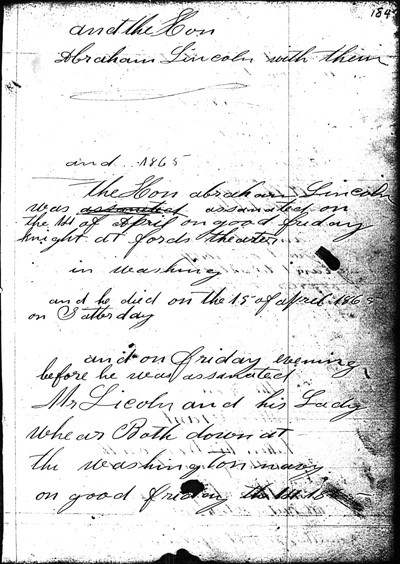
Diarist, Michael Shiner, was an African-American Navy Yard worker who chronicled events in Washington D.C over 60 years.
-
Transcription
and the Hon Abraham Lincoln with them.
and 1865
The Hon abraham Lincoln was assinated assanated on the 14 of April on good friday knight at fords theater in washing
and he died on the 15 of april 1865 on Satturday
and on friday evening before he was assanated Mr Licoln and his Lady whear Both down at the washington navy on good friday the 14 1865 -
Source
-
Rights
This item is in the public domain and may be reproduced and used for any purpose, including research, teaching, private study, publication, broadcast or commercial use, with proper citation and attribution.
-
Tags
-
Cite this Item
Michael Shiner. "Excerpt from The Diary of Michael Shiner ". Remembering Lincoln. Web. Accessed May 4, 2026. https://rememberinglincoln.fords.org/node/1170
-
Creator
Michael Shiner
-
Date
April 1865
from May. 1, 1865
Excerpt from The Diary of Michael Shiner
-
Description
Diarist, Michael Shiner, was an African-American Navy Yard worker who chronicled events in Washington D.C over 60 years.
-
Source
-
Rights
This item is in the public domain and may be reproduced and used for any purpose, including research, teaching, private study, publication, broadcast or commercial use, with proper citation and attribution.
-
Creator
Michael Shiner
-
Date
May 1, 1865
from Dec. 15, 1865
Abraham Lincoln, a Speech
-
Full Title
Abraham Lincoln, a Speech
-
Description
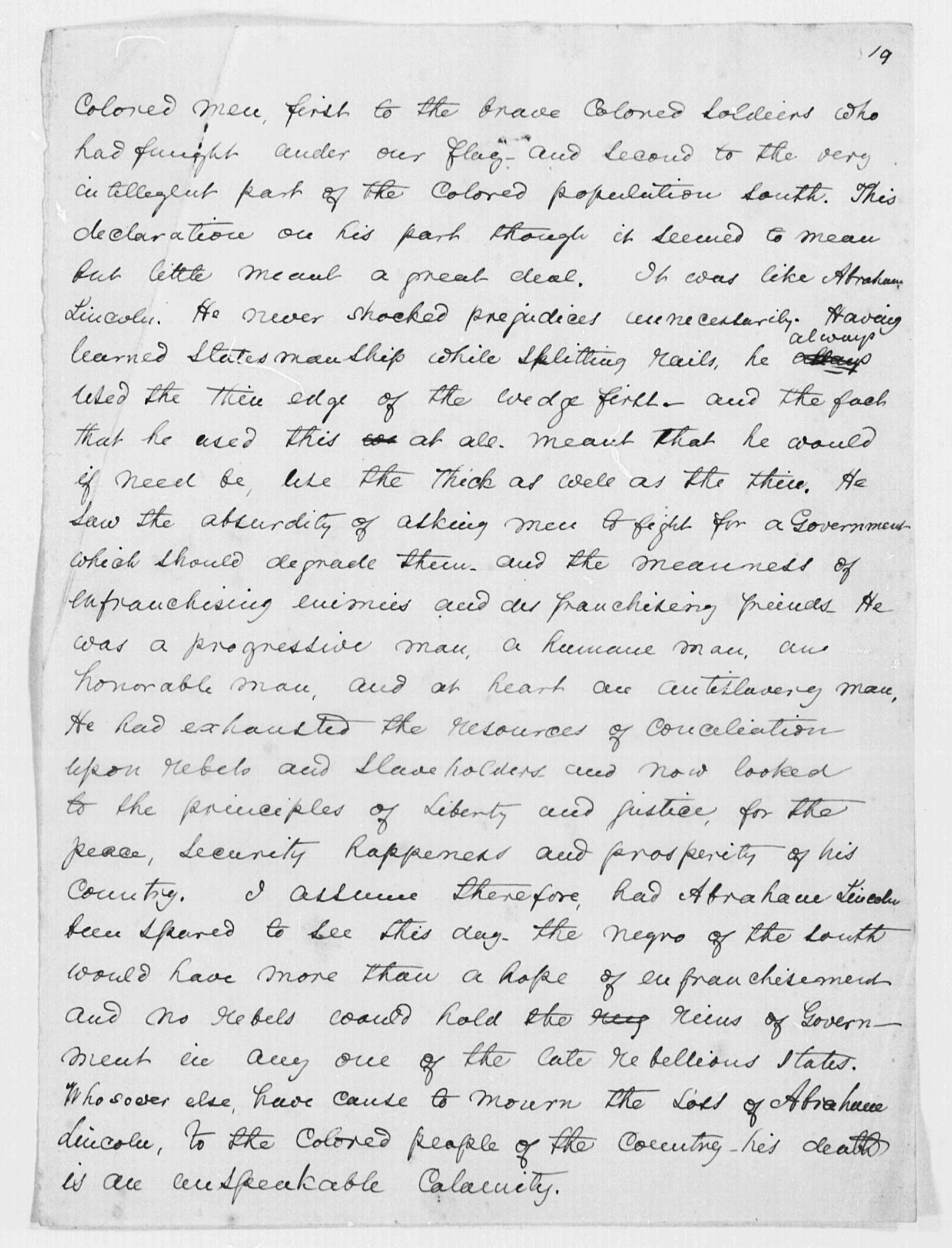
In this speech, Frederick Douglass reflected on how the outpouring of joy at the conclusion of the Civil War turned to mourning with Lincoln’s assassination. His death, according to Douglass was not only tragic, but also prevented recently freed slaves and African Americans from gaining the ear of wise and well-intentioned leader. Towards the end of his speech, Douglass pondered how life would have been different had Lincoln not perished in April, lamenting that his death was a great blow against African American rights.
-
Transcription
Colored men, first to the brave Colored Soldiers who had fought under our flag and second to the very intelligent part of the Colored population South. This declaration on his part though it seemed to mean but little meant a great deal. It was like Abraham Lincoln. He never shocked prejudices unnecessarily. Having learned Statesmanship while splitting rails, he always used the thin edge of the wedge first, and the fact that he used this at all meant that he would if need be, use the thick as well as the thin. He saw the absurdity of asking men to fight for a Government which should degrade them, and the meanness of enfranchising enemies and de-franchising friends. He was a progressive man, a humane man, an honorable man, and at heart an antislavery man. He had exhausted the resources of conciliation upon rebels and slaveholders and now looked to the principles of Liberty and justice, for the peace, security, happiness and prosperity of his Country. I assume therefore, had Abraham Lincoln been spared to see this day, the negro of the South would have more than a hope of enfranchisement and no rebels could hold the reins of Government in any one of the late rebellious States. Whosoever else have cause to mourn the loss of Abraham Lincoln, to the Colored people of the Country his death is an unspeakable calamity.
[Transcription by: Evan Laugen, Chandra Manning's class, Georgetown University]. -
Source
Frederick Douglass Papers, Manuscript Division, Library of Congress
-
Rights
This item is in the public domain and may be reproduced and used for any purpose, including research, teaching, private study, publication, broadcast or commercial use, with proper citation and attribution.
-
Tags
-
Cite this Item
Frederick Douglass. "Abraham Lincoln, a Speech". Remembering Lincoln. Web. Accessed May 4, 2026. https://rememberinglincoln.fords.org/node/812
-
Creator
Frederick Douglass
-
Date
Late December 1865
from Dec. 15, 1865
Abraham Lincoln, a Speech
-
Description
In this speech, Frederick Douglass reflected on how the outpouring of joy at the conclusion of the Civil War turned to mourning with Lincoln’s assassination. His death, according to Douglass was not only tragic, but also prevented recently freed slaves and African Americans from gaining the ear of wise and well-intentioned leader. Towards the end of his speech, Douglass pondered how life would have been different had Lincoln not perished in April, lamenting that his death was a great blow against African American rights.
-
Source
Frederick Douglass Papers, Manuscript Division, Library of Congress
-
Rights
This item is in the public domain and may be reproduced and used for any purpose, including research, teaching, private study, publication, broadcast or commercial use, with proper citation and attribution.
-
Creator
Frederick Douglass
-
Date
December 15, 1865