from Apr. 19, 1865
Faith in God
-
Full Title
Faith in God
-
Description
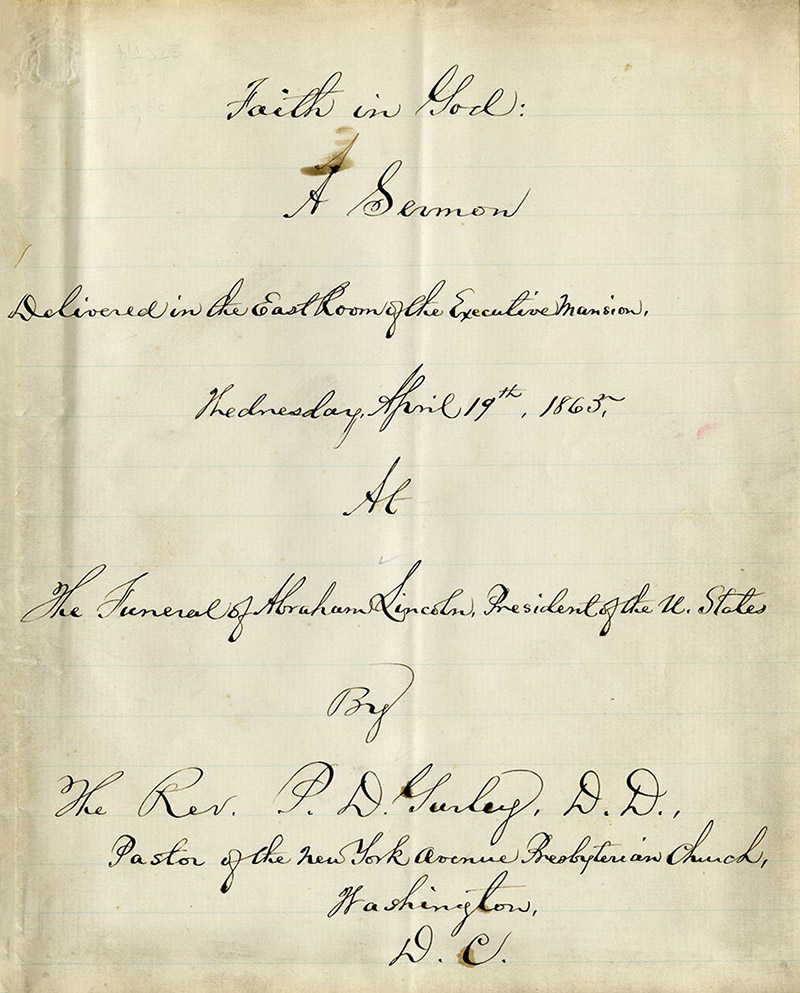
Manuscript sermon delivered in the East Room of the Executive Mansion, Wednesday, April 19, 1865, at the funeral of Abraham Lincoln, President of the U.S., by the Reverend Phineas Densmore Gurley, pastor of the New York Avenue Presbyterian Church, Washington, D.C.
-
Transcription
[Page 1]
Faith in God:
A Sermon
Delivered in the East Room of the Executive Mansion.
Wednesday, April 19th, 1863.
At
The Funeral of Abraham Lincoln, President of the U. States
By The Rev. P. D. Gurley. D. D..
Pastor of the New York Avenue Presbyterian Church, Washington,
D.C.
[Page 2] 1
Funeral Address.
Mark x1. 22.
“Have Faith in God.”
As we stand here to-day, mourners around this coffin and around the lifeless remains of our beloved Chief Magistrate, we recognize and we adore the sovereignty of God. His throne is in the heavens, and his kingdom ruleth over all. He hath done, and He hath permitted to be done, whatsoever He pleased. “Clouds and darkness are round about Him; righteousness and judgment are the habitations of his throne.” His way is in the sea, and his path in the great waters, and his footsteps are not known. “Canst thou by searching find out God? Canst thou find out the Almighty unto perfection? It is as high as heaven; what canst thou do? Deeper than hell; what canst thou know? The measure thereof if longer than the earth, and broader than the sea. If he cut off, and shut up, or gather together, then who can hinder Him? For He knoweth vain men; He seeth wickedness also; will
[Page 3]
2
He not then consider it? — We bow before before his infinite majesty. We bow, we weep, we worship.
“Where reasons fails, with all her powers,
There faith prevails, and love adores.”
It was a cruel, cruel hand, that dark hand of the assassin, which smote our honored, wise, and noble President, and filled the land with sorrow. But above and beyond that hand there is another which we must see and acknowledge. It is the chastening hand of a wise and faithful Father. He gives us this bitter cup. And the cup that our Father hath give us, shall we not drink it?
“God of the just, thou gavest us the cup:
We yield to thy behest, and drink it up.”
“Whom the Lord loveth he chasteneth.” O how these blessed words have cheered and strengthened and sustained us through all these long and weary years of civil strife, while our friends and brothers on so many ensanguined fields were falling and dying for the causes of Liberty
[Page 4]
3
and Union! Let them cheer, and strengthen, and sustain us to-day True, this new sorrow and chastening has come in such an hour and in such a way as we thought not, and it bears the impress of a rod that is very heavy, and of a mystery that is very deep. That such a life should be sacrificed, at such a time, by such a foul and diabolical agency; that the man at the head of the nation, whom the people had learned to trust with a confiding and a loving confidence, and upon whom more than upon any other were centred, under God, our best hopes for the true and speedy pacification of the country, the restoration of the Union, and the return of harmony and love; that he should be taken from us, and taken just as the prospect of peace was brightly opening upon our torn and bleeding country, and just as he was beginning to be animated and gladdened with the hope of ere long enjoying with the people the blessed fruit and reward of his and their toil, and care, and patience, and self-sacrificing devotion to the interests of Liberty and the Union—O it is a mysterious and
[Page 5]
4
a most afflicting visitation! But it is our Father in heaven, the God of our fathers, and our God, who permits us to be so suddenly and sorely smitten; and we know that his judgments are right, and that in faithfulness He has afflicted us. In the midst of our rejoicings we needed this stroke, this dealing, this discipline; and therefore He has sent it. Let us remember, our affliction has not come forth of the dust, and our trouble has not sprung out of the ground. Through and beyond all second causes let us look, and see the sovereign permissive agency of the great First Cause. It is his prerogative to bring light out of darkness and good out of evil. Surely the wrath of man shall praise Him, and the remainder of wrath He will restrain. In the light of a clearer day we may yet see that the wrath which planned and perpetrated the death of the President, was overruled by Him whose judgments are unsearchable, and his ways past finding out, for the highest welfare of all those interests which are so dear to the Christian patriot and philanthropist,
[Page 6]
5
and for which a loyal people have made such an unexampled sacrifice of treasure and of blood. Let us not be faithless, but believing.
“Blind unbelief is prone to err,
And scan his work in vain;
God is his own interpreter,
And He will make it plain.”
We will wait for his interpretation, and we will wait in faith, nothing doubting. He who has led us so well, and defended and prospered us so wonderfully, during the last four years of toil, and struggle, and sorrow, will not forsake us now. He may chasten, but He will not destroy. He may purify us more and more in the furnace of trial, but He will not consume us. No, no! He has chosen us as He did his people of old in the furnace of affliction, and He has said of us as He said of them, “This people have I formed for myself; they shall show forth my praise.” Let our principal anxiety now be that this new sorrow may be a sanctified sorrow; that it
[Page 7]
6
may lead us to deeper repentance, to a more humbling sense of our dependence upon God, and to the more unreserved consecration of ourselves and all that we have to the cause of truth and justice, of law and order, of liberty and good government, of pure and undefiled religion. Then, though weeping may endure for a night, joy will come in the morning. Blessed be God! despite of this great and sudden and temporary darkness, the morning has begun to dawn—the morning of a bright and glorious day, such as our country has never seen. That day will come and not tarry, and the death of an hundred Presidents and their Cabinets can never, never prevent it. While we are thus hopeful, however, let us also be humble. The occasion calls us to prayerful and tearful humiliation. It demands of us that we lie low, very low, before Him who has smitten us for our sins. O that all our rulers and all our people may bow in the dust to-day beneath the chastening hand of God! And may their voices go up to Him as one voice, and their hearts
[Page 8]
7
go up to Him as one heart, pleading with Him for mercy, for grace to sanctify our great and sore bereavement, and for wisdom to guide us in this our time of need. Such a united cry and pleading will not be in vain. It will enter into the ear and heart of Him who sits upon the throne, and He will say to us, as to His ancient Israel, “In a little wrath I hid my face from thee for a moment: but with everlasting kindness will I have mercy upon thee, saith the Lord, the Redeemer.”—
I have said that the people confided in the late lamented President with a full and a loving confidence. Probably no man since the days of Washington was ever so deeply and firmly embedded and enshrined in the very hearts of the people as Abraham Lincoln. Nor was it a mistaken confidence and love. He deserves is—deserved it well—deserved it all. He merited it by his character, by his acts, and by the whole tenor, and tone, and spirit of his life. He was simple and sincere, plain and honest, truthful and just, benevolent and kind. His perceptions were quick and clear, his
[Page 9]
8
Judgments were calm and accurate, and his purposes were good and pure beyond a question. Always and every where he aimed and endeavored to be right and to do right. His integrity was thorough, all-pervading, all-controlling, and incorruptible. It was the same in every place and relation, in the consideration and the control of matters great or small, the same firm and steady principle of power and beauty that shed a clear and crowning lustre upon all his other excellencies of mind and heart, and recommended him to his fellow citizens as the man, who, in a time of unexampled peril, when the very life of the nation was at stake, should be chosen to occupy, in the country and for the country, its highest post of power and responsibility. How wisely and well, how purely and faithfully, how firmly and steadily, how justly and successfully he did occupy that post and meet its grave demands in circumstances of surpassing trial and difficulty, is known to you all, known to the country and the world. He comprehended from the
[Page 10]
9
first the perils to which treason had exposed the freest and best Government in the world on the earth, the vast interests of liberty and humanity that were to be saved or lost forever in the urgent impending conflict; he rose to the dignity and momentousness of the occasion, saw his duty as the Chief Magistrate of a great and imperiled imperiled imperilled people and he determined to do his duty, and his whole duty, seeking the guidance and leaning upon the arm of Him of whom it is written, “Hee giveth power to the faint, and to them that have no might he increaseth strength.” Yes, he leaned upon His arm. He recognized and received the truth that the “kingdom is the Lord’s, and He is the governor among the nations.” He remembered that “God is in the history,” and he felt that nowhere had his hand and his mercy been so marvellously conspicuous as in the history of this nation. He hoped and he prayed that that same hand would continue to guide us, and that same mercy continue to abound to us in the time of our greatest need. I speak what I know, and testify what I have
[Page 11]
10
often heard him say, when I affirm that that guidance and mercy were the prop on which he humbly and habitually leaned; they were the best hope he had for himself and for his country. Hence, when he was leaving his home in Illinois, and coming to this city to take his seat in the executive chair of a distrubed and troubled nation, he said to the oldand tried friends who gathered tearfully around him and bade him farewell, “I leave you with this request: pray for me.” They did pray for him; and millions of others prayed for him; not did they pray in vain. Their prayer was heard, and the answer appears in all his subsequent history; it shines forth with a heavenly radiance in the whole course and tenor of his administration, from its commencement to its close. God raised him up for a great and glorious mission, furnished him for his work, and aided him in its accomplishment. Nor was it merely by strength of mind, and honesty of heart, and purity and pertinacity of purpose, that He furnished him; in addition to these
[Page 12]
11
things, He gave him a calm and abiding confidence in the overruling providence of God and in the ultimate triumph of truth and righteousness through the power and the blessing of God. This confidence strengthened him in all his hours of anxiety and toil, and inspired him with calm and cheering hope when others were inclining to despondency and gloom. Never shall I forget the emphasis and the deep emotion with which he said in this very room, to a company of clergymen and others, who called to pay him their respects in the darkest days of our civil conflict: “Gentlemen, my hope of success in this great and terrible struggle rests on that immutable foundation, the justice and goodness of God. And when events are very threatening, and prospects very dark, I still hope that in some way which man can not see all will be well in the end, because our course is just, and God is on our side.” Such was his sublime and holy faith, and it was an anchor to his soul, both sure and steadfast. It made him firm and strong. It em-
[Page 13]
12
boldened him in the pathway of duty, however rugged and perilous it might be. It made him valiant for the right; for the cause of God and humanity, and it held him in steady, patient, and unswerving adherence to a policy of administration which he thought, and which one all now think, both God and humanity required him to adopt. We admired and loved him on many accounts—for strong and various reasons: we admired his childlike simplicity, his freedom from guile and deceit, his staunch and sterling integrity, his kind and forgiving temper, his industry and patience, his persistent, self-sacrificing devotion to all the duties of his eminent position, from the least to the greatest, his readiness to hear and consider the cause of the poor and humble, the suffering and the oppressed; his charity toward those who questioned the correctness of his opinions and the wisdom of his policy his wonderful skill in reconciling differences among the friends of the Union, leading them away from abstractions, and inducing them to work together and harmoniously for the common
[Page 14]
13
weal; his true and enlarged philanthropy, that knew no distinction of color or race, but regarded all men as brethren, and endowed alike by their Creator “with certain inalienable rights, among which are life, liberty, and the pursuit of happiness”; his inflexible purpose that what freedom had gained in our terrible civil strife should never be lost, and that the end of the war should be the end of slavery, and, as a consequence of rebellion; his readiness to spend and be spent for the attainment of such a triumph—a triumph, the blessed fruits of which shall be as widespreading as the earth and as enduring as the sun:—All these things commanded and fixed our admiration, and the admiration of the world, and stamped upon his character and life the unmistakable impress of greatness. But more sublime than any or all of these, more holy and influential, more beautiful, and strong, and sustaining, was his abiding confidence in God and in the final triumph of truth and righteousness through Him and for his sake. This was his noblest virtue,
[Page 15]
14
his grandest principle, the secret alike of his strength, his patience, and his success. And this, it seems to me, after being near him steadily, and with him often, for more than four years, is the principle by which, more than by any other, “he, being dead, yet speaketh.” Yes; by his steady enduring confidence in God, and in the complete ultimate success of the cause of God, which is the cause of humanity, more than by any other way, does he now speak to us and to the nation he loved and served so well. By this he speaks to his successor in office, and charges him to “Love faith in God.” By this he speaks to the members of his cabinet, the men with whom he counseled so often and was associated so long, and he charges them to “have faith in God.” BY this he speaks to the officers and men of our noble army and navy, and, as they stand at their posts of duty and peril, he charges them to “have faith in God.” By this he speaks to all who occupy positions of influence and authority in these sad and troublous times, and he charges them all to “have faith in God.” By
[Page 16]
15
this he speaks to this great people as they sit in sackcloth to-day, and weep for him with a bitter wailing, and refuse to be comforted, and he charges them to “have faith in God.” And by this he will speak through the ages and to all rulers and peoples of in every land, and his message to them will be, “Cling to liberty and right; battle for them; bleed for them; die for them, if need be; and have confidence in God.” O that the voice of this testimony may sink down into our hearts to-day and every day, and into the heart of the nation, and exert its appropriate influence upon our feelings, our faith, our patience, and our devotion to the cause of freedom and humanity—a cause clearer to us now than ever before, because consecrated by the blood of its most conspicuous defender, its wisest and most fondly-trusted lives, and He can guide and strengthen his successor, as He guided and strengthened him. He is dead; but the memory of his virtue, of his wise and patriotic counsels and labors, of his calm and steady faith in
[Page 17]
16
God, lives, is precious, and will be a power for good in the country quite down to the end of time. He is dead; but the cause he so ardently loved, so ably, patiently, faithfully represented and defended—not for himself only, not for us only, but for all people in all their coming generations, till time shall be no more—that cause survives his fall, and will survive it. The light of its brightening prospects flashes cheeringly to-day athwart the gloom occasioned by his death, and the language of God’s united providences is telling us that, though the friends of liberty die, liberty itself is immortal. There is no assassin strong enough and no weapon deadly enough to quench its inextinguishable life, or arrest its onward march to the conquest and empire of the world. This is our confidence, and this is our consolation, as we weep and mourn to-day. Though our beloved President is dead slain, our beloved country is saved. And so we sing of mercy as well as of judgment. Tears of gratitude mingle with those of sorrow. While there is darkness, there is also the dawning of a brighter, happier day
[Page 18]
17
Upon our stricken and weary land. God be praised that our fallen Chief lived long enough to see the day dawn and the daystar of joy and peace arise upon the nation. He saw it, and he was glad. Alas! Alas! He only saw the dawn. When the sun has risen, full—orbed and glorious, and a happy reunited people are rejoicing in its light,—alas! Alas! It will shine upon his grave. But that grave will be a precious and a consecrated spot. The friends of liberty and of the Union will repair to it in years and ages to come, to pronounce the memory of its occupant blessed, and, gathering from his very ashes, and from the rehearsal of his deeds and virtues, fresh incentives to patriotism, they will there renew their vows of fidelity to their country and their God.
And now I know not that I can more appropriately conclude this discourse, which is but a sincere and simple utterance of the heart, than by addressing to our departed President, with some slight modification, the language which Tacitus in his life of Agricola, addressed to his venerable and de
[Page 19]
18
parted father-in-law: “With you we may not congratulate; you are blessed, not only because your life was a career of glory, but because you were released, when, your country safe, it was happiness to die. We have lost a parent, and, in our distress, it is now an addition to our heartfelt sorrow that we had it not in our power to commune with you on the bed of languishing, and receive your last embrace. Your dying words would have been ever dear to us; your commands we should have treasured up; and graved them on our hearts. This sad comfort we have lost, and the wound for that reason, pierces deeper. From the world of spirits behold your disconsolate family and people; exalt our minds from fond regret and avoiding grief to the contemplation of your virtues. Those we must not lament; it were impiety to sully them with a tear. To cherish their memory, to embalm them with our praises, and, so far as we can, to emulate your bright example, will be the truest mark of our respect, the best tribute we can offer. Your wife will thus preserve the memory of the best of husbands, and thus your children
[Page 20]
19
will prove their filial piety. By dwelling constantly on your words and actions, they will have an illustrious character before their eyes, and, not content with the bare image or your mortal frame, they will have what is more valuable—the form and features of your mind. Busts and statues, like their original, are frail and perishable. The soul is formed of fine elements, and its inward form is not to be expressed by the hand of an artist with unconscious matter—our manners and our morals may in some degree trace the resemblance. All of you that gained out love and raised our admiration still subsists, and will ever subsist, preserved in the minds of men, the register of ages, and the records of fame. Others, who have figured on the stage of life and were the worthies of a former day, will wink, for want of a faithful historian, into the common lot of oblivion, inglorious and unremembered; but you, our lamented friend and head, delineated with truth, and fairly consigned to prosperity, will survive yourself, and triumph over the injuries of time.”—
[Transcription by McCaela Michas]
-
Source
RAREDOC G963f, Presbyterian Historical Society, Philadelphia, PA
-
Rights
Use of this item for research, teaching, and private study is permitted with proper citation and attribution. Reproduction of the images of this item for publication, broadcast, or commercial use requires written permission from the Presbyterian Historical Society. For permission, contact the Reference Desk.
-
Tags
-
Cite this Item
Gurley, P.D. (Phineas Densmore), 1816-1868.. "Faith in God". Remembering Lincoln. Web. Accessed June 3, 2026. https://rememberinglincoln.fords.org/node/763

-
Creator
Gurley, P.D. (Phineas Densmore), 1816-1868.
-
Date
April 19, 1865
-
Material
paper and ink
-
Dimensions
9.75" x 7.75"
from Apr. 19, 1865
Faith in God
-
Description
Manuscript sermon delivered in the East Room of the Executive Mansion, Wednesday, April 19, 1865, at the funeral of Abraham Lincoln, President of the U.S., by the Reverend Phineas Densmore Gurley, pastor of the New York Avenue Presbyterian Church, Washington, D.C.
-
Source
RAREDOC G963f, Presbyterian Historical Society, Philadelphia, PA
-
Rights
Use of this item for research, teaching, and private study is permitted with proper citation and attribution. Reproduction of the images of this item for publication, broadcast, or commercial use requires written permission from the Presbyterian Historical Society. For permission, contact the Reference Desk.
-
Creator
Gurley, P.D. (Phineas Densmore), 1816-1868.
-
Date
April 19, 1865
-
Material
paper and ink
-
Dimensions
9.75" x 7.75"
from Apr. 15, 1865
Mary Henry Diary
-
Full Title
Mary Henry Diary
-
Description
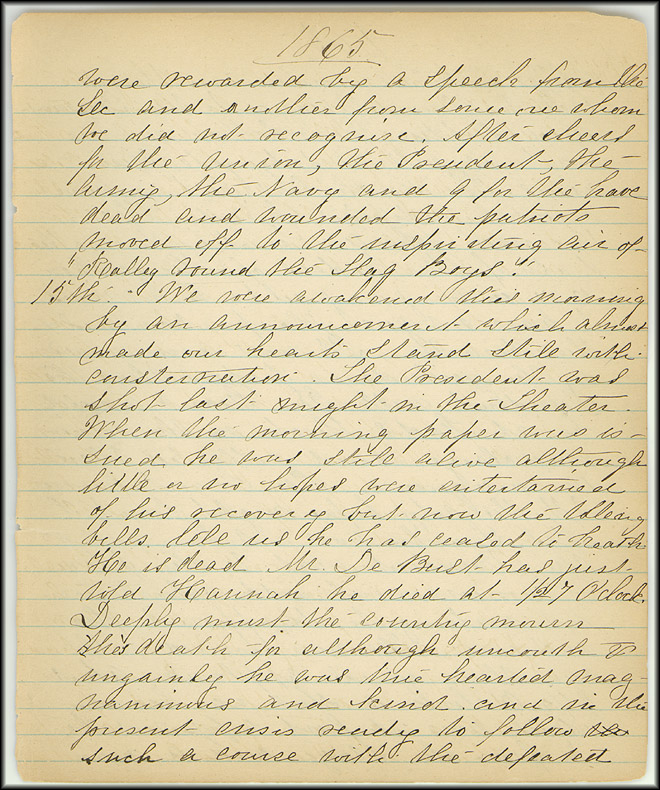
Mary Henry, the daughter of the Secretary of the Smithsonian, recorded her thoughts about the death of Lincoln and provided an extensive discussion of the funeral in Washington.
-
Transcription
[April] 15th. We were awakened this morning by an announcement which almost made our hearts stand still with consternation. The President was shot last night in the Theater. When the morning paper was issued he was still alive although little or no hopes were entertained of his recovery but now the tolling bells tell us he has ceased to breathe. He is dead. Mr. De Bust has just told Hannah he died at ½ 7 o'clock. Deeply must the country mourn this death for although uncouth & ungainly he was true hearted, magnanimous and kind and in the present crisis ready to follow the such a course with the defeated belligerants as would win them back to their allegiance to the Government and subdue the rebellion in their hearts as well as subjugate their aims. The South has lost in him a good & judicious friend. His successor Johnson heartily desires the death of the leaders of the rebellion & is in every way ultra in his views. I have not given the particulars of the disaster. It was announced in the yesterday's papers that the President with Gen Grant would be at Ford's Theater in the evening and a large crowd collected there in consequence. Gen Grant however left the city before night for N.Y. Mrs. Lincoln had not been well & the President went to the place of amusement with reluctance, not wishing to disappoint the audience. He was received with more than usual applause. About 9½ o'clock a shot was heard which was at first supposed to be from the stage and a man leaped from the President's box upon the stage crying, "Sic semper Tyrannis" "I have done it." and making his way to the door mounted a horse & rode off. The shrieks of Madame Lincoln first announced to the petrified audience the catastrophe which had taken place. The President was found to be in a state of insensibility, shot twice through the head. He was immediately conveyed to a house opposite the theatre followed by Mrs. L. escorted by her friends in an almost frantic condition.
At the same time of the accident an attempt was also made upon the life of Sec. Seward. The assasin entered the house upon the plea that he had brought a prescription of Dr. Verde the physician of the Sec. He pushed passed the servant into the room of the sick man & after disabling the attendants inflicted several sabre wounds in his neck & then made his escape. Sec. Stanton it is said was warned of the danger and guarded himself against it. The rain is falling heavily and the bells still toll their melancholy tale.
7 P.M. The sad day of excitement is over. The President's body has been embalmed and lies in state at the White House while the frantic grief of Mrs. Lincoln has settled into an apathetic dejection from which it is impossible to arouse her. The President remained unconcious to the last. The members of the Cabinet, Mrs. & Miss Kinney and Miss Harris surrounded his bed. Dr. Gurley was present & afterwards escorted the bereaved widow to her home. At the request of Mrs. Lincoln, he communicated the mournful intelligence to poor little Tad who was wandering from group to group of the sorrowing attendants endeavoring vainly to find out what was the matter. His cries when he heard that he was Fatherless were exceedingly touching. He has been the most constant companion of the President. Johnson has received the oath of office and seems impressed with the dignity and responsibility of his new office. The assasins have not yet been arrested but the evidence if conclusive that Booth a miserable actor and worthless vagrant, a Son of the great tragedian, committed the deed. That is the murder of the President--the stabbing of Mr. Seward was probably done by an accomplice. Mr. Seward is in a critical position and has not been informed of the death of the President or of the danger of his son, who was so much injured by the assasin that very little hope is entertained of his life. The feeling of resentment at the South as instigating in all probability the murder is deep and I fear will entirely replace the feeling of kindness before entertained for the insurgents. The Southerners if they have countenanced the dreadful deed have fatally mistaken the interest of their cause.
[April] 17th. The sorrow for the President's death is deep and universal as we went to church yesterday we found all the houses draped in black. In front of the studio of Mr. Baumgrass, a large portrait of Mr. Lincoln was suspended surrounded with the marks of mourning. The church was so thronged with stranger we with difficulty made our way into the building and after standing for some time were provided with seats in the isle. The pulpit and gallery was dressed in black and the Presidents pew was closed and clothed with the same emblem. The Dr. in a short introductory address alluded to the terrible calamity which had befallen the Nation and spoke in terms of true affection of the personal qualities of our beloved chief Magistrate. The Assasins have not yet been found. The feeling against the South is exceedingly bitter. Mr. Seward's wounds are not as serious as was at first supposed and he will probably recover. He was informed last night of the death of the President and of the critical condition of his son still remains in a state of insensibility. The funeral ceremonies are expected to take place on Wednesday.
[April] 18th. Have just returned from the Kennedys where I passed the night. I went to see Dr. & Mrs. Gurley yesterday afternoon. The Dr. said he had been called to go to the President about 4 o'clock in the morning. He found him in the house opposite the theatre lying insensible upon a bed with the life blood dripping from the wound in his head upon the clothes on the floor beneath. The several members of the Cabinet & other persons were standing around the deepest sorrow depicted upon their countenances. The Dr. went to the bed side but for a while was too much overcome with his feelings to perform the religious services required of him. He went to Mrs. Lincoln and found her in an almost frantic condition. The President died about 7½ o'clock. Dr. Gurley returned to his bed side a few moments before his decease. He made his way through the sorrowing & silent spectators & found him slowly drawing his breath at long intervals lying as before perfectly motionless. A faint hardly perceptable motion in his throat and all was over. So still was the room that the ticking of the President's watch was distinctly heard. After a solemn & impressive prayer, Dr. Gurley went to break the sad intelligence to Mrs. Lincoln who was in the parlor below. She cried out "Oh why did you not tell me he was dying?" Robert Lincoln showed great self possession & calmness and did all in his power to comfort his sorrow stricken Mother. Dr. Gurley went with her to the White House. Some of her expressions are exceedingly painful. To day remains of the good kind man are deposited in the East Room and from an early hour the streets have been thronged with people going to take their last view of him. Sally & Annie Kennedy asked me to go with them but I thought I would rather remember him as I saw him last at the Capitol at the inaugeration. Carry and I are going out again soon, we feel too restless to remain at home. Father writes that the feeling of resentment against the Southerners in New York is bitter in the extreme. One man for an expression indicating want of sympathy in the general sorrow was thrown over the railing of a ferry boat & instantly crushed by the wheels. We expect Father to night. He heard the news shortly after his arrival in New York on Friday night. Capt. Alexander was here this morning. He says he has no doubt that Boothe is concealed in Baltimore. It will be very difficult to catch him being an actor he is accustomed to assume all disguises. The Capt. is firmly convinced that the assassination and attempted murder of Mr. Seward was a plot to destroy the amicable relations springing up between the North and the South through the humane policy of Mr. Lincoln and by substituting a sterner administration and harsher measures against the rebels with increased bitter feeling to unite the South for further resistance. Seward was Mr. Lincoln's chief supporter in his lenient measures.
The city is in such a state of excitement that the slightest unusual circumstance attracts a crowd immediately. Yesterday afternoon while I was making a call a number of carriages passed the window where I was seated some empty, some filled driving furiously and the street was soon filled with people running eagerly towards N.Y. Ave. not a one of them knowing what was the matter. In a few moments a crowd extending over several squares had collected. After some time it was discovered that two negro women fighting has caused the disturbance. Traces of the assassin have been found and several supposed accomplices in the plot arrested but great fears are entertained that the murderers will escape. A sense of insecurity pervades the community and guards have been placed around the houses of the most prominent citizens.
[April] 19th Wed[nesday]. To day was the funeral of our good kind President. The ceremonies of the White House were conducted by Dr. Gurley, Dr. Hall, Bishop Simpson and one other clergyman whose name I have forgotten, in the East Room. The catafalco was erected in the centre of the appartment graduated semi circular platforms were arranged around this for the accommodation of the invited attendants. The various delegations had each their place assigned. Father was invited to take part with the officers of the Smith. Inst. and I went with him to the Treasury building were he obtained for me a position upon one of the porticos to witness the procession. Only four or five ladies were admitted into the East Room. It was a beautiful day and as the people collected at the corners of the streets, at the windows & upon the roof of the houses, it was difficult to realize we were not preparing for some gala festival instead of the last sad honours to the well beloved dead. The procession left the White House about 2 P.M. We were notified that it had started by the distant booming of guns & the tolling of bells. The sad sweet strains of the funeral march heralded its approach and soon the military escort appeared marching slowly with bent heads & guns reversed. The sad pagent was two hours in passing. The funeral car was heavily draped with black plainly showing the coffin which was adorned with beautiful flowers. The remains were placed in the Capitol & will be open to the view of the public until Friday morning. They are to be conveyed to Springfield.
[April] 26th. The remains of President Lincoln left the city yeste Friday morning. Dr. Gurley has joined the company who escort them. The papers this morning contain a description of the manner in which the cortege has been received. Mrs. Lincoln is quite ill and poor little Tad quite inconsolable. Mercy tempered with a great deal [of] severity is approbated to be the policy of the new President in dealing with the rebels.
-
Source
Smithsonian Institution Archives
-
Rights
This item is in the public domain.
-
Tags
-
Cite this Item
Mary Henry. "Mary Henry Diary". Remembering Lincoln. Web. Accessed June 3, 2026. https://rememberinglincoln.fords.org/node/551
-
Creator
Mary Henry
-
Date
April 15, 1865
from Apr. 15, 1865
Mary Henry Diary
-
Description
Mary Henry, the daughter of the Secretary of the Smithsonian, recorded her thoughts about the death of Lincoln and provided an extensive discussion of the funeral in Washington.
-
Source
Smithsonian Institution Archives
-
Rights
This item is in the public domain.
-
Creator
Mary Henry
-
Date
April 15, 1865
from Apr. 15, 1865
Emilie Davis Diary
-
Full Title
Emilie Davis Diary
-
Description
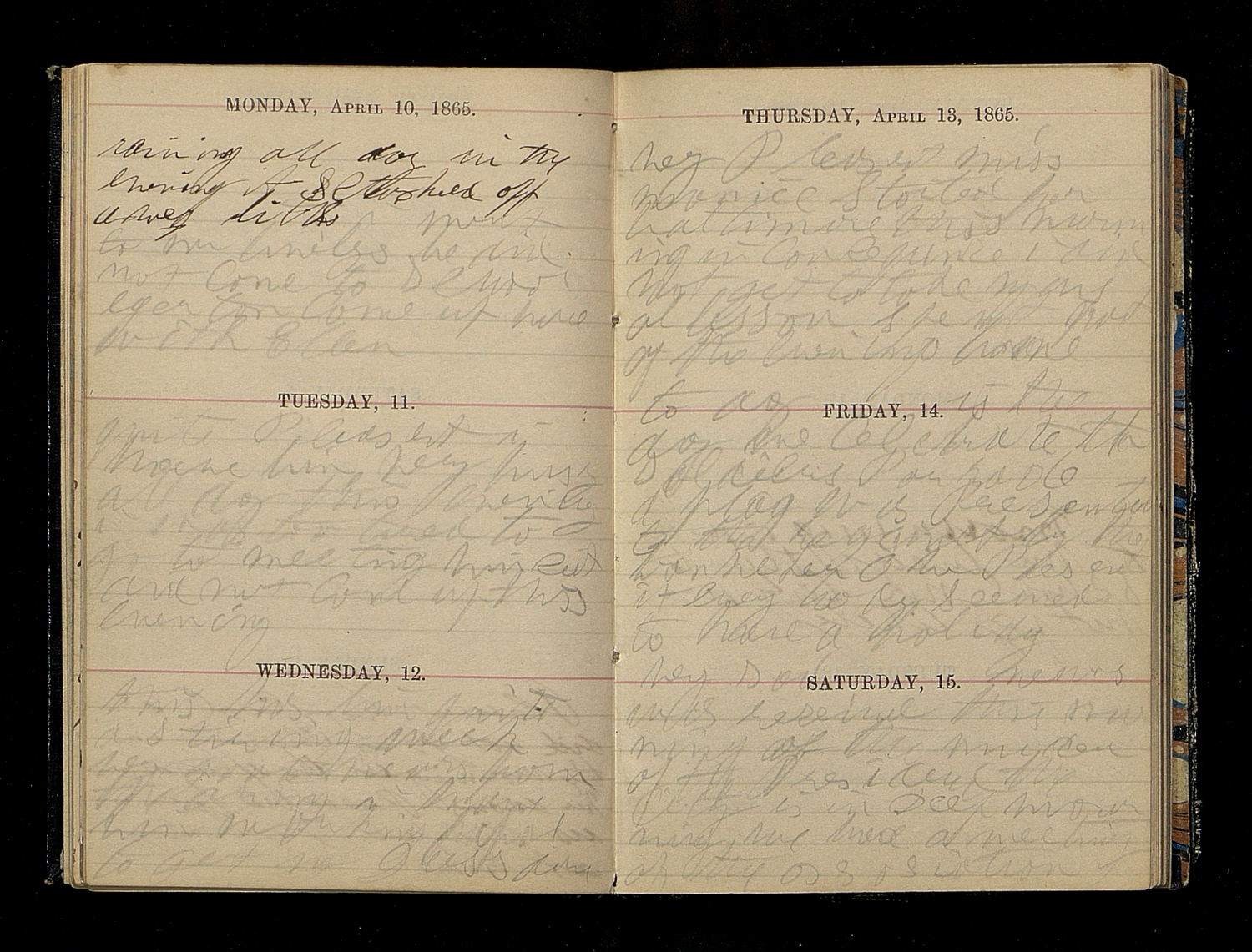
Emilie Davis, a free African American living in Philadelphia, recorded the events of her life from 1863 to 1865, including the end of the Civil War and the Lincoln assassination.
-
Transcription
MONDAY, APRIL 10, 1865
raining all day in the evening it [...] off [...] i went to mr livelys he did not come to sermon egerton come up here with Ellen
TUESDAY, APRIL 11, 1865
quite pleasent i have bin very busy all day this evening i was too tired to go to meeting Vincent did not come up this evening
WEDNESDAY, APRIL 12, 1865
this has bin quite a stressing week very [...] mrs Jones [...] i have bin with him [...] to get my Dress done
THURSDAY, APRIL 13, 1865
very Pleasent Miss Janice started for Baltimore this morning in Concequence i did not get to the [...] al lesson spent most of the evening home
FRIDAY, APRIL 14, 1865
to day is the day we Celebrate the soldiers Parrade a flag was presented to the reggiment by the [...] very Plesent it every body seemed to have a holidy
SATURDAY, APRIL 15, 1865
very sad newes was received this morning of the murder of the President the city is in deep mourning we had a meeting of the association
SUNDAY, APRIL 16, 1865
it Decided to PosPone the fare very fine Day everyone seems to Partake of the solemnity of the times Docto Jones spoke for us
MONDAY, APRIL 17, 1865
to day was set aPart for a general holiday but seemes to me a day of mourning i went to mr livelys then to school mr ling was not very lively
TUESDAY, APRIL 18, 1865
nothing special on home to day meeting at night not good meeting after meeting Nell and went to Sarah Shines Vincent invisible
WEDNESDAY, APRIL 19, 1865
to day is a general holiday the churches are open and the day has the apperanece of Sunday the Preisedent is concidered buried today i was out in the afternoon we Did not have church mr gibbs being away Vincent was up a little while
THURSDAY, APRIL 20, 1865
everything assumes a solem aspect the streets look mournful the people more so i went to mr livelys in the afternoon i did not get far from it rained all the afternoon and evening i spent the evening with Nellie
FRIDAY, APRIL 21, 1865
cloudy and very dark the funeral Prossion Pass through tomorrow i have not bin out to day i am tired of the st Vincent was up this evening he is so full of business
SATURDAY, APRIL 22, 1865
lovely morning to is the day long to be remembered i have bin very busy all morning the President comes in town this afternoon i went out about 3 in the afternoon it was the gravest funeral i ever saw
SUNDAY, APRIL 23, 1865
the coffin and hearse was beutiful this morning went down to see the President but could not for the crowd mr robinson spoke for us in the afternoon very interesting sermon after church Vincent and i tried to get to see the President
MONDAY, APRIL 24, 1865
i got to see him after waiting four hours and a half it was [...] a sight worth seeing very Pelesent i did not to mr lively we went to the concert it was very nice with one exception lizzie [...] sing
TUESDAY, APRIL 25, 1865
miserable the rest done well very good house very fine day i stoped at mr Jonsons a little while Nellie and i went to see Sarah Shim then to meeting very good meeting after meeting went down town
WEDNESDAY, APRIL 26, 1865
quite warm to day i have soore throat as a [...] Sunday adventure nothing of intrest to day Nell come up this evening she has not spent an evening with me for some time
THURSDAY, APRIL 27, 1865
very much like summer today very Plesent i went down to mr livleys in the afternoon Nell i went out shoping i went down to [...] a little while in the evening i spent at home
-
Source
Historical Society of Pennsylvania (images); Emilie Davis Diaries Project at Villanova University (transcription)
-
Rights
Use of this item for research, teaching, and private study is permitted with proper citation and attribution. Reproduction of the images of this item for publication, broadcast, or commercial use requires written permission from the Historical Society of Pennsylvania. Reproduction of the transcription of this item for publication, broadcast, or commercial use requires written permission from Villanova University.
-
Tags
-
Cite this Item
Emilie Davis. "Emilie Davis Diary". Remembering Lincoln. Web. Accessed June 3, 2026. https://rememberinglincoln.fords.org/node/549
-
Creator
Emilie Davis
-
Date
April 15, 1865
from Apr. 15, 1865
Emilie Davis Diary
-
Description
Emilie Davis, a free African American living in Philadelphia, recorded the events of her life from 1863 to 1865, including the end of the Civil War and the Lincoln assassination.
-
Source
Historical Society of Pennsylvania (images); Emilie Davis Diaries Project at Villanova University (transcription)
-
Rights
Use of this item for research, teaching, and private study is permitted with proper citation and attribution. Reproduction of the images of this item for publication, broadcast, or commercial use requires written permission from the Historical Society of Pennsylvania. Reproduction of the transcription of this item for publication, broadcast, or commercial use requires written permission from Villanova University.
-
Creator
Emilie Davis
-
Date
April 15, 1865
from Apr. 16, 1865
Anonymous Diary
-
Full Title
Journal – Sunday April 16 (Attended Church) to Friday 21
-
Description
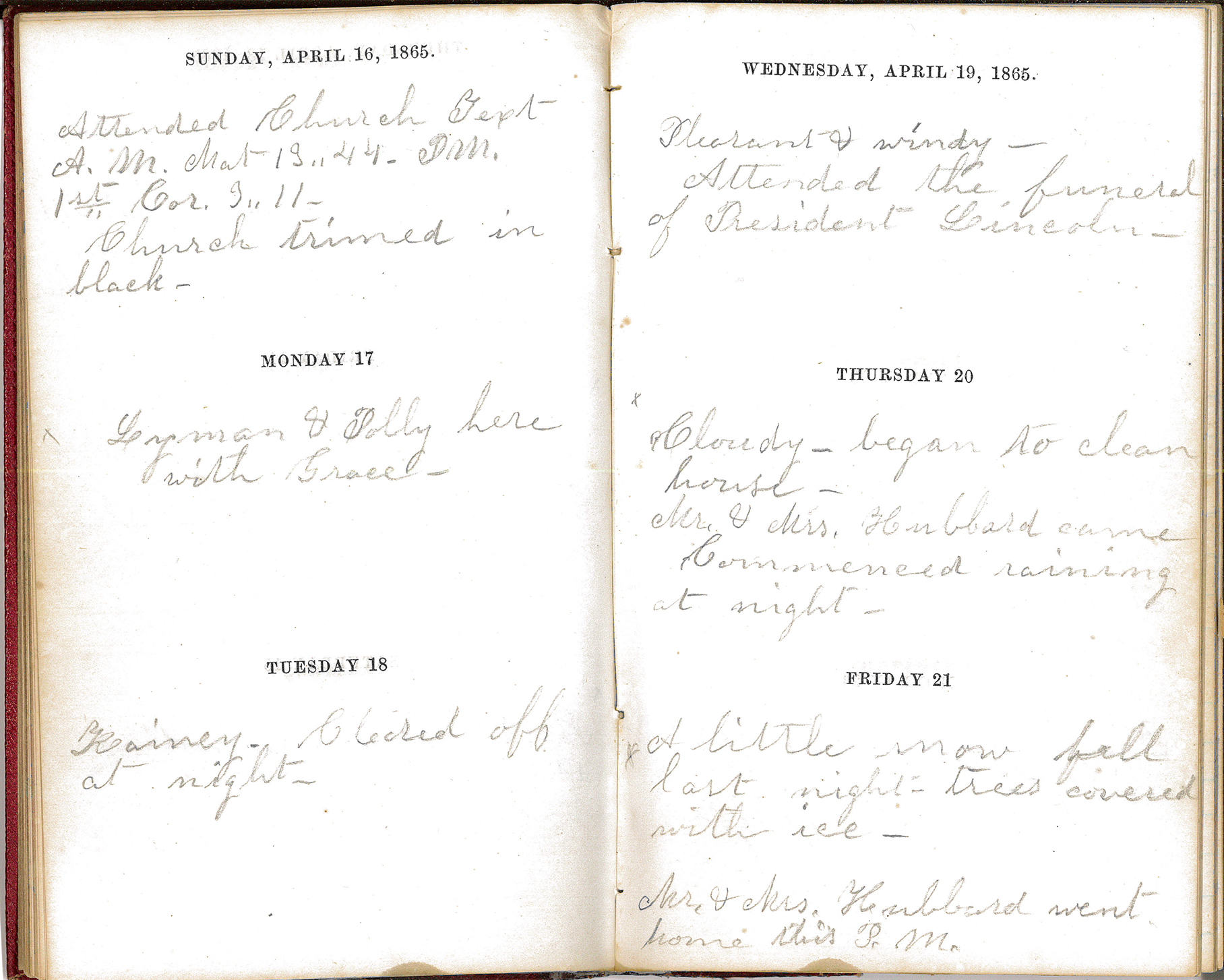
Personal journal entries from Sunday, April 16, 1865, to Friday, April 21, 1865. On Sunday April 16th the author notes that they attended church services and the church was trimmed in black. On Wednesday April 19th, the author notes that they attended the funeral of Abraham Lincoln.
-
Source
Tucker Collection care of Museum of the Grand Prairie
-
Rights
Use of this item for research, teaching and private study is permitted with proper citation and attribution to the Museum of the Grand Prairie, Champaign County Forest Preserve District. Reproduction of this item for publication, broadcast, or commercial use requires written permission. For permission please contact Museum of the Grand Prairie, Champaign County Forest Preserve District.
-
Tags
-
Cite this Item
Unknown. "Journal – Sunday April 16 (Attended Church) to Friday 21". Remembering Lincoln. Web. Accessed June 3, 2026. https://rememberinglincoln.fords.org/node/401

-
Creator
Unknown
-
Date
April 16, 1865
from Apr. 16, 1865
Journal – Sunday April 16 (Attended Church) to Friday 21
-
Description
Personal journal entries from Sunday, April 16, 1865, to Friday, April 21, 1865. On Sunday April 16th the author notes that they attended church services and the church was trimmed in black. On Wednesday April 19th, the author notes that they attended the funeral of Abraham Lincoln.
-
Source
Tucker Collection care of Museum of the Grand Prairie
-
Rights
Use of this item for research, teaching and private study is permitted with proper citation and attribution to the Museum of the Grand Prairie, Champaign County Forest Preserve District. Reproduction of this item for publication, broadcast, or commercial use requires written permission. For permission please contact Museum of the Grand Prairie, Champaign County Forest Preserve District.
-
Creator
Unknown
-
Date
April 16, 1865
from Apr. 19, 1865
Journal – DC Journal Sunday April 16 to Friday 21
-
Full Title
Journal – DC Journal Sunday April 16 to Friday 21
-
Description
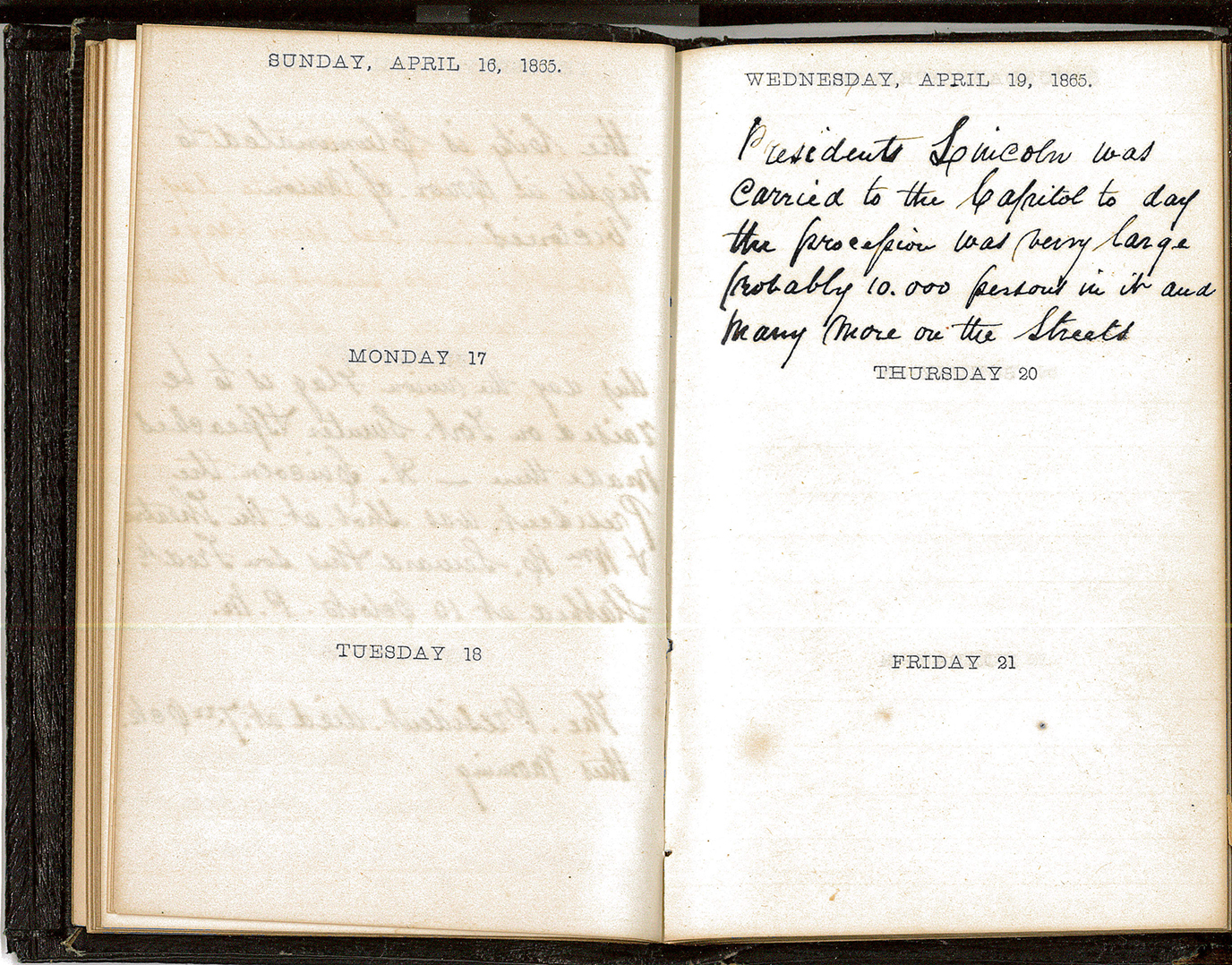
Pages of a journal dating from Sunday, April 16, 1865, to Friday, April 21, 1865. Most of the entries are blank. The Wednesday, April 19, 1865, entry notes that “President Lincoln was carried to the Capitol to day” and discusses the procession.
-
Transcription
WEDNESDAY, APRIL 19, 1865.
President Lincoln was
carried to the Capitol to day
the procession was very large
probably 10,000 persons in it and
many more on the streets
THURSDAY 20
[[No Notes]]
FRIDAY 21
[[No Notes]]
[Transcription team: Jaeger K., Gabriel Z., Dwight S.]
[New Hampton Middle School, New Hampton, Iowa]
-
Source
Tucker Collection care of Museum of the Grand Prairie
-
Rights
Use of this item for research, teaching and private study is permitted with proper citation and attribution to the Museum of the Grand Prairie, Champaign County Forest Preserve District. Reproduction of this item for publication, broadcast, or commercial use requires written permission. For permission please contact Museum of the Grand Prairie, Champaign County Forest Preserve District.
-
Tags
-
Cite this Item
Unknown. "Journal – DC Journal Sunday April 16 to Friday 21". Remembering Lincoln. Web. Accessed June 3, 2026. https://rememberinglincoln.fords.org/node/399
-
Creator
Unknown
-
Date
April 19, 1865
from Apr. 19, 1865
Journal – DC Journal Sunday April 16 to Friday 21
-
Description
Pages of a journal dating from Sunday, April 16, 1865, to Friday, April 21, 1865. Most of the entries are blank. The Wednesday, April 19, 1865, entry notes that “President Lincoln was carried to the Capitol to day” and discusses the procession.
-
Source
Tucker Collection care of Museum of the Grand Prairie
-
Rights
Use of this item for research, teaching and private study is permitted with proper citation and attribution to the Museum of the Grand Prairie, Champaign County Forest Preserve District. Reproduction of this item for publication, broadcast, or commercial use requires written permission. For permission please contact Museum of the Grand Prairie, Champaign County Forest Preserve District.
-
Creator
Unknown
-
Date
April 19, 1865
from Jan. 1, 1907
Alice Strickler Keyes diary entry
-
Full Title
Alice Strickler Keyes diary entry
-
Description
Alice Strickler Keyes eyewitness account of the day that Lincoln’s funeral train stopped in Columbus, Ohio, on its way to Springfield, Illinois, where the remains of the president and those of his son Willie would be buried. This account is an excerpt from the Alice Strickler Keyes diary passage in the Altrurian Club of Columbus, Ohio President's Book.
-
Transcription
[Page 1]
25
These grounds, at the head of State street, it was so far from the town and in such a swampy and unimproved district, that it too was dubbed “Swayne’s Folly.” Noah Swayne became most widely known as Justice of the Supreme Court of the United States.
His home at the head of State street was later occupied by J. Ewing Miller. Its site is now that of the Carnegie Library.
Before the “Insane Asylum” burned, the terminus of all our walks eastward, was the great flat boulder, that still lies on the sidewalk in the east Broad street, east of Jefferson Avenue.
A little farther east the Asylum Grounds ended, and not far beyond, lay “Riley’s Woods,” and the open country.
In April, 1865, Columbus with the rest of The Nation was celebrating the “Fall of Fort Sumpter,” the surrender of General Lee, and the End of the “Civil War.” There was great rejoicing.
April 14th was appointed by Governor Brough as a day of thanksgiving. On that day there were services in the churches in the morning;—in the afternoon
[Page 2]
26
and evening everything was done that is possible on such occasions to express the joy of the citizens. The town was lavishly decorated.
The next morning, April 15th all this joy was turned to sorrow when the news of President Lincoln’s assassination reached the city. The emblems of Victory gave place to those of mourning for the fallen Chief.
It was learned a few days later, that the funeral train on its way to Springfield, Illinois, would stop in Columbus, and that the body of the President would lie in state for one day, in the Rotunda of the Capitol.
At school we were told that the city Fire Department would be in the procession to meet the train at the station, and that a number of young girls, dressed in deep mourning were wanted—one to stand beside each driver on the fire engines, and many others to ride on the large “Hook and Ladder” wagon, reconstructed for the occasion.
[Page 3]
27
This plan was carried out. Forty-two school girls of varying ages, of whom I was one, rode on this car, massed around one of our teachers (Miss Sarah Smith) who was heavily draped in black and represented “Columbia.”
After the coffin of President Lincoln was placed on the splendid funeral car, the procession started back on its route through the streets of the city.
At intervals the black robed girls on the float, led by their teacher, sang verses from dirge-like hymns.
When the procession stopped at the gate of the Capitol, these girls left their float and were led into the building, and past the coffin of the President. It is said over fifty thousand people viewed “the remains” that day.
The catalogue used to carry the body of President Lincoln had a canopy shaped like a pagoda. It was large, covered with black cloth, festooned, and trimmed with silver fringe. It was drawn by six white horses with large black plumes on their heads. The horses had a covering of black cloth edged with silver fringe, and each horse was led by a groom dressed in black.
[Page 4]
28
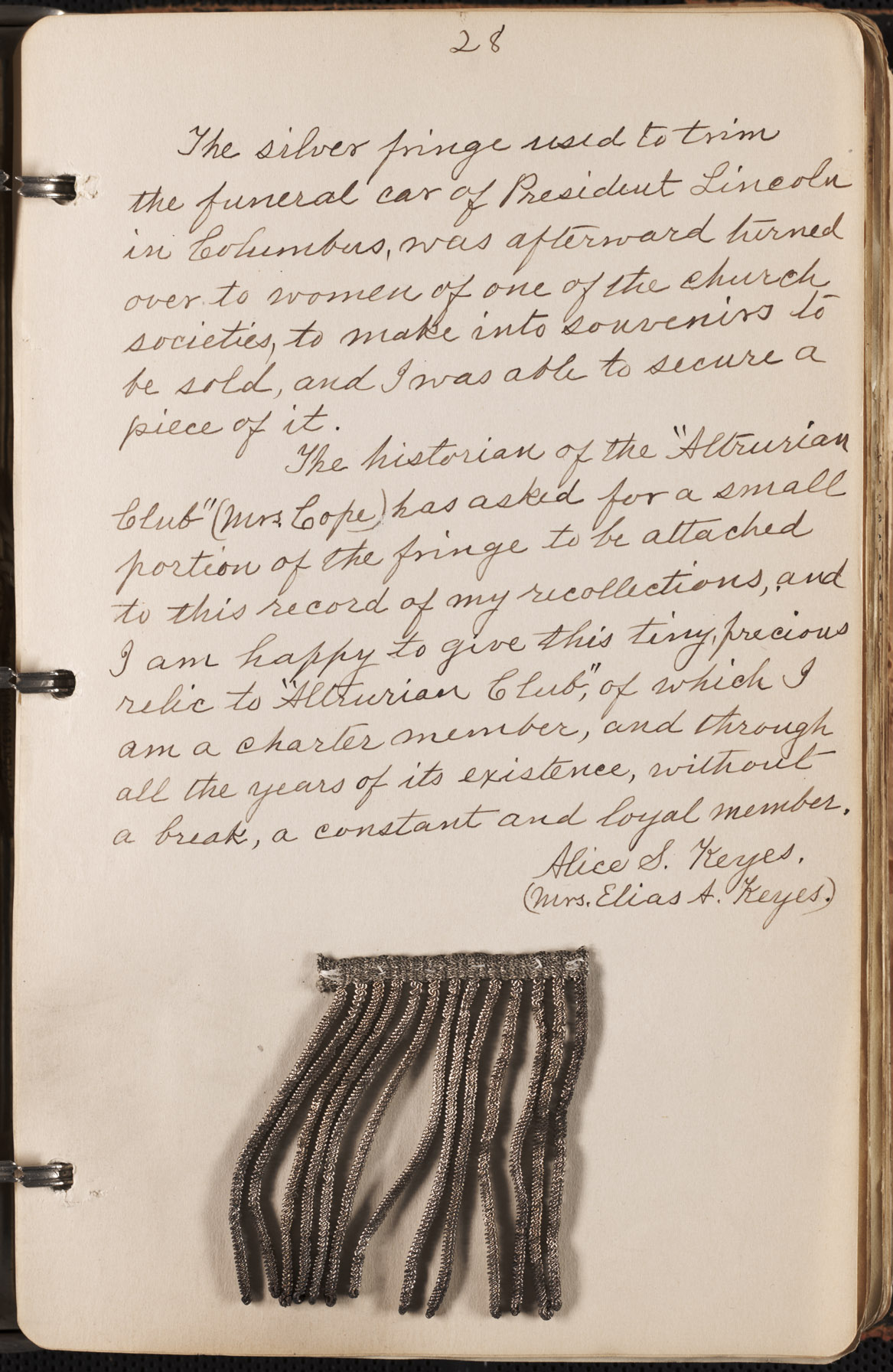
The silver fringe used to trim the funeral car of President Lincoln in Columbus, was afterward turned over to women of one of the church societies, to make into souvenirs to be sold, and I was able to secure a piece of it.
The historian of the “Altrurian Club” (Mrs. Cope) has asked for a small portion of the fringe to be attached to this record of my recollections, and I am happy to give this tiny, precious relic to “Altrurian Club,” of which I am a charter member, and through all the years of its existence, without a break, a constant and loyal member.
Alice S. Keyes
(Mrs. Elias A. Keyes.)
[piece of silver fringe attached]
[Transcription by McCaela Michas]
-
Source
-
Rights
Use of this item for research, teaching, and private study is permitted with proper citation and attribution, as Courtesy of the Ohio History Connection, Abraham Lincoln Presidential Collection . Reproduction of this item for publication, broadcast, or commercial use requires written permission. For permission, please see this web page.
-
Tags
-
Cite this Item
Keyes, Alice Strickler. "Alice Strickler Keyes diary entry". Remembering Lincoln. Web. Accessed June 3, 2026. https://rememberinglincoln.fords.org/node/282

-
Creator
Keyes, Alice Strickler
-
Date
1907
from Jan. 1, 1907
Alice Strickler Keyes diary entry
-
Description
Alice Strickler Keyes eyewitness account of the day that Lincoln’s funeral train stopped in Columbus, Ohio, on its way to Springfield, Illinois, where the remains of the president and those of his son Willie would be buried. This account is an excerpt from the Alice Strickler Keyes diary passage in the Altrurian Club of Columbus, Ohio President's Book.
-
Source
-
Rights
Use of this item for research, teaching, and private study is permitted with proper citation and attribution, as Courtesy of the Ohio History Connection, Abraham Lincoln Presidential Collection . Reproduction of this item for publication, broadcast, or commercial use requires written permission. For permission, please see this web page.
-
Creator
Keyes, Alice Strickler
-
Date
January 1, 1907
from May. 4, 1865
Ellen Kean to Sol Smith
-
Full Title
Letter of Ellen Kean, New York, to Sol Smith, May 4, 1865
-
Description
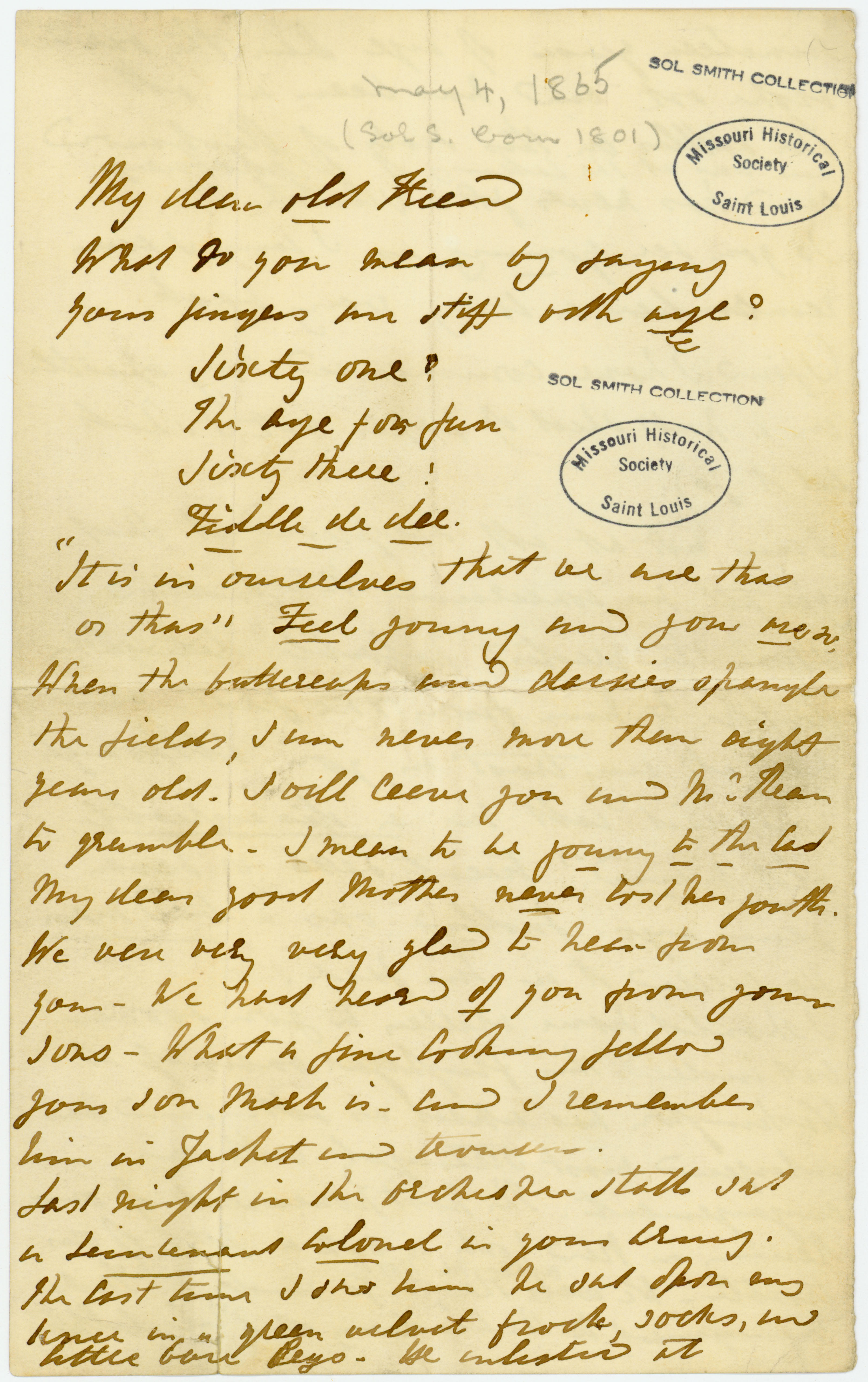
Describes the funeral of Abraham Lincoln in detail.
-
Source
Missouri History Museum
-
Rights
This item is in the public domain.
-
Tags
-
Cite this Item
Kean, Ellen, 1805-1880. "Letter of Ellen Kean, New York, to Sol Smith, May 4, 1865". Remembering Lincoln. Web. Accessed June 3, 2026. https://rememberinglincoln.fords.org/node/315

-
Creator
Kean, Ellen, 1805-1880
-
Date
May 4, 1865
from May. 4, 1865
Letter of Ellen Kean, New York, to Sol Smith, May 4, 1865
-
Description
Describes the funeral of Abraham Lincoln in detail.
-
Source
Missouri History Museum
-
Rights
This item is in the public domain.
-
Creator
Kean, Ellen, 1805-1880
-
Date
May 4, 1865
from May. 21, 1865
A.M. Black to Jane Black
-
Full Title
Letter of A. M. Black, Springfield, to Sister [Jane Black], May 21, 1865
-
Description
Describes a wreath he obtained from Abraham Lincoln's funeral for her. States, ". . . .I have got the Lincoln Wreath for you. Josephine got it from her mother Mrs. Edwards. It was made and placed on the Coffin in Chicago by Miss Arnold of that place she is a daughter of Congressman Arnold. . . .Strangers are making great efforts to get relics. . . .Josephine is to have enough of Mr. Lincoln's hair to fill a small locket. . . ."
-
Source
Missouri History Museum
-
Rights
This item is in the public domain.
-
Tags
-
Cite this Item
Black, Alexander M.. "Letter of A. M. Black, Springfield, to Sister [Jane Black], May 21, 1865". Remembering Lincoln. Web. Accessed June 3, 2026. https://rememberinglincoln.fords.org/node/312
-
Creator
Black, Alexander M.
-
Date
May 21, 1865
from May. 21, 1865
Letter of A. M. Black, Springfield, to Sister [Jane Black], May 21, 1865
![Letter of A. M. Black, Springfield, to Sister [Jane Black], May 21, 1865](https://rememberinglincoln.fords.org/sites/default/files/A.M.%20Black%20Letter%201.jpg)
-
Description
Describes a wreath he obtained from Abraham Lincoln's funeral for her. States, ". . . .I have got the Lincoln Wreath for you. Josephine got it from her mother Mrs. Edwards. It was made and placed on the Coffin in Chicago by Miss Arnold of that place she is a daughter of Congressman Arnold. . . .Strangers are making great efforts to get relics. . . .Josephine is to have enough of Mr. Lincoln's hair to fill a small locket. . . ."
-
Source
Missouri History Museum
-
Rights
This item is in the public domain.
-
Creator
Black, Alexander M.
-
Date
May 21, 1865
from May. 4, 1865
E. Rothesay Miller to Theodore Freeley Gale
-
Full Title
Letter of E. Rothesay Miller, "The Monastery," Princeton, to Free [Theodore Freeley Gale], May 4, 1865
-
Description
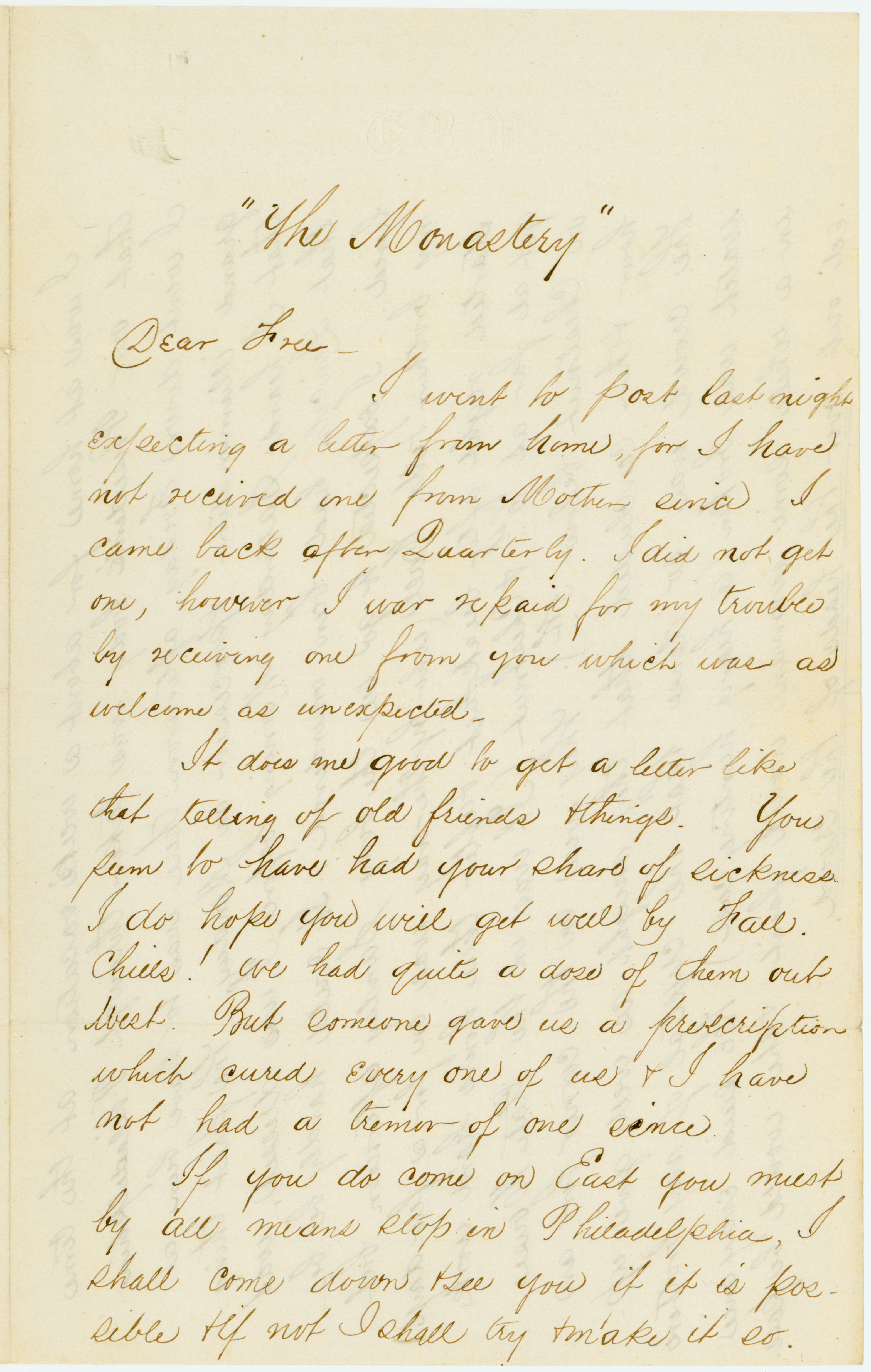
Regarding his education at Princeton and Abraham Lincoln's body passing through Philadelphia after the assassination. States, ". . . .I was at home for about a week's vacation at the time that our President's body was taken through Philadelphia. I went down Friday afternoon: there was to have been a grand illumination — procession on Monday. The first thing that I heard Saturday Morning before I was dressed was that Lincoln had been murdered. It could hardly be believed. I expected to go see the body Sunday afternoon but my brother — Mr. Hall. . . .started right after breakfast — after three hours hard work got as far as 6th — Chestnut (It was in the State House on Chestnut below 5th.) They were on the corner for an hour — then concluded that they might as well give up. The crowd was so dense that the crystal of my brother's watch was broken (a heavy hunting case). He said every once in a while some woman would faint — she would be passed out over the heads of the crowd. . . ."
-
Source
Missouri History Museum
-
Rights
This item is in the public domain.
-
Tags
-
Cite this Item
Miller, Edward Rothesay. "Letter of E. Rothesay Miller, "The Monastery," Princeton, to Free [Theodore Freeley Gale], May 4, 1865". Remembering Lincoln. Web. Accessed June 3, 2026. https://rememberinglincoln.fords.org/node/311
-
Creator
Miller, Edward Rothesay
-
Date
May 4, 1865
from May. 4, 1865
Letter of E. Rothesay Miller, "The Monastery," Princeton, to Free [Theodore Freeley Gale], May 4, 1865
-
Description
Regarding his education at Princeton and Abraham Lincoln's body passing through Philadelphia after the assassination. States, ". . . .I was at home for about a week's vacation at the time that our President's body was taken through Philadelphia. I went down Friday afternoon: there was to have been a grand illumination — procession on Monday. The first thing that I heard Saturday Morning before I was dressed was that Lincoln had been murdered. It could hardly be believed. I expected to go see the body Sunday afternoon but my brother — Mr. Hall. . . .started right after breakfast — after three hours hard work got as far as 6th — Chestnut (It was in the State House on Chestnut below 5th.) They were on the corner for an hour — then concluded that they might as well give up. The crowd was so dense that the crystal of my brother's watch was broken (a heavy hunting case). He said every once in a while some woman would faint — she would be passed out over the heads of the crowd. . . ."
-
Source
Missouri History Museum
-
Rights
This item is in the public domain.
-
Creator
Miller, Edward Rothesay
-
Date
May 4, 1865
from Apr. 14, 1865
Senator Alexander Ramsey Diary
-
Full Title
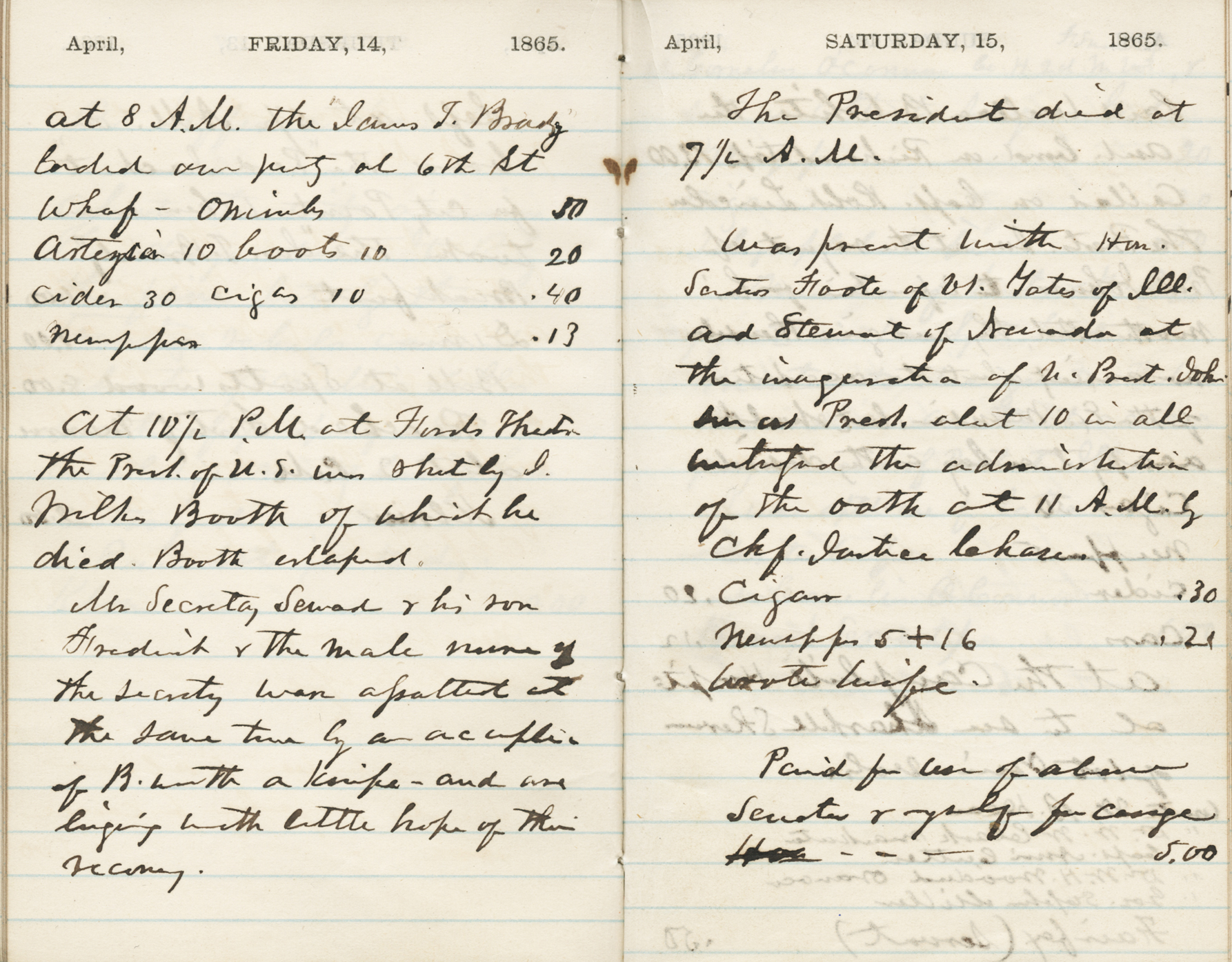
Senator Alexander Ramsey's Diary Entries, April 1865
-
Description
Senator Ramsey of Minnesota was in Washington D.C. when President Lincoln was assassinated. These are his diary entries from when it happened, including details as he heard them; being part of President Johnson inauguration; and his participation in the congressional escort on Lincoln's funeral train.
-
Transcription
April 14, 1865
At 10 ½ pm at Fords Theater the Presd. of U.S. was shot by J. Wilkes Booth of which he died. Booth escaped.
Mr. Secretary Seward and his son Frederick and the male servant of the Secretary were attacked (?) at the same time by an accomplice of B. with a knife – and is lingering with little hope of their recovery.
The President died at 7 ½ a.m.
Was present with Hon. Senators Foote of Vt. Gates of Ill. And Steward of Nevada at the inauguration of V. Pres. Johnson as Presd. about 10 in all witnessed the administration of the oath at 11 am by Chf. Justice Chase.
Cigar .30
Newspapers 5 & 16 .21
Boot(?) knife
Paid for use of above senators and myself for carriage 5.00
April 21, 1865
Left Washington as one of a congressional escort in conveying the body of Abm. Lincoln late Presid. of U.S. from Washington to Springfield. Left at 8 a.m. reached Baltimore at 10 and left at 5 PM and reached Harrisburg at 8 pm
(?) Trunk .50
at Baltimore .30
-
Source
Alexander Ramsey and Family Papers, Minnesota Historical Society
-
Rights
Use of this item for research, teaching, and private study is permitted with proper citation and attribution, as Alexander Ramsey and Family Papers, Minnesota Historical Society, Minnesota Historical Society. Reproduction of this item for publication, broadcast, or commercial use requires written permission. For permission, please see this web page.
-
Tags
-
Cite this Item
Alexander Ramsey. "Senator Alexander Ramsey's Diary Entries, April 1865". Remembering Lincoln. Web. Accessed June 3, 2026. https://rememberinglincoln.fords.org/node/292

-
Creator
Alexander Ramsey
-
Date
April 14, 1865
from Apr. 14, 1865
Senator Alexander Ramsey's Diary Entries, April 1865
-
Description
Senator Ramsey of Minnesota was in Washington D.C. when President Lincoln was assassinated. These are his diary entries from when it happened, including details as he heard them; being part of President Johnson inauguration; and his participation in the congressional escort on Lincoln's funeral train.
-
Source
Alexander Ramsey and Family Papers, Minnesota Historical Society
-
Rights
Use of this item for research, teaching, and private study is permitted with proper citation and attribution, as Alexander Ramsey and Family Papers, Minnesota Historical Society, Minnesota Historical Society. Reproduction of this item for publication, broadcast, or commercial use requires written permission. For permission, please see this web page.
-
Creator
Alexander Ramsey
-
Date
April 14, 1865