from Apr. 14, 1881
Louisiana's tribute to Abraham Lincoln
-
Full Title
Louisiana's tribute to the memory of Abraham Lincoln, President of the United States : public demonstration in the city of New Orleans, April 22, 1865 ; resolutions, speeches of Christian Roselius and others, etc., etc.
-
Description
Printed in 1881, this book is a complication of reactions to Lincoln's Death from the city of New Orleans.
-
Transcription
[cover:]
Louisiana’s Tribute
To the Memory of
Abraham Lincoln,
President of the United States
Public Demonstration in the City of New Orleans
April 22, 1865
Resolutions, Speeches of Christian Roselius and Others, Etc., Etc.,
Compiled by J. S. Whitaker, Chairman.
New Orleans: Picayune Office Job Print, 66 Camp Street.
1881.
[page 3:]
New Orleans, April 14, 1881
Hon. William E. Shutt, Springfield Ills.:
My Dear Sir, —
When in the summer of 1878, I visited Springfield, one of the chief pleasures I experienced was in passing over places made to certain extent sacred as having been once the home of Abraham Lincoln. You remember how I was struck with the simplicity of his dwelling, and how the recital of many incidents of his noble and unostentatious life as a citizen of Illinois interested me.
With you I finally visited the tomb in your beautiful cemetery, where repose his remains, and while the crypt or chamber in the monument I examined the various records commemorative of the life of our martyred President, and read the eulogiums pronounced upon him in every State and city of this vast nationality he so largely contributed to save.
Among all of these I found no fitting memorial from the State of Louisiana where the news of his terrible taking off by the hands of an assassin produced as much of grief, and of horror, as in any other portion of the Union.
In the following pages taken from “The New Orleans Times,” then conducted by my friend Thomas P. May, Esq., you will find the proceedings by which our people sought to demonstrate our sorrow and their appreciation of our national loss.
By placing these memorials among others in the Monument you will, while conferring a favor on me personally, preserve, what I esteem, an earnest tribute to one of the greatest and noblest characters, that has adorned the annals of our Country
Respectfully, Yours,
J. S. Whitaker
--
We extract the following leading article of the N.O. Times of the morning of 19th, of April, from the pen of Thos. P. May
Assassination of the President and Secretary of State.
The astounding intelligence which it is our painful duty this morning to announce, will paralyze our readers with a sense of unutterable terror, as it must already have paralyzed the mass of the people of the United States. It is difficult to bring the mind to conceive of an atrocity so swift and terrible, unrelenting and devilish. The civilized world will stand shuddering and appalled at the contemplation of so black a deed, and try vainly for words to characterize its utter enormity. The blows struck at President Lincoln and Secretary Seward have gone to the core of the great heart of the nation. The poignant anguish of those fatal wounds penetrate the bosoms of the loyal millions of our country. It seems terrible that the great epoch of a nation’s redemption from a vast and prolonged conspiracy, must needs have been marked by a deed so foul, and a bereavement so afflictive; that the leader of the nation, through its terrible night of civil war, and his chief advisor, must needs have fallen by the hands of assassins before they could witness the fruition of what they have so long, so ardently and ably labored for.
Our heart and hand fail us in the further contemplation of this inexpresibly painful tragedy, for which history furnishes no parallel of enormity.
The country mourns a terrible bereavement. Let us bow in submission to this awful decree of Almighty God, and pray and trust that out of this great affliction good may come to the nation at last.
--
In this Evening’s issue of the Times of the 19th, appeared the following.
The melancholy news of this morning struck every one with horror at the cowardly deed, which has bereaved the Nation of its head and afflicted the people that delighted to do him honor. Seconding the desire of the people the Mayor of the city that once took steps to declare all city business suspended, at the same time that the bells of the city be rung at twelve o’clock, and the official places hung with crape, and such testimonials as would show the sympathy of our people with the Nation in this calamity. The citizens met at Liberty Hall for the purpose of giving expression to their sentiment at this unholy and nefarious deed.
--
Called to Order
Thos. J. Durant arose and stating that the Nation and our people stood aghast at the most appalling crime, suggested the propriety of taking immediate action and nominated Judge Howell, of the Supreme Court, as chairman.
Before taking his seat the Chairman of the meeting confessed that words were inadequate to express his deep horror at this most atrocious and appalling crime. The deepest feelings were those that were inexpressible. The heart of the nation was now throbbing painfully at the misfortune which had befallen the people in the loss of Abraham Lincoln, the President of the United States. He could only hope that in the providence of God, even this calamity might work for good.
The nomination of T.P. May as Secretary of the meeting was accepted unanimously.
--
The Sentiments.
The sentiments of each one of the speakers, of every citizen present, whatever his occupation or his calling, was of the most unfeigned regret as well as horror at the atrocity of the crime. These sentiments were uttered as each one of speakers made suggestions as to the steps which should be taken in the matter. There was no difference of opinion, the only difference being as to the best mode of expressing the feeling of the people.
--
The Results of The Deliberations
After many suggestions as to the place of meeting, after several motions were argued, it was finally concluded that a committee of five be appointed, on whom should devolve all arrangements necessary for the assembly of the citizens on Saturday next. The President appointed on this committee Judge Whitaker, W.T. Gilbert, D. Emely, J.G. Belden, B. Campbell —Judge J.S. Whitaker to act as Chairman.
--
The District Courts Closed
The Judges of the District Courts held a joint session in the rooms of the Second Court, and proposed resolutions concerning the recent calamity. The following is an extract from the minutes of the meeting:
Whereas, The nation is called upon to mourn a great national calamity which has befallen it, in the untimely death of Abraham Lincoln, President of the United States, and William H. Seward, Secretary of State:
Be it resolved, That we, the Judges of the six District Courts of New Orleans, considering it eminently proper as a mark of the high respect and esteem in which the deceased were held, and recognize their many virtues, do adjourn until Monday, the 24th inst.
--
State Offices Ordered to be Closed.
State of Louisiana, Executive Department,
New Orleans, April 19, 1865
owing to the mournful news of the death of the President of the United States and Secretary of State, under circumstances calculated to strike horror to the minds of all good citizens, it is hereby ordered that all offices connected with the State to be closed to-day and to-morrow, the 20th inst.
J. Madison Wells, Governor of Louisiana
--
Action by the First District Court.
At the opening of the First District Court this morning, on motion of the Attorney General, and on suggesting that a telegram announcing the appalling news that two great and illustrious citizens of this Republic—Abraham Lincoln, our honored and immortal President, and our world-renowned Secretary of State, Wm. H. Seward--- have fallen in the plentitude of their fame at the hands of diabolical assassins, on account of the devotion of the said President and Secretary to American liberty and the rights of man, it is ordered, that this court do now adjourn till Thursday (to-morrow) morning, at 10 o’clock, to enable all its officers and employees to take part in the ceremonies of mourning and woe.
--
Action of the Firemen’s Charitable Association.
Fireman’s Charitable Association,
New Orleans, April 19, 1865—12 o’clock
The Fire Department of this city, in view of the sad calamity which has befallen the country in the death of the President of the United States and of the Secretary of State, are requested to suspend the national flag at half-mast from their respective Engine Houses immediately after the publication of this notice.
I.N. Marks, President
Alfred Belanger, Chief Engineer.
--
Action of the Firemen’s Charitable Association
The Firemen’s Charitable Association, as will be noticed by the advertisement, have requested the Fire Department of New Orleans to raise the flag at half-mast over all the Engine Houses, as a mark of sorrow in view of the great national bereavement.
--
The Foreign Consuls
The flags of the offices of the foreign consuls in this city are at half-mast to-day, in appropriate observance of the terrible affliction which has befallen the country.
--
The Customhouse
The various offices of the Customhouse are draped in mourning, and business is suspended
--
The Postoffice
The Postoffice is closed for the day, and preparations are making to drape the exterior of the building in mourning.
--
From the Times of April 20, 1865
The Appearance of the City Yesterday.
The history of New Orleans can furnish few instances of such wide-spread gloom and depression as that exhibited yesterday. The closing of places of business was almost universal, and altogether unprecedented. Considering the short time for preparation, the number of buildings draped with crape was little less than surprising. The display of flags and mourning drapery was too general to admit of particularization. There was scarcely a public office not thus mournfully adorned. Conspicuous among the private residences which were draped were those of Hon. J. Durant and Hon. T. P. May. The Catholic Church on Common Street, and the Charity Hospital, also displayed the emblems of mourning. Col. Saunders & Co., Camp Street, were not behind hand in the general display. The decorations at the National Bank and the United States Treasury Buildings were especially chaste and tasteful.
The public schools were dismissed at an early hour, and thousands of children helped to make up the crowds which thronged the streets.
[transcription by:
Taylor Osborne]
-
Source
Lincoln Financial Foundation Collection via The Internet Archive
-
Rights
This item is in the public domain and may be reproduced and used for any purpose, including research, teaching, private study, publication, broadcast or commercial use, with proper citation and attribution.
-
Tags
-
Cite this Item
J.S. Whitaker. "Louisiana's tribute to the memory of Abraham Lincoln, President of the United States : public demonstration in the city of New Orleans, April 22, 1865 ; resolutions, speeches of Christian Roselius and others, etc., etc.". Picayune Office Job Print. Remembering Lincoln. Web. Accessed May 8, 2026. https://rememberinglincoln.fords.org/node/1192
-
Creator
J.S. Whitaker
-
Publisher
Picayune Office Job Print
-
Date
April 14, 1881
from Apr. 14, 1881
Louisiana's tribute to the memory of Abraham Lincoln, President of the United States : public demonstration in the city of New Orleans, April 22, 1865 ; resolutions, speeches of Christian Roselius and others, etc., etc.

-
Description
Printed in 1881, this book is a complication of reactions to Lincoln's Death from the city of New Orleans.
-
Source
Lincoln Financial Foundation Collection via The Internet Archive
-
Rights
This item is in the public domain and may be reproduced and used for any purpose, including research, teaching, private study, publication, broadcast or commercial use, with proper citation and attribution.
-
Creator
J.S. Whitaker
-
Publisher
Picayune Office Job Print
-
Date
April 14, 1881
from Feb. 14, 1866
Regarding the Death of Abraham Lincoln, Arizona Miner
-
Full Title
Regarding the Death of Abraham Lincoln, Arizona Miner
-
Description
The Arizona House of Representatives, President of the Council and the Assistant Secretary of the Arizona Territory signed a resolution as a formal expression of regret for the death of President Abraham Lincoln in February 1866. This article is an official recording of the opinion of the people of Arizona almost a year after the event. A copy of the resolution was sent to President Lincoln's family and was published in the Arizona Miner newspaper as well as other journals of the Pacific and Atlantic States. Originally established as a Republican newspaper in 1864 by Territorial Secretary Richard McCormick (nominated by President Lincoln in 1863), the publication grew to become very politically partisan when racist Democrat John H. Marion took over as editor in 1867. Arizona became a state in 1912.
-
Transcription
Regarding the death of Abraham Lincoln.
WHEREAS, There has been, to this time, no formal expression of regret on the part of the people of Arizona over the untimely and lamentable death of Abraham Lincoln, the sixteenth President of the United States; therefore
Resolved, By the House of Representatives, the Council concurring, That we record our abhorrence of the dastardly act which deprived the nation of the valuable life of Abraham Lincoln, when his great statesmanship and noble character had won the confidence and applause of the civilized world, and the wisdom of his administration of public affairs, at the most critical period in the life of the American people, was universally conceded.
Resolved, That here where civil law was first established by the generous consideration of his administration, as elsewhere upon the continent, which owes so much to his honest and persistent devotion to liberty to justice and to the government of the people, his name is honored and revered as that of a true patriot, a profound ruler, and a magnanimous and unselfish man, whose highest motive was the public good, and whose consistent career has elevated the dignity, brightened the renown, and enriched the history of the Republic.
Resolved, That a copy of these resolutions be forwarded to the family of the illustrious dead, and to the present President of the United States, also that they be published in the ARIZONA MINER, and in the principal journals of the Pacific and Atlantic States.
JAMES S. GILES,
Speaker of the House of Representatives.
HENRY A. BIGELOW,
President of the Council.
A true copy of the original on file in my office.
HENRY W. FLEURY,
Assistant Secretary of the Territory.
[Transcription by: Ricarda H., Dr. Susan Corbesero’s Class, Ellis School, Pittsburgh, Pennsylvania] -
Source
Library of Congress Chronicling America
-
Rights
This item is in the public domain and may be reproduced and used for any purpose, including research, teaching, private study, publication, broadcast or commercial use, with proper citation and attribution.
-
Tags
-
Cite this Item
Fort Whipple Arizona Miner. "Regarding the Death of Abraham Lincoln, Arizona Miner". Tisdale A. Hand. Remembering Lincoln. Web. Accessed May 8, 2026. https://rememberinglincoln.fords.org/node/1096
-
Creator
Fort Whipple Arizona Miner
-
Publisher
Tisdale A. Hand
-
Date
February 14, 1866
from Feb. 14, 1866
Regarding the Death of Abraham Lincoln, Arizona Miner

-
Description
The Arizona House of Representatives, President of the Council and the Assistant Secretary of the Arizona Territory signed a resolution as a formal expression of regret for the death of President Abraham Lincoln in February 1866. This article is an official recording of the opinion of the people of Arizona almost a year after the event. A copy of the resolution was sent to President Lincoln's family and was published in the Arizona Miner newspaper as well as other journals of the Pacific and Atlantic States. Originally established as a Republican newspaper in 1864 by Territorial Secretary Richard McCormick (nominated by President Lincoln in 1863), the publication grew to become very politically partisan when racist Democrat John H. Marion took over as editor in 1867. Arizona became a state in 1912.
-
Source
Library of Congress Chronicling America
-
Rights
This item is in the public domain and may be reproduced and used for any purpose, including research, teaching, private study, publication, broadcast or commercial use, with proper citation and attribution.
-
Creator
Fort Whipple Arizona Miner
-
Publisher
Tisdale A. Hand
-
Date
February 14, 1866
from Jan. 31, 1866
Joseph S. Caulk to Andrew Johnson and Edwin M. Stanton
-
Full Title
Joseph S. Caulk to Andrew Johnson and Edwin M. Stanton
-
Description
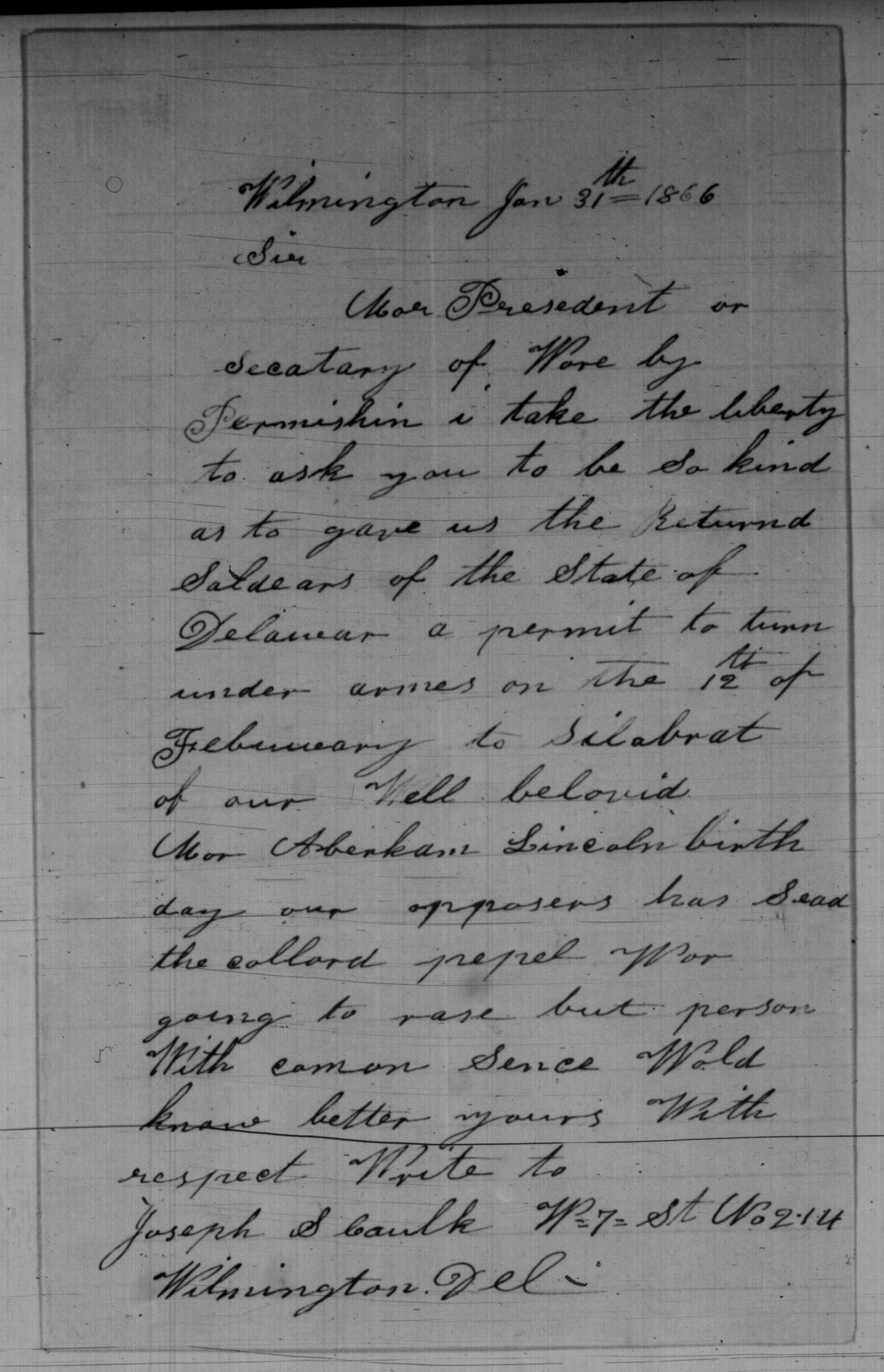
Joseph S. Caulk, a veteran of Company K of the 24th Regiment of the U.S. Colored Infantry, wrote to President Andrew Johnson and Secretary of War Edwin Stanton seeking permission to march while armed to honor the deceased President Abraham Lincoln's birthday in 1866. Caulk, a bricklayer from Delaware, enlisted in the U.S. Army at age 44 on March 28, 1865, shortly before the surrender of Confederate General Robert E. Lee.
-
Transcription
Wilmington Jan 31th 1866
Sir
Mr President or Secatary of Ware by Permishin i take the liberty to ask you to be so kind as to gave us the Returnd Soldears of the State of Delawear a permit to turn under armes on the 12th of Februeary to Silabrat of our Well belovid Mr Aberham Lincoln birth day our opposers has Sead the collard pepel Wor going to rase but person With comon Sence Wold know better yours With respect Write to
Joseph S. Caulk W. 7. St No 214
Wilmington, Del– -
Source
Shared by Jonathan White, associate professor of American Studies at Christopher Newport University. Joseph S. Caulk to Andrew Johnson and Edwin M. Stanton, January 31, 1866, in RG 107 (Records of the Office of the Secretary of War), microfilm M494 (Letters Received by the Secretary of War From the President, Executive Departments, and War Department Bureaus, 1862-1870), reel 84.
-
Rights
This item is in the public domain may be reproduced and used for any purpose, including research, teaching, private study, publication, broadcast or commercial use, with proper citation and attribution.
-
Tags
-
Cite this Item
Joseph S. Caulk. "Joseph S. Caulk to Andrew Johnson and Edwin M. Stanton". Remembering Lincoln. Web. Accessed May 8, 2026. https://rememberinglincoln.fords.org/node/1087
-
Creator
Joseph S. Caulk
-
Date
January 31, 1866
from Jan. 31, 1866
Joseph S. Caulk to Andrew Johnson and Edwin M. Stanton
-
Description
Joseph S. Caulk, a veteran of Company K of the 24th Regiment of the U.S. Colored Infantry, wrote to President Andrew Johnson and Secretary of War Edwin Stanton seeking permission to march while armed to honor the deceased President Abraham Lincoln's birthday in 1866. Caulk, a bricklayer from Delaware, enlisted in the U.S. Army at age 44 on March 28, 1865, shortly before the surrender of Confederate General Robert E. Lee.
-
Source
Shared by Jonathan White, associate professor of American Studies at Christopher Newport University. Joseph S. Caulk to Andrew Johnson and Edwin M. Stanton, January 31, 1866, in RG 107 (Records of the Office of the Secretary of War), microfilm M494 (Letters Received by the Secretary of War From the President, Executive Departments, and War Department Bureaus, 1862-1870), reel 84.
-
Rights
This item is in the public domain may be reproduced and used for any purpose, including research, teaching, private study, publication, broadcast or commercial use, with proper citation and attribution.
-
Creator
Joseph S. Caulk
-
Date
January 31, 1866
from Sep. 9, 2015
"Great Sorrow" & "Ford's Theater"
-
Full Title
Grand Rapids Herald Articles
-
Description
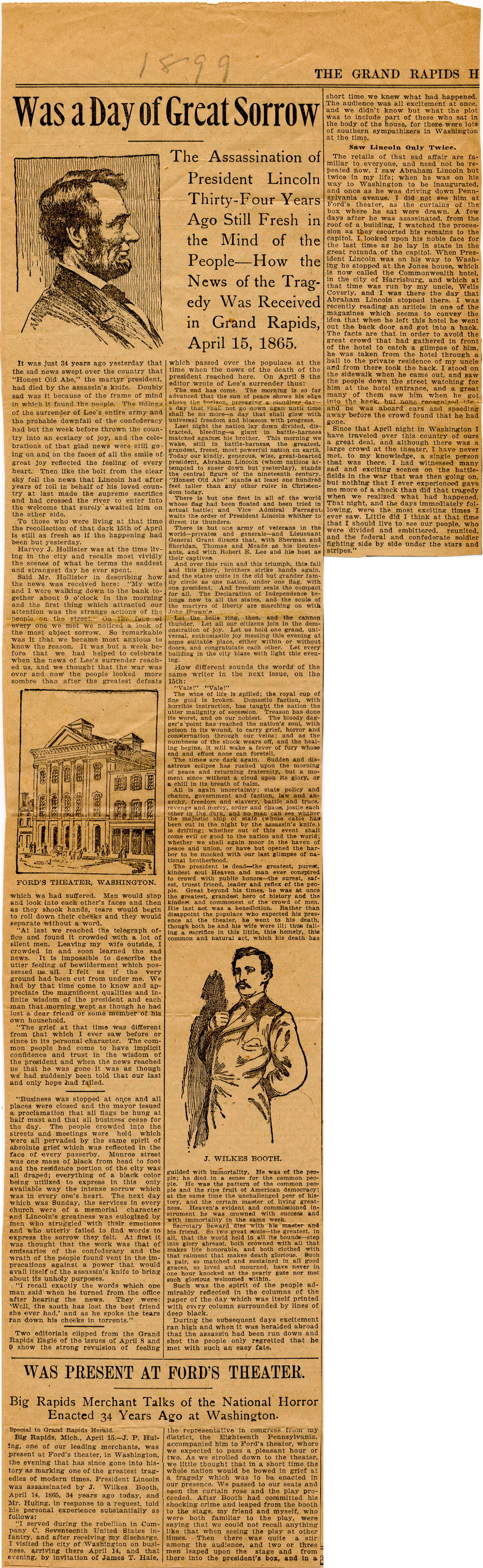
In a retrospective, the Grand Rapids Herald sought the perspectives of local residents who remembered the day Lincoln was assassinated. Harvey J. Hollister recalled the intense grief felt by many in Grand Rapids and the ways in which they practiced collective, public mourning. Next, the article quoted extensively from two editorials by the Grand Rapids Eagle, one on the day the war ended on April 8, 1865, and one immediately after the assassination on the 15th. These were included to be representative of the broader shift in Northern public opinion from optimism to disillusionment in this short span of time. In the subsequent article, Big Rapids, Michigan, resident J. P. Huling described his memories of being an audience member at Ford’s Theater the night of the assassination. Furthermore, he remembered details of Lincoln’s funeral as well as the two times he saw Lincoln before the president’s death.
-
Transcription
[penciled in at top of page] [1899] The Grand Rapids H[cut off]
Was a Day of Great Sorrow
----------
The Assassination of
President Lincoln
Thirty-Four Years
Ago Still Fresh in
the Mind of the
People—How the
News of the Trag-
edy Was Received
in Grand Rapids,
April 15, 1865.
It was just 34 years ago yesterday that
the sad news swept over the country that
“Honest Old Abe,” the martyr president,
had died by the assassin’s knife. Doubly
sad was it because of the frame of mind
in which it found the people. The tidings
of the surrender of Lee’s entire army and
the probably downfall of the confederacy
had but the week before thrown the cou-
try into an ecstacy of joy, and the cele-
brations of that glad news were still go-
ing on and on the faces of all the smile of
great joy reflected the feeling of every
heart. Then like the bolt from the clear
sky fell the news that Lincoln had after
years of toil in behalf of his loved coun-
try at last made the supreme sacrifice
and had crossed the river to enter into
the welcome that surely awaited him on
the other side.
To those who were living at that time
the recollection of that dark 15th of April
is still as fresh as if the happening had
been but yesterday.
Harvey J. Hollister was at the time liv-
ing in the city and recalls most vividly
the scenes of what he terms the saddest
and strangest day he ever spent.
Said Mr. Hollister in describing how
the news was received here: “My wife
and I were walking down to the bank to-
gether about 9 o’clock in the morning
and the first thing which attracted our
attention was the strange actions of the
people on the street. On the face of
every one we met we notice a look of
the most abject sorrow. So remarkable
was it that we became most anxious to
know the reason. It was but a week be-
fore that we had helped to celebrate
when the news of Lee’s surrender reach-
ed us, and we thought that the war was
over and now the people looked more
somber than after the greatest defeats
[illustration of Ford’s Theater]
[Caption] [FORD’S THEATER, WASHINGTON]
which we had suffered. Men would stop
and look into each other’s faces and then
as they shook hands, tears would begin
to roll down their cheeks and they would
separate without a word.
“At last we reached the telegraph of-
fice and found it crowded with a lot of
silent men. Leaving my wife outside, I
crowded in and soon learned the sad
news. It is impossible to describe the
utter feeling of bewilderment which pos-
sessed us all. I felt as if the very
ground had been cut from under me. We
had by that time come to know and ap-
preciate the magnificent qualities and in-
finite wisdom of the president and each
man that morning wept as though he had
lost a dear friend or some member of his
own household.
“The grief at that time was different
from that which I ever saw before or
since in its personal character. The com-
on people had come to have implicit
confidence and trust in the wisdom of
the president and when the news reached
us that he was gone it was as though
we had suddenly been told that our last
and only hope had failed.
---------
“Business was stopped at once and all
places were closed and the mayor issued
a proclamation that all flags be hung at
half mast and that all business cease for
the day. The people crowded into the
streets and meetings were held which
were all pervaded by the same spirit of
absolute grief which was reflected in the
face of every passerby. Monroe street
was one mass of black from head to foot
and the residence portion of the city was
all draped: everything of a black color
being utilized to express in this only
available way the intense sorrow which
was in every one’s heart. The next day
which was Sunday, the services in every
church were of a memorial character
and Lincoln’s greatness was eulogized by
men who struggled with their emotions
and who utterly failed to find the words to
express the sorrow they felt. At first it
was thought that the work was that of
emissaries of the confederacy and the
wrath of the people found vent in the im-
precations against a power that would
avail its unholy purposes.
“I recall exactly the words which one
man said when he turned from the office
after hearing the news. They were:
‘Well, the south has lost the best friend
she ever had,’ and as he spoke the tears
ran down his cheeks in torrents.”
---------
Two editorials clipped from the Grand
Rapids Eagle of the issues of April 8 and
9 show the strong revulsion of feeling
which passed over the populace at the
time when the news of the death of the
president reached here. On April 8 the
editor wrote of Lee’s surrender thus:
[written in smaller font] [The end has come. The morning is so far
advanced that the sun of peace shows his edge
above the horizon, presaging a cloudless day—
a day that shall not go down again until time
shall be no more—a day that shall glow with
universal freedom and blossom with progress.
Last night the nation lay down divided, dis-
tracted, bleeding—a giant in battle-harness
matched against his brother. This morning we
wake, still in battle-harness, the greatest.
grandest, freest, most powerful nation on earth.
Today our kindly, generous, wise, great-hearted
president, Abraham Lincoln (whom nations at-
tempted to sneer down but yesterday), stands
the central figure of the nineteenth century.
“Honest Old Abe” stands at least one hundred
feet taller than any other ruler in Christen-
dom today.
There is but one fleet in all of the world
whose flag had been floated and been tried in
actual battle; and Vice Admiral Farragut
waits the order of President Lincoln wither to
direct its thunders.
There is but one army of veterans in the
world—privates and generals—and Lieutenant
General Grant directs that, with Sherman and
Sheridan, Thomas and Meade as his lieuten-
ants, and with Robert E. Lee and his host as
their captives.
And over this ruin and this triumph, this fall
and this glory, brothers strike hands again,
and the states unite in the old but grander fam-
ily circle as one nation, under one flag, with
one president. And freedom seals the compact
for all. The Declaration of Independence be-
longs now to all the states, and the souls of
the martyrs of liberty are marching on with
John Brown’s.
Let the bells ring, then, and the cannon
thunder. Let all our citizens join in the dem-
onstration of joy. Let us hold one grand, uni-
versal, enthusiastic joy meeting this evening at
some suitable place, either within or without
doors, and congratulate each other. Let every
building in the city blaze with light this even-
ing.]
How different sounds the words of the
same writer in the next issue, on the
15th:
[written in smaller font] [“Vale!” “Vale!”
The wine of life is spilled; the royal cup of
fine gold is broken. Domestic faction, with
horrible instruction, has taught the nation the
utter malignity of secession. Treason has done
its worst, and on our noblest. The bloody dag-
ger’s point has reached the nation’s soul, with
poison in its wound, to carry grief, horror and
consternation through our veins; and as the
numbness of the shock wears off, and the heal-
ing begins, it will wake a fever of fury whose
end and effect none can foretell.
The times are dark again. Sudden and dis-
astrous eclipse has rushed upon the morning
of peace and returning fraternity, but a mo-
ment since without a cloud upon its glory, or
a chill in its breath of balm.
All is again uncertainty; state policy and
chance, government and faction, law and an-
archy, freedom and slavery, battle and truce,
revenge and mercy, order and chaos, jostle each
other in the dark, and no man can see whther
the majestic ship of state (whose cable has
been cut in the night by the assassin’s knife,)
is drifting; whether out of this event shall
come evil or good to the nation and the world;
whether we shall again moor in the haven of
peace and union, or have but opened the har-
bor to be mocked with out last glimpse of na-
tional brotherhood.
The president is dead—the greatest, purest,
kindest soul Heaven and man ever conspired
to crowd with public honors—the surest, saf-
est, truest friend, leader and reflex of the peo-
ple. Great beyond his times, he was at once
the greatest, grandest hero of history and the
kindest and commonest of the crowd of men.
his last act was a benediction. Rather than
disappoint the populace who expected his pres-
ence at the theater, he went to his death,
though both he and his wife were ill; thus fall-
ing a sacrifice in this little, this homely, this
common and natural act, which his death has
[illustration of John Wilkes Booth]
[Caption] [J. WILKES BOOTH]
guilded with immortality. He was of the peo-
ple; he died in a sense for the common peo-
ple. He was the pattern of the common peo-
ple and the ripe fruit of American democracy;
at the same time the unchallenged peer of his-
tory, and the certain master of living great-
ness. Heaven’s evident and commissioned in-
strument he was crowned with success and
with immortality in the same week.
Secretary Seward dies with his master and
his friend. So two great souls—the greatest, in
all, that the world held in all its bounds—step
into glory abreast, both crowned with all that
makes life honorable, and both clothed with
that raiment that makes death glorious. Such
a pair, so matched and sustained in all good
graces, so loved and mourned, have never in
one hour knocked at the pearly gate nor met
such glorious welcomed within.]
Such was the spirit of the people ad-
mirably reflected in the columns of the
paper of the day which was heralded abroad
that the assassin had been run down and
shot the people only regretted that he
met with such an easy fate.
WAS PRESENT AT FORD’S THEATER.
---------------------
Big Rapids Merchant Talks of the National Horror
Enacted 34 Years Ago at Washington.
[written in smaller font] [Special to Grand Rapids Herald.]
Big Rapids, Mich., April 15.—J. P. Hul-
ing, one of our leading merchants, was
present at Ford’s theater, in Washington,
the evening that has since gone into his-
tory as marking one of the greatest trag-
edies of modern times. President Lincoln
was assassinated by J. Wilkes Booth,
April 14, 1865, 34 years ago today, and
Mr. Huling, in response to a request, told
his personal experience substantially as
follows:
“I served during the rebellion in Com-
pany C, Seventeenth United States in-
fantry, and after receiving my discharge,
I visited the city of Washington on bus-
iness, arriving there April 14, and that
evening, by invitation of James T. Hale,
the representative in congress from my
district, the Eighteenth Pennsylvania,
accompanied him to Ford’s theater, where
we expected to pass a pleasant hour or
two. As we strolled down to the theater,
we little thought that in a short time the
whole nation would be bowed in grief at
a tragedy which was to be enacted in
our presence. We passed to our seats and
soon the curtain rose and the play pro-
ceded. After Booth had committed his
shocking crime and leaped from the booth
to the stage, my friend and myself, who
were both familiar with the play, were
saying that we could not recall anything
like that when seeing the play at other
times. Then there was quite a stir
among the audience, and two or three
men leaped upon the stage and from
there into the president’s box, and in a
short time we knew what had happened.
The audience was all excitement at once,
and we didn’t know but what the plot
was to include part of these who sat in
the body of the house, for there were lots
of southern sympathizers in Washington
at the time.
[boldface] [Saw Lincoln Only Twice.]
The retails of that sad affair are fa-
miliar to everyone, and need not be re-
peated now. I saw Abraham Lincoln but
twice in my life; when he was on his
way to Washington to be inaugurated,
and once as he was driving down Penn-
Sylvania avenue. I did not see him at
Ford’s theater, as the curtains of the
box where he sat were drawn. A few
days after he was assassinated, from the
roof of a building, I watched the process-
sion as they escorted his remains to the
capitol. I looked upon his noble face for
the last time as he lay in state in the
great rotunda of the capitol. When Pres-
ident Lincoln was on his way to Wash-
ing he stopped at the Jones house, which
is now called the Commonwealth hotel,
in the city of Harrisburg, and which at
that time was run by my uncle, Wells
Coverly, and I was there the day that
Abraham Lincoln stopped there. I was
recently reading an article in one of the
magazines which seems to convey the
idea that when he left this hotel he went
out the back door and got into a hack.
The facts are that in order to avoid the
great crowd that had gathered in front
of the hotel to catch a glimpse of him,
he was taken from the hotel through a
hall to the private residence of my uncle
and from there took the hack. I stood on
the sidewalk when he came out, and saw
the people down the street watching for
him at the hotel entrance, and a great
many of them saw him when he got
into the hack, but none recognized him
and he was aboard cars and speeding
away before the crowd found that he had
gone.
Since that April night in Washington I
have traveled over this country of ours
a great deal, and although there was a
large crowd at the theater, I have never
met, to my knowledge, a single person
that was there. I had witnessed many
sad and exciting scenes on the battle-
fields in the war that was then going on,
but nothing that I ever experienced gave
me more of a shock than did that tragedy
when we realized what had happened.
That night, and the days immediately fol-
owing, were the most exciting times I
ever saw. Little did I think at that time
that I should live to see our people, who
were divided and embittered, reunited,
and the federal and confederate soldier
fighting side by side under the stars and
stripes.”
-
Source
c.00130 - John Edison Papers
-
Rights
Educational use only, no other permissions given. Copyright to this resource is held by Michigan State University and is provided here for educational purposes only. It may not be reproduced or distributed in any format without written permission of the University Archives & Historical Collections, Michigan State University.
-
Tags
-
Cite this Item
Grand Rapids Herald. "Grand Rapids Herald Articles". Michigan State University Archives & Historical Collections. Remembering Lincoln. Web. Accessed May 8, 2026. https://rememberinglincoln.fords.org/node/859
-
Creator
Grand Rapids Herald
-
Publisher
Michigan State University Archives & Historical Collections
-
Date
April 16, 1899
-
Material
Newspaper
-
Dimensions
6.75" x 22.25"
from Sep. 9, 2015
Grand Rapids Herald Articles
-
Description
In a retrospective, the Grand Rapids Herald sought the perspectives of local residents who remembered the day Lincoln was assassinated. Harvey J. Hollister recalled the intense grief felt by many in Grand Rapids and the ways in which they practiced collective, public mourning. Next, the article quoted extensively from two editorials by the Grand Rapids Eagle, one on the day the war ended on April 8, 1865, and one immediately after the assassination on the 15th. These were included to be representative of the broader shift in Northern public opinion from optimism to disillusionment in this short span of time. In the subsequent article, Big Rapids, Michigan, resident J. P. Huling described his memories of being an audience member at Ford’s Theater the night of the assassination. Furthermore, he remembered details of Lincoln’s funeral as well as the two times he saw Lincoln before the president’s death.
-
Source
c.00130 - John Edison Papers
-
Rights
Educational use only, no other permissions given. Copyright to this resource is held by Michigan State University and is provided here for educational purposes only. It may not be reproduced or distributed in any format without written permission of the University Archives & Historical Collections, Michigan State University.
-
Creator
Grand Rapids Herald
-
Publisher
Michigan State University Archives & Historical Collections
-
Date
September 9, 2015
-
Material
Newspaper
-
Dimensions
6.75" x 22.25"
from May. 7, 1866
Poem in memory of Abraham Lincoln
-
Full Title
Poem in memory of Abraham Lincoln
-
Description
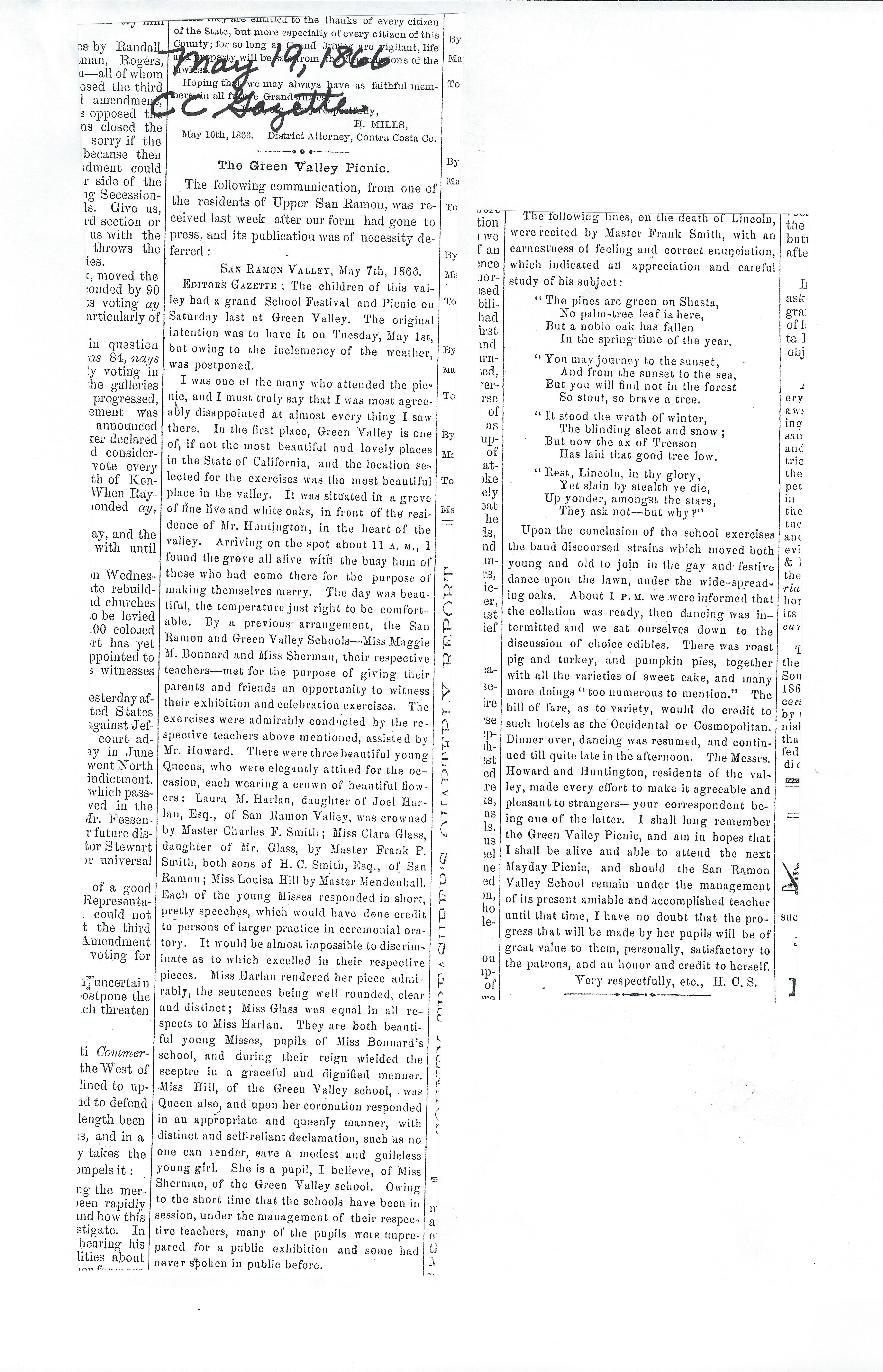
This is an article appearing in the Contra Costa Gazette on May 19, 1866. The article describes the Green Valley School Festival and Picnic. At the picnic a poem about the death of Abraham Lincoln was read by student Frank Smith.
-
Source
The Museum of the San Ramon Valley
-
Rights
This item may be reproduced an used for any purpose, including research, teaching, private study, publication, broadcast or commercial use with proper citation and attribution.
-
Tags
-
Cite this Item
Frank Smith. "Poem in memory of Abraham Lincoln". Contra Costa Gazette. Remembering Lincoln. Web. Accessed May 8, 2026. https://rememberinglincoln.fords.org/node/486
-
Creator
Frank Smith
-
Publisher
Contra Costa Gazette
-
Date
May 7, 1866
-
Material
newspaper
from May. 7, 1866
Poem in memory of Abraham Lincoln
-
Description
This is an article appearing in the Contra Costa Gazette on May 19, 1866. The article describes the Green Valley School Festival and Picnic. At the picnic a poem about the death of Abraham Lincoln was read by student Frank Smith.
-
Source
The Museum of the San Ramon Valley
-
Rights
This item may be reproduced an used for any purpose, including research, teaching, private study, publication, broadcast or commercial use with proper citation and attribution.
-
Creator
Frank Smith
-
Publisher
Contra Costa Gazette
-
Date
May 7, 1866
-
Material
newspaper
from Apr. 17, 1866
Tolling of the Bells
-
Full Title
Tolling of the Bells - Cleveland Daily Leader
-
Description
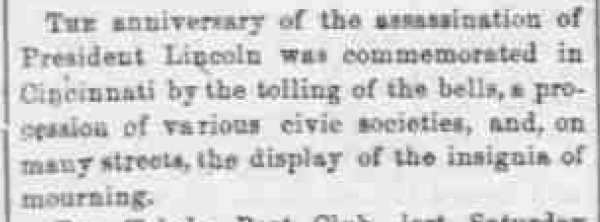
Cincinnati commemorated the anniversary of Lincoln's assassination by tolling the bells and displaying mourning insignia throughout the city.
-
Rights
This item is in the public domain and may be reproduced and used for any purpose, including research, teaching, private study, publication, broadcast or commercial use, with proper citation and attribution.
-
Tags
-
Cite this Item
Cleveland Daily Leader. "Tolling of the Bells - Cleveland Daily Leader". Remembering Lincoln. Web. Accessed May 8, 2026. https://rememberinglincoln.fords.org/node/461
-
Creator
Cleveland Daily Leader
-
Date
April 17, 1866
from Apr. 17, 1866
Tolling of the Bells - Cleveland Daily Leader
-
Description
Cincinnati commemorated the anniversary of Lincoln's assassination by tolling the bells and displaying mourning insignia throughout the city.
-
Rights
This item is in the public domain and may be reproduced and used for any purpose, including research, teaching, private study, publication, broadcast or commercial use, with proper citation and attribution.
-
Creator
Cleveland Daily Leader
-
Date
April 17, 1866
from Apr. 16, 1866
"In Memory of Abraham Lincoln"
-
Full Title
"In Memory of Abraham Lincoln" - Cleveland Daily Leader
-
Description
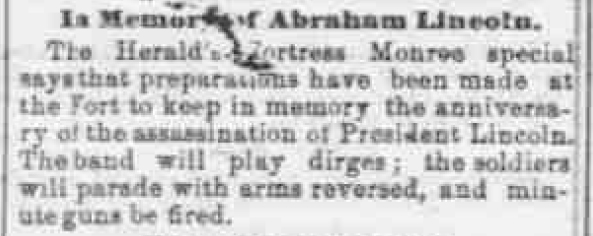
The Cleveland Daily Leader tells of preparations to commemorate Lincoln's assassination with solemn music, soldiers, and the firing of guns.
-
Rights
This item is in the public domain and may be reproduced and used for any purpose, including research, teaching, private study, publication, broadcast or commercial use, with proper citation and attribution.
-
Tags
-
Cite this Item
Cleveland Daily Leader. ""In Memory of Abraham Lincoln" - Cleveland Daily Leader ". Remembering Lincoln. Web. Accessed May 8, 2026. https://rememberinglincoln.fords.org/node/460
-
Creator
Cleveland Daily Leader
-
Date
April 16, 1866
from Apr. 16, 1866
"In Memory of Abraham Lincoln" - Cleveland Daily Leader
-
Description
The Cleveland Daily Leader tells of preparations to commemorate Lincoln's assassination with solemn music, soldiers, and the firing of guns.
-
Rights
This item is in the public domain and may be reproduced and used for any purpose, including research, teaching, private study, publication, broadcast or commercial use, with proper citation and attribution.
-
Creator
Cleveland Daily Leader
-
Date
April 16, 1866
from Apr. 14, 1866
Department of State Orders
-
Full Title
Department of State Orders
-
Description
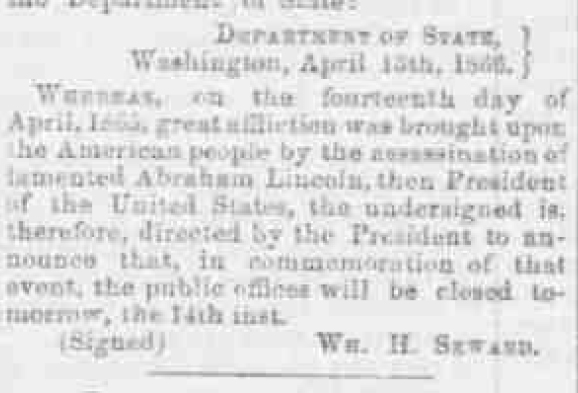
William Seward orders that public offices will be closed to commemorate the anniversary of Lincoln's assassination.
-
Rights
This item is in the public domain and may be reproduced and used for any purpose, including research, teaching, private study, publication, broadcast or commercial use, with proper citation and attribution.
-
Tags
-
Cite this Item
Cleveland Daily Leader. "Department of State Orders". Remembering Lincoln. Web. Accessed May 8, 2026. https://rememberinglincoln.fords.org/node/459
-
Creator
Cleveland Daily Leader
-
Date
April 14, 1866
from Apr. 14, 1866
Department of State Orders
-
Description
William Seward orders that public offices will be closed to commemorate the anniversary of Lincoln's assassination.
-
Rights
This item is in the public domain and may be reproduced and used for any purpose, including research, teaching, private study, publication, broadcast or commercial use, with proper citation and attribution.
-
Creator
Cleveland Daily Leader
-
Date
April 14, 1866
from Apr. 10, 1866
Illinois Proclamation
-
Full Title
Illinois Proclamation - Cleveland Daily Leader
-
Description
The Governor of Illinois commemorates the one-year anniversary of Lincoln's assassination.
-
Rights
This item is in the public domain and may be reproduced and used for any purpose, including research, teaching, private study, publication, broadcast or commercial use, with proper citation and attribution.
-
Tags
-
Cite this Item
Cleveland Daily Leader. "Illinois Proclamation - Cleveland Daily Leader". Remembering Lincoln. Web. Accessed May 8, 2026. https://rememberinglincoln.fords.org/node/458
-
Creator
Cleveland Daily Leader
-
Date
April 10, 1866
from Apr. 10, 1866
Illinois Proclamation - Cleveland Daily Leader

-
Description
The Governor of Illinois commemorates the one-year anniversary of Lincoln's assassination.
-
Rights
This item is in the public domain and may be reproduced and used for any purpose, including research, teaching, private study, publication, broadcast or commercial use, with proper citation and attribution.
-
Creator
Cleveland Daily Leader
-
Date
April 10, 1866
from Apr. 12, 1866
"Infamous"
-
Full Title
"Infamous"
-
Description
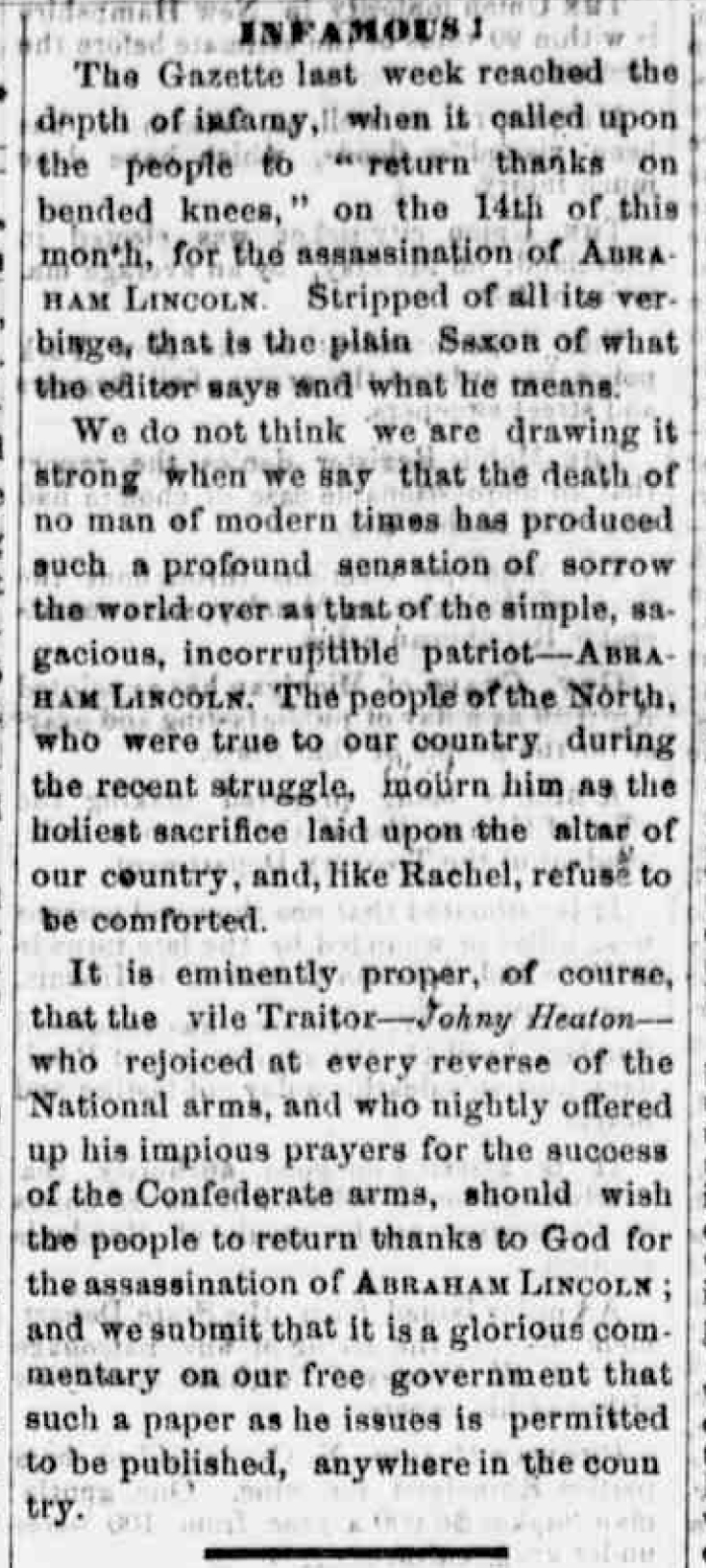
Short article commemorating the approaching one-year anniversary of Lincoln's assassination. It states "the death of no man of modern times has produced such a profound sensation of sorrow the world over as that of the simple, sagacious, incorruptible patriot--Abraham Lincoln."
-
Rights
This item is in the public domain and may be reproduced and used for any purpose, including research, teaching, private study, publication, broadcast or commercial use, with proper citation and attribution.
-
Tags
-
Cite this Item
Beltmont Chronicle. ""Infamous"". Remembering Lincoln. Web. Accessed May 8, 2026. https://rememberinglincoln.fords.org/node/448
-
Creator
Beltmont Chronicle
-
Date
April 12, 1866
from Apr. 12, 1866
"Infamous"
-
Description
Short article commemorating the approaching one-year anniversary of Lincoln's assassination. It states "the death of no man of modern times has produced such a profound sensation of sorrow the world over as that of the simple, sagacious, incorruptible patriot--Abraham Lincoln."
-
Rights
This item is in the public domain and may be reproduced and used for any purpose, including research, teaching, private study, publication, broadcast or commercial use, with proper citation and attribution.
-
Creator
Beltmont Chronicle
-
Date
April 12, 1866