from May. 4, 1865
E. Rothesay Miller to Theodore Freeley Gale
-
Full Title
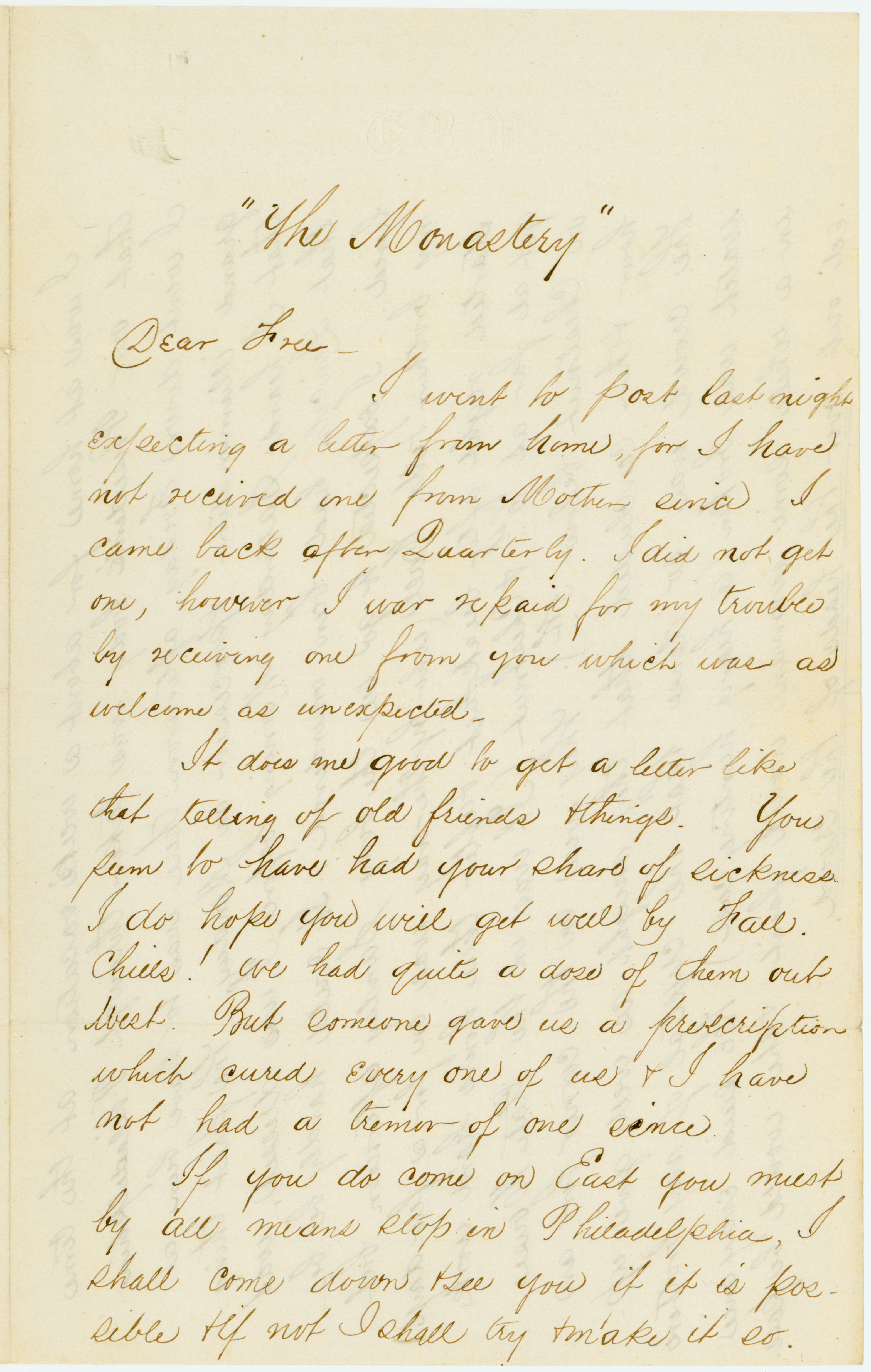
Letter of E. Rothesay Miller, "The Monastery," Princeton, to Free [Theodore Freeley Gale], May 4, 1865
-
Description
Regarding his education at Princeton and Abraham Lincoln's body passing through Philadelphia after the assassination. States, ". . . .I was at home for about a week's vacation at the time that our President's body was taken through Philadelphia. I went down Friday afternoon: there was to have been a grand illumination — procession on Monday. The first thing that I heard Saturday Morning before I was dressed was that Lincoln had been murdered. It could hardly be believed. I expected to go see the body Sunday afternoon but my brother — Mr. Hall. . . .started right after breakfast — after three hours hard work got as far as 6th — Chestnut (It was in the State House on Chestnut below 5th.) They were on the corner for an hour — then concluded that they might as well give up. The crowd was so dense that the crystal of my brother's watch was broken (a heavy hunting case). He said every once in a while some woman would faint — she would be passed out over the heads of the crowd. . . ."
-
Source
Missouri History Museum
-
Rights
This item is in the public domain.
-
Tags
-
Cite this Item
Miller, Edward Rothesay. "Letter of E. Rothesay Miller, "The Monastery," Princeton, to Free [Theodore Freeley Gale], May 4, 1865". Remembering Lincoln. Web. Accessed May 5, 2026. https://rememberinglincoln.fords.org/node/311

-
Creator
Miller, Edward Rothesay
-
Date
May 4, 1865
from May. 4, 1865
Letter of E. Rothesay Miller, "The Monastery," Princeton, to Free [Theodore Freeley Gale], May 4, 1865
-
Description
Regarding his education at Princeton and Abraham Lincoln's body passing through Philadelphia after the assassination. States, ". . . .I was at home for about a week's vacation at the time that our President's body was taken through Philadelphia. I went down Friday afternoon: there was to have been a grand illumination — procession on Monday. The first thing that I heard Saturday Morning before I was dressed was that Lincoln had been murdered. It could hardly be believed. I expected to go see the body Sunday afternoon but my brother — Mr. Hall. . . .started right after breakfast — after three hours hard work got as far as 6th — Chestnut (It was in the State House on Chestnut below 5th.) They were on the corner for an hour — then concluded that they might as well give up. The crowd was so dense that the crystal of my brother's watch was broken (a heavy hunting case). He said every once in a while some woman would faint — she would be passed out over the heads of the crowd. . . ."
-
Source
Missouri History Museum
-
Rights
This item is in the public domain.
-
Creator
Miller, Edward Rothesay
-
Date
May 4, 1865
from May. 15, 1865
Edward Bates to O. D. Filley
-
Full Title
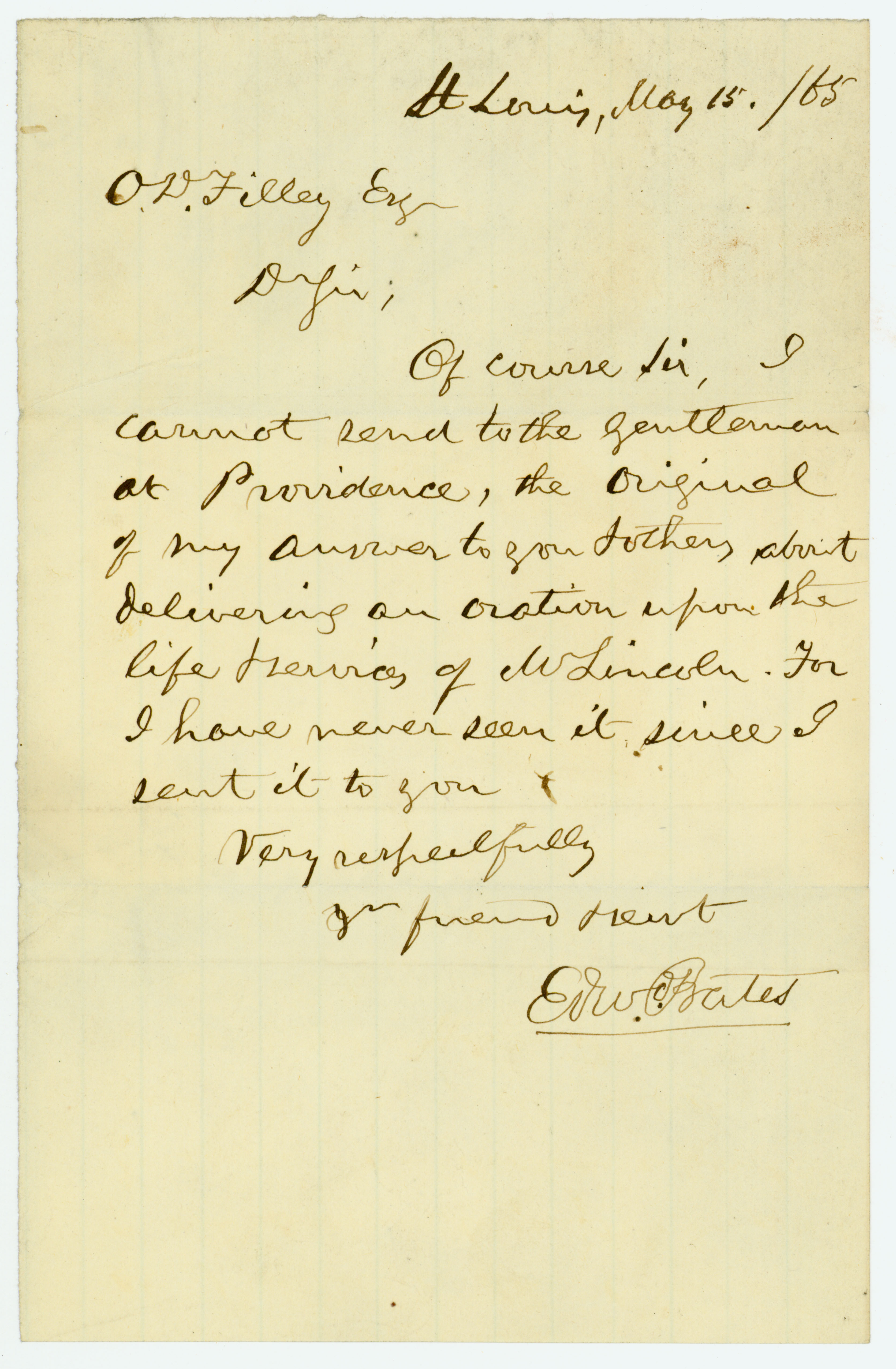
Note of Edward Bates, St. Louis, to O. D. Filley, May 15, 1865
-
Description
Reads, "Of course Sir, I cannot send to the gentleman at Providence, the original of my answer to you — others about delivering an oration upon the life — services of Mr. Lincoln. For I have never seen it since I sent it to you."
-
Source
Missouri History Museum
-
Rights
This item is in the public domain.
-
Tags
-
Cite this Item
Bates, Edward, 1793-1869. "Note of Edward Bates, St. Louis, to O. D. Filley, May 15, 1865". Remembering Lincoln. Web. Accessed May 5, 2026. https://rememberinglincoln.fords.org/node/310
-
Creator
Bates, Edward, 1793-1869
-
Date
May 15, 1865
from May. 15, 1865
Note of Edward Bates, St. Louis, to O. D. Filley, May 15, 1865
-
Description
Reads, "Of course Sir, I cannot send to the gentleman at Providence, the original of my answer to you — others about delivering an oration upon the life — services of Mr. Lincoln. For I have never seen it since I sent it to you."
-
Source
Missouri History Museum
-
Rights
This item is in the public domain.
-
Creator
Bates, Edward, 1793-1869
-
Date
May 15, 1865
from Apr. 21, 1865
Nellie Blow to Minerva Blow
-
Full Title
Partial letter of Nellie Blow, New York, to Dearest Mother [Minerva Blow], April 21, 1865
-
Description
Regarding the prevailing gloom and sadness in the city due to the death of President Lincoln. States that Miss Haines took her out riding on the day of the funeral train. End of letter missing.
-
Source
Missouri History Museum
-
Rights
This item is in the public domain.
-
Tags
-
Cite this Item
Blow, Nellie. "Partial letter of Nellie Blow, New York, to Dearest Mother [Minerva Blow], April 21, 1865". Remembering Lincoln. Web. Accessed May 5, 2026. https://rememberinglincoln.fords.org/node/308
-
Creator
Blow, Nellie
-
Date
April 21, 1865
from Apr. 21, 1865
Partial letter of Nellie Blow, New York, to Dearest Mother [Minerva Blow], April 21, 1865
![Partial letter of Nellie Blow, New York, to Dearest Mother [Minerva Blow], April 21, 1865](https://rememberinglincoln.fords.org/sites/default/files/Nellie%20Blow%20Letter%201.jpg)
-
Description
Regarding the prevailing gloom and sadness in the city due to the death of President Lincoln. States that Miss Haines took her out riding on the day of the funeral train. End of letter missing.
-
Source
Missouri History Museum
-
Rights
This item is in the public domain.
-
Creator
Blow, Nellie
-
Date
April 21, 1865
from Apr. 19, 1865
Jud M. Bemis to Jenny
-
Full Title
Letter of Jud M. Bemis, St. Louis, to his sister Jenny, April 19, 1865
-
Description
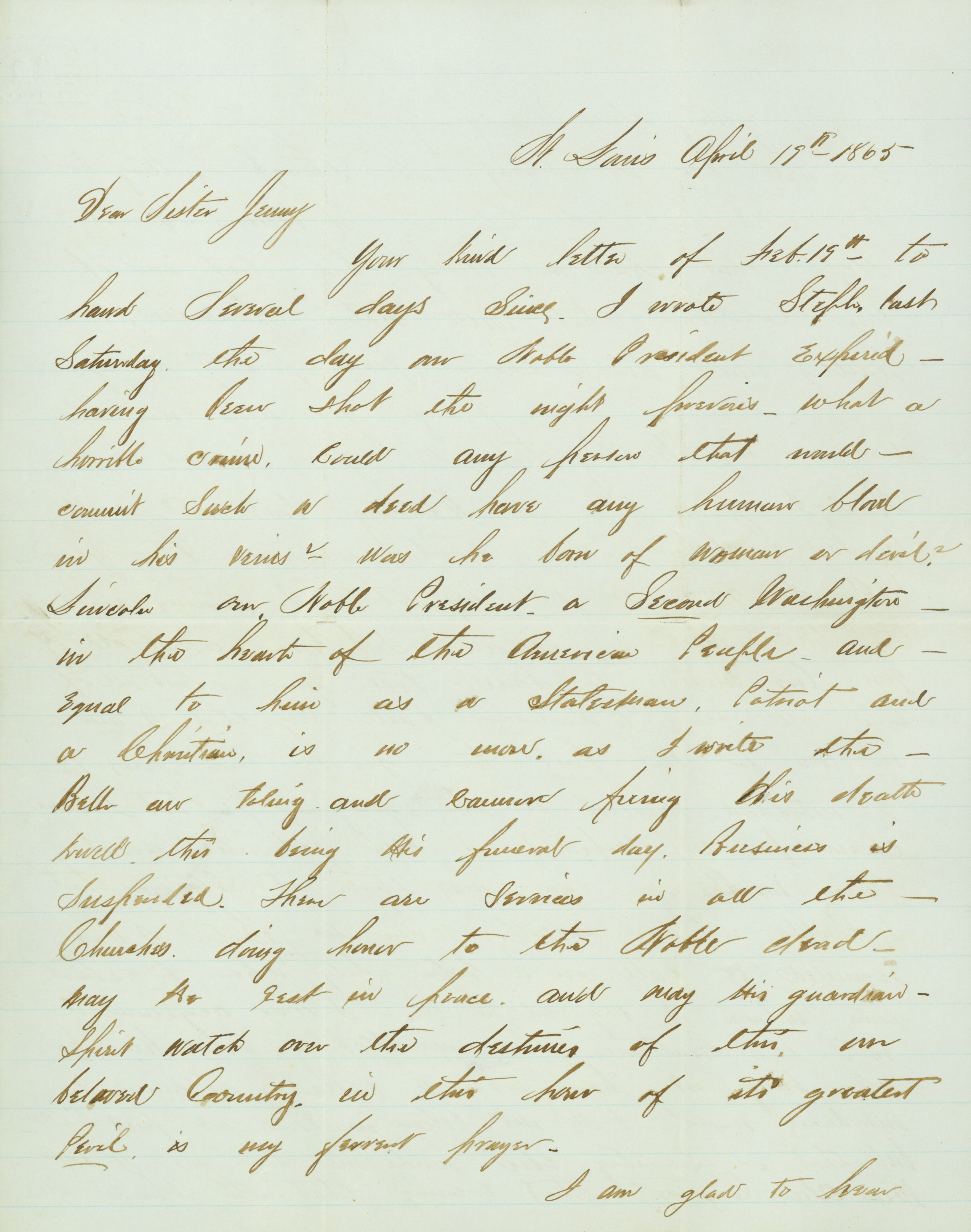
Mentions the death of President Lincoln and the local church services to remember him in St. Louis.
-
Transcription
St. Louis, April 19th, 1865
Dear Sister Jenny,
Your kind letter of Feb 19th to
hand several days since. I wrote Steph last
Saturday the day our noble President expired -
having been shot the night previous - what a
horrible crime. Could any person that would -
commit such a deed have any human blood
in his veins? Was he born of woman or devil?
Lincoln our noble President a second Washington -
in the heart of the American people and -
equal to him as a Statesmen, Patriot and
a Christian, is no more as I write this -
Beth our taking and [?] firing his death
[?] this being his funeral day. Business is
suspended. There are services in all the -
churches doing honor to the [?] dead -
may he rest in peace. [?] may his guardian
spirit watch over the destinies of [?] our
beloved country in this hour of its greatest
period is my [?] prayer -
I am glad to hear
Tammy is getting along so fairly. Do you think she
She will be as strong as though nothing had
ever [?] her? I hope so. I believe I wrote
Steph that Nate and Molly had lost one of
their children. that with Nate’s financials -
troubles must make them feel pretty badly.
Jenny you [?] [?] it
was as my wedding tour. [?] Jenny it was not.
If I ever [?] a wedding tour it will
be to California and that within two years -
Well I guess you will say that I [?] right
to the point - so I am - I know about all of
your love matters. So I will tell you about all of
mine. Well Jenny to [?]. I will say that I am
in love for the first time. Yes for the first time -
I introduced myself to the young lady that I have
chosen for my wife (if I can get her) about
three months ago - you may think it’s strange that
I should introduce myself - when in Boston I was
requested to call on a Boston lady stopping here when I return
home which I agreed to do - I was acquainted
with the gentleman she was stopping with him. He
not being at home when I called - of course I
[?] myself. do not believe in love at first sight
but that or something the under me say as I left
Miss Alice Logswell that evening that I’m thankful for -
[Transcription by: Megan Klein, Rachel Engl's class, Lehigh University.] -
Source
Missouri History Museum
-
Rights
This item is in the public domain.
-
Tags
-
Cite this Item
Bemis, Judson Moss, 1833-1921. "Letter of Jud M. Bemis, St. Louis, to his sister Jenny, April 19, 1865". Remembering Lincoln. Web. Accessed May 5, 2026. https://rememberinglincoln.fords.org/node/307
-
Creator
Bemis, Judson Moss, 1833-1921
-
Date
April 19, 1865
from Apr. 19, 1865
Letter of Jud M. Bemis, St. Louis, to his sister Jenny, April 19, 1865
-
Description
Mentions the death of President Lincoln and the local church services to remember him in St. Louis.
-
Source
Missouri History Museum
-
Rights
This item is in the public domain.
-
Creator
Bemis, Judson Moss, 1833-1921
-
Date
April 19, 1865
from Jun. 11, 1865
Edward Bates to P. R. Fendall
-
Full Title
Letter of Edward Bates, St. Louis, to P. R. Fendall, Esq., Washington City, June 11, 1865
-
Description
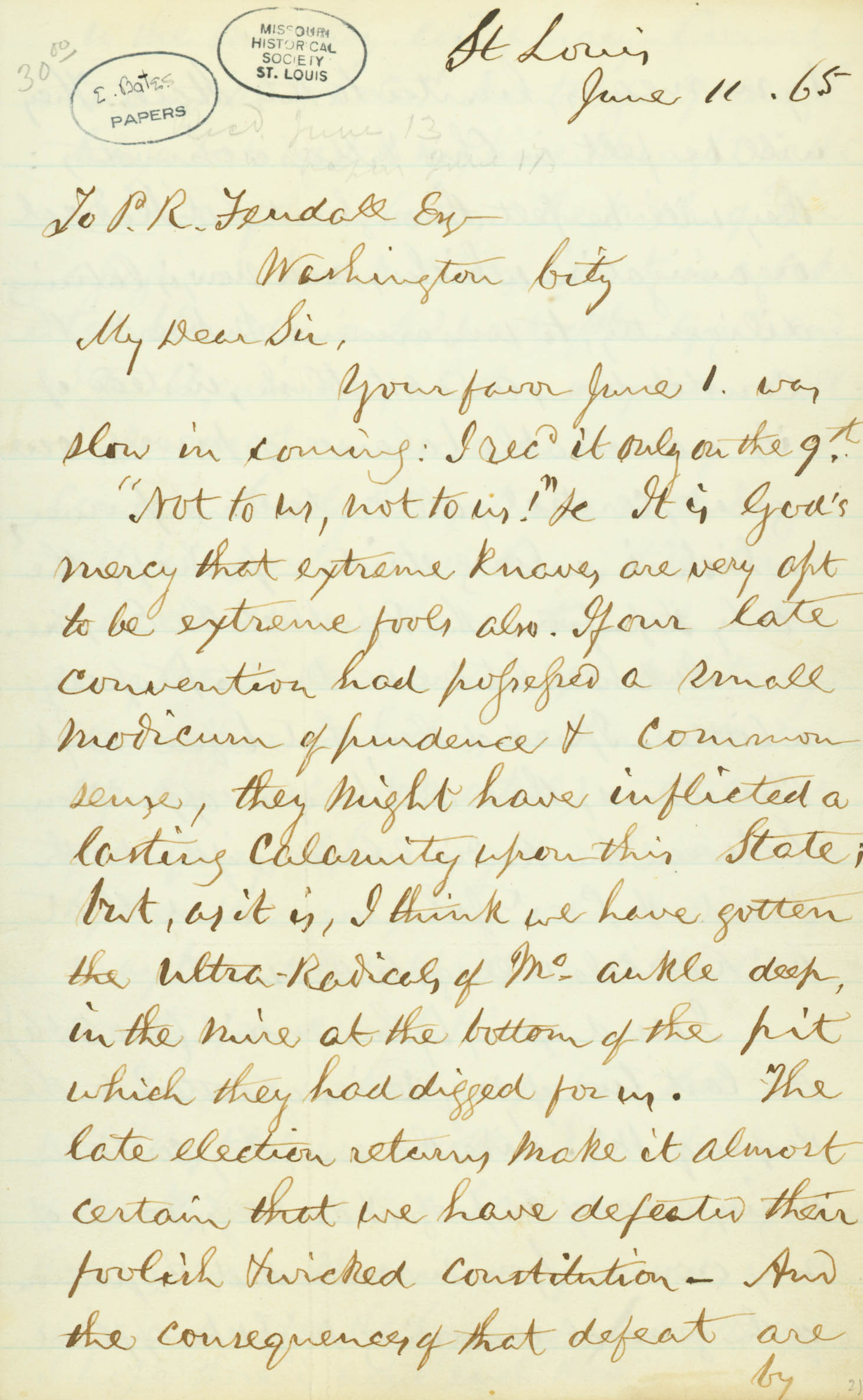
Regarding Missouri politics, President Andrew Johnson, and the trial of Lincoln's assassins.
-
Source
Missouri History Museum
-
Rights
This item is in the public domain.
-
Tags
-
Cite this Item
Bates, Edward, 1793-1869. "Letter of Edward Bates, St. Louis, to P. R. Fendall, Esq., Washington City, June 11, 1865". Remembering Lincoln. Web. Accessed May 5, 2026. https://rememberinglincoln.fords.org/node/306
-
Creator
Bates, Edward, 1793-1869
-
Date
June 11, 1865
from Jun. 11, 1865
Letter of Edward Bates, St. Louis, to P. R. Fendall, Esq., Washington City, June 11, 1865
-
Description
Regarding Missouri politics, President Andrew Johnson, and the trial of Lincoln's assassins.
-
Source
Missouri History Museum
-
Rights
This item is in the public domain.
-
Creator
Bates, Edward, 1793-1869
-
Date
June 11, 1865
from Apr. 17, 1865
Moses Many Lightning Face to S.R. Riggs
-
Full Title
Letter from Moses Many Lightning Face to S. R. Riggs from Davenport, Iowa
-
Description
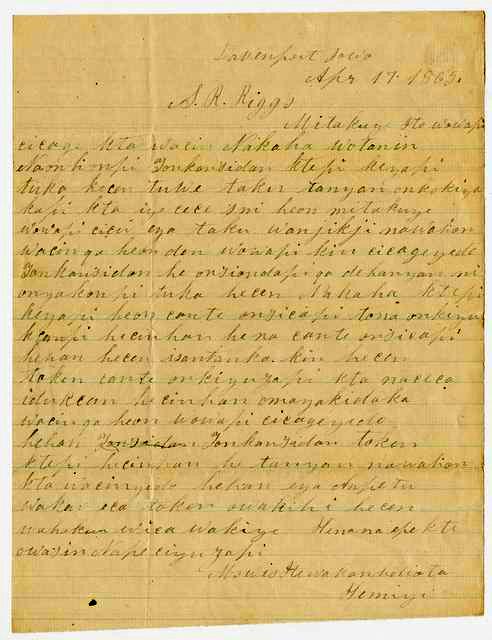
After the hanging of 38 Dakota warriors in Mankato, Minnesota in the aftermath of the U.S.-Dakota War, the other 270 Dakota men who had been sentenced but not hung were sent to a prison camp in Davenport, Iowa. This is where they heard the rumor of President Lincoln's assassination. Moses Many Lightning Face, one of the prisoners, sent this letter to missionary Stephen Riggs asking if the rumor was true. It was recently translated from the Dakota by Dr. Clifford Canku/Mato Watakpe and published in the book The Dakota Prisoner of War Letters; the original is in the Collection of the Minnesota Historical Society.
-
Transcription
Davenport, Iowa April 17, 1865
S.R. Riggs
Well, my relative, I wish to write you a letter, we have heard news. They have said that the President [Abraham Lincoln] was killed. But someone of authority should tell us if this is not true. Thus, my relative, I write to you this letter. Also, I have heard several rumors, therefore, I want to write you this letter – it is so. The President has compassion for us, as so far we are still alive, but now they told us he was killed, and we are saddened. Those of us here think if this is so, we are heartbroken. Perhaps the attitude of the cavalry soldiers may change toward us. Tell me what your thoughts are, I want to know, that’s why I write to you. Then I wish to hear exactly how they killed the President. Then, also on Sundays when I am able, I do the preaching to them. That is all I’m going to say, I shake all your hands.
Moses Many Lightning Face This is me
-
Source
Minnesota Historical Society
-
Rights
Use of this item for research, teaching, and private study is permitted with proper citation and attribution, as Joseph A. Wheelock and family papers, Minnesota Historical Society. Reproduction of this item for publication, broadcast, or commercial use requires written permission. For permission, please see this web page.
-
Tags
-
Cite this Item
Moses Many Lightning Face and Clifford Canku/Mato Watakpe. "Letter from Moses Many Lightning Face to S. R. Riggs from Davenport, Iowa". Remembering Lincoln. Web. Accessed May 5, 2026. https://rememberinglincoln.fords.org/node/300

-
Creator
Moses Many Lightning Face and Clifford Canku/Mato Watakpe
-
Date
April 17, 1865
from Apr. 17, 1865
Letter from Moses Many Lightning Face to S. R. Riggs from Davenport, Iowa
-
Description
After the hanging of 38 Dakota warriors in Mankato, Minnesota in the aftermath of the U.S.-Dakota War, the other 270 Dakota men who had been sentenced but not hung were sent to a prison camp in Davenport, Iowa. This is where they heard the rumor of President Lincoln's assassination. Moses Many Lightning Face, one of the prisoners, sent this letter to missionary Stephen Riggs asking if the rumor was true. It was recently translated from the Dakota by Dr. Clifford Canku/Mato Watakpe and published in the book The Dakota Prisoner of War Letters; the original is in the Collection of the Minnesota Historical Society.
-
Source
Minnesota Historical Society
-
Rights
Use of this item for research, teaching, and private study is permitted with proper citation and attribution, as Joseph A. Wheelock and family papers, Minnesota Historical Society. Reproduction of this item for publication, broadcast, or commercial use requires written permission. For permission, please see this web page.
-
Creator
Moses Many Lightning Face and Clifford Canku/Mato Watakpe
-
Date
April 17, 1865
from May. 5, 1865
Augustus Clark to John A. Andrew
-
Full Title
Letter from Augustus Clark to John A. Andrew, 5 May 1865
-
Description
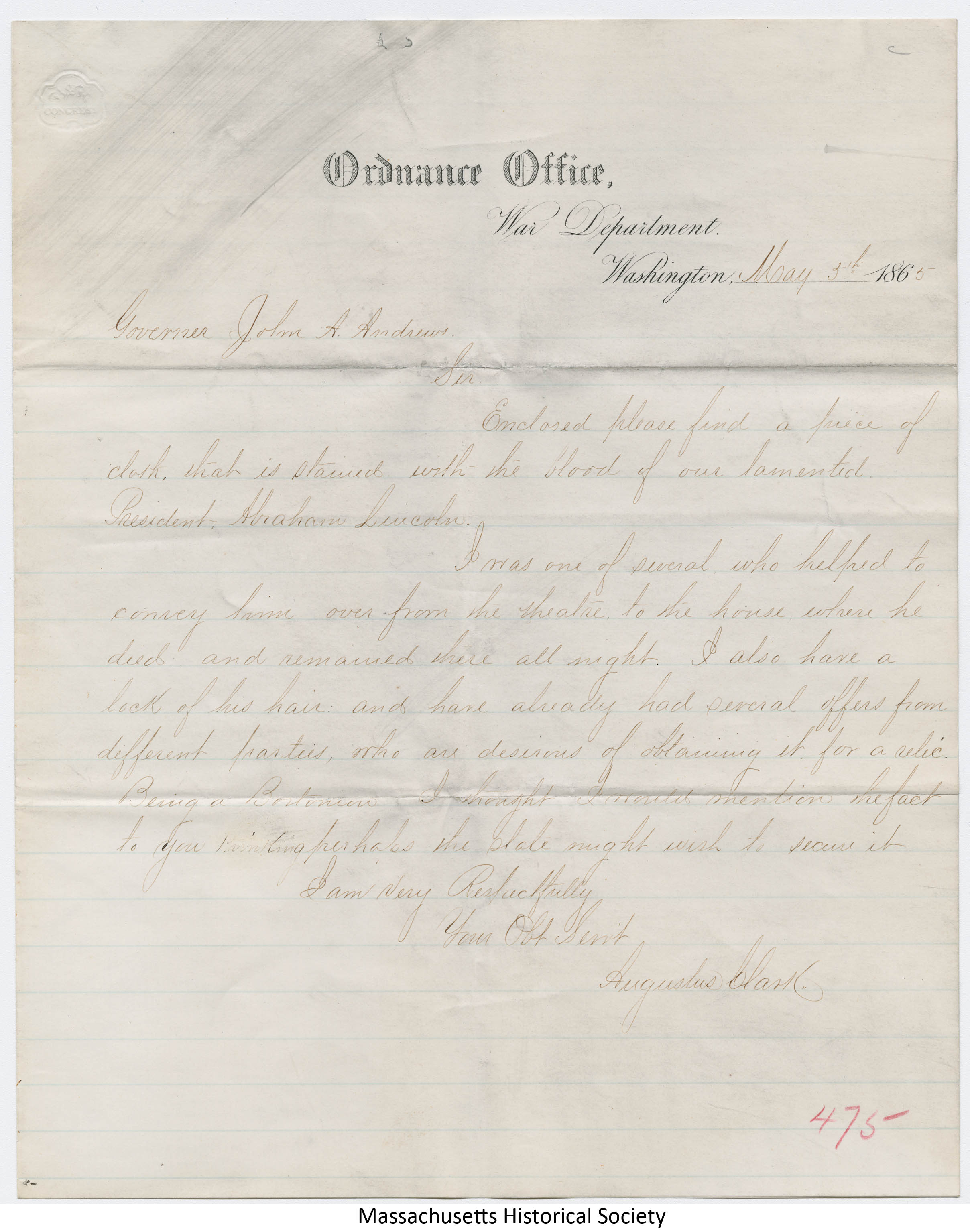
Augustus Clark, a War Department employee,sent this letter to the Governor of Massachusetts, John A. Andrew along with a small piece of cloth that was stained with the blood of Abraham Lincoln. Clark was one of the people who moved Lincoln from Ford's Theatre to Petersen's boardinghouse.
-
Transcription
Ordnance Office, War Department. Washington, May 5th 1865
Governor John A. Andrew
Sir
Enclosed please find a piece of
cloth that is stained with the blood of our lamented
President, Abraham Lincoln.
I was one of several who helped to
convey him over from the theatre to the house where he
died and remained there all night. I also have a
lock of his hair: and have already had several offers from
different parties, who are desirous of obtaining it for a relic.
Being a Bostonian I thought I would mention the fact
to you thinking perhaps the state might wish to secure it.
I am very Respectfully
Your Obt Servt,
Augustus Clark
-
Source
Massachusetts Historical Society, Special collections, manuscripts
-
Rights
Use of this item for research, teaching, and private study is permitted with proper citation and attribution, as: From the Collection of the Massachusetts Historical Society. Reproduction of this item for publication, broadcast, or commercial use requires written permission. For permission, please see this web page
-
Tags
-
Cite this Item
Clark, Augustus. "Letter from Augustus Clark to John A. Andrew, 5 May 1865". Remembering Lincoln. Web. Accessed May 5, 2026. https://rememberinglincoln.fords.org/node/288

-
Creator
Clark, Augustus
-
Date
May 5, 1865
-
Material
24.8 cm x 20 cm
from May. 5, 1865
Letter from Augustus Clark to John A. Andrew, 5 May 1865
-
Description
Augustus Clark, a War Department employee,sent this letter to the Governor of Massachusetts, John A. Andrew along with a small piece of cloth that was stained with the blood of Abraham Lincoln. Clark was one of the people who moved Lincoln from Ford's Theatre to Petersen's boardinghouse.
-
Source
Massachusetts Historical Society, Special collections, manuscripts
-
Rights
Use of this item for research, teaching, and private study is permitted with proper citation and attribution, as: From the Collection of the Massachusetts Historical Society. Reproduction of this item for publication, broadcast, or commercial use requires written permission. For permission, please see this web page
-
Creator
Clark, Augustus
-
Date
May 5, 1865
-
Material
24.8 cm x 20 cm
from Apr. 16, 1865
Augustus Clark to S. M. Allen
-
Full Title
Letter from Augustus Clark to S. M. Allen, 16 April 1865
-
Description
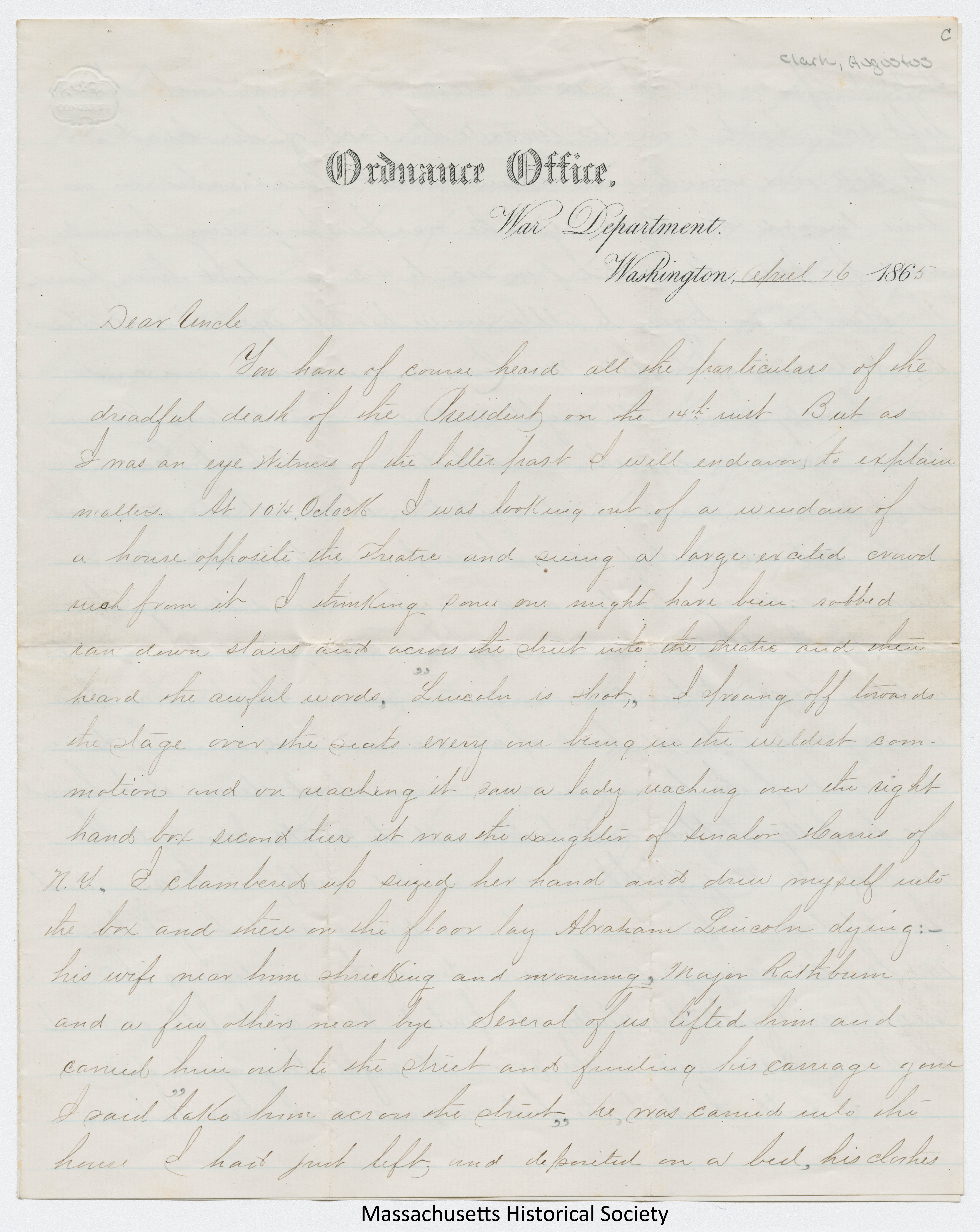
This letter, written by Augustus Clark, a War Department employee, to his uncle, Stephen M. Allen of Woburn, Massachusetts, includes a firsthand account of the awful scenes at Ford's Theatre in Washington, D.C. after John Wilkes Booth had shot Abraham Lincoln. Clark also describes what he witnessed at Petersen's boardinghouse across the street from the theatre, where Lincoln died.
-
Transcription
[Page 1]
Ordnance Office, War Department Washington, April 16 1865
Dear Uncle [S. M. Allen ]
You have of course heard all the particulars of the
dreadful death of the President on the 14th inst But as
I was an eye Witness of the latter part I will endeavor to explain
matters. At 10¼ Oclock I was looking out of a window of
a house opposite the theatre and seeing a large excited crowd
rush from it I thinking some one might have been robbed
ran down stairs and across the street into the theatre and then
heard the awful words, "Lincoln is shot"—I sprang off towards
the stage over the seats every one being in the wildest commotion
and on reaching it saw a lady reaching over the right
hand box second tier it was the daughter of Senator Harris of
N.Y. I clambered up seized her hand and drew myself into
the box and there on the floor lay Abraham Lincoln dying:—
his wife near him shrieking and moaning, Major Rathburn
and a few others near by. Several of us lifted him and
carried him out to the street and finding his carriage gone
I said "take him across the street" he was carried into the
house I had just left, and deposited on a bed, his clothes
[Page 2]
stripped off:— he was shot in the head on a line with the
left ear about 2 inches towards the back of the head,
the Ball was round and entered about three inches in a
line towards his right eye—he was breathing very heavily
and his pulse fluctuated from 105 to 42 in about three hours.
The blood soon begun to settle under his left eye and blackened
the whole side of his face. Mrs Lincoln soon came over and
was hardly sane all night and is now quite low, Laura
Keene came over with her but did not stop—his [son] came in
about Eleven and was much agitated. Soon all the members
of the Cabinet rushed in with grief and terror depicted on
their faces: many Senators and members arrived during the
night—the street was cleared of all strangers and a great
military force stationed around the square. Stanton was there
issuing orders to all parts of the union and seemed to
do most of the business. news came about eleven that Seward
was fearfully stabbed and it seemed to strike terror into the
hearts of all. Maj. Rathburn was wounded badly in the arm and
fainted twice before his wound was dressed and he got home.
Mrs Lincoln came into the room seven times during the
night and felt dreadfully she fainted twice and fell over onto
the floor. I remained in the room all night long and did
all I could to help. The best surgeons were there but no
[Page 3]
attempt was made to extricate the Ball as he was pronounced
fatally wounded at first examination he lingered
on 'till seven twenty "AM" when he breathed his last in
presence of the members of the Cabinet several senators
and others. Mrs Lincoln was not in the room at the time of
his death. The body at nine oclock was taken to the White
House and has been embalmed. I got a lock of his
hair and a towel saturated with the blood of the best
man that ever was President and a friend of the south.
They now have a President that will show them no mercy
and they deserve none. I will enclose a piece of the towel
for you as a relic.
The folks are all well and hope this
will find you family the same. Give my love to all
and excuse this writing as it is quite late and I am
very nervous.
I am as Ever Yours Truly
Gussie
-
Source
Massachusetts Historical Society, Special collections, manuscripts
-
Rights
Use of this item for research, teaching, and private study is permitted with proper citation and attribution, as: From the Collection of the Massachusetts Historical Society. Reproduction of this item for publication, broadcast, or commercial use requires written permission. For permission, please see this web page.
-
Tags
-
Cite this Item
Clark, Augustus. "Letter from Augustus Clark to S. M. Allen, 16 April 1865". Remembering Lincoln. Web. Accessed May 5, 2026. https://rememberinglincoln.fords.org/node/287
-
Creator
Clark, Augustus
-
Date
April 16, 1865
-
Material
25 cm x 20 cm
from Apr. 16, 1865
Letter from Augustus Clark to S. M. Allen, 16 April 1865
-
Description
This letter, written by Augustus Clark, a War Department employee, to his uncle, Stephen M. Allen of Woburn, Massachusetts, includes a firsthand account of the awful scenes at Ford's Theatre in Washington, D.C. after John Wilkes Booth had shot Abraham Lincoln. Clark also describes what he witnessed at Petersen's boardinghouse across the street from the theatre, where Lincoln died.
-
Source
Massachusetts Historical Society, Special collections, manuscripts
-
Rights
Use of this item for research, teaching, and private study is permitted with proper citation and attribution, as: From the Collection of the Massachusetts Historical Society. Reproduction of this item for publication, broadcast, or commercial use requires written permission. For permission, please see this web page.
-
Creator
Clark, Augustus
-
Date
April 16, 1865
-
Material
25 cm x 20 cm
from Apr. 23, 1865
Edwin Bynner to sister
-
Full Title
Letter from Edwin Bynner to his sister, 23 April 1865
-
Description
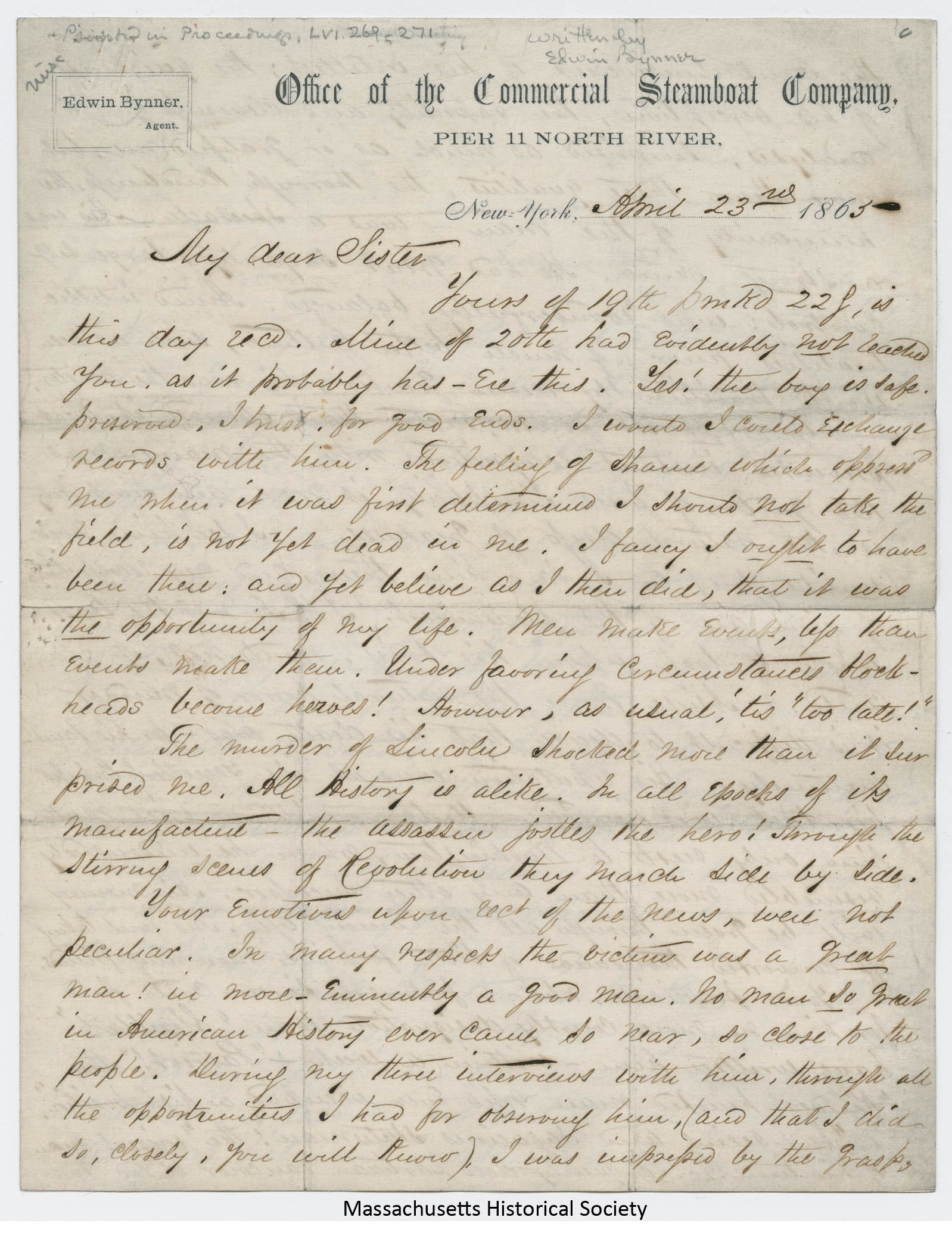
In this letter written by Edwin Bynner, an agent of the Commercial Steam Boat Company in New York, to his sister, Bynner describes his reaction and thoughts about Abraham Lincoln and the assassination. Bynner comments that he is more shocked than surprised at the assassination and recalls the greatness and humanity of Abraham Lincoln. Bynner states that during his three interactions with Lincoln he observed firsthand Lincoln's intellect and perceptiveness. Bynner was impressed with Lincoln's strong mind.
-
Source
Massachusetts Historical Society, Miscellaneous manuscripts collection
-
Rights
Use of this item for research, teaching, and private study is permitted with proper citation and attribution, as: From the Collection of the Massachusetts Historical Society. Reproduction of this item for publication, broadcast, or commercial use requires written permission. For permission, please see this web page.
-
Tags
-
Cite this Item
Bynner, Edwin. "Letter from Edwin Bynner to his sister, 23 April 1865". Remembering Lincoln. Web. Accessed May 5, 2026. https://rememberinglincoln.fords.org/node/286
-
Creator
Bynner, Edwin
-
Date
April 23, 1865
-
Material
25 cm x 19.7 cm
from Apr. 23, 1865
Letter from Edwin Bynner to his sister, 23 April 1865
-
Description
In this letter written by Edwin Bynner, an agent of the Commercial Steam Boat Company in New York, to his sister, Bynner describes his reaction and thoughts about Abraham Lincoln and the assassination. Bynner comments that he is more shocked than surprised at the assassination and recalls the greatness and humanity of Abraham Lincoln. Bynner states that during his three interactions with Lincoln he observed firsthand Lincoln's intellect and perceptiveness. Bynner was impressed with Lincoln's strong mind.
-
Source
Massachusetts Historical Society, Miscellaneous manuscripts collection
-
Rights
Use of this item for research, teaching, and private study is permitted with proper citation and attribution, as: From the Collection of the Massachusetts Historical Society. Reproduction of this item for publication, broadcast, or commercial use requires written permission. For permission, please see this web page.
-
Creator
Bynner, Edwin
-
Date
April 23, 1865
-
Material
25 cm x 19.7 cm
from Apr. 17, 1865
Schuyler Colfax to Joseph Medill
-
Full Title
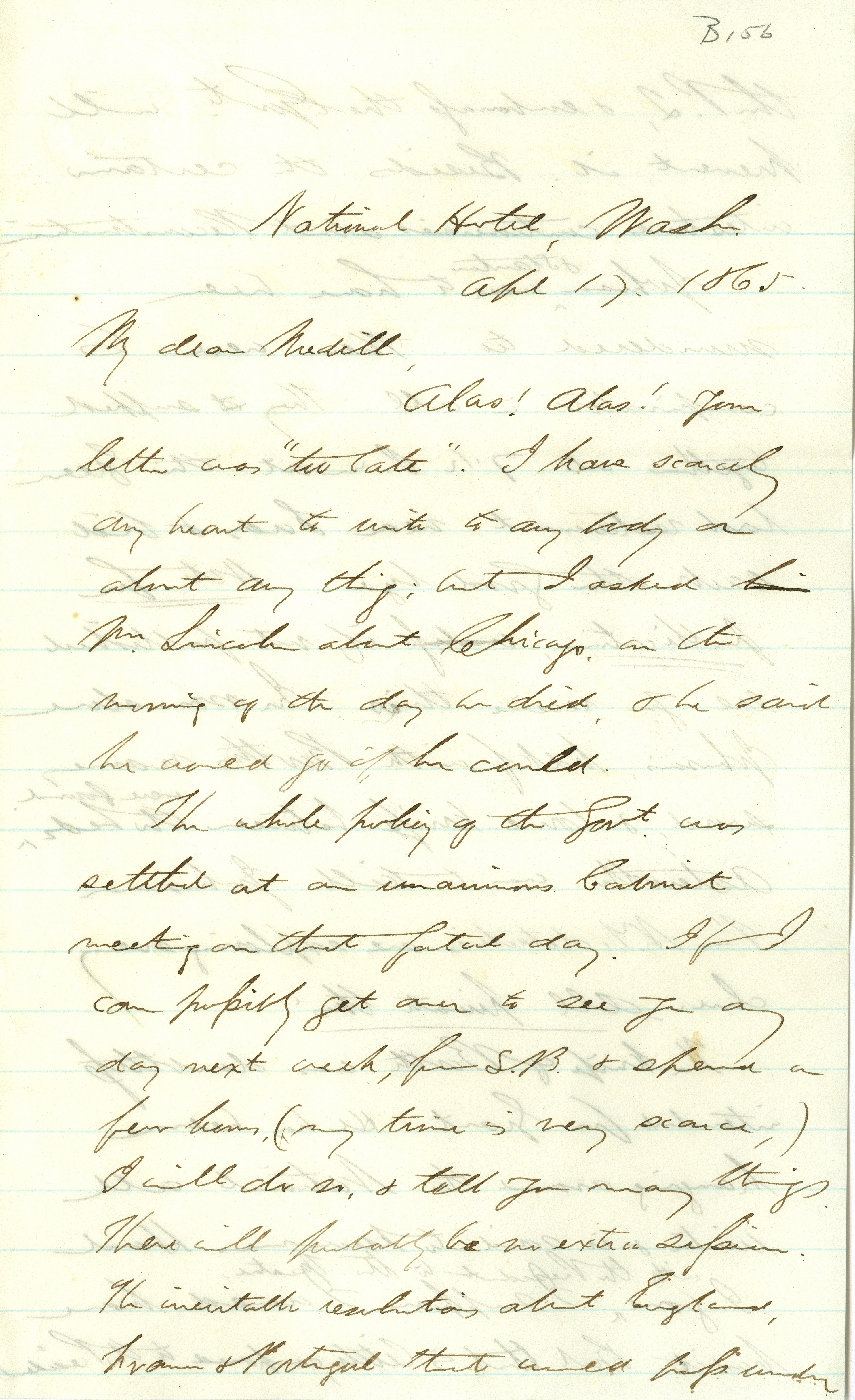
Handwritten letter to Joseph Medill from Schuyler Colfax
-
Description
Speaker of the U.S. House of Representatives Schuyler Colfax's response to Chicago Tribune newspaper editor and owner Joseph Medill's April 14, 1865 letter to Abraham Lincoln. Colfax describes the immediate aftermath of Lincoln's assassination.
-
Transcription
Page one
National Hotel, Wash.
April 17, 1865
My dear Medill:
Alas! Alas! Your letter was “too late”. I have scarcely any hart to write to anybody or about anything; but I asked Mr. Lincoln about Chicago, on the mourning of the day he died and he said he would go if he could. The whole policy of the Gov’t was settled at a unanimous cabinet meeting on that fatal day. If I can possibly get over to see you any day next week, from S. B. and spend a few hours (my time is very scarce) I will do so, and tell you many things. There will probably be no extra session. The inevitable resolutions about England, France & Portugal that would pass under
Page two
the P. I. and embarrass the Gov’t will prevent it. Besides the certain intestine controversies about Reconstruction. Johnson & Stanton were to have been murdered too. There were 6 conspirators in all. They supped together at 7 ½ p.m. at the Greenback restaurant near Fads bid each other good bye. Not for publication, if not published are ere you receive this. In room above Johnson’s, hdkf. with Booth’s name, sword and bowie knife between the beds were found. Asteroth was to kill Johnson. The N.Y. detective are exploring every clue. All private this.
The knife of Booth was doubtless intended for Grant. He has been hanging around the national all winter and is said to know me. Had I gone with the President to the theater I suppose I would have had it. But that is little compared to the President.
Page three
Much obliged for what you tell me about a young lady I think really a great deal of. But I ought not to know what you say. Mrs. M. may tell me of her opinion of me. The shadow of the past is over yet, when alone, more than ever; and I have no more idea and ought not to have as to matrimony than you have today. I should be very exacting as to affection & I ought not to think of changing my situation unless I feel that I could give as much as I should demand. I generally pass by these things as Mrs. M. knows, buy I have given you a glimpse into a heart that has ceased to sorrow for what God took from me forever.
With earnest regards to Mrs. M.
Yours ever
Schuyler Colfax
I yet expect to the plains in May.
-
Source
Robert R. McCormick Research Center, III-10 Joseph Medill Archives, 1840-1899
-
Rights
This item may be reproduced and used for any purpose, including research, teaching, private study, publication, broadcast or commercial use, with proper citation and attribution.
-
Tags
-
Cite this Item
Colfax, Schuyler, 1823-1885. "Handwritten letter to Joseph Medill from Schuyler Colfax". Remembering Lincoln. Web. Accessed May 5, 2026. https://rememberinglincoln.fords.org/node/268

-
Creator
Colfax, Schuyler, 1823-1885
-
Date
April 17, 1865
-
Material
Letter
from Apr. 17, 1865
Handwritten letter to Joseph Medill from Schuyler Colfax
-
Description
Speaker of the U.S. House of Representatives Schuyler Colfax's response to Chicago Tribune newspaper editor and owner Joseph Medill's April 14, 1865 letter to Abraham Lincoln. Colfax describes the immediate aftermath of Lincoln's assassination.
-
Source
Robert R. McCormick Research Center, III-10 Joseph Medill Archives, 1840-1899
-
Rights
This item may be reproduced and used for any purpose, including research, teaching, private study, publication, broadcast or commercial use, with proper citation and attribution.
-
Creator
Colfax, Schuyler, 1823-1885
-
Date
April 17, 1865
-
Material
Letter