from Apr. 20, 1865
"The Last of the Earth"
-
Full Title
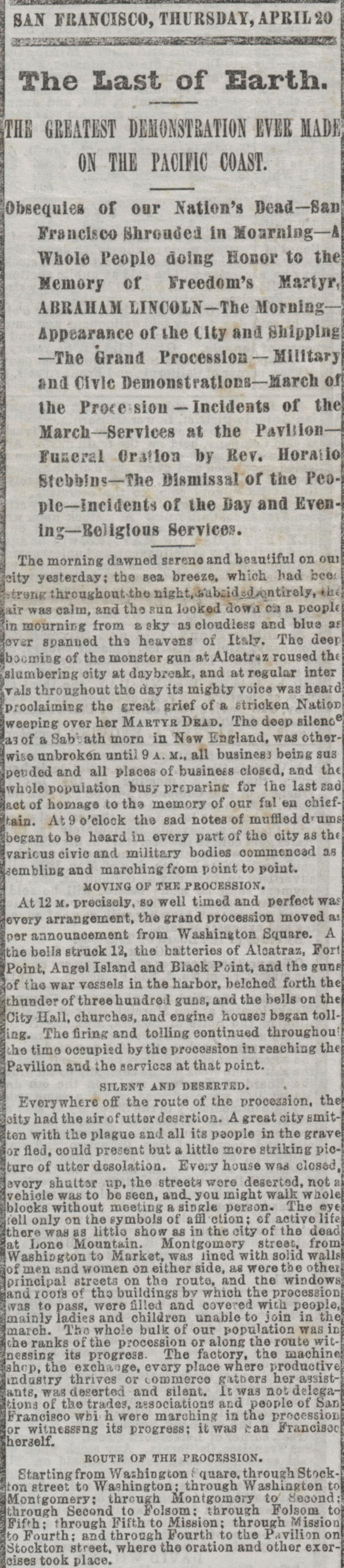
"The Last of the Earth. The Greatest Demonstration Ever Made on the Pacific Coast"
-
Description
April 20, 1865 edition of San Francisco's Daily Alta in which the article describes the funeral obsequies performed for Lincoln.
-
Source
Library of Congress Alfred Whital Stern Collection of Lincolniana, portfolio 6, no. 4
-
Rights
This item is in the public domain and may be reproduced and used for any purpose, including research, teaching, private study, publication, broadcast or commercial use, with proper citation and attribution
-
Tags
-
Cite this Item
Daily Alta. ""The Last of the Earth. The Greatest Demonstration Ever Made on the Pacific Coast"". Remembering Lincoln. Web. Accessed December 14, 2025. https://rememberinglincoln.fords.org/node/742
-
Creator
Daily Alta
-
Date
April 20, 1865
from Apr. 20, 1865
"The Last of the Earth. The Greatest Demonstration Ever Made on the Pacific Coast"
-
Description
April 20, 1865 edition of San Francisco's Daily Alta in which the article describes the funeral obsequies performed for Lincoln.
-
Source
Library of Congress Alfred Whital Stern Collection of Lincolniana, portfolio 6, no. 4
-
Rights
This item is in the public domain and may be reproduced and used for any purpose, including research, teaching, private study, publication, broadcast or commercial use, with proper citation and attribution
-
Creator
Daily Alta
-
Date
April 20, 1865
from Apr. 19, 1865
Order of Exercises for Lincoln's Funeral
-
Full Title
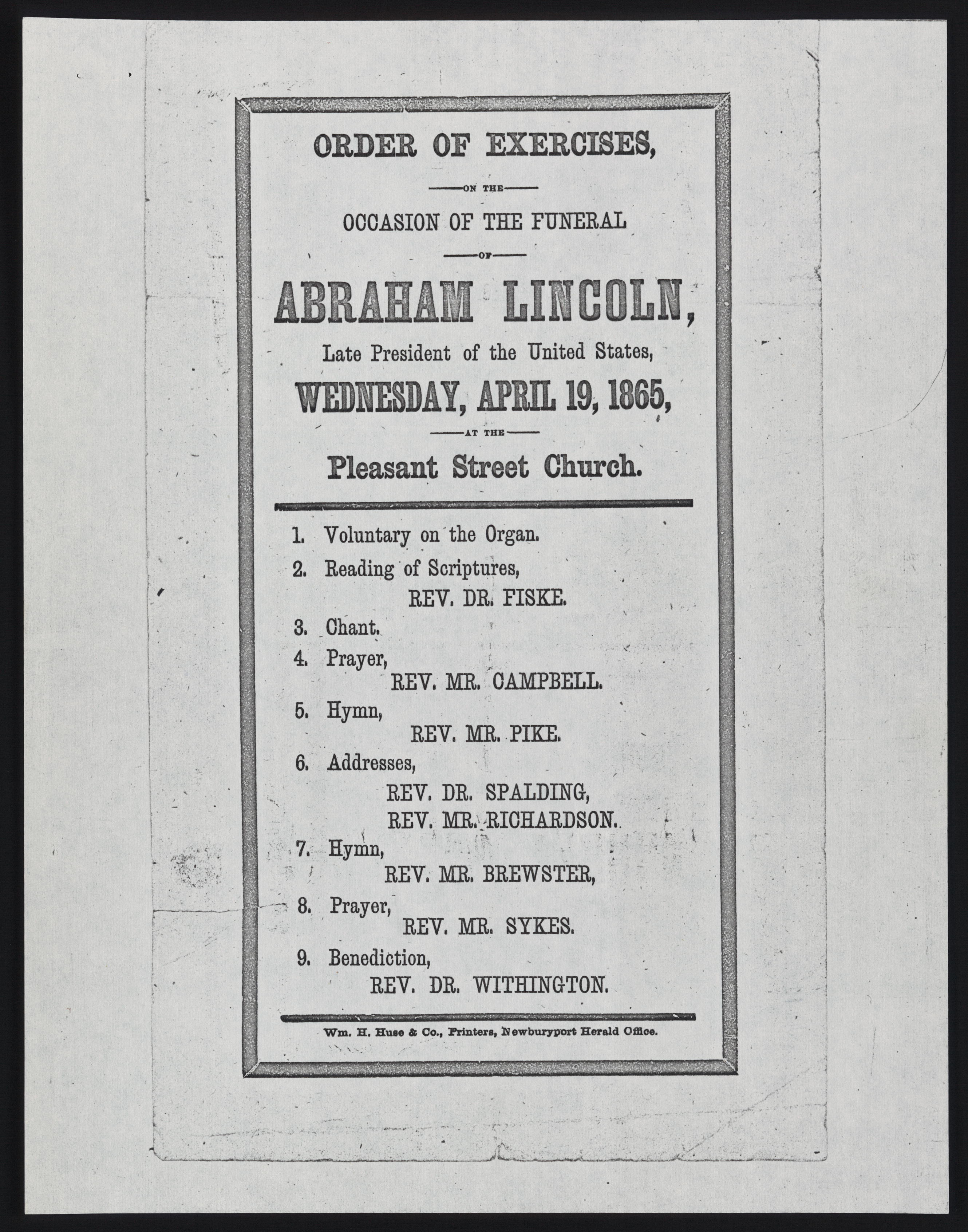
Order of Exercises, Occasion of the Funeral of Abraham Lincoln
-
Description
Order of exercises for Lincoln's funeral. Published by Wm. H. Huse & Co., Printers, Newburyport, Massachusetts, April 19, 1865
-
Source
Library of Congress, Alfred Whital Stern Collection of Lincolniana portfolio 16, no. 33
-
Rights
This item is in the public domain and may be reproduced and used for any purpose, including research, teaching, private study, publication, broadcast or commercial use, with proper citation and attribution
-
Tags
-
Cite this Item
Wm. H. Huse & Co., Printers, Newburyport, Massachusetts. "Order of Exercises, Occasion of the Funeral of Abraham Lincoln". Remembering Lincoln. Web. Accessed December 14, 2025. https://rememberinglincoln.fords.org/node/737
-
Creator
Wm. H. Huse & Co., Printers, Newburyport, Massachusetts
-
Date
April 19, 1865
from Apr. 19, 1865
Order of Exercises, Occasion of the Funeral of Abraham Lincoln
-
Description
Order of exercises for Lincoln's funeral. Published by Wm. H. Huse & Co., Printers, Newburyport, Massachusetts, April 19, 1865
-
Source
Library of Congress, Alfred Whital Stern Collection of Lincolniana portfolio 16, no. 33
-
Rights
This item is in the public domain and may be reproduced and used for any purpose, including research, teaching, private study, publication, broadcast or commercial use, with proper citation and attribution
-
Creator
Wm. H. Huse & Co., Printers, Newburyport, Massachusetts
-
Date
April 19, 1865
from Apr. 30, 1865
Horatio Nelson Taft Diary, April 30, 1865
-
Full Title
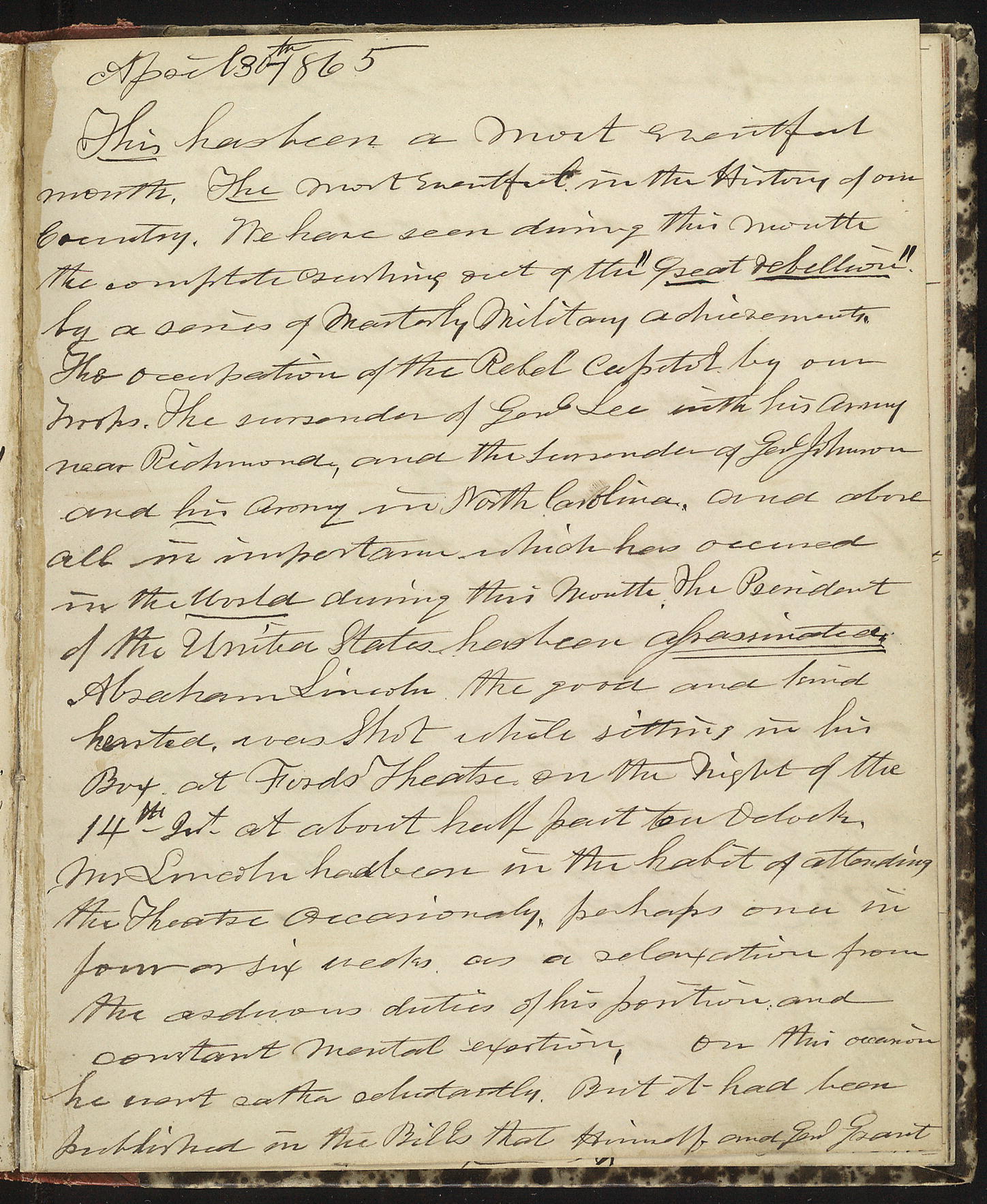
Horatio Nelson Taft Diary, April 30, 1865
-
Description
Patent examiner Horatio Nelson Taft discussed the events of the previous month, calling April 1865 "the most eventful in the History of our Country."
-
Transcription
April 30th 1865
This has been a most eventful month. The most eventful in the History of our Country. We have seen during this month the complete crushing out of the “Great rebellion” by a series of masterly Military achievements. The occupation of the Rebel Capitol by our troops. The surrender of Genl Lee with his Army near Richmond, and the surrender of Genl Johnson and his Army in North Carolina, and above all in importance which has occured in the World during this month, The President of the United States has been assassinated. Abraham Lincoln, the good and kind hearted, was Shot while sitting in his Box at Fords Theatre on the night of the 14th Int at about half past ten O'clock. Mr Lincoln had been in the habit of attending the Theatre occasionaly, perhaps once in four or six weeks, as a relaxation from the arduous duties of his position and constant mental exertion. On this occasion he went rather reluctantly. But it had been published in the Bills that Himself and Genl Grant would be present, and Genl Grant having left the City in the evening train for Phila, the President said that he did not “wish the people to be disappointed” and so went with his Lady arriving about ½ past 8. Miss Harris (daughter of Hon Ira Harris) and Maj Rathbone of Albany were also in the same Box, which was a double one, two being thrown into one. This Box was in the 2nd Tier and entered from the Dress circle through a narrow corridor some three feet wide and eight or ten long. There was a door at the dress circle end and at the other end there were two doors, one for each Box but now the two Boxes being thrown into one, one of the doors was closed. The other was open, and all of them unguarded. The assassin J Wilkes Booth had made his arrangements in the most deliberate manner (probably during that day). He had fixed a bar across the door leading into the dress circle and had cut a hole through the closed door leading to the Box, which enabled him to see the exact position of the President and others in the Box without being seen himself. At about ½ past 10, he entered the corridor from the Dress circle, bared the door to prevent any one from entering, examined the position of Mr Lincoln through the hole in the closed door. Then entered the Box behind all who were there (as they were looking toward the stage) and standing within three or four feet of Mr Lincoln, Shot him in the back of the head. The ball entering about two inches from the left ear near the base of the skull and lodging in the brain about two inches back of the right eye. His head was probably inclined forward at the time. The Murderer rushed to the front of the Box with a dagger in his hand. Major Rathbone caught his coat but Booth struck him on the arm with the dagger wounding him severely, which compelled him to let go his hold. Booth vaulted over the front of the Box and as he did so exclaimed “Sic Semper Tyranis” (Thus To Tyrants). As he Jumped from the box his spur cau[gh]t in the flag and as he struck the to see the exact position of the President and others in the Box without being seen himself. At about ½ past 10, he entered the corridor from the Dress circle, bared the door to prevent any one from entering, examined the position of Mr Lincoln through the hole in the closed door. Then entered the Box behind all who were there (as they were looking toward the stage) and standing within three or four feet of Mr Lincoln, Shot him in the back of the head. The ball entering about two inches from the left ear near the base of the skull and lodging in the brain about two inches back of the right eye. His head was probably inclined forward at the time. The Murderer rushed to the front of the Box with a dagger in his hand. Major Rathbone caught his coat but Booth struck him on the arm with the dagger wounding him severely, which compelled him to let go his hold. Booth vaulted over the front of the Box and as he did so exclaimed “Sic Semper Tyranis” (Thus To Tyrants). As he Jumped from the box his spur cau[gh]t in the flag and as he struck the Stage he came to a crouching position from the effect of the concussion, his hands striking the floor but he recovered himself in a moment and flourishing his dagger he strode across the Stage some forty feet in sight of the spectators and past some of the actors, and reaching the back door which opens into a lane, he mounted a fleet horse and escaped. The lane enters F St betwen 9th & 10 Sts. The audience was paralized for some seconds, but rushed on to the Stage. A Surgeon was called for and Charles S Taft a Surgeon being present was lifted up from the Stage to the Box by those present. Before this the bar had been removed by Maj Rathbone and several men had reached the Box. When Chas reached the Box the President was lying upon the floor. Water and stimulants were used immediately but without avail in attempts to revive him. He was taken up and carried from the Theatre to the House opposite in
about fifteen minutes after he was shot. A Dr Leale from Armory Square Hospital was the first Surgeon in the box. But Chas did not know that there was any Surgeon but himself present until the President was removed from the Theatre. Chas had charge of him until Dr Stone (the Presidents family Physician) arrived which was half an hour after he was placed on a bed at the House of Mr Peterson, opposite. When the shot was fired Mrs Lincoln was sitting near her husband with her hand on his knee. She says she saw the flash and heard the report of the pistol, thinking it was in some way connected with the the Play. She leaned forward to see what it was, and then looked to Mr Lincoln to see where he was looking. He was sitting with his head droped down and eyes shut. She was not alarmed at this, he sometimes held his head in that way when in deep thought, but she put her hand on his forehead and he not stirring she put it on the back of his head and feeling it wet she immediately withdrew it covered with blood. She then screamed and that is the last she remembered that took place in the Theatre. She says, as she put her hand on his head she recollects that something suddenly brushed past her and rubbing off her Shawl. It was Booth as he jumped from the Box. The President made no noise, nor attempted to speak, nor Stirred a limb after he was shot, nor was he conscious for one moment from that time until he died. When his skin was touched or his hand was taken, there was a slight quiver or tremor of the muscles, but that was all. Mustard paste was applied nearly all over the body and stimulants were given as long as he could swallow in hopes to revive him but entirely without avail. His pulse ceased to beat at 22 minutes past Seven. Chas had his hand on his heart, he said it fluttered or trilled for 10 seconds longer. It was the opinion of the Surgeons that the wound would have killed most men instantly, or in a very few minutes. But Mr Lincoln had so much vitality that he lived nearly nine hours. There were four Surgeons in immediate or active attendance. Dr Stone, The Surgeon Genl Dr Barnes, The Assistant Surgeon Genl Dr Crane and Charles. Some others were present whose services were not required. Most of the members of the Cabinet were there all night. Chief Justice Chase and other distinguished men. Mr Senator Sumner with Robert Lincoln leaning on his shoulder near the head of the bed. Sec'y Stanton was active in giving directions and writing dispatches all night. Genl Meigs Stood at the door to keep out all who were not wanted or to see that the room was not crowded. The room is at the end of the entrance Hall about 9 feet by 15, with two windows and three doors, one door entering from the Hall, one at the left as you enter, opening to an open porch or piazza, and the other at the farther end of the room, opening into another small room from which stairs decended to to [sic] the Basement. Some few individuals came in to the room through that door clandestinely. Mrs Lincoln occupied a room near by with some of her friends who were there. She went in frequently to see the President with Doct Gurley (The family Pastor) who had been sent for about 3 O'clock. She was not in the room when he died. Robert Lincoln was there and Dr Gurley, the two private Secretaries of the President Nicolay and Hay. Upon one occasion when Mrs L went in and saw her husband she fainted and was carried out insensible. It was thought best for her not to be there when he died. Dr Gurley prayed by the bedside of the President when he first arrived (at 3 o'clock). Then went into the room where Mrs Lincoln was and prayed with her, and remained with her most of the time, accompanying her and supporting her into the room of the dying President when she visited it. After the death Dr Gurley who was standing near Mr Stanton said shall we have any religious exercises here or elsewhere now? Yes said Mr Stanton offer Prayer ________ now and here. For the last half hour before the death, the utmost stillness had prevailed in the room, not a word, not a whisper was heard. The President of the United States dying, surrounded by his Cabinet and many of the first men in the Nation standing like statues around the bed presented a scene for an artist seldom equaled for solemn grandeur. It is to be hoped that it will yet be transfered to Canvass. After the President died Dr Gurley went to Mrs L and told her “the President is dead.” O - why did you not let me know? Why did you not tell me? “Your friends thought it was not best. You must be resigned to the will of God. You must be calm and trust in God and in your friends.” She soon after left, with Dr G for her Home. She was asked during the night if her son “Tad” (Thaddeus) (a boy about twelve years old) should be sent for. “O, my poor “Taddy” what will become of him? O do not send for him, his violent grief would disturb the House.” When they reached the Presidents house “Tad” met them on the Portico. “Where is my Pa? Where is my Pa? He kept repeating the question till they got into the room of Mrs Lincoln. He had heard that his Pa had been shot but evidently expected him when his mother came. He was very much excited and alarmed but had not thought that his Pa could be dead. “Taddy” your Pa is dead” said Dr Gurley. He was not prepared for this. He screamed in an agony of grief “O what shall I do? What shall I do? My Brother is dead. My Father is dead. O what shall I do? What will become of me? O what shall I do? O mother you will not die will you. O don't you die Ma. You wont die will you Mother? If you die I shall be all alone. O dont die Ma.” Dr Gurley said that up to that time he himself had not shed a tear, but he could not witness “Tads” grief unmoved and the Tears flowed freely. He said, when I got back to my own house at about 10 o'clock that morning, “I felt as though I had been engaged all night in a terrible Battle and had but just strength enough left to drag myself off the field.” -
Source
-
Rights
This item is in the public domain and may be reproduced and used for any purpose, including research, teaching, private study, publication, broadcast or commercial use, with proper citation and attribution.
-
Tags
-
Cite this Item
Horatio Nelson Taft. "Horatio Nelson Taft Diary, April 30, 1865". Remembering Lincoln. Web. Accessed December 14, 2025. https://rememberinglincoln.fords.org/node/691
-
Creator
Horatio Nelson Taft
-
Date
April 30, 1865
from Apr. 30, 1865
Horatio Nelson Taft Diary, April 30, 1865
-
Description
Patent examiner Horatio Nelson Taft discussed the events of the previous month, calling April 1865 "the most eventful in the History of our Country."
-
Source
-
Rights
This item is in the public domain and may be reproduced and used for any purpose, including research, teaching, private study, publication, broadcast or commercial use, with proper citation and attribution.
-
Creator
Horatio Nelson Taft
-
Date
April 30, 1865
from May. 4, 1865
Telegraph of Gideon Welles, May 4, 1865
-
Full Title
U.S. Military Telegraph of Gideon Welles, Secretary Navy, to Comdt. Navy Yard [J.B. Montgomery], May 4, 1865
-
Description
States, "Have Guns fired every half hour from noon till Sunday closing with a national Salute, in honor of the late President whose funeral is now taking place in Springfield, Illinois. . . ."
-
Rights
This item is in the public domain.
-
Tags
-
Cite this Item
Welles, Gideon, 1802-1878. "U.S. Military Telegraph of Gideon Welles, Secretary Navy, to Comdt. Navy Yard [J.B. Montgomery], May 4, 1865". . Remembering Lincoln. Web. Accessed December 14, 2025. https://rememberinglincoln.fords.org/node/671
-
Creator
Welles, Gideon, 1802-1878
-
Publisher
-
Date
May 4, 1865
-
Material
from May. 4, 1865
U.S. Military Telegraph of Gideon Welles, Secretary Navy, to Comdt. Navy Yard [J.B. Montgomery], May 4, 1865
![U.S. Military Telegraph of Gideon Welles, Secretary Navy, to Comdt. Navy Yard [J.B. Montgomery], May 4, 1865](https://rememberinglincoln.fords.org/sites/default/files/221-Military%20Telegraph%20of%20Gideon%20Welles%2C%20page%201.jpg)
-
Description
States, "Have Guns fired every half hour from noon till Sunday closing with a national Salute, in honor of the late President whose funeral is now taking place in Springfield, Illinois. . . ."
-
Rights
This item is in the public domain.
-
Creator
Welles, Gideon, 1802-1878
-
Publisher
-
Date
May 4, 1865
-
Material
from Apr. 22, 1865
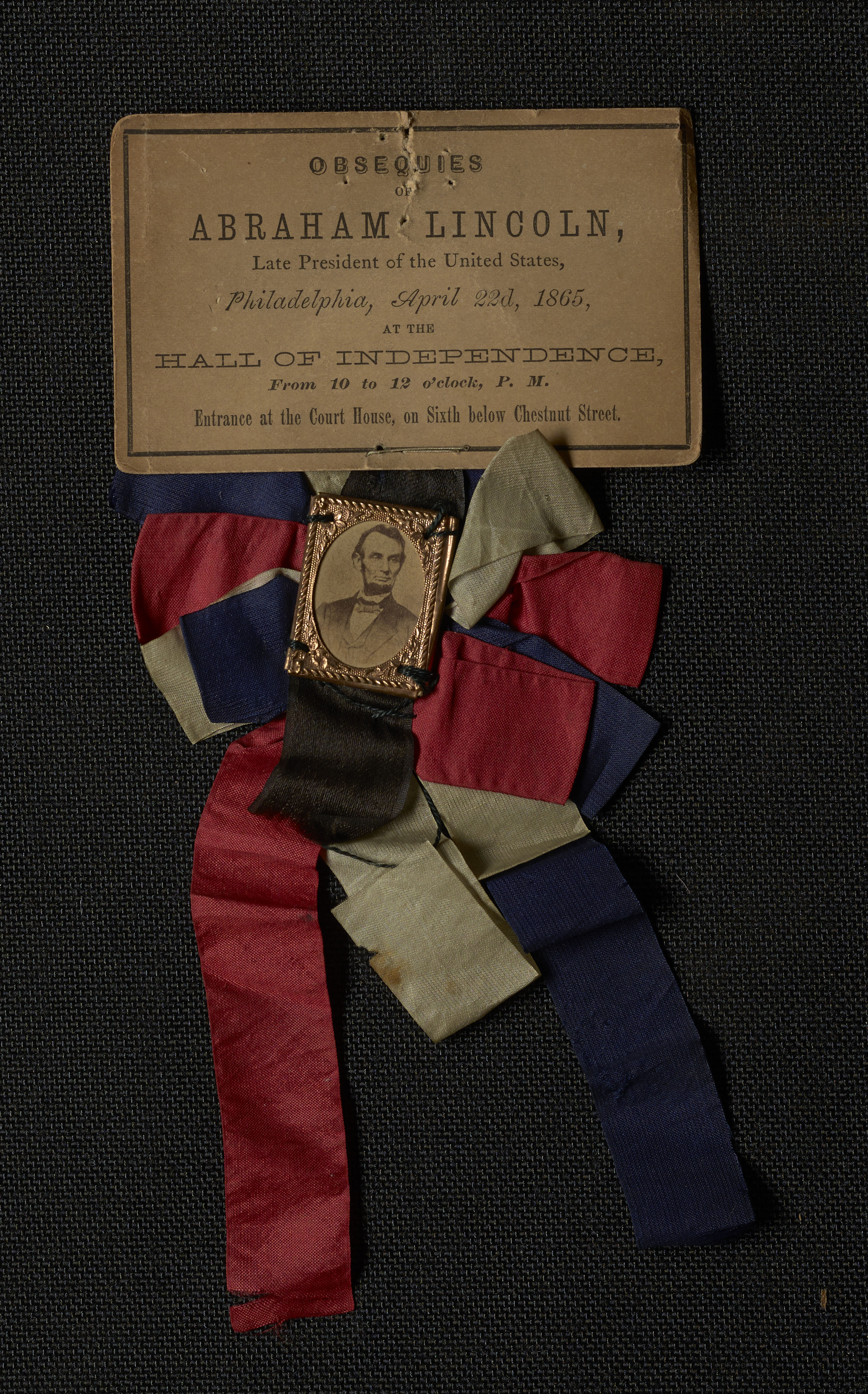
Mourning Ribbon, Philadelphia Services
-
Full Title
Mourning ribbon for services in honor of Lincoln in Philadelphia.
-
Description
Red, blue, white, and black cloth ribbon with framed photographic portrait of Lincoln at center and cared attached above reading: "Obsequies of Abraham Lincoln, Late President of the United States, Philadelphia, April 22nd 1865, at the Hall of Independence from 10 to 12 o'clock P.M. Entrance at the Court House, on Sixth below Chestnut Street.
-
Source
-
Rights
This item is in the Public Domain.
-
Tags
-
Cite this Item
Unknown. "Mourning ribbon for services in honor of Lincoln in Philadelphia. ". Remembering Lincoln. Web. Accessed December 14, 2025. https://rememberinglincoln.fords.org/node/688
-
Creator
Unknown
-
Date
April 22, 1865
from Apr. 22, 1865
Mourning ribbon for services in honor of Lincoln in Philadelphia.
-
Description
Red, blue, white, and black cloth ribbon with framed photographic portrait of Lincoln at center and cared attached above reading: "Obsequies of Abraham Lincoln, Late President of the United States, Philadelphia, April 22nd 1865, at the Hall of Independence from 10 to 12 o'clock P.M. Entrance at the Court House, on Sixth below Chestnut Street.
-
Source
-
Rights
This item is in the Public Domain.
-
Creator
Unknown
-
Date
April 22, 1865
from Apr. 17, 1865
W.A. Nichols to M.B. Field, April 17, 1865
-
Full Title
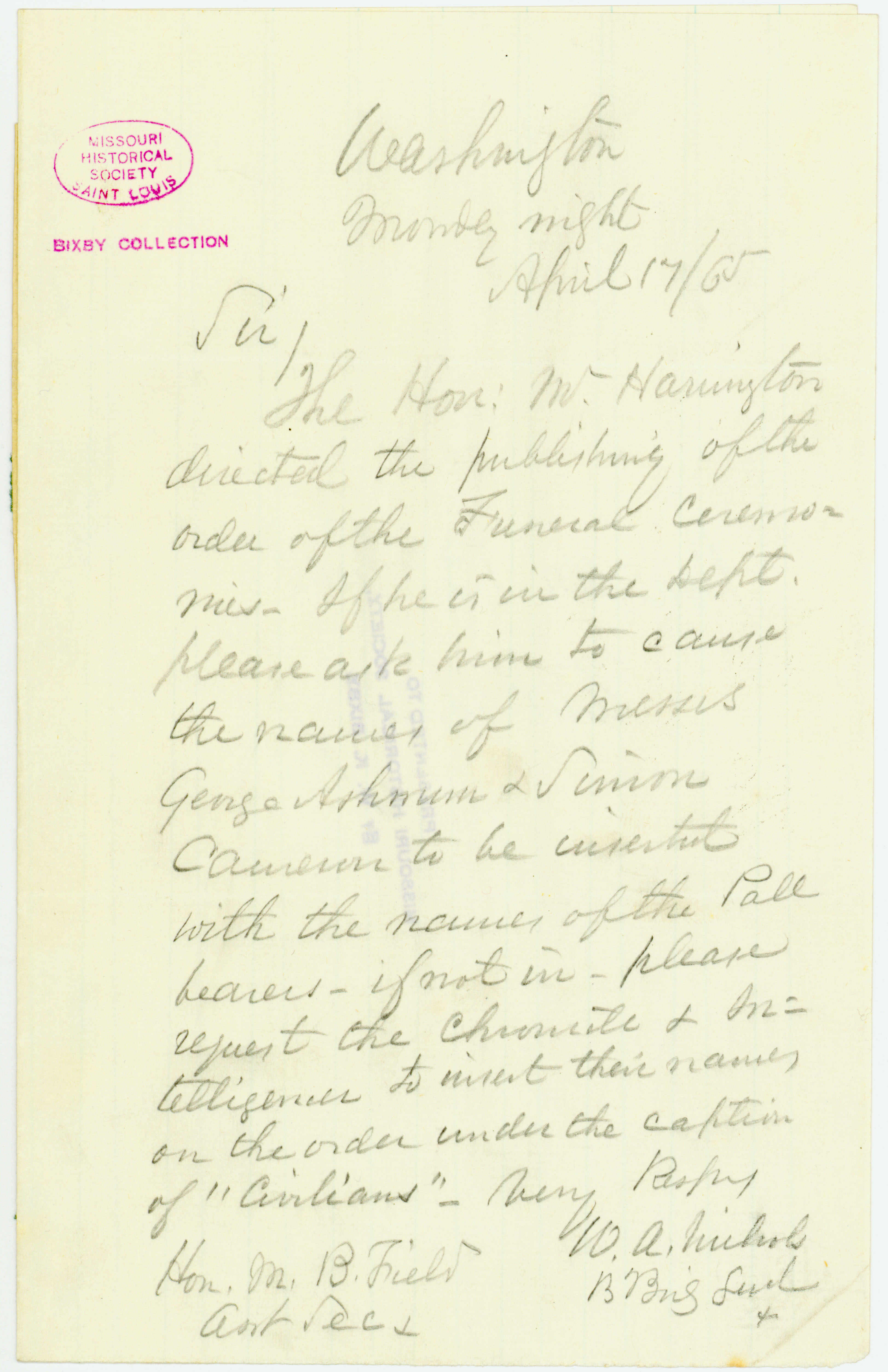
Letter signed W.A. Nichols, Washington, to Hon. M.B. Field, Asst. Sec., April 17, 1865
-
Description
States, "The Hon. Mr. Harrington [George Harrington] directed the publishing of the order of the Funeral Ceremonies. If he is in the Dept. please ask him to cause the names of Messrs. George Ashman & Simon Cameron to be inserted with the names of the Pall bearers. . . ." Regarding plans for Abraham Lincoln's funeral.
-
Transcription
Washington
Monday night
April 17/65
Sir,
The Hon. Mr Harrington directed the publishing of the order of the Funeral Ceremonies. If he is in the Dept. please ask him to cause the names of Messrs. George Ashman and Simon Cameron to be inserted with the names of the Pall bearers. If not in, please request the Chronicle and Intelligence to insert their names on the order under the caption of “Civilians.” -Very Respectfully
Hon. M. B. Field W. A. Nichols
Asst Sec.
[Transcription by: Evan Laugen, Chandra Manning's class, Georgetown University]. -
Source
-
Rights
This item is in the public domain.
-
Tags
-
Cite this Item
Nichols, W. A.. "Letter signed W.A. Nichols, Washington, to Hon. M.B. Field, Asst. Sec., April 17, 1865". Remembering Lincoln. Web. Accessed December 14, 2025. https://rememberinglincoln.fords.org/node/679
-
Creator
Nichols, W. A.
-
Date
April 17, 1865
from Apr. 17, 1865
Letter signed W.A. Nichols, Washington, to Hon. M.B. Field, Asst. Sec., April 17, 1865
-
Description
States, "The Hon. Mr. Harrington [George Harrington] directed the publishing of the order of the Funeral Ceremonies. If he is in the Dept. please ask him to cause the names of Messrs. George Ashman & Simon Cameron to be inserted with the names of the Pall bearers. . . ." Regarding plans for Abraham Lincoln's funeral.
-
Source
-
Rights
This item is in the public domain.
-
Creator
Nichols, W. A.
-
Date
April 17, 1865
from Apr. 1, 1865
Printed Order of Funeral Procession
-
Full Title
Printed order of the procession of the funeral of Abraham Lincoln, [April 1865]
-
Description
A printed order of the Abraham Lincoln's funeral procession
-
Source
A0653_7
-
Rights
This item is in the public domain.
-
Tags
-
Cite this Item
anonymous. "Printed order of the procession of the funeral of Abraham Lincoln, [April 1865]". George R. Harrington Papers. Remembering Lincoln. Web. Accessed December 14, 2025. https://rememberinglincoln.fords.org/node/676
-
Creator
anonymous
-
Publisher
George R. Harrington Papers
-
Date
1865
from Apr. 1, 1865
Printed order of the procession of the funeral of Abraham Lincoln, [April 1865]
![Printed order of the procession of the funeral of Abraham Lincoln, [April 1865]](https://rememberinglincoln.fords.org/sites/default/files/226-Printed%20Order%20of%20Funeral%20Procession%2C%20page%201.jpg)
-
Description
A printed order of the Abraham Lincoln's funeral procession
-
Source
A0653_7
-
Rights
This item is in the public domain.
-
Creator
anonymous
-
Publisher
George R. Harrington Papers
-
Date
April 1, 1865
from Apr. 17, 1865
Telegram of J.M. Berrien, April 17, 1865
-
Full Title
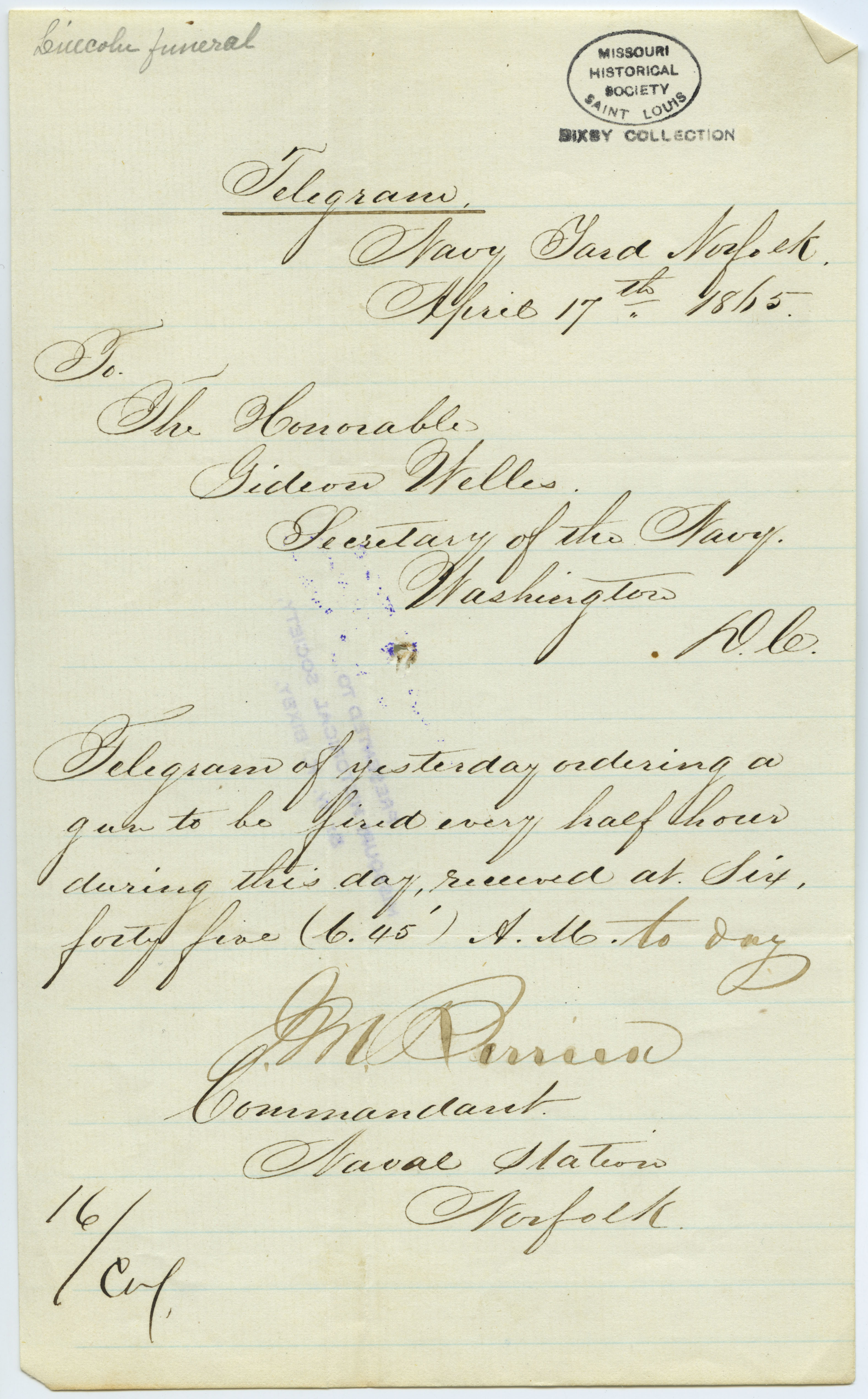
Contemporary copy of telegram of J.M. Berrien, Commandant Naval Station, Norfolk, to The Honorable Gideon Welles, Secretary of the Navy, Washington, D.C., April 17, 1865
-
Description
States, "Telegram of yesterday ordering a gun to be fired every half hour during this day, received at Six, forty five (6.45') A.M. to day. . . ." Refers to orders for the day of Abraham Lincoln's funeral.
-
Rights
This item is in the public domain.
-
Tags
-
Cite this Item
Berrien, J. M.. "Contemporary copy of telegram of J.M. Berrien, Commandant Naval Station, Norfolk, to The Honorable Gideon Welles, Secretary of the Navy, Washington, D.C., April 17, 1865". . Remembering Lincoln. Web. Accessed December 14, 2025. https://rememberinglincoln.fords.org/node/641
-
Creator
Berrien, J. M.
-
Publisher
-
Date
April 17, 1865
-
Material
from Apr. 17, 1865
Contemporary copy of telegram of J.M. Berrien, Commandant Naval Station, Norfolk, to The Honorable Gideon Welles, Secretary of the Navy, Washington, D.C., April 17, 1865
-
Description
States, "Telegram of yesterday ordering a gun to be fired every half hour during this day, received at Six, forty five (6.45') A.M. to day. . . ." Refers to orders for the day of Abraham Lincoln's funeral.
-
Rights
This item is in the public domain.
-
Creator
Berrien, J. M.
-
Publisher
-
Date
April 17, 1865
-
Material
from Apr. 17, 1865
Telegram of F.A. Parker, April 17, 1865
-
Full Title
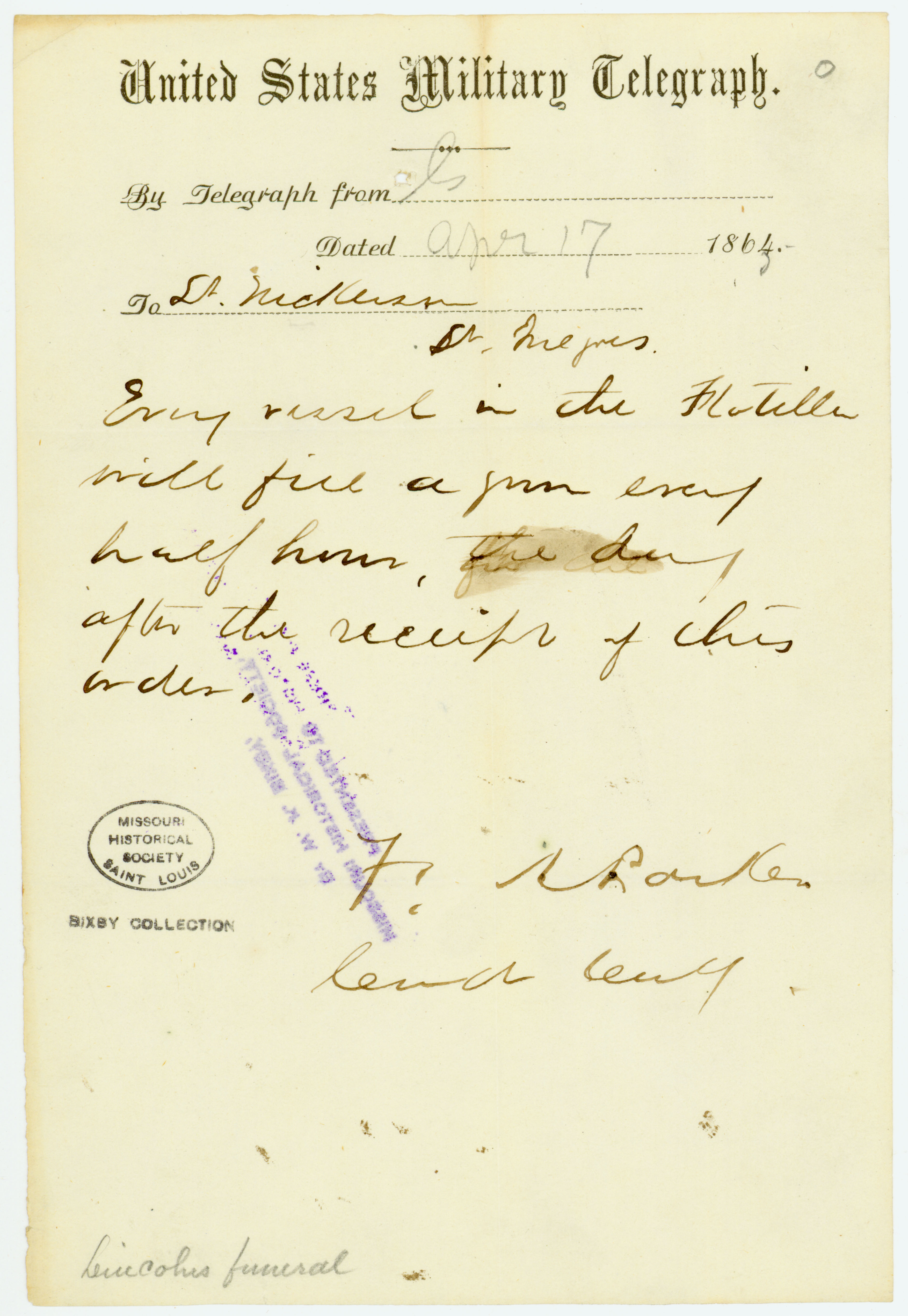
Telegram of F. A. Parker to Lt. Nickerson, April 17, 1865
-
Description
States, "Every vessel in the Flotilla will fire a gun every half hour the day after the receipt of this order. . . ." Relates to observance of the funeral of President Abraham Lincoln.
-
Rights
This item is in the public domain.
-
Tags
-
Cite this Item
Parker, F. A.. "Telegram of F. A. Parker to Lt. Nickerson, April 17, 1865". . Remembering Lincoln. Web. Accessed December 14, 2025. https://rememberinglincoln.fords.org/node/634
-
Creator
Parker, F. A.
-
Publisher
-
Date
April 17, 1865
-
Material
from Apr. 17, 1865
Telegram of F. A. Parker to Lt. Nickerson, April 17, 1865
-
Description
States, "Every vessel in the Flotilla will fire a gun every half hour the day after the receipt of this order. . . ." Relates to observance of the funeral of President Abraham Lincoln.
-
Rights
This item is in the public domain.
-
Creator
Parker, F. A.
-
Publisher
-
Date
April 17, 1865
-
Material
from Apr. 15, 1865
Mary Henry Diary
-
Full Title
Mary Henry Diary
-
Description
Mary Henry, the daughter of the Secretary of the Smithsonian, recorded her thoughts about the death of Lincoln and provided an extensive discussion of the funeral in Washington.
-
Transcription
[April] 15th. We were awakened this morning by an announcement which almost made our hearts stand still with consternation. The President was shot last night in the Theater. When the morning paper was issued he was still alive although little or no hopes were entertained of his recovery but now the tolling bells tell us he has ceased to breathe. He is dead. Mr. De Bust has just told Hannah he died at ½ 7 o'clock. Deeply must the country mourn this death for although uncouth & ungainly he was true hearted, magnanimous and kind and in the present crisis ready to follow the such a course with the defeated belligerants as would win them back to their allegiance to the Government and subdue the rebellion in their hearts as well as subjugate their aims. The South has lost in him a good & judicious friend. His successor Johnson heartily desires the death of the leaders of the rebellion & is in every way ultra in his views. I have not given the particulars of the disaster. It was announced in the yesterday's papers that the President with Gen Grant would be at Ford's Theater in the evening and a large crowd collected there in consequence. Gen Grant however left the city before night for N.Y. Mrs. Lincoln had not been well & the President went to the place of amusement with reluctance, not wishing to disappoint the audience. He was received with more than usual applause. About 9½ o'clock a shot was heard which was at first supposed to be from the stage and a man leaped from the President's box upon the stage crying, "Sic semper Tyrannis" "I have done it." and making his way to the door mounted a horse & rode off. The shrieks of Madame Lincoln first announced to the petrified audience the catastrophe which had taken place. The President was found to be in a state of insensibility, shot twice through the head. He was immediately conveyed to a house opposite the theatre followed by Mrs. L. escorted by her friends in an almost frantic condition.
At the same time of the accident an attempt was also made upon the life of Sec. Seward. The assasin entered the house upon the plea that he had brought a prescription of Dr. Verde the physician of the Sec. He pushed passed the servant into the room of the sick man & after disabling the attendants inflicted several sabre wounds in his neck & then made his escape. Sec. Stanton it is said was warned of the danger and guarded himself against it. The rain is falling heavily and the bells still toll their melancholy tale.
7 P.M. The sad day of excitement is over. The President's body has been embalmed and lies in state at the White House while the frantic grief of Mrs. Lincoln has settled into an apathetic dejection from which it is impossible to arouse her. The President remained unconcious to the last. The members of the Cabinet, Mrs. & Miss Kinney and Miss Harris surrounded his bed. Dr. Gurley was present & afterwards escorted the bereaved widow to her home. At the request of Mrs. Lincoln, he communicated the mournful intelligence to poor little Tad who was wandering from group to group of the sorrowing attendants endeavoring vainly to find out what was the matter. His cries when he heard that he was Fatherless were exceedingly touching. He has been the most constant companion of the President. Johnson has received the oath of office and seems impressed with the dignity and responsibility of his new office. The assasins have not yet been arrested but the evidence if conclusive that Booth a miserable actor and worthless vagrant, a Son of the great tragedian, committed the deed. That is the murder of the President--the stabbing of Mr. Seward was probably done by an accomplice. Mr. Seward is in a critical position and has not been informed of the death of the President or of the danger of his son, who was so much injured by the assasin that very little hope is entertained of his life. The feeling of resentment at the South as instigating in all probability the murder is deep and I fear will entirely replace the feeling of kindness before entertained for the insurgents. The Southerners if they have countenanced the dreadful deed have fatally mistaken the interest of their cause.
[April] 17th. The sorrow for the President's death is deep and universal as we went to church yesterday we found all the houses draped in black. In front of the studio of Mr. Baumgrass, a large portrait of Mr. Lincoln was suspended surrounded with the marks of mourning. The church was so thronged with stranger we with difficulty made our way into the building and after standing for some time were provided with seats in the isle. The pulpit and gallery was dressed in black and the Presidents pew was closed and clothed with the same emblem. The Dr. in a short introductory address alluded to the terrible calamity which had befallen the Nation and spoke in terms of true affection of the personal qualities of our beloved chief Magistrate. The Assasins have not yet been found. The feeling against the South is exceedingly bitter. Mr. Seward's wounds are not as serious as was at first supposed and he will probably recover. He was informed last night of the death of the President and of the critical condition of his son still remains in a state of insensibility. The funeral ceremonies are expected to take place on Wednesday.
[April] 18th. Have just returned from the Kennedys where I passed the night. I went to see Dr. & Mrs. Gurley yesterday afternoon. The Dr. said he had been called to go to the President about 4 o'clock in the morning. He found him in the house opposite the theatre lying insensible upon a bed with the life blood dripping from the wound in his head upon the clothes on the floor beneath. The several members of the Cabinet & other persons were standing around the deepest sorrow depicted upon their countenances. The Dr. went to the bed side but for a while was too much overcome with his feelings to perform the religious services required of him. He went to Mrs. Lincoln and found her in an almost frantic condition. The President died about 7½ o'clock. Dr. Gurley returned to his bed side a few moments before his decease. He made his way through the sorrowing & silent spectators & found him slowly drawing his breath at long intervals lying as before perfectly motionless. A faint hardly perceptable motion in his throat and all was over. So still was the room that the ticking of the President's watch was distinctly heard. After a solemn & impressive prayer, Dr. Gurley went to break the sad intelligence to Mrs. Lincoln who was in the parlor below. She cried out "Oh why did you not tell me he was dying?" Robert Lincoln showed great self possession & calmness and did all in his power to comfort his sorrow stricken Mother. Dr. Gurley went with her to the White House. Some of her expressions are exceedingly painful. To day remains of the good kind man are deposited in the East Room and from an early hour the streets have been thronged with people going to take their last view of him. Sally & Annie Kennedy asked me to go with them but I thought I would rather remember him as I saw him last at the Capitol at the inaugeration. Carry and I are going out again soon, we feel too restless to remain at home. Father writes that the feeling of resentment against the Southerners in New York is bitter in the extreme. One man for an expression indicating want of sympathy in the general sorrow was thrown over the railing of a ferry boat & instantly crushed by the wheels. We expect Father to night. He heard the news shortly after his arrival in New York on Friday night. Capt. Alexander was here this morning. He says he has no doubt that Boothe is concealed in Baltimore. It will be very difficult to catch him being an actor he is accustomed to assume all disguises. The Capt. is firmly convinced that the assassination and attempted murder of Mr. Seward was a plot to destroy the amicable relations springing up between the North and the South through the humane policy of Mr. Lincoln and by substituting a sterner administration and harsher measures against the rebels with increased bitter feeling to unite the South for further resistance. Seward was Mr. Lincoln's chief supporter in his lenient measures.
The city is in such a state of excitement that the slightest unusual circumstance attracts a crowd immediately. Yesterday afternoon while I was making a call a number of carriages passed the window where I was seated some empty, some filled driving furiously and the street was soon filled with people running eagerly towards N.Y. Ave. not a one of them knowing what was the matter. In a few moments a crowd extending over several squares had collected. After some time it was discovered that two negro women fighting has caused the disturbance. Traces of the assassin have been found and several supposed accomplices in the plot arrested but great fears are entertained that the murderers will escape. A sense of insecurity pervades the community and guards have been placed around the houses of the most prominent citizens.
[April] 19th Wed[nesday]. To day was the funeral of our good kind President. The ceremonies of the White House were conducted by Dr. Gurley, Dr. Hall, Bishop Simpson and one other clergyman whose name I have forgotten, in the East Room. The catafalco was erected in the centre of the appartment graduated semi circular platforms were arranged around this for the accommodation of the invited attendants. The various delegations had each their place assigned. Father was invited to take part with the officers of the Smith. Inst. and I went with him to the Treasury building were he obtained for me a position upon one of the porticos to witness the procession. Only four or five ladies were admitted into the East Room. It was a beautiful day and as the people collected at the corners of the streets, at the windows & upon the roof of the houses, it was difficult to realize we were not preparing for some gala festival instead of the last sad honours to the well beloved dead. The procession left the White House about 2 P.M. We were notified that it had started by the distant booming of guns & the tolling of bells. The sad sweet strains of the funeral march heralded its approach and soon the military escort appeared marching slowly with bent heads & guns reversed. The sad pagent was two hours in passing. The funeral car was heavily draped with black plainly showing the coffin which was adorned with beautiful flowers. The remains were placed in the Capitol & will be open to the view of the public until Friday morning. They are to be conveyed to Springfield.
[April] 26th. The remains of President Lincoln left the city yeste Friday morning. Dr. Gurley has joined the company who escort them. The papers this morning contain a description of the manner in which the cortege has been received. Mrs. Lincoln is quite ill and poor little Tad quite inconsolable. Mercy tempered with a great deal [of] severity is approbated to be the policy of the new President in dealing with the rebels.
-
Source
Smithsonian Institution Archives
-
Rights
This item is in the public domain.
-
Tags
-
Cite this Item
Mary Henry. "Mary Henry Diary". Remembering Lincoln. Web. Accessed December 14, 2025. https://rememberinglincoln.fords.org/node/551
-
Creator
Mary Henry
-
Date
April 15, 1865
from Apr. 15, 1865
Mary Henry Diary
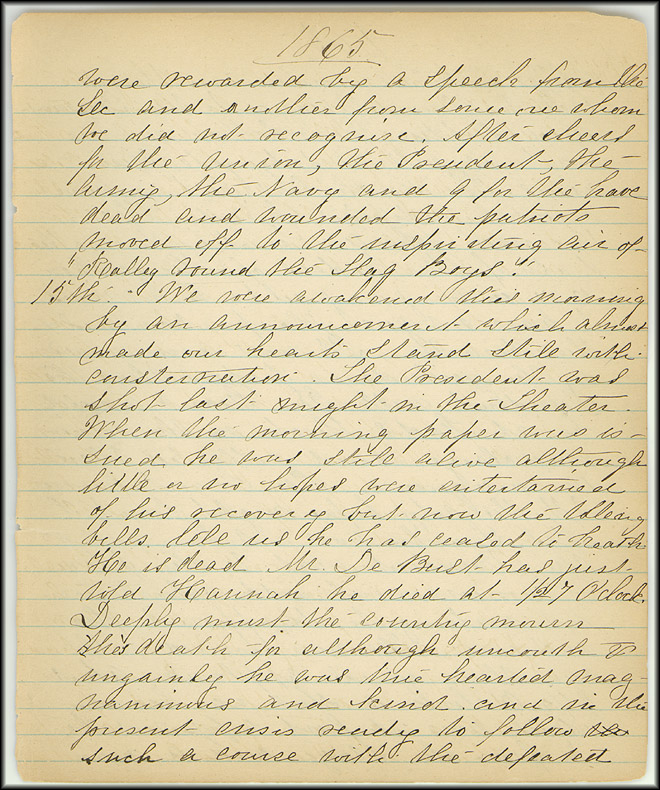
-
Description
Mary Henry, the daughter of the Secretary of the Smithsonian, recorded her thoughts about the death of Lincoln and provided an extensive discussion of the funeral in Washington.
-
Source
Smithsonian Institution Archives
-
Rights
This item is in the public domain.
-
Creator
Mary Henry
-
Date
April 15, 1865