from May. 4, 1865
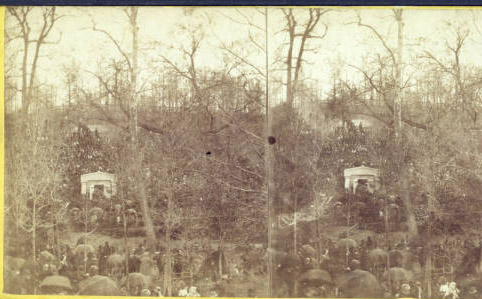
Funeral of Abraham Lincoln at the Vault
-
Full Title
Funeral of Abraham Lincoln at the Vault
-
Description
This black and white photograph shows the end journey of Lincoln's funeral procession at Oak Ridge Cemetery. There is a large crowd gather directly in front and on top of the tomb.
-
Source
-
Rights
Use of this item for research, teaching and private study is permitted with proper citation and attribution. Reproduction of this item for publication, broadcast or commercial use requires written permission. For permission, please contact Huntington Digital Library, San Marino, Ca.
-
Tags
-
Cite this Item
Ridgway Glover. "Funeral of Abraham Lincoln at the Vault". Remembering Lincoln. Web. Accessed June 22, 2026. https://rememberinglincoln.fords.org/node/832
-
Creator
Ridgway Glover
-
Date
1865-05-04
-
Dimensions
8.3 x 17 cm (3 1/4 x 6 3/4 in.)
from May. 4, 1865
Funeral of Abraham Lincoln at the Vault
-
Description
This black and white photograph shows the end journey of Lincoln's funeral procession at Oak Ridge Cemetery. There is a large crowd gather directly in front and on top of the tomb.
-
Source
-
Rights
Use of this item for research, teaching and private study is permitted with proper citation and attribution. Reproduction of this item for publication, broadcast or commercial use requires written permission. For permission, please contact Huntington Digital Library, San Marino, Ca.
-
Creator
Ridgway Glover
-
Date
May 4, 1865
-
Dimensions
8.3 x 17 cm (3 1/4 x 6 3/4 in.)
from Apr. 28, 1865
Booth Shot and Killed
-
Full Title
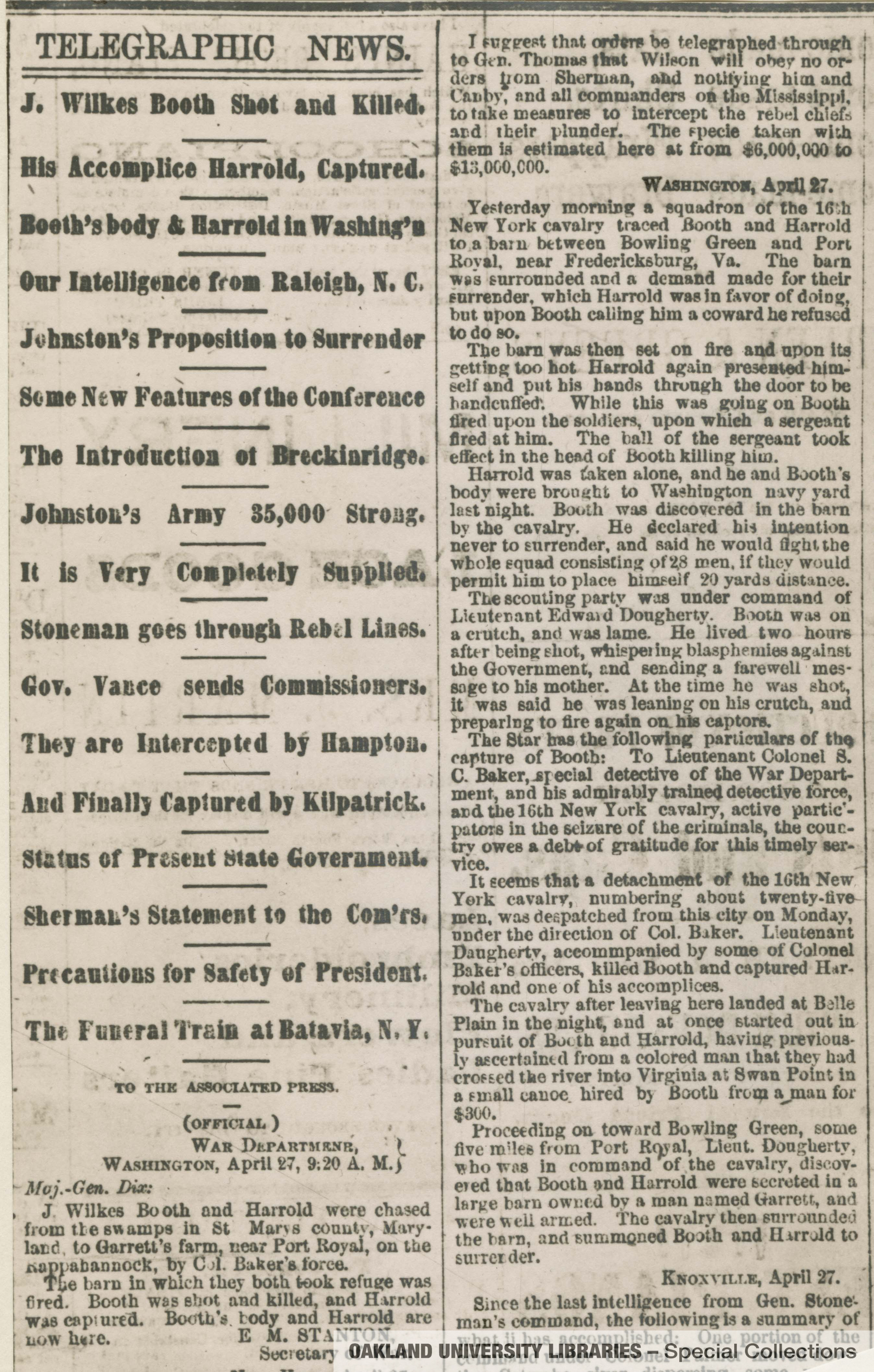
"John Wilkes Booth Shot and Killed"
-
Description
News article with bylines: J. Wilkes Booth shot and killed, His accomplice Harrold captured, Booth's body and Harrold's in Washington. The article gives details of the capture.
-
Source
Springer Collection, Oakland University Special Collections
-
Rights
This item may be reproduced and used for any purpose, including research, teaching, private study, publication, broadcast, or commercial use, with proper citation and attribution.
-
Tags
-
Cite this Item
Louisville Daily Journal. ""John Wilkes Booth Shot and Killed"". Louisville Daily Journal. Remembering Lincoln. Web. Accessed June 22, 2026. https://rememberinglincoln.fords.org/node/807

-
Creator
Louisville Daily Journal
-
Publisher
Louisville Daily Journal
-
Date
April 28, 1865
-
Material
newspaper
from Apr. 28, 1865
"John Wilkes Booth Shot and Killed"
-
Description
News article with bylines: J. Wilkes Booth shot and killed, His accomplice Harrold captured, Booth's body and Harrold's in Washington. The article gives details of the capture.
-
Source
Springer Collection, Oakland University Special Collections
-
Rights
This item may be reproduced and used for any purpose, including research, teaching, private study, publication, broadcast, or commercial use, with proper citation and attribution.
-
Creator
Louisville Daily Journal
-
Publisher
Louisville Daily Journal
-
Date
April 28, 1865
-
Material
newspaper
from Sep. 18, 1866
Wilkes Booth and his Dead Body
-
Full Title
Wilkes Booth and his Dead Body [From the Cincinnati Union of Sunday]
-
Description
News article with details of what happened to the body of John Wilkes Booth.
-
Transcription
Wilkes Booth and his Dead Body. -
[From the Cincinnati Union of Sunday}
The Louisville Courier has the following:
“Wilkes Booth, whose body Secretary Stanton took so much pains to dispose of, so that no man should ever know the spot where it was buried, is reported to be in Europe. The story is that the man who ‘Boston Corbett’ so heroically shot, and whose body Stanton refused to exhibit to any one that ever saw Booth, was a poor wretch hired by the assassins to personate Booth, in order to facilitate the escape of the latter. Whether there be or be not any truth in this story, it will never cease to be a suspicious circumstance connected with the fate of Wilkes Booth, that Stan-ton refused to deliver the body that was brought up from Virginia to his friends or even to let them look upon it.”
Dating a couple of months from the time that Booth, the assassin of President Lincoln, was shot and killed by Boston Corbett, in the attempt to capture him, sensation stories like the above have been of frequent occurrence. Of course there is not a shadow of truth in the tale of Booth being still alive. The body was fully recognized as being that of Booth, and although tales were told about it be-ing secretly taken out to sea and sunk, and others about it being buried at mid-night, in an obscure place, by two men employed by Government, and who were sworn to secrecy, yet facts, known to but few, and carefully kept from the newspa-per press, show that the body was given over to the relatives of Booth, and that it was buried in either New England or in Canada.
The facts, as we had them at the time on authority not to be doubted, are as follows:
A few days before the body of Booth so mysteriously disappeared, our informant, a resident of New York, and favorably known as a dramatic writer, was called upon after bank hours to cash the draft of an undertaker, a near neighbor, who stated that he had received an order from the Booth family, to repair to Washington with a coffin, and there to receive the body of John Wilkes Booth, which would be surrendered to him on their order, and to convey it North for burial. The under-taker said he would return, and pass through New York, en route with the body, on a Thursday evening, or on Friday morning of the same week.
The morning after the undertaker left Washington, the report came by telegraph that the body had mysteriously disappear-ed—that it had been secretly buried—one report said in an old field, another in the Penitentiary yard, and still another that it had been taken to sea and sunk.
The undertaker did not return to his family until some days had elapsed. He came from the North, but declined to give any information relative to the place where John Wilkes Booth, under another name, had been buried. Should it get out, he said, the grave would be violated and the body removed, and the family were naturally anxious that this should not be.
These facts coming to us from the source they did, are more than sufficient to convince us, not only of the death of John Wilkes Booth, but that his body, with a pledge of secrecy freely given and fully kept, was given over to his family for burial, and that, except the relatives of Booth and the undertaker, no living being knows where the last remains of John Wilkes Booth are interred. No slab marks the last resting place of the assas-sin. The man who dug the grave knew not for whom it was intended, and in the burial permit was inserted a false name. In his unknown grave the assassin will lie until the grave gives up its sheeted dead, and all are called to judgement.
[Transcription by Alicia B., Ford's Theatre Society.] -
Source
Springer Collection, Oakland University Special Collections
-
Rights
This item may be reproduced and used for any purpose, including research, teaching, private study, publication, broadcast, or commercial use, with proper citation and attribution.
-
Tags
-
Cite this Item
Louisville Courier. "Wilkes Booth and his Dead Body [From the Cincinnati Union of Sunday]". Louisville Courier. Remembering Lincoln. Web. Accessed June 22, 2026. https://rememberinglincoln.fords.org/node/806
-
Creator
Louisville Courier
-
Publisher
Louisville Courier
-
Date
September 18, 1866
-
Material
newspaper
from Sep. 18, 1866
Wilkes Booth and his Dead Body [From the Cincinnati Union of Sunday]
![Wilkes Booth and his Dead Body [From the Cincinnati Union of Sunday]](https://rememberinglincoln.fords.org/sites/default/files/Remembering%20Lincoln_021.jpg)
-
Description
News article with details of what happened to the body of John Wilkes Booth.
-
Source
Springer Collection, Oakland University Special Collections
-
Rights
This item may be reproduced and used for any purpose, including research, teaching, private study, publication, broadcast, or commercial use, with proper citation and attribution.
-
Creator
Louisville Courier
-
Publisher
Louisville Courier
-
Date
September 18, 1866
-
Material
newspaper
from Apr. 15, 1865
Removal of the President's Body
-
Full Title
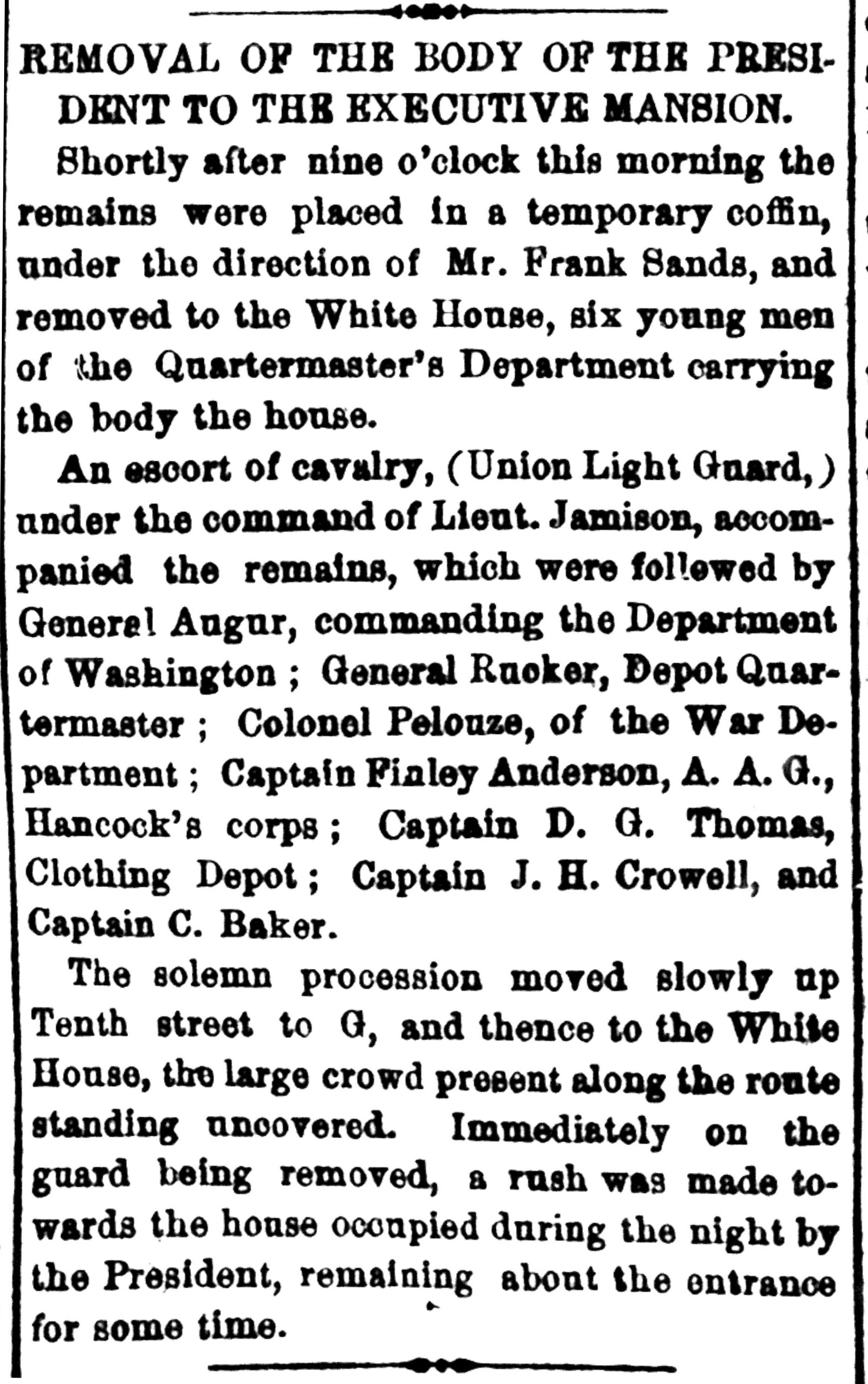
"Removal of the body of the President to the executive mansion"
-
Description
Article describing the procession accompanying President Abraham Lincoln's body from the Peterson house to the White House. The article describes the procession as escorted by Union Light Guard calvary and military officers, as well as a large crowd, which descended on the Peterson house once the President's body was removed.
-
Transcription
Removal of the body of the president to the executive mansion.
Shortly after nine o'clock this morning the remains were placed in a temporary coffin, under the direction of Mr. Frank Sands, and removed to the Whtie House, six young men of the Quartermaster's Department carrying the body the house.
An escort of cavalry, (Union Light Guard,) under the command of Lieut. Jamison, accompanied the remains, which were followed by General Augur, commanding the Department of Washington; General Rucker, Depot Quartermaster; Colonel Pelouze, of the War Department; Captain Finley Anderson, A. A. G.; Hancock's corps; Captain D. G. Thomas, Clothing Depot; Captain J. H. Crowell, and Captain C. Baker.
The solemn procession moved slowly up Tenth street to G, and thence to the White House, the large crowd present along the route standing uncovered. Immediately on the guard being removed, a rush was made towards the house occupied during the night by the President, remaining about the entrance for some time. -
Source
Washingtoniana Microfilm Collection
-
Rights
This item may be reproduced and used for any purpose, including research, teaching, private study, publication, broadcast or commercial use, with proper citation and attribution.
-
Tags
-
Cite this Item
Daily Constitutional Union. ""Removal of the body of the President to the executive mansion"". Remembering Lincoln. Web. Accessed June 22, 2026. https://rememberinglincoln.fords.org/node/498

-
Creator
Daily Constitutional Union
-
Date
April 15, 1865
-
Material
newspaper
from Apr. 15, 1865
"Removal of the body of the President to the executive mansion"
-
Description
Article describing the procession accompanying President Abraham Lincoln's body from the Peterson house to the White House. The article describes the procession as escorted by Union Light Guard calvary and military officers, as well as a large crowd, which descended on the Peterson house once the President's body was removed.
-
Source
Washingtoniana Microfilm Collection
-
Rights
This item may be reproduced and used for any purpose, including research, teaching, private study, publication, broadcast or commercial use, with proper citation and attribution.
-
Creator
Daily Constitutional Union
-
Date
April 15, 1865
-
Material
newspaper
from Apr. 28, 1865
"How the Late President Looks in His Coffin"
-
Full Title
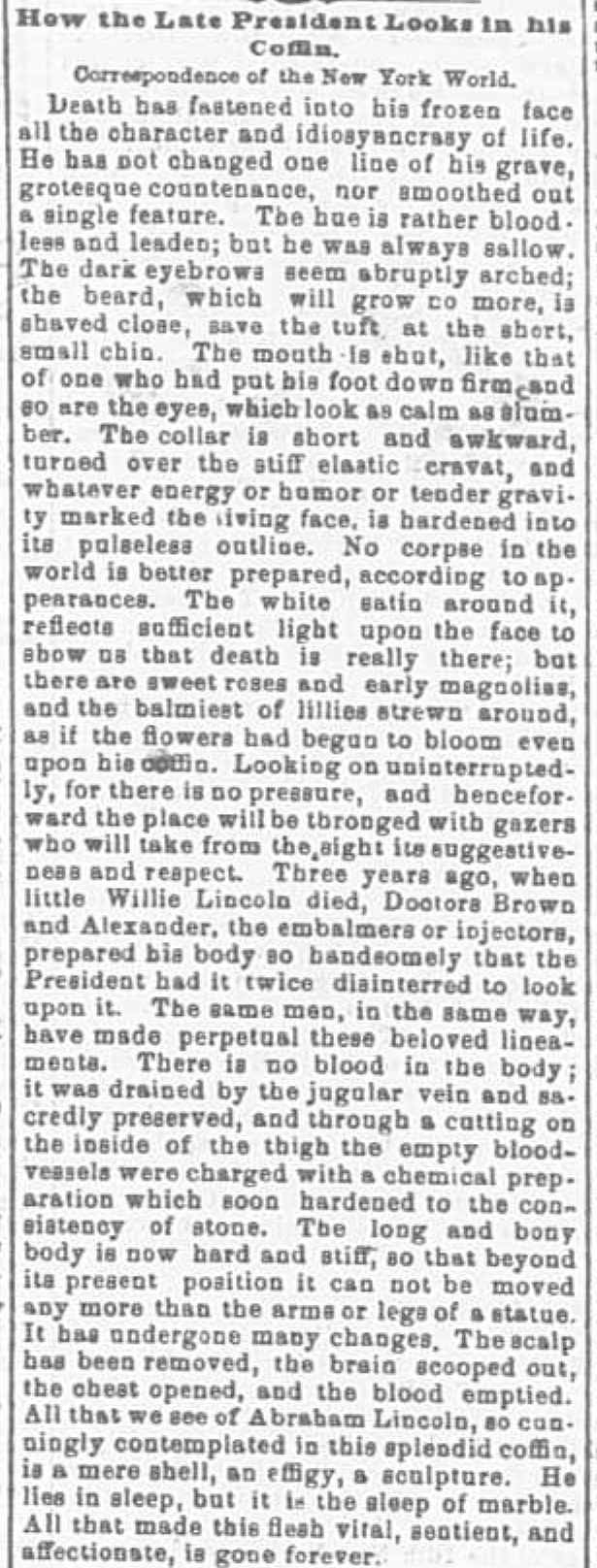
"How the Late President Looks in His Coffin"
-
Description
The Daily Intelligencer of Wheeling, VA (now WV) describes how President Lincoln's body was prepared for his burial.
-
Rights
This item is in the public domain and may be reproduced and used for any purpose, including research, teaching, private study, publication, broadcast or commercial use, with proper citation and attribution.
-
Tags
-
Cite this Item
Daily Intelligencer. ""How the Late President Looks in His Coffin"". Remembering Lincoln. Web. Accessed June 22, 2026. https://rememberinglincoln.fords.org/node/475
-
Creator
Daily Intelligencer
-
Date
April 28, 1865
from Apr. 28, 1865
"How the Late President Looks in His Coffin"
-
Description
The Daily Intelligencer of Wheeling, VA (now WV) describes how President Lincoln's body was prepared for his burial.
-
Rights
This item is in the public domain and may be reproduced and used for any purpose, including research, teaching, private study, publication, broadcast or commercial use, with proper citation and attribution.
-
Creator
Daily Intelligencer
-
Date
April 28, 1865
from Jan. 1, 1907
Alice Strickler Keyes diary entry
-
Full Title
Alice Strickler Keyes diary entry
-
Description
Alice Strickler Keyes eyewitness account of the day that Lincoln’s funeral train stopped in Columbus, Ohio, on its way to Springfield, Illinois, where the remains of the president and those of his son Willie would be buried. This account is an excerpt from the Alice Strickler Keyes diary passage in the Altrurian Club of Columbus, Ohio President's Book.
-
Transcription
[Page 1]
25
These grounds, at the head of State street, it was so far from the town and in such a swampy and unimproved district, that it too was dubbed “Swayne’s Folly.” Noah Swayne became most widely known as Justice of the Supreme Court of the United States.
His home at the head of State street was later occupied by J. Ewing Miller. Its site is now that of the Carnegie Library.
Before the “Insane Asylum” burned, the terminus of all our walks eastward, was the great flat boulder, that still lies on the sidewalk in the east Broad street, east of Jefferson Avenue.
A little farther east the Asylum Grounds ended, and not far beyond, lay “Riley’s Woods,” and the open country.
In April, 1865, Columbus with the rest of The Nation was celebrating the “Fall of Fort Sumpter,” the surrender of General Lee, and the End of the “Civil War.” There was great rejoicing.
April 14th was appointed by Governor Brough as a day of thanksgiving. On that day there were services in the churches in the morning;—in the afternoon
[Page 2]
26
and evening everything was done that is possible on such occasions to express the joy of the citizens. The town was lavishly decorated.
The next morning, April 15th all this joy was turned to sorrow when the news of President Lincoln’s assassination reached the city. The emblems of Victory gave place to those of mourning for the fallen Chief.
It was learned a few days later, that the funeral train on its way to Springfield, Illinois, would stop in Columbus, and that the body of the President would lie in state for one day, in the Rotunda of the Capitol.
At school we were told that the city Fire Department would be in the procession to meet the train at the station, and that a number of young girls, dressed in deep mourning were wanted—one to stand beside each driver on the fire engines, and many others to ride on the large “Hook and Ladder” wagon, reconstructed for the occasion.
[Page 3]
27
This plan was carried out. Forty-two school girls of varying ages, of whom I was one, rode on this car, massed around one of our teachers (Miss Sarah Smith) who was heavily draped in black and represented “Columbia.”
After the coffin of President Lincoln was placed on the splendid funeral car, the procession started back on its route through the streets of the city.
At intervals the black robed girls on the float, led by their teacher, sang verses from dirge-like hymns.
When the procession stopped at the gate of the Capitol, these girls left their float and were led into the building, and past the coffin of the President. It is said over fifty thousand people viewed “the remains” that day.
The catalogue used to carry the body of President Lincoln had a canopy shaped like a pagoda. It was large, covered with black cloth, festooned, and trimmed with silver fringe. It was drawn by six white horses with large black plumes on their heads. The horses had a covering of black cloth edged with silver fringe, and each horse was led by a groom dressed in black.
[Page 4]
28
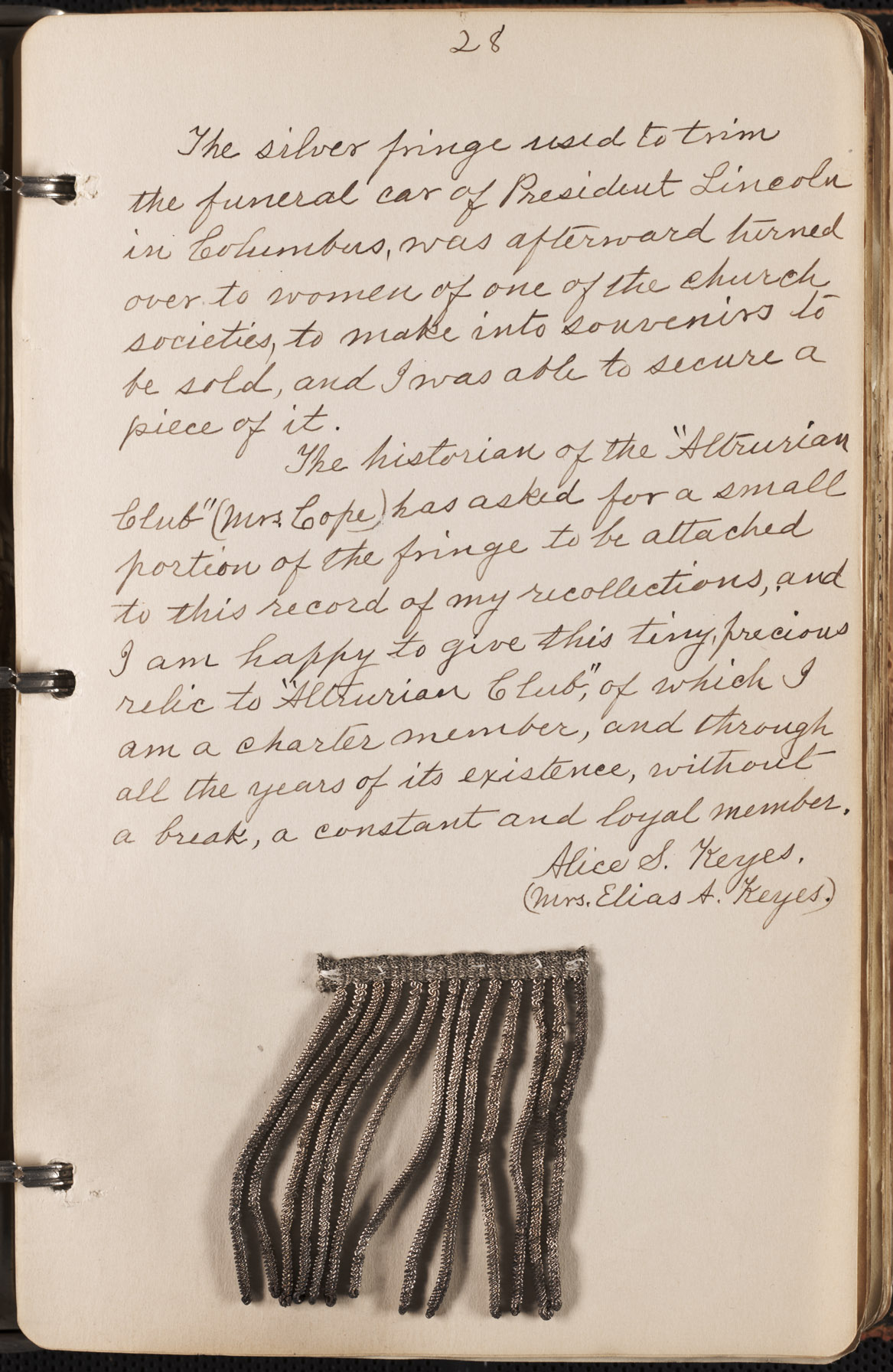
The silver fringe used to trim the funeral car of President Lincoln in Columbus, was afterward turned over to women of one of the church societies, to make into souvenirs to be sold, and I was able to secure a piece of it.
The historian of the “Altrurian Club” (Mrs. Cope) has asked for a small portion of the fringe to be attached to this record of my recollections, and I am happy to give this tiny, precious relic to “Altrurian Club,” of which I am a charter member, and through all the years of its existence, without a break, a constant and loyal member.
Alice S. Keyes
(Mrs. Elias A. Keyes.)
[piece of silver fringe attached]
[Transcription by McCaela Michas]
-
Source
-
Rights
Use of this item for research, teaching, and private study is permitted with proper citation and attribution, as Courtesy of the Ohio History Connection, Abraham Lincoln Presidential Collection . Reproduction of this item for publication, broadcast, or commercial use requires written permission. For permission, please see this web page.
-
Tags
-
Cite this Item
Keyes, Alice Strickler. "Alice Strickler Keyes diary entry". Remembering Lincoln. Web. Accessed June 22, 2026. https://rememberinglincoln.fords.org/node/282

-
Creator
Keyes, Alice Strickler
-
Date
1907
from Jan. 1, 1907
Alice Strickler Keyes diary entry
-
Description
Alice Strickler Keyes eyewitness account of the day that Lincoln’s funeral train stopped in Columbus, Ohio, on its way to Springfield, Illinois, where the remains of the president and those of his son Willie would be buried. This account is an excerpt from the Alice Strickler Keyes diary passage in the Altrurian Club of Columbus, Ohio President's Book.
-
Source
-
Rights
Use of this item for research, teaching, and private study is permitted with proper citation and attribution, as Courtesy of the Ohio History Connection, Abraham Lincoln Presidential Collection . Reproduction of this item for publication, broadcast, or commercial use requires written permission. For permission, please see this web page.
-
Creator
Keyes, Alice Strickler
-
Date
January 1, 1907
from May. 21, 1865
A.M. Black to Jane Black
-
Full Title
Letter of A. M. Black, Springfield, to Sister [Jane Black], May 21, 1865
-
Description
Describes a wreath he obtained from Abraham Lincoln's funeral for her. States, ". . . .I have got the Lincoln Wreath for you. Josephine got it from her mother Mrs. Edwards. It was made and placed on the Coffin in Chicago by Miss Arnold of that place she is a daughter of Congressman Arnold. . . .Strangers are making great efforts to get relics. . . .Josephine is to have enough of Mr. Lincoln's hair to fill a small locket. . . ."
-
Source
Missouri History Museum
-
Rights
This item is in the public domain.
-
Tags
-
Cite this Item
Black, Alexander M.. "Letter of A. M. Black, Springfield, to Sister [Jane Black], May 21, 1865". Remembering Lincoln. Web. Accessed June 22, 2026. https://rememberinglincoln.fords.org/node/312

-
Creator
Black, Alexander M.
-
Date
May 21, 1865
from May. 21, 1865
Letter of A. M. Black, Springfield, to Sister [Jane Black], May 21, 1865
![Letter of A. M. Black, Springfield, to Sister [Jane Black], May 21, 1865](https://rememberinglincoln.fords.org/sites/default/files/A.M.%20Black%20Letter%201.jpg)
-
Description
Describes a wreath he obtained from Abraham Lincoln's funeral for her. States, ". . . .I have got the Lincoln Wreath for you. Josephine got it from her mother Mrs. Edwards. It was made and placed on the Coffin in Chicago by Miss Arnold of that place she is a daughter of Congressman Arnold. . . .Strangers are making great efforts to get relics. . . .Josephine is to have enough of Mr. Lincoln's hair to fill a small locket. . . ."
-
Source
Missouri History Museum
-
Rights
This item is in the public domain.
-
Creator
Black, Alexander M.
-
Date
May 21, 1865
from May. 5, 1865
Towel fragment with Lincoln's blood
-
Full Title
Fragment of towel stained with blood of Abraham Lincoln
-
Description
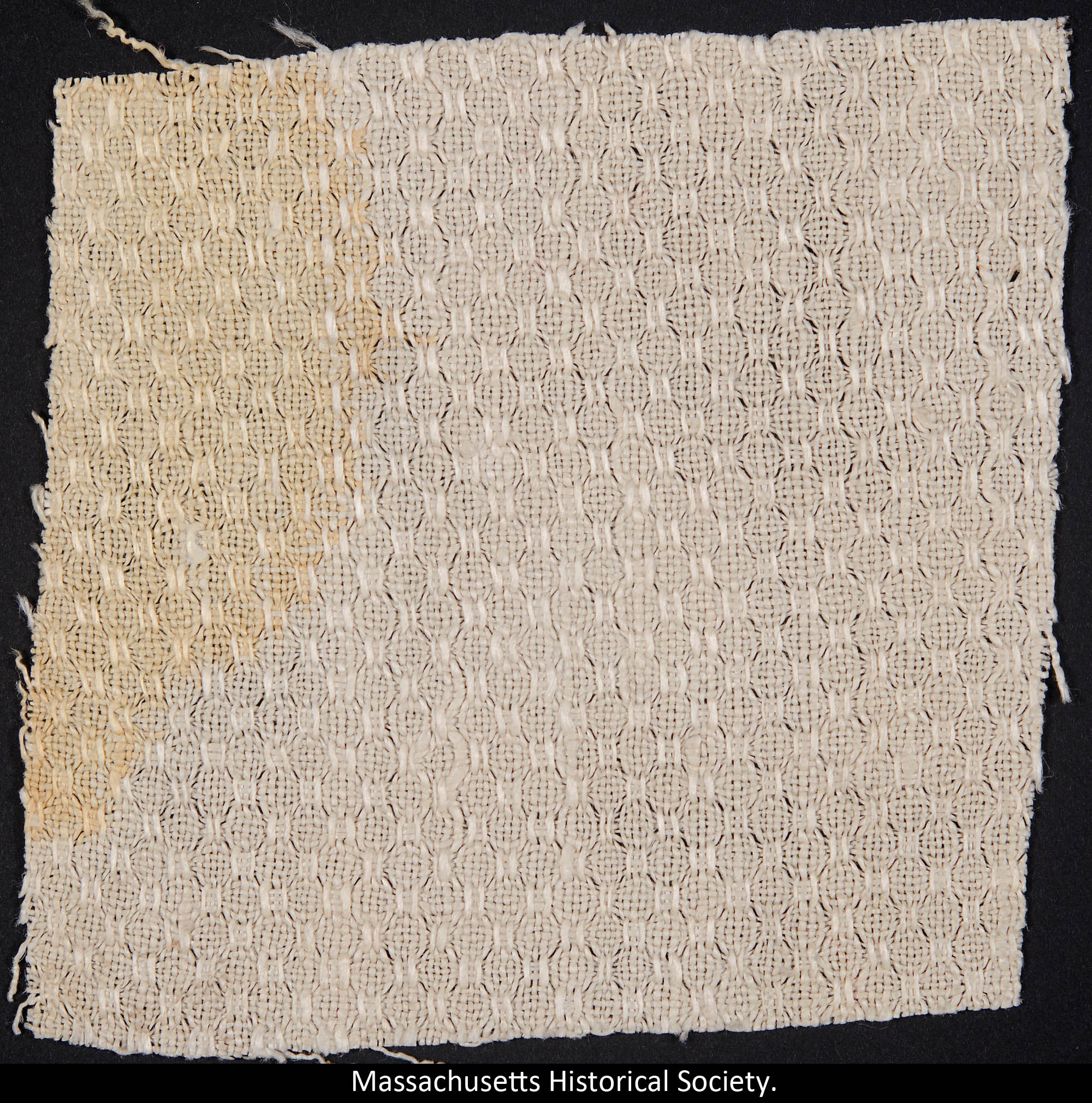
This piece of fabric is from a woven white linen towel and has a faded brown stain, the blood of Abraham Lincoln. This small artifact was sent as an enclosure in a letter dated 5 May 1865 from Augustus Clark, a War Department employee, to Massachusetts Governor John A. Andrew. Clark was one of the men who moved Lincoln, after he was shot, from Ford's Theatre to Petersen's boarding house.
-
Source
Massachusetts Historical Society, Artifact #475
-
Rights
Use of this item for research, teaching, and private study is permitted with proper citation and attribution, as: From the Collection of the Massachusetts Historical Society. Reproduction of this item for publication, broadcast, or commercial use requires written permission. For permission, please see this web page.
-
Tags
-
Cite this Item
Augustus Clark. "Fragment of towel stained with blood of Abraham Lincoln". Remembering Lincoln. Web. Accessed June 22, 2026. https://rememberinglincoln.fords.org/node/289

-
Creator
Augustus Clark
-
Date
1865
-
Dimensions
7.5 cm x 8 cm
from May. 5, 1865
Fragment of towel stained with blood of Abraham Lincoln
-
Description
This piece of fabric is from a woven white linen towel and has a faded brown stain, the blood of Abraham Lincoln. This small artifact was sent as an enclosure in a letter dated 5 May 1865 from Augustus Clark, a War Department employee, to Massachusetts Governor John A. Andrew. Clark was one of the men who moved Lincoln, after he was shot, from Ford's Theatre to Petersen's boarding house.
-
Source
Massachusetts Historical Society, Artifact #475
-
Rights
Use of this item for research, teaching, and private study is permitted with proper citation and attribution, as: From the Collection of the Massachusetts Historical Society. Reproduction of this item for publication, broadcast, or commercial use requires written permission. For permission, please see this web page.
-
Creator
Augustus Clark
-
Date
May 5, 1865
-
Dimensions
7.5 cm x 8 cm
from May. 5, 1865
Augustus Clark to John A. Andrew
-
Full Title
Letter from Augustus Clark to John A. Andrew, 5 May 1865
-
Description
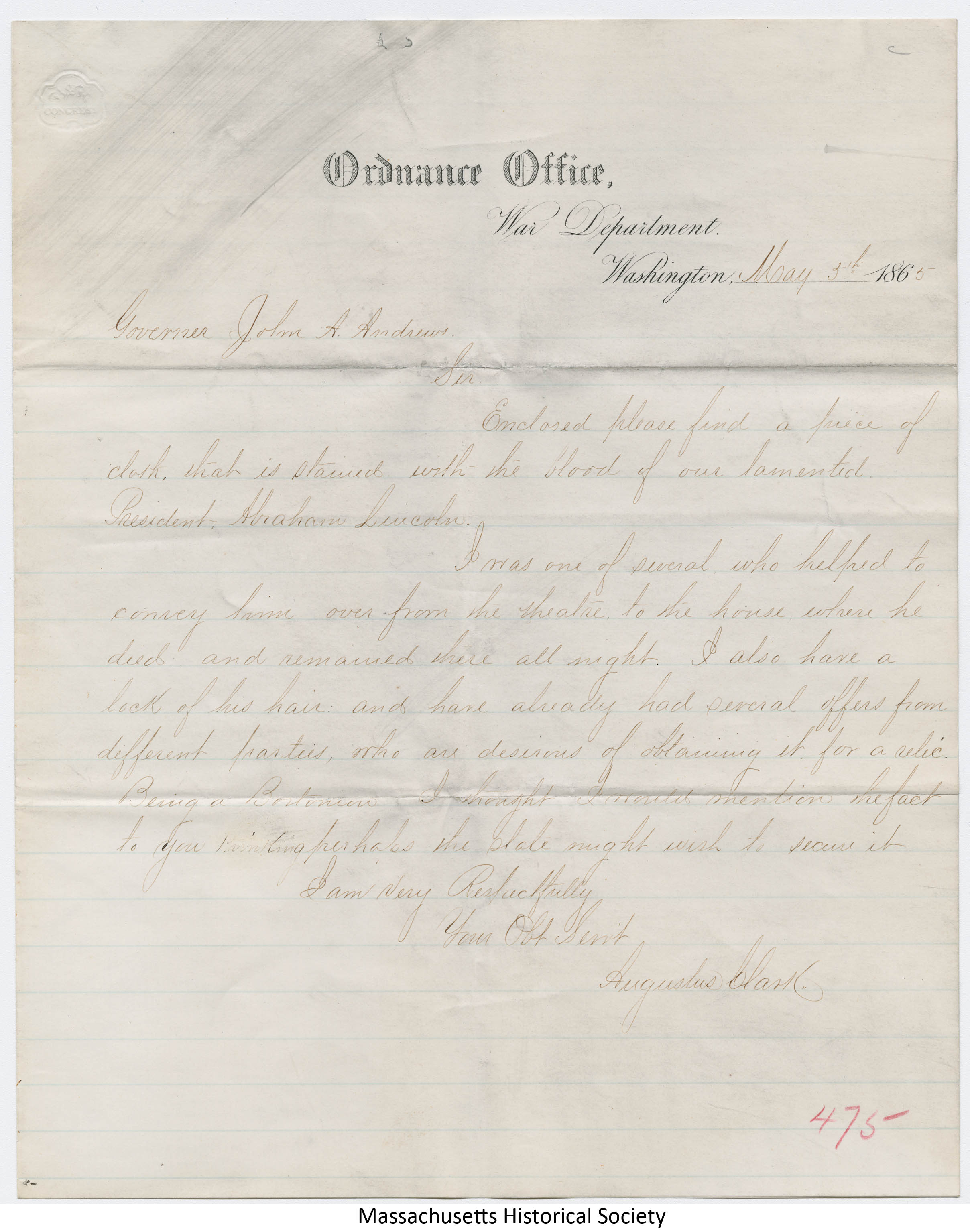
Augustus Clark, a War Department employee,sent this letter to the Governor of Massachusetts, John A. Andrew along with a small piece of cloth that was stained with the blood of Abraham Lincoln. Clark was one of the people who moved Lincoln from Ford's Theatre to Petersen's boardinghouse.
-
Transcription
Ordnance Office, War Department. Washington, May 5th 1865
Governor John A. Andrew
Sir
Enclosed please find a piece of
cloth that is stained with the blood of our lamented
President, Abraham Lincoln.
I was one of several who helped to
convey him over from the theatre to the house where he
died and remained there all night. I also have a
lock of his hair: and have already had several offers from
different parties, who are desirous of obtaining it for a relic.
Being a Bostonian I thought I would mention the fact
to you thinking perhaps the state might wish to secure it.
I am very Respectfully
Your Obt Servt,
Augustus Clark
-
Source
Massachusetts Historical Society, Special collections, manuscripts
-
Rights
Use of this item for research, teaching, and private study is permitted with proper citation and attribution, as: From the Collection of the Massachusetts Historical Society. Reproduction of this item for publication, broadcast, or commercial use requires written permission. For permission, please see this web page
-
Tags
-
Cite this Item
Clark, Augustus. "Letter from Augustus Clark to John A. Andrew, 5 May 1865". Remembering Lincoln. Web. Accessed June 22, 2026. https://rememberinglincoln.fords.org/node/288
-
Creator
Clark, Augustus
-
Date
May 5, 1865
-
Material
24.8 cm x 20 cm
from May. 5, 1865
Letter from Augustus Clark to John A. Andrew, 5 May 1865
-
Description
Augustus Clark, a War Department employee,sent this letter to the Governor of Massachusetts, John A. Andrew along with a small piece of cloth that was stained with the blood of Abraham Lincoln. Clark was one of the people who moved Lincoln from Ford's Theatre to Petersen's boardinghouse.
-
Source
Massachusetts Historical Society, Special collections, manuscripts
-
Rights
Use of this item for research, teaching, and private study is permitted with proper citation and attribution, as: From the Collection of the Massachusetts Historical Society. Reproduction of this item for publication, broadcast, or commercial use requires written permission. For permission, please see this web page
-
Creator
Clark, Augustus
-
Date
May 5, 1865
-
Material
24.8 cm x 20 cm
from Apr. 16, 1865
Augustus Clark to S. M. Allen
-
Full Title
Letter from Augustus Clark to S. M. Allen, 16 April 1865
-
Description
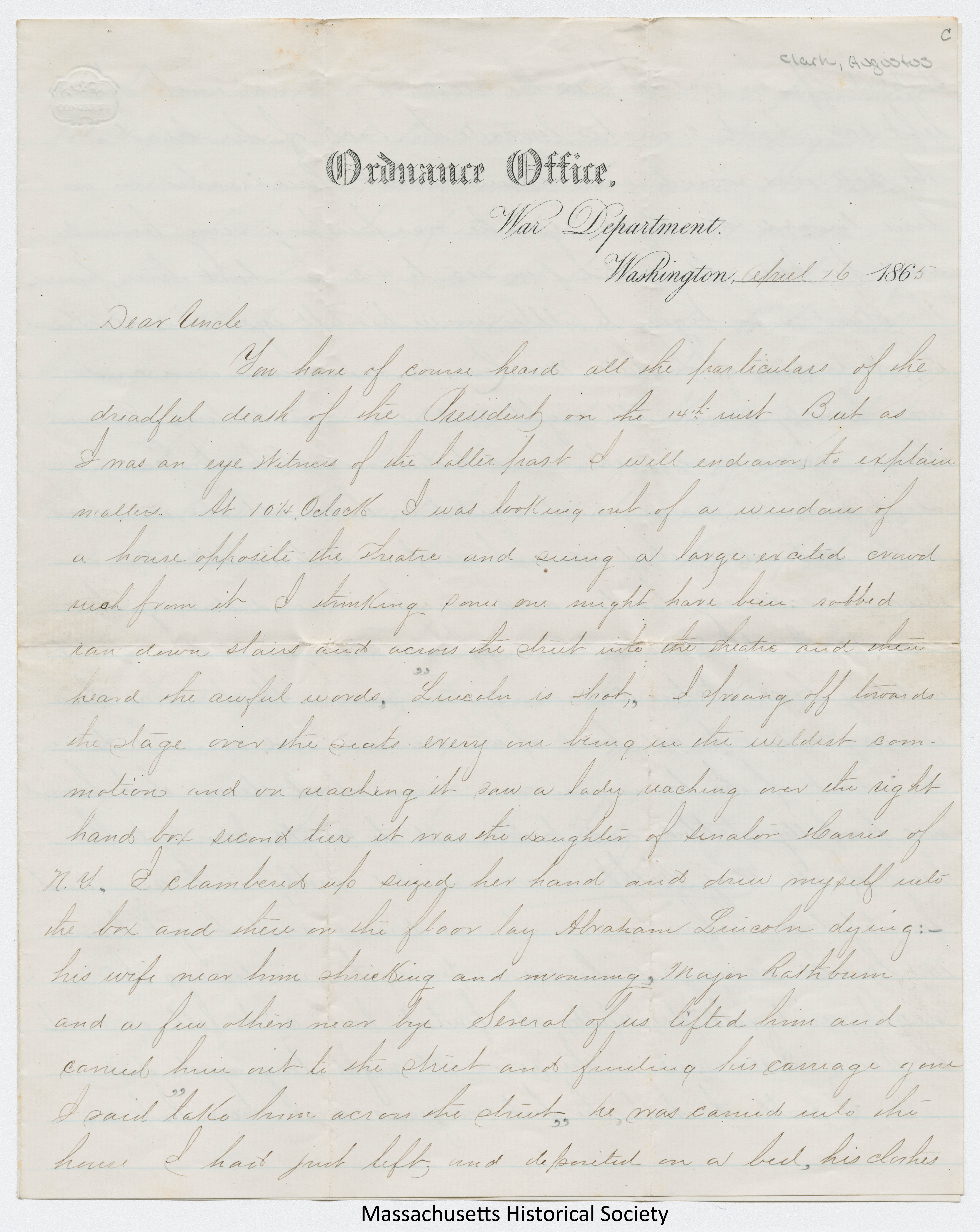
This letter, written by Augustus Clark, a War Department employee, to his uncle, Stephen M. Allen of Woburn, Massachusetts, includes a firsthand account of the awful scenes at Ford's Theatre in Washington, D.C. after John Wilkes Booth had shot Abraham Lincoln. Clark also describes what he witnessed at Petersen's boardinghouse across the street from the theatre, where Lincoln died.
-
Transcription
[Page 1]
Ordnance Office, War Department Washington, April 16 1865
Dear Uncle [S. M. Allen ]
You have of course heard all the particulars of the
dreadful death of the President on the 14th inst But as
I was an eye Witness of the latter part I will endeavor to explain
matters. At 10¼ Oclock I was looking out of a window of
a house opposite the theatre and seeing a large excited crowd
rush from it I thinking some one might have been robbed
ran down stairs and across the street into the theatre and then
heard the awful words, "Lincoln is shot"—I sprang off towards
the stage over the seats every one being in the wildest commotion
and on reaching it saw a lady reaching over the right
hand box second tier it was the daughter of Senator Harris of
N.Y. I clambered up seized her hand and drew myself into
the box and there on the floor lay Abraham Lincoln dying:—
his wife near him shrieking and moaning, Major Rathburn
and a few others near by. Several of us lifted him and
carried him out to the street and finding his carriage gone
I said "take him across the street" he was carried into the
house I had just left, and deposited on a bed, his clothes
[Page 2]
stripped off:— he was shot in the head on a line with the
left ear about 2 inches towards the back of the head,
the Ball was round and entered about three inches in a
line towards his right eye—he was breathing very heavily
and his pulse fluctuated from 105 to 42 in about three hours.
The blood soon begun to settle under his left eye and blackened
the whole side of his face. Mrs Lincoln soon came over and
was hardly sane all night and is now quite low, Laura
Keene came over with her but did not stop—his [son] came in
about Eleven and was much agitated. Soon all the members
of the Cabinet rushed in with grief and terror depicted on
their faces: many Senators and members arrived during the
night—the street was cleared of all strangers and a great
military force stationed around the square. Stanton was there
issuing orders to all parts of the union and seemed to
do most of the business. news came about eleven that Seward
was fearfully stabbed and it seemed to strike terror into the
hearts of all. Maj. Rathburn was wounded badly in the arm and
fainted twice before his wound was dressed and he got home.
Mrs Lincoln came into the room seven times during the
night and felt dreadfully she fainted twice and fell over onto
the floor. I remained in the room all night long and did
all I could to help. The best surgeons were there but no
[Page 3]
attempt was made to extricate the Ball as he was pronounced
fatally wounded at first examination he lingered
on 'till seven twenty "AM" when he breathed his last in
presence of the members of the Cabinet several senators
and others. Mrs Lincoln was not in the room at the time of
his death. The body at nine oclock was taken to the White
House and has been embalmed. I got a lock of his
hair and a towel saturated with the blood of the best
man that ever was President and a friend of the south.
They now have a President that will show them no mercy
and they deserve none. I will enclose a piece of the towel
for you as a relic.
The folks are all well and hope this
will find you family the same. Give my love to all
and excuse this writing as it is quite late and I am
very nervous.
I am as Ever Yours Truly
Gussie
-
Source
Massachusetts Historical Society, Special collections, manuscripts
-
Rights
Use of this item for research, teaching, and private study is permitted with proper citation and attribution, as: From the Collection of the Massachusetts Historical Society. Reproduction of this item for publication, broadcast, or commercial use requires written permission. For permission, please see this web page.
-
Tags
-
Cite this Item
Clark, Augustus. "Letter from Augustus Clark to S. M. Allen, 16 April 1865". Remembering Lincoln. Web. Accessed June 22, 2026. https://rememberinglincoln.fords.org/node/287
-
Creator
Clark, Augustus
-
Date
April 16, 1865
-
Material
25 cm x 20 cm
from Apr. 16, 1865
Letter from Augustus Clark to S. M. Allen, 16 April 1865
-
Description
This letter, written by Augustus Clark, a War Department employee, to his uncle, Stephen M. Allen of Woburn, Massachusetts, includes a firsthand account of the awful scenes at Ford's Theatre in Washington, D.C. after John Wilkes Booth had shot Abraham Lincoln. Clark also describes what he witnessed at Petersen's boardinghouse across the street from the theatre, where Lincoln died.
-
Source
Massachusetts Historical Society, Special collections, manuscripts
-
Rights
Use of this item for research, teaching, and private study is permitted with proper citation and attribution, as: From the Collection of the Massachusetts Historical Society. Reproduction of this item for publication, broadcast, or commercial use requires written permission. For permission, please see this web page.
-
Creator
Clark, Augustus
-
Date
April 16, 1865
-
Material
25 cm x 20 cm