from Apr. 15, 1965
The Rebel Fiends at Work
-
Full Title
The Rebel Fiends at Work
-
Description
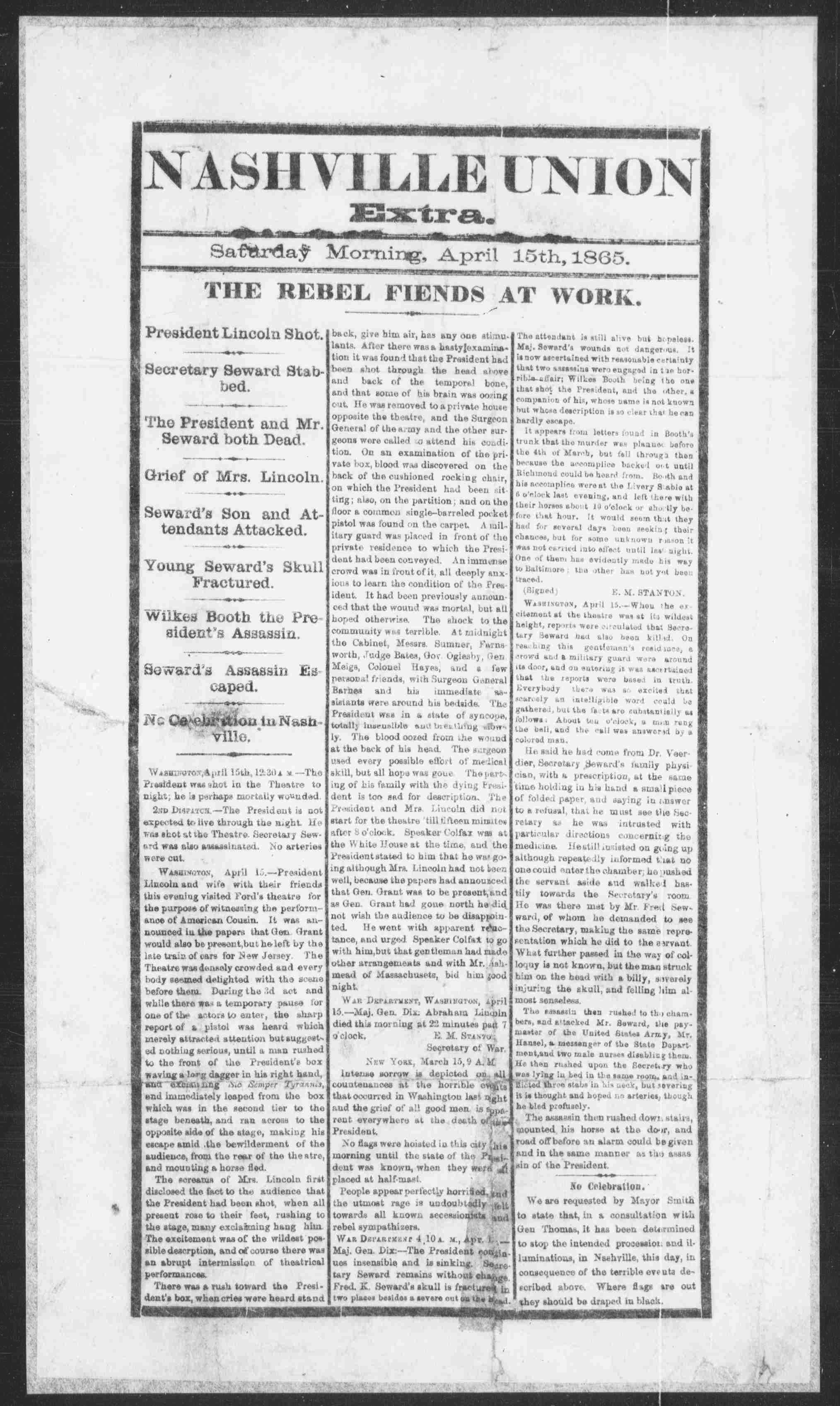
The Nashville Daily Union was one of the few newspapers that was established during and that survived the Civil War. This article prints a dispatch from Secretary of War Edward Stanton to Major General Dix recounting the details of Abraham Lincoln's assassination. The article falsely states that Edward Stanton was also killed. It concludes by declaring that a scheduled procession and illuminations in Nashville will not occur as a consequence of these events.
-
Transcription
NASHVILLE UNION
Extra.
Saturday Morning, April 15th, 1865.
THE REBEL FIENDS AT WORK.
President Lincoln Shot.
Secretary Seward Stabbed.
The President and Mr. Seward both Dead.
Grief of Mrs. Lincoln.
Seward’s Son and At-tendants Attacked.
Young Seward’s Skull Fractured.
Wilkes Booth the Pre-sident’s Assassin.
Seward’s Assassin Es-caped.
Nc Celebration in Nash-ville.
Washington, April 15th, 12:30 AM – The President was shot in the Theatre tonight; he is perhaps mortally wounded.
2nd DISPATCH – The President is not expected to live through the night. He was shot at the Theatre. Secretary Seward was also assassinated. No arteries were cut.
Washington, April 15.- President Lincoln and wife with their friends this evening visited Ford’s theatre for the purpose of witnessing the performance of American Cousin. It was announced in the papers that Gen. Grant would also be present, but he left by the late train of cars for New Jersey. The Theatre was densely crowded and every body seemed delighted with the scene before them. During the 3d act and while there was a temporary pause for one of the actors to enter, the sharp report of a pistol was heard which merely attracted attention but suggested nothing serious, until a man rushed to the front of the President’s box waving a long dagger in his right hand, and exclaiming Sic Semper Tyrannis and immediately leaped from the box which was in the second tier to the stage beneath and ran across to the opposite side of the stage, making his escape amid the bewilderment of the audience, from the rear of the theatre, and mounting a horse fled.
The screams of Mrs. Lincoln first disclosed the fact to the audience that the President had been shot, when all present rose to their feet, rushing to the stage, many exclaiming hang him. The excitement was of the wildest pos-sible description, and of course there was an abrupt intermission of theatrical performances.
There was a rush toward the Presi-dent’s box, when cries were heard stand back, give him air, has any one stimu-lants. After there was a hasty examina-tion it was found that the President had been shot through the head above and back of the temporal bone, and that some of his brain oozing out. He was removed to a private house opposite the theatre, and the Surgeon General of the army and the other sur-geons wer called to attend his condition. On an examination of the pri-vate box, blood was discovered on the back of the cushioned rocking chair, on which the President had been sit-ting; also, on the partition; and on the floor a common single-barreled pocket pistol was found on the carpet. A mil-itary guard was placed in front of the private residence to which the Presi-dent had been conveyed. An immense crowd was in front of it all, all deeply anx-ious to learn the condition of the Pres-ident. It had been previously announced that the wound was mortal, but all hoped otherwise. The shock to the community was terrible. At midnight the Cabinet, Messrs. Sumner, Farns-worth, Judge Bates, Gov. Oglesby, Gen. Meigs, Colonel Hayes and a few personal friends, with Surgeon General Barhea and his immediate as-sistants were around his bedside. The President was in a state of syncope, totally insensible and breathing slowly. The blood oozed from the wound at the back of his head. The surgeon used every possible effort of medical skill, but all hope was gone. The parting of his family with the dying Presi-dent is too sad for description. The President and Mrs. Lincoln did not start for the theatre ‘till fifteen minutes after 8 o’clock. Speaker Colfax was at the White House at that time, and the President stated to him that he was going although Mrs. Lincoln had not been well, because the papers had announced that Gen. Grant was to be present, and as Gen. Grant had gone north he did not wish the audience to be disappointed. He went with apparent reluc-tance, and urged Speaker Colfax to go with him , but that gentleman had made other arrangements and with Mr. Ash-mead of Massachusetts, bid him good night.
WAR DEPARTMENT, Washington, April 15.-Maj. Gen. Dix: Abraham Lincoln died this morning at 22 minutes past 7 o’clock.
E.M. Stanton
Secretary of War
New York, March 15, 9 A.M.
Intense sorrow is depicted on all countenances at the horrible events that occurred in Washington last night and the grief of all good men is apparent everywhere at the death of the President.
No flags were hoisted in this city this morning until the state of the President was known, when they were placed at half-mast.
People appear perfectly horrified and the utmost rage is undoubtedly felt towards all known secessionists and rebel sympathizers.
War Department 4, 10 A.M., April 1-
Maj. Gen. Dix:- The President continues insensible and is sinking. Secretary Seward remains without change. Fred K. Seward’s skull is fractured in two places besides a severe cut on the head.
The attendant is still alive but hopeless. Maj. Seward’s wounds not dangerous. It is now ascertained with reasonable certainty that two assassins were engaged in the hor-rible affair; Wilkes Booth being the one who shot the President, and the other, a companion of his, whose name is not known but whose description is so clear that he can hardly escape.
It appears from letters found in Booth’s trunk that the murder was planned before the 4th of March, but fell through then because the accomplice backed out until Richmond could be heard from. Booth and his accomplice were at the Livery Stable at 6 o’clock last evening, and left there with their horses about 10 o’clock or shortly before that hour. It would seem that they had for several days been seeking their chances, but for some unknown reason it was not carried into effect until last night. One of them has evidently made his way to Baltimore; the other has not yet been traced.
(Signed)
E.M. Stanton
Washington, April 15- When the excitement at the theatre was at its wildest height, reports were circulated that Secretary Seward had also been killed. On reaching this gentleman’s residence, a crowd and military guard were around its door, and on entering it was ascertained that the reports were based in truth. Everybody there was so excited that scarcely an intelligible word could be gathered, but the facts are substantially as follows: About ten o’clock, a man rang the bell and the call was answered by a colored man.
He said he had come from Dr. Veerdier, Secretary Seward’s family physician, with a prescription, at the same time holding in his hand a small piece of folded paper, and saying in answer to a refusal, that he must see the Sec-retary as he was intrusted with particular directions concerning the medicine. He still insisted on going up although repeatedly informed that no one could enter the chamber, he pushed the servant aside and walked has-tily towards the Secretary’s room. He was there met by Mr. Fred Sew-ard, of whom he demanded to see the Secretary, making the same repre-sentation which he did to the servant. What further passed inn the way of col-loquy is not known, but the man struck him on the head with a billy, severely injuring the skull and felling him almost senseless.
The assassin then rushed to the cham-bers, and attacked Mr. Seward, the pay-master of the United States Army, Mr. Hansel, a messenger of the State Depart-ment and two male nurses disabling them. He then rushed upon the Secretary who was lying in bed in the same room, and inflicted three stabs in his neck, but severing it is thought and hoped no arteries, though he bled profusely.
The assassin then rushed downstairs, mounted his horse at the door, and road off before an alarm could be given and in the same manner as the assas-sin of the President.
[Transcription by Alicia B., Ford's Theatre Society.] -
Source
Chronicling America: Historic American Newspapers,Library of Congress
-
Rights
This item is in the public domain and may be reproduced and used for any purpose, including research, teaching, private study, publication, broadcast or commercial use, with proper citation and attribution.
-
Tags
-
Cite this Item
The Nashville Daily Union. "The Rebel Fiends at Work". Remembering Lincoln. Web. Accessed December 14, 2025. https://rememberinglincoln.fords.org/node/1201
-
Creator
The Nashville Daily Union
-
Date
April 15, 1965
from Apr. 15, 1965
The Rebel Fiends at Work
-
Description
The Nashville Daily Union was one of the few newspapers that was established during and that survived the Civil War. This article prints a dispatch from Secretary of War Edward Stanton to Major General Dix recounting the details of Abraham Lincoln's assassination. The article falsely states that Edward Stanton was also killed. It concludes by declaring that a scheduled procession and illuminations in Nashville will not occur as a consequence of these events.
-
Source
Chronicling America: Historic American Newspapers,Library of Congress
-
Rights
This item is in the public domain and may be reproduced and used for any purpose, including research, teaching, private study, publication, broadcast or commercial use, with proper citation and attribution.
-
Creator
The Nashville Daily Union
-
Date
April 15, 1965
from May. 20, 1865
John Wilkes Booth "Buried at Sea"
-
Full Title
John Wilkes Booth "Buried at Sea" - Frank Leslie's Illustrated Newspaper Drawing
-
Description
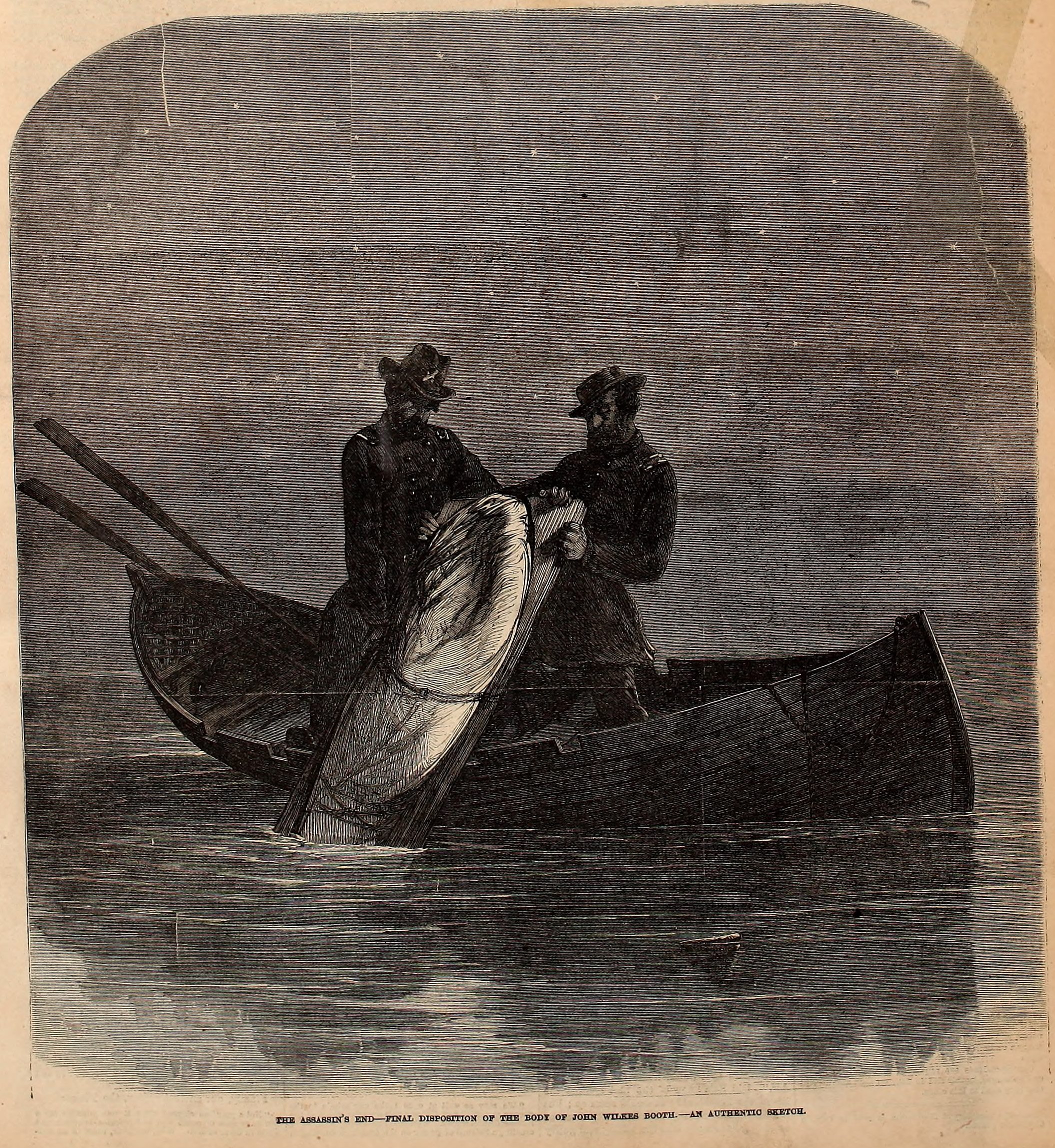
In the May 20th, 1865 edition of Frank Leslie's Illustrated Weekly newspaper, this image was printed inaccurately depicting the burial of President Lincoln's assassin, actor John Wilkes Booth. The federal government was worried what the public would do if they buried the body, so they staged a burial at sea and then secretly buried the assassin in an unmarked location. In 1869 they released the body to Booth's family and he was reburied in their family plot in Baltimore, Maryland. Frank Leslie's Illustrated Weekly was a literary and news publication founded in 1855 which ran until 1922. It was one of several started by publisher and illustrator Frank Leslie. Leslie was a British engraver who came to the United States in 1848. The Illustrated Weekly followed a tested and proven formula of carefully combining elements of war, politics, art, science, travel and exploration, literature and the fine arts in each issue, enhanced with between 16 and 32 illustrations. By 1897 its circulation had grown to an estimated 65,000 copies.
-
Source
The Lincoln Financial Foundation Collection
-
Rights
To request rights and permissions to use Lincoln Financial Foundation Collection images in research or publications, please download our image rights permission form: https://www.lincolncollection.org/access/image-rights-permissions/.
-
Tags
-
Cite this Item
Frank Leslie. "John Wilkes Booth "Buried at Sea" - Frank Leslie's Illustrated Newspaper Drawing". Frank Leslie . Remembering Lincoln. Web. Accessed December 14, 2025. https://rememberinglincoln.fords.org/node/1110
-
Creator
Frank Leslie
-
Publisher
Frank Leslie
-
Date
May 20, 1865
from May. 20, 1865
John Wilkes Booth "Buried at Sea" - Frank Leslie's Illustrated Newspaper Drawing
-
Description
In the May 20th, 1865 edition of Frank Leslie's Illustrated Weekly newspaper, this image was printed inaccurately depicting the burial of President Lincoln's assassin, actor John Wilkes Booth. The federal government was worried what the public would do if they buried the body, so they staged a burial at sea and then secretly buried the assassin in an unmarked location. In 1869 they released the body to Booth's family and he was reburied in their family plot in Baltimore, Maryland. Frank Leslie's Illustrated Weekly was a literary and news publication founded in 1855 which ran until 1922. It was one of several started by publisher and illustrator Frank Leslie. Leslie was a British engraver who came to the United States in 1848. The Illustrated Weekly followed a tested and proven formula of carefully combining elements of war, politics, art, science, travel and exploration, literature and the fine arts in each issue, enhanced with between 16 and 32 illustrations. By 1897 its circulation had grown to an estimated 65,000 copies.
-
Source
The Lincoln Financial Foundation Collection
-
Rights
To request rights and permissions to use Lincoln Financial Foundation Collection images in research or publications, please download our image rights permission form: https://www.lincolncollection.org/access/image-rights-permissions/.
-
Creator
Frank Leslie
-
Publisher
Frank Leslie
-
Date
May 20, 1865
from Apr. 20, 1865
Mayor's Proclamation on the Death of Abraham Lincoln - Brownville, Nebraska
-
Full Title
Brownville, Nebraska Territory Mayor's Proclamation on the Death of Abraham Lincoln
-
Description
The newly elected Mayor of Brownville, Nebraska Territory, Charles G. Dorsey, made a proclamation on the death of Abraham Lincoln, which was published in the Nebraska Advertiser the week after the President's death. The town of Brownville heard about Lincoln's death almost immediately. The city of Brownville was only about 10 years old at the time of Lincoln's assassination. The Nebraska Advertiser was founded in 1856 by a recent resident, Robert Wilkinson Furnas. Fumas was opposed to slavery and those views were often illustrated in the newspaper.
-
Source
-
Rights
This item is in the public domain and may be reproduced and used for any purpose, including research, teaching, private study, publication, broadcast or commercial use, with proper citation and attribution.
-
Tags
-
Cite this Item
Nebraska Advertiser. "Brownville, Nebraska Territory Mayor's Proclamation on the Death of Abraham Lincoln". Robert Wilkinson Furnas. Remembering Lincoln. Web. Accessed December 14, 2025. https://rememberinglincoln.fords.org/node/1097
-
Creator
Nebraska Advertiser
-
Publisher
Robert Wilkinson Furnas
-
Date
April 20, 1865
from Apr. 20, 1865
Brownville, Nebraska Territory Mayor's Proclamation on the Death of Abraham Lincoln

-
Description
The newly elected Mayor of Brownville, Nebraska Territory, Charles G. Dorsey, made a proclamation on the death of Abraham Lincoln, which was published in the Nebraska Advertiser the week after the President's death. The town of Brownville heard about Lincoln's death almost immediately. The city of Brownville was only about 10 years old at the time of Lincoln's assassination. The Nebraska Advertiser was founded in 1856 by a recent resident, Robert Wilkinson Furnas. Fumas was opposed to slavery and those views were often illustrated in the newspaper.
-
Source
-
Rights
This item is in the public domain and may be reproduced and used for any purpose, including research, teaching, private study, publication, broadcast or commercial use, with proper citation and attribution.
-
Creator
Nebraska Advertiser
-
Publisher
Robert Wilkinson Furnas
-
Date
April 20, 1865
from Nov. 16, 2015
"We Mourn a Father Slain"
-
Full Title
"We Mourn a Father Slain" Mourning Ribbon
-
Description
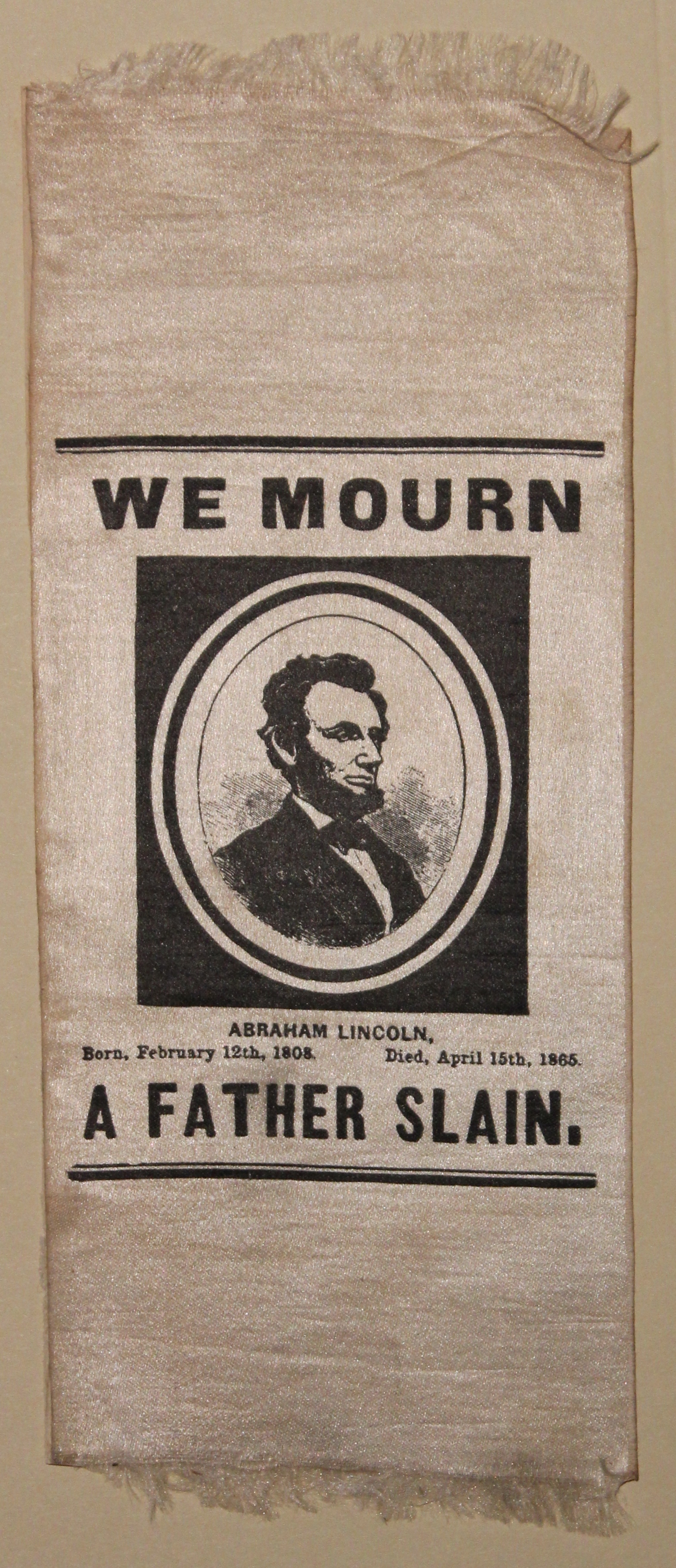
This mourning ribbon, owned by Union League member John C. Browne, was worn during President Lincoln's funeral procession in Philadelphia on April 22-23, 1865. The white silk ribbon includes a printed oval picture of Lincoln. Notice the incorrect birth year listed on the ribbon.
-
Transcription
WE MOURN
Abraham Lincoln,
Born February 12, 1808 Died April 15, 1865
A FATHER SLAIN.
-
Source
The Abraham Lincoln Foundation of The Union League of Philadelphia (Object ID: 2008.22.3)
-
Rights
Use of this item for research, teaching and private study is permitted with proper citation and attribution, as “Courtesy of The Abraham Lincoln Foundation of The Union League of Philadelphia.” Reproduction of this item for publication, broadcast or commercial use requires written permission. For permission, please contact The Abraham Lincoln Foundation.
-
Tags
-
Cite this Item
Unknown. ""We Mourn a Father Slain" Mourning Ribbon". Remembering Lincoln. Web. Accessed December 14, 2025. https://rememberinglincoln.fords.org/node/911

-
Creator
Unknown
-
Date
April 22-23 1865
-
Material
Silk
-
Dimensions
8.5 x 3.5
from Nov. 16, 2015
"We Mourn a Father Slain" Mourning Ribbon
-
Description
This mourning ribbon, owned by Union League member John C. Browne, was worn during President Lincoln's funeral procession in Philadelphia on April 22-23, 1865. The white silk ribbon includes a printed oval picture of Lincoln. Notice the incorrect birth year listed on the ribbon.
-
Source
The Abraham Lincoln Foundation of The Union League of Philadelphia (Object ID: 2008.22.3)
-
Rights
Use of this item for research, teaching and private study is permitted with proper citation and attribution, as “Courtesy of The Abraham Lincoln Foundation of The Union League of Philadelphia.” Reproduction of this item for publication, broadcast or commercial use requires written permission. For permission, please contact The Abraham Lincoln Foundation.
-
Creator
Unknown
-
Date
November 16, 2015
-
Material
Silk
-
Dimensions
8.5 x 3.5
from
Philadelphia Police Ribbon
-
Full Title
Philadelphia Police Mourning Ribbon
-
Description
This mourning badge was worn by Mr. Godfrey Stringer when President Lincoln’s body lay in state in Philadelphia, PA. Lincoln’s body was brought to Philadelphia on April 22, 1865. The object includes a cardboard police badge covered in black gauze and black silk ribbon. Below the black cinched ribbon, there is a white silk ribbon that reads, “We Mourn Our Nation’s Loss. Born February 12th, 1809, Died April 17th 1865.” Notice the incorrect date listed for the President's death.
-
Transcription
We Mourn Our Nation’s Loss.
Born February 12th, 1809
Died April 17th 1865. -
Source
The Abraham Lincoln Foundation of The Union League of Philadelphia (Object ID: 2001.240.1)
-
Rights
Use of this item for research, teaching and private study is permitted with proper citation and attribution, as “Courtesy of The Abraham Lincoln Foundation of The Union League of Philadelphia.” Reproduction of this item for publication, broadcast or commercial use requires written permission. For permission, please contact The Abraham Lincoln Foundation.
-
Tags
-
Cite this Item
Unknown. "Philadelphia Police Mourning Ribbon". Remembering Lincoln. Web. Accessed December 14, 2025. https://rememberinglincoln.fords.org/node/891
-
Creator
Unknown
-
Material
Cardboard, gauze, silk, paper
-
Dimensions
9.25 x 3.75
from
Philadelphia Police Mourning Ribbon

-
Description
This mourning badge was worn by Mr. Godfrey Stringer when President Lincoln’s body lay in state in Philadelphia, PA. Lincoln’s body was brought to Philadelphia on April 22, 1865. The object includes a cardboard police badge covered in black gauze and black silk ribbon. Below the black cinched ribbon, there is a white silk ribbon that reads, “We Mourn Our Nation’s Loss. Born February 12th, 1809, Died April 17th 1865.” Notice the incorrect date listed for the President's death.
-
Source
The Abraham Lincoln Foundation of The Union League of Philadelphia (Object ID: 2001.240.1)
-
Rights
Use of this item for research, teaching and private study is permitted with proper citation and attribution, as “Courtesy of The Abraham Lincoln Foundation of The Union League of Philadelphia.” Reproduction of this item for publication, broadcast or commercial use requires written permission. For permission, please contact The Abraham Lincoln Foundation.
-
Creator
Unknown
-
Material
Cardboard, gauze, silk, paper
-
Dimensions
9.25 x 3.75
from Aug. 26, 2015
Reverend Leonard Francis Smith
-
Full Title
Reverend Leonard Francis Smith
-
Description
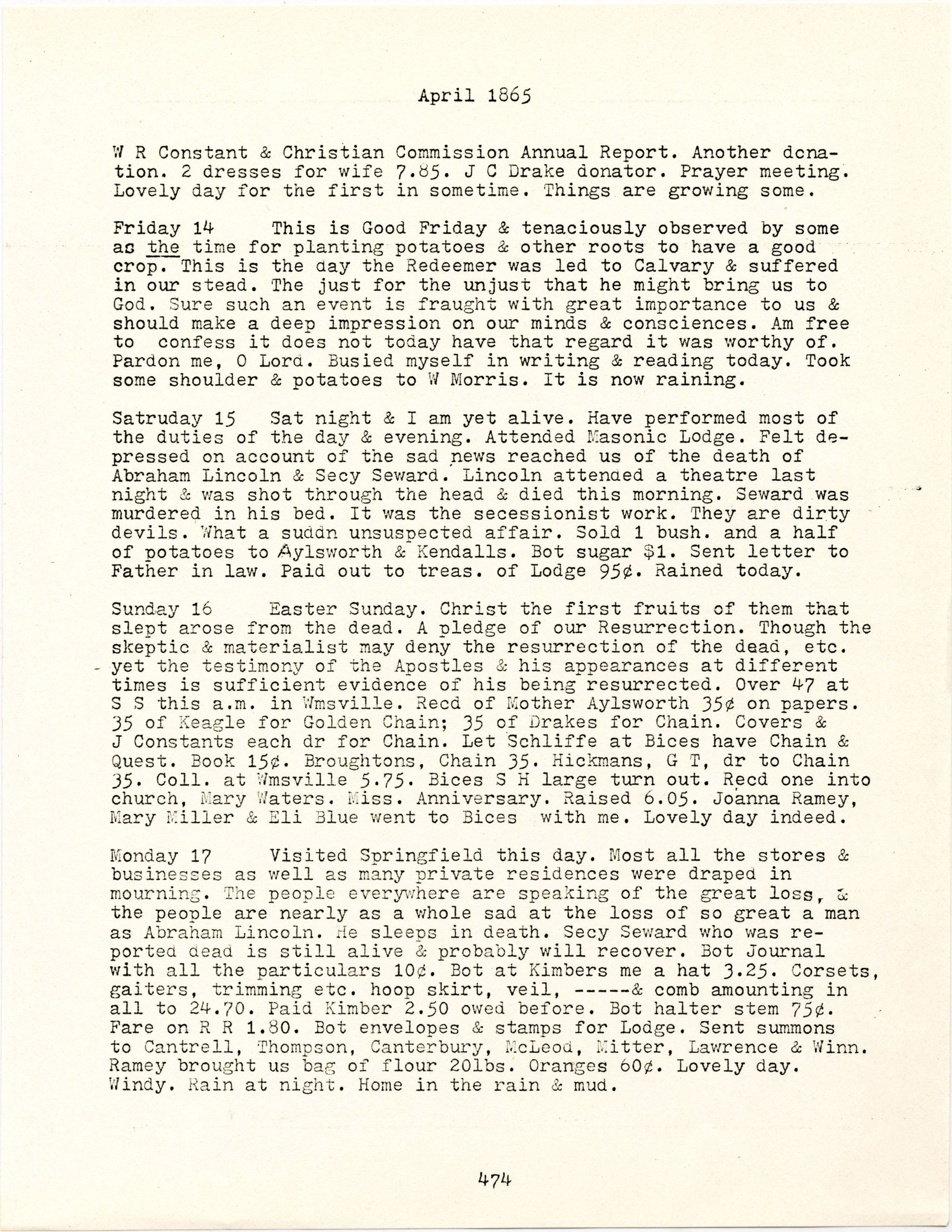
Reverend Leonard Francis Smith was a Methodist preacher appointed to the Girard, Illinois, circuit at the time of Lincoln's death. He traveled to Lincoln's hometown of Springfield, Illinois, two days after the assassination and observed the collective mourning. Smith also held a service in his church the day Lincoln's ceremonial burial service was held in Washington D.C. In his diary, Smith recalls these events and comments on the progress of the hunt for Lincoln's killer and the person who attempted to murder Secretary of State, William H. Seward.
-
Transcription
April 1865
[continued from previous page] W R Constant & Christian Commission Annual Report. Another dona-
tion. 2 dresses for wife 7.85. J C Drake donator. Prayer meeting.
Lovely day for the first in sometime. Things are growing some.
Friday 14 This is Good Friday & tenaciously observed by some
as the time for planting potatoes & other roots to have a good
crop. This is the day the redeemer was led to Cavalry & suffered
in our stead. The just for the unjust that he might bring us to
God. Sure such an event is fraught with great importance to us &
should make a deep impression on our minds & consciences. Am free
to confess it does not today have that regard it was worthy of.
Pardon me, O Lord. Busied myself in writing & reading today. Took
some shoulder & potatoes to W Morris. It is now raining.
Satruday 15 Sat night & I am yet alive. Have performed most of
the duties of the day & evening. Attended Masonic Lodge. Felt de-
pressed on account of the sad news reached us of the death of
Abraham Lincoln & Secy Seward. Lincoln attended a theatre last
night & was shot through the head & died this morning. Seward was
murdered in his bed. It was the secessionist work. They are dirty
devils. What a suddn unsuspected affair. Sold 1 bush. and a half
of potatoes to Aylsworth & Kendalls. Bot sugar $1. Sent letter to
Father in law. Paid out to treas. of Lodge 95¢. Rained today.
Sunday 16 Easter Sunday. Christ the first fruits of them that
slept arose from the dead. A pledge of our Resurrection. Though the
skeptic & materialist may deny the resurrection of the dead, etc.
yet the testimony of the Apostles & his appearances at different
times is sufficient evidence of his being resurrected. Over 47 at
S S this a.m. in Wmsville. Recd of Mother Aylsworth 35¢ on papers.
35 of Keagle for Golden Chain; 35 of Drakes for Chain. Covers &
J Constants each dr for Chain. Let Schliffe at Bices have Chain &
Quest. Book 15¢. Broughtons, Chain 35. Hickmans, G T, dr to Chain
35. Coll. at Wmsville 5.75. Bices S H large turn out. Recd one into
church, Mary Waters. Miss. Anniversary. Raised 6.05. Joanna Ramey,
Mary Miller & Eli Blue went to Bices with me. Lovely day indeed.
Monday 17 Visited Springfield this day. Most all the stores &
businesses as well as many private residences were draped in
mourning. The people everywhere are speaking of the great loss, &
the people are nearly as a whole sad at the loss of so great a man
as Abraham Lincoln. He sleeps in death. Secy Seward who was re-
ported dead is still alive & probably will recover. Bot Journal
with all the particulars 10¢. Bot at Kimbers me a hat 3.25. Corsets,
gaiters, trimming etc. hoop skirts, veil, -----& comb amounting in
all to 24.70. Paid Kimber 2.50 owed before . Bot halter stem 75¢.
Fare on R R 1.80. Bot envelopes & stamps for Lodge. Sent summons
to Cantrell, Thompson, Canterbury, McLeod, Mitter, Lawrence & Winn.
Ramey brought us bag of flour 20lbs. Oranges 60¢. Lovely day.
Windy. Rain at night. Home in the rain & mud.
474
April 1865
Thursday 18 Lincoln, brave, honest & great. Abraham Lincoln is
dead. He died a martyr. Yea he lived to set menfree. He rests from
labor. His body will shortly be buried. His memory will be cher-
ished through the future ages. He was the country’s friend. Has
fallen. The wretch is not as yet captured. Vengeance will yet over-
take him. Good news. Mobile is ours. Johnston negotiating. Recd
dispatch from Elkhart inviting me to officiate tomorrow. Signed
D L Dana. Letter from Jesse K. Sent letter to George Smith, Rev
Simms, P Cartwright. Recd 75¢ of C Brest & $2 quarterage, Sister
Purce;$10 donation of Wm. Mount. Beans of Council. Paper 10¢.
Planted beans & potatoes. Quite warm. Rain 8:30.
Wednesday 19 Today the citizens of the town & country assembled
in our church to commemorate the burial of Abraham Lincoln at
Washington. Services were opened by reading from 2 Sam 1:17 and
Psa 46. Then singing & prayer, then sketch of his life, the speech
by Jacob Beck, then singing, then Bro Todd spoke. Took text. Then
I read his Farewell Address at Springfield. Then a little talk &
resolutions which were adopted by all save a few Copperheads.
Church was draped in mourning. Recd sub. to Central, Fletcher
Council, & 2$ through Bro Laucke. Had some eggs etc. exchanged.
Set a hen. Paid Olsen $5 which pays till June 26. Recd letter etc
Planted some corn. Quite summer like. Peaches are out in blossom.
Thursday 20 The supposed assassin of Seward caught. Should be
hanged up till dead, dead. Sent letter to Capt J B Jenkins, Baton
Rouge. Indebted to Lodge 72.00 & 61/2 yrs interest. Bot stamps 25¢.
Sent letter to Mason, Bloomington. Recd one from Kittie Lowe & $10
in it. Were aroused at 3 a.m. by neighbors. Pickerell Bices store
& two dwelling were burned by some incendiaries. Planted corn,
beets, squashes, butter beans, cymblings [cabbage sprouts] and
transplanted some hemp. Prayer meeting. Dr Winn joined on Prob.
& Langley & wife by letter. Rained by spells some today.
Friday 21 Fasting primitively was regarded by the Saviour as
essential to the casting out of stubborn devils or dumb spirits.
The directions for fasting were important. Examples worthy of
notice in reference to fasting are given us. The blessed Master &
his Disciples & Apostles fasted often. We do not fast as often now
since we do not have such humble views of ourselves as we ought to
have. Since we are not as holy nor as useful. Letter from Rev
Gooding. His babe died. Circular Syrian Lodge No 333. Bought sugar
(white) 4 lbs $1. Coal oil 1. per gal. Recd 35¢ for Chain. Bot
Tribune 10¢. Put some cucumber seed in the ground. Heard opening
sermon at the Presbytery. Rev Marcus, Micah 7:7. Bro Bishop Haller
supped with us. Rained by times all day.
Saturday 22 Lamentations 3:26: It is good for man – Dr Cartwright
preached at 11 a.m. from that text to small assembly at Yocums S H
Dined at Wm Yocums. Quarterly Conf. Recd of Wmsville this quarter
$28, 4. already allowed; of Fancy Creek 37. quarterage & 5.00
Donation; & $11 for potatoes; of Yocums 9.00; of Wolfe Creek
475
-
Source
HC.00190 - Reverend Leonard Smith Diaries Collection
-
Rights
Educational use only, no other permissions given. Copyright to this resource is held by Michigan State University and is provided here for educational purposes only. It may not be reproduced or distributed in any format without written permission of the University Archives & Historical Collections, Michigan State University.
-
Tags
-
Cite this Item
Reverend Leonard Francis Smith. "Reverend Leonard Francis Smith ". Michigan State University Archives & Historical Collections. Remembering Lincoln. Web. Accessed December 14, 2025. https://rememberinglincoln.fords.org/node/851
-
Creator
Reverend Leonard Francis Smith
-
Publisher
Michigan State University Archives & Historical Collections
-
Date
April 15, 1865
-
Material
Typed on Paper
-
Dimensions
8" x 10"
from Aug. 26, 2015
Reverend Leonard Francis Smith
-
Description
Reverend Leonard Francis Smith was a Methodist preacher appointed to the Girard, Illinois, circuit at the time of Lincoln's death. He traveled to Lincoln's hometown of Springfield, Illinois, two days after the assassination and observed the collective mourning. Smith also held a service in his church the day Lincoln's ceremonial burial service was held in Washington D.C. In his diary, Smith recalls these events and comments on the progress of the hunt for Lincoln's killer and the person who attempted to murder Secretary of State, William H. Seward.
-
Source
HC.00190 - Reverend Leonard Smith Diaries Collection
-
Rights
Educational use only, no other permissions given. Copyright to this resource is held by Michigan State University and is provided here for educational purposes only. It may not be reproduced or distributed in any format without written permission of the University Archives & Historical Collections, Michigan State University.
-
Creator
Reverend Leonard Francis Smith
-
Publisher
Michigan State University Archives & Historical Collections
-
Date
August 26, 2015
-
Material
Typed on Paper
-
Dimensions
8" x 10"
from Apr. 16, 1865
Letter to his parents from J. D. McClure, April 16, 1865
-
Full Title
Handwritten Letter to Dear Parents from J. D. McClure, April 16, 1865
-
Description
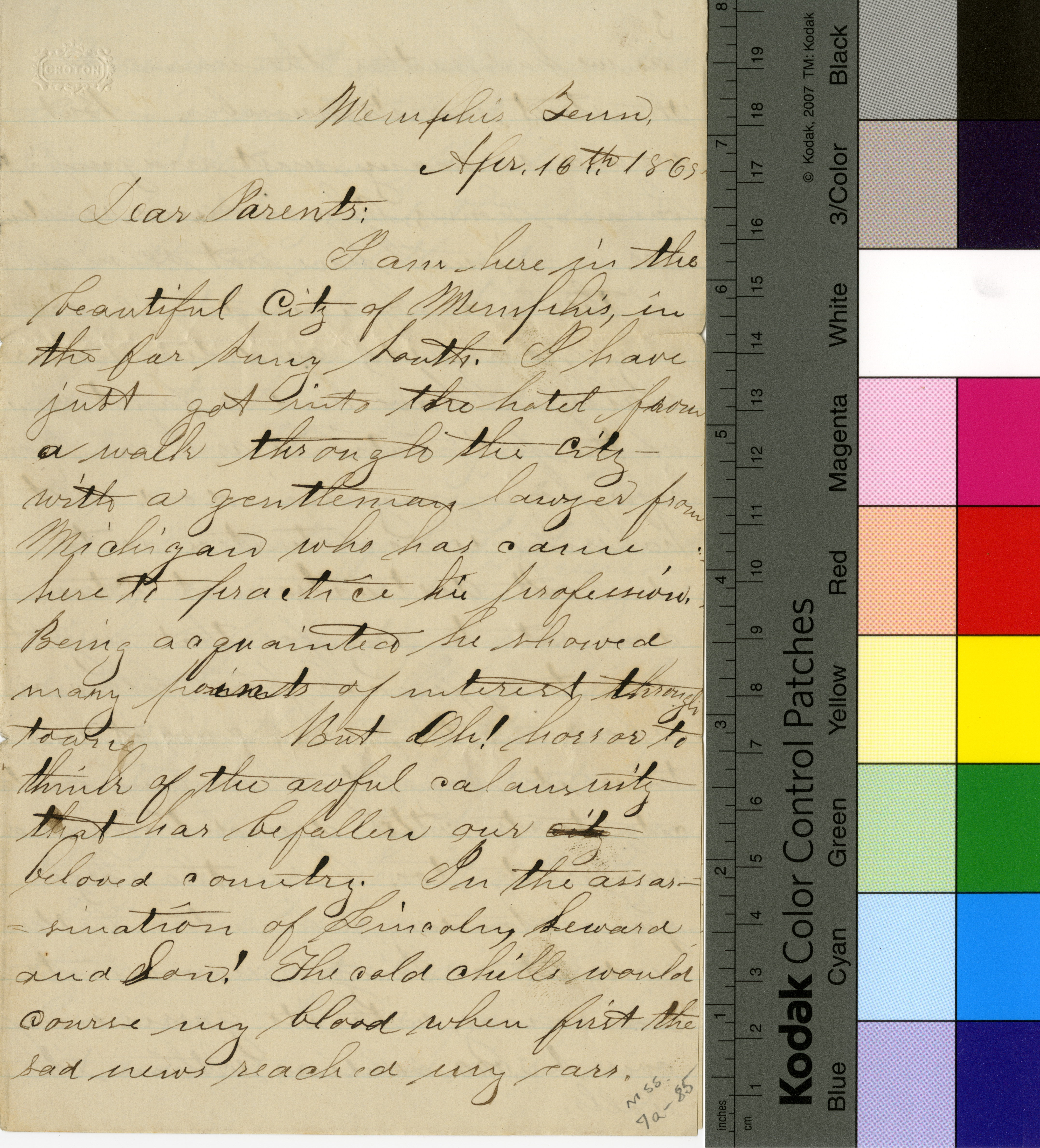
Letter to his Dear (Unidentified) Parents from their son, J. D. McClure, April 16, 1865. McClure was in Memphis (Tenn.) setting up a business. He may have been from Iowa originally. McClure writes at first about moving to Memphis and having a tour of the town. Then he abruptly and emotionally transitions to having heard about the assassinations of President Lincoln, Seward, and Son that day from the boat coming from Cairo. He writes of the flags in town being at half-mast and draped in mourning [bunting]. McClure refers to the Secessionists as demons who will be destroyed by God. He then returns to the story of his tour of town, trying to help a lady find her husband at an unknown address, viewing the strong fortifications, battery, and garrison with lots of Union soldiers, the warm temperature and advanced state of growth in the trees and vegetables compared to those in the North, and how at present he has little business.
-
Transcription
Page One
Memphis, Tenn.
April 16th, 1865
Dear Parents:
I am here in the
beautiful city of Memphis in
the far flung South. I have
just got into the hotel from
a walk through the city
with a gentleman lawyer from
Michigan who has come
here to practice his profession.
Being acquainted he showed
many points of interest through
town. But Oh! Horror to
think of the awful calamnity [sic]
that has befallen our city[crossed out]
beloved country. In the assass-
ination of Lincoln Seward
and Son! The cold chills would
course my blood when first the
sad news reached my ears.
Page Two
2
The news first reached here this
morning on the boat from
Cairo. The news flew like
magic throughout the place
and the flags of the city were
hung at half mast, and
draped in mourning. What
horror to think our nation’s loss,
to see our Star Spangled banner
draped in mourning! “Whom
God will destroy he first maketh
mad”, and these demons, [of secession-inserted] are
surely sufficiently mad for
distruction [sic]. If possible I
will drive these thoughts away
for the present and write some-thing else. I got a carriage
this morning for Mrs. Billings
of Keohrels [sp?] who came down on
the same boat to visit her
husband. We rode for one hour
but did not succeed in finding
Page Three
3
as we had neither the name of
the street nor its number. But
we did see many most magnificent
business houses, Churches and residen-
ces. True I have not seen all
of the place by a considerable in
my hours ride, and two hours
walk. I have had a faint view
of the fortifications as I can have
now from my window. Yet,
Pickering is so situated as to
deal out distruction [sic] at a tremen-
dous rate to any foe the might
dare to approach from below or
above on the river, and it could
turn its mighty power from the
city to its utter demolition and
very hasty too. I see the large
guns standing upon the battery
ready at a single moments
warning, with its garrison of
over 3,000 soldiers within its
walls.
Page Four
Then how different the atmos-
phere here; the Sun is almost at
its meridian high to shining
forth its [genial-inserted] rays of warmth and
gladness. It is as warm here
as in June there, yet it is neither
sultry nor hot, but as I enhale [sic]
the atmosphere it seems cool
and embracing, much like we
sometimes have North just ater [sic]
a shower in a sultry hot
August day or the purer are [air-sic]
while the dew is rising in a
summers morning.
Then again how different
vegetation here; when I left
there was scarsely [sic] any of the
tees were putting forth their leaves
or buds, but before we reached this
point the peach and apple trees
had fruit put forth their blooms and
had fallen off. And to-day
the leaves on the oak and other
trees are almost full ground
and the gardens and yards are
green with grass and vegetables.
Page Four
But with all this I can’t tell
how I shall like the place.
I may not like the climate, the
the [sic] city, the practice to be had,
the people, nor the manner
of living. I do not know that
I have any occasion to be
discouraged unless it may be
from the high price of living.
It is Sunday and the most of
business is closed of course and
I am doing [sic] nothing in the way
of business. It will brobably [sic]
be one or two or perhaps three
weeks before I shall know
what to do. In the mean time
I shall enquire and remain
as contented as possible.
I guess it is dinner time.
I will write again when I
get more settled in business.
Your Affectionate son, J. D. McClure
-
Source
Clarke Historical Library, Central Michigan University, J. D. McClure Correspondence, 1865
-
Rights
This item may be reproduced and used for any purpose, including research, teaching, private study, publication, broadcast or commercial use, with proper citation and attribution.
-
Tags
-
Cite this Item
McClure, J. D.. "Handwritten Letter to Dear Parents from J. D. McClure, April 16, 1865". Remembering Lincoln. Web. Accessed December 14, 2025. https://rememberinglincoln.fords.org/node/848
-
Creator
McClure, J. D.
-
Date
1865
-
Material
Letter
-
Dimensions
8x9.5 inches
from Apr. 16, 1865
Handwritten Letter to Dear Parents from J. D. McClure, April 16, 1865
-
Description
Letter to his Dear (Unidentified) Parents from their son, J. D. McClure, April 16, 1865. McClure was in Memphis (Tenn.) setting up a business. He may have been from Iowa originally. McClure writes at first about moving to Memphis and having a tour of the town. Then he abruptly and emotionally transitions to having heard about the assassinations of President Lincoln, Seward, and Son that day from the boat coming from Cairo. He writes of the flags in town being at half-mast and draped in mourning [bunting]. McClure refers to the Secessionists as demons who will be destroyed by God. He then returns to the story of his tour of town, trying to help a lady find her husband at an unknown address, viewing the strong fortifications, battery, and garrison with lots of Union soldiers, the warm temperature and advanced state of growth in the trees and vegetables compared to those in the North, and how at present he has little business.
-
Source
Clarke Historical Library, Central Michigan University, J. D. McClure Correspondence, 1865
-
Rights
This item may be reproduced and used for any purpose, including research, teaching, private study, publication, broadcast or commercial use, with proper citation and attribution.
-
Creator
McClure, J. D.
-
Date
April 16, 1865
-
Material
Letter
-
Dimensions
8x9.5 inches
from Sep. 18, 1866
Wilkes Booth and his Dead Body
-
Full Title
Wilkes Booth and his Dead Body [From the Cincinnati Union of Sunday]
-
Description
News article with details of what happened to the body of John Wilkes Booth.
-
Transcription
Wilkes Booth and his Dead Body. -
[From the Cincinnati Union of Sunday}
The Louisville Courier has the following:
“Wilkes Booth, whose body Secretary Stanton took so much pains to dispose of, so that no man should ever know the spot where it was buried, is reported to be in Europe. The story is that the man who ‘Boston Corbett’ so heroically shot, and whose body Stanton refused to exhibit to any one that ever saw Booth, was a poor wretch hired by the assassins to personate Booth, in order to facilitate the escape of the latter. Whether there be or be not any truth in this story, it will never cease to be a suspicious circumstance connected with the fate of Wilkes Booth, that Stan-ton refused to deliver the body that was brought up from Virginia to his friends or even to let them look upon it.”
Dating a couple of months from the time that Booth, the assassin of President Lincoln, was shot and killed by Boston Corbett, in the attempt to capture him, sensation stories like the above have been of frequent occurrence. Of course there is not a shadow of truth in the tale of Booth being still alive. The body was fully recognized as being that of Booth, and although tales were told about it be-ing secretly taken out to sea and sunk, and others about it being buried at mid-night, in an obscure place, by two men employed by Government, and who were sworn to secrecy, yet facts, known to but few, and carefully kept from the newspa-per press, show that the body was given over to the relatives of Booth, and that it was buried in either New England or in Canada.
The facts, as we had them at the time on authority not to be doubted, are as follows:
A few days before the body of Booth so mysteriously disappeared, our informant, a resident of New York, and favorably known as a dramatic writer, was called upon after bank hours to cash the draft of an undertaker, a near neighbor, who stated that he had received an order from the Booth family, to repair to Washington with a coffin, and there to receive the body of John Wilkes Booth, which would be surrendered to him on their order, and to convey it North for burial. The under-taker said he would return, and pass through New York, en route with the body, on a Thursday evening, or on Friday morning of the same week.
The morning after the undertaker left Washington, the report came by telegraph that the body had mysteriously disappear-ed—that it had been secretly buried—one report said in an old field, another in the Penitentiary yard, and still another that it had been taken to sea and sunk.
The undertaker did not return to his family until some days had elapsed. He came from the North, but declined to give any information relative to the place where John Wilkes Booth, under another name, had been buried. Should it get out, he said, the grave would be violated and the body removed, and the family were naturally anxious that this should not be.
These facts coming to us from the source they did, are more than sufficient to convince us, not only of the death of John Wilkes Booth, but that his body, with a pledge of secrecy freely given and fully kept, was given over to his family for burial, and that, except the relatives of Booth and the undertaker, no living being knows where the last remains of John Wilkes Booth are interred. No slab marks the last resting place of the assas-sin. The man who dug the grave knew not for whom it was intended, and in the burial permit was inserted a false name. In his unknown grave the assassin will lie until the grave gives up its sheeted dead, and all are called to judgement.
[Transcription by Alicia B., Ford's Theatre Society.] -
Source
Springer Collection, Oakland University Special Collections
-
Rights
This item may be reproduced and used for any purpose, including research, teaching, private study, publication, broadcast, or commercial use, with proper citation and attribution.
-
Tags
-
Cite this Item
Louisville Courier. "Wilkes Booth and his Dead Body [From the Cincinnati Union of Sunday]". Louisville Courier. Remembering Lincoln. Web. Accessed December 14, 2025. https://rememberinglincoln.fords.org/node/806

-
Creator
Louisville Courier
-
Publisher
Louisville Courier
-
Date
September 18, 1866
-
Material
newspaper
from Sep. 18, 1866
Wilkes Booth and his Dead Body [From the Cincinnati Union of Sunday]
![Wilkes Booth and his Dead Body [From the Cincinnati Union of Sunday]](https://rememberinglincoln.fords.org/sites/default/files/Remembering%20Lincoln_021.jpg)
-
Description
News article with details of what happened to the body of John Wilkes Booth.
-
Source
Springer Collection, Oakland University Special Collections
-
Rights
This item may be reproduced and used for any purpose, including research, teaching, private study, publication, broadcast, or commercial use, with proper citation and attribution.
-
Creator
Louisville Courier
-
Publisher
Louisville Courier
-
Date
September 18, 1866
-
Material
newspaper
from Apr. 15, 1865
"Terrible Work of Blood!"
-
Full Title
"Terrible Work of Blood!"
-
Description
This broadside printed in Madison, Indiana announces Lincoln's death, reprints Edwin Stanton's reports and mistakenly says that Seward is dying.
-
Source
Library of Congress, Alfred Whital Stern Collection of Lincolniana, portfolio 7, no. 60
-
Rights
This item is in the public domain and may be reproduced and used for any purpose, including research, teaching , private study, publication, broadcast or commercial use, with proper citation and attribution
-
Tags
-
Cite this Item
anonymous. ""Terrible Work of Blood!"". Remembering Lincoln. Web. Accessed December 14, 2025. https://rememberinglincoln.fords.org/node/754
-
Creator
anonymous
-
Date
April 15, 1865
from Apr. 15, 1865
"Terrible Work of Blood!"

-
Description
This broadside printed in Madison, Indiana announces Lincoln's death, reprints Edwin Stanton's reports and mistakenly says that Seward is dying.
-
Source
Library of Congress, Alfred Whital Stern Collection of Lincolniana, portfolio 7, no. 60
-
Rights
This item is in the public domain and may be reproduced and used for any purpose, including research, teaching , private study, publication, broadcast or commercial use, with proper citation and attribution
-
Creator
anonymous
-
Date
April 15, 1865
from Apr. 16, 1865
"Arrest of Booth!"
-
Full Title
"Arrest of Booth!"
-
Description
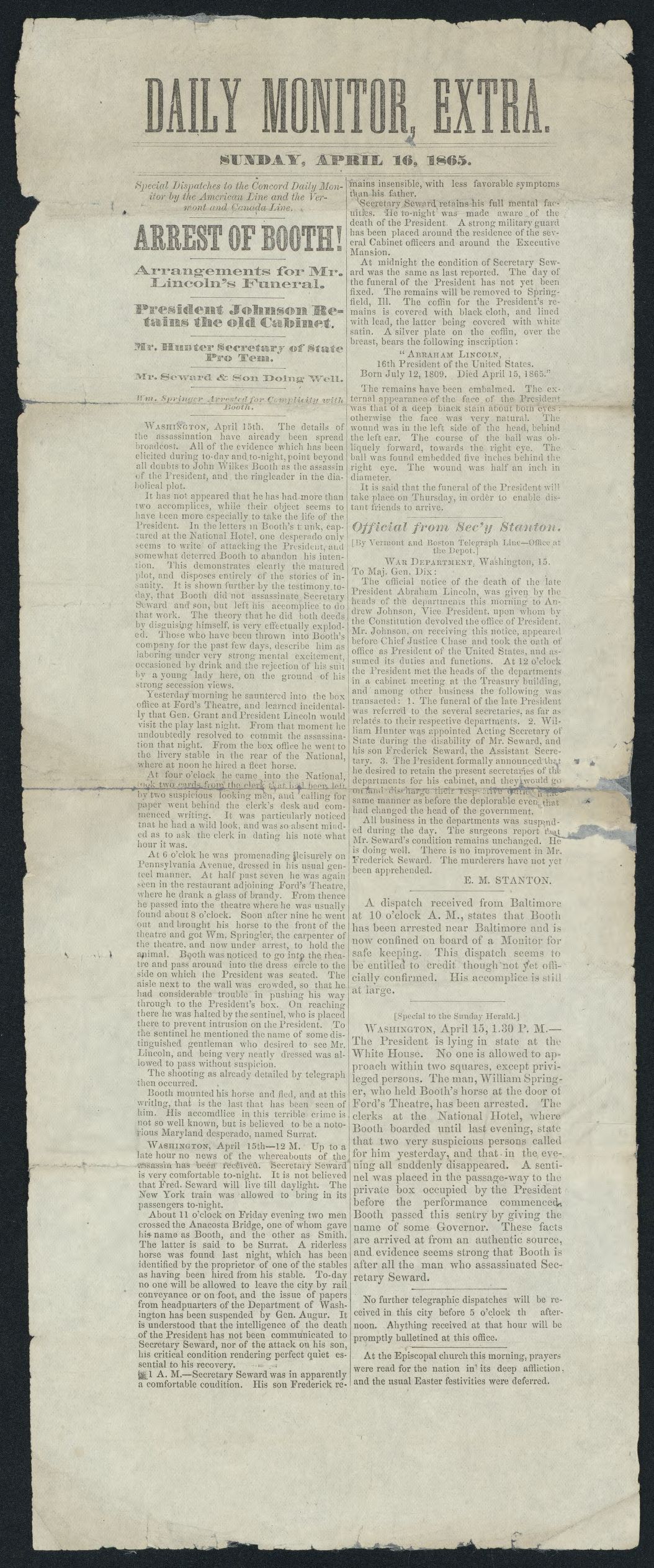
An April 16, 1865 edition of the Daily Monitor Extra from Concord, Vermont that falsely reports the arrest of John Wilkes Booth.
-
Transcription
DAILY MONITOR EXTRA
SUNDAY, APRIL 16, 1865
Special Dispatches to the Concord Daily Monitor by the American Line and the Vermont and Canada Line.
ARREST OF BOOTH!
Arrangements for Mr. Lincoln’s Funeral.
President Johnson Retains the old Cabinet.
Mr. Hunter Secretary of State Pro Tem.
Mr. Seward & Son Doing Well.
Wm. Springer Arrested for Complicity with Booth.
Washington, April 15th. The details of the assassination have already been spread broadcost. All of the evidence which has been elicited during to-day and to-night, point beyond all doubts to John Wilkes Booth as the assassin of the President, and the ringleader in the diabolical plot.
It has not appeared that he has had more than two accomplices, while their object seems to have been more especially to take the life of the President. In the letters in Booth’s trunk, captured at the National Hotel, one desperado only seems to write of attacking the President, and somewhat deterred Booth to abandon his intention. This demonstrates clearly the matured plot, and disposes entirely of the stories of insanity. It is shown further by the testimony today, that Booth did not assassinate Secretary Seward and son, but left his accomplice to do that work. The theory that he did both deeds by disguising himself, is very effectually exploded. Those who have been thrown into Booth’s company for the past few days describe him as laboring under very strong mental excitement, occasioned by drink and the rejection of his suit by a young lady here, on the ground of his strong secession views.
Yesterday morning he sauntered into the box office at Ford’s Theatre, and learned incidentally that Gen. Grant and President Lincoln would visit the play last night. From that moment he undoubtedly resolved to commit the assassination that night. From the box office he went to the livery stable in the rear of the National, where at noon he hired a fleet horse.
At four o’clock he came into the National, took two cards from the clerk that had been left by two suspicious looking men, and calling for paper went behind the clerk’s desk and commenced writing. It was particularly noticed that he had a wild look, and was so absent minded as to ask the clerk in dating his note what hour it was.
At 6 o’clok [clock] he was promenading leisurely on Pennsylvania Avenue, dressed in his usual genteel manner. At half past seven he was again seen in the restaurant adjoining Ford’s Theatre, where he drank a glass of brandy. From thence he passed into the theatre where he was usually found about 8 o’clock. Soon after nine he went out and brought his horse to the front of the theatre and got Wm. Springler, the carpenter of the theatre, and now under arrest, to hold the animal. Booth was noticed to go into the theatre and pass around into the dress circle to the side on which the President was seated. The aisle next to the wall was crowded, so that he had considerable trouble in pushing his way through to the President’s box. On reaching there he was halted by the sentinel, who is placed there to prevent intrusion on the President. To the sentinel he mentioned the name of some distinguished gentleman who desired to see Mr. Lincoln, and being very neatly dressed was allowed to pass without suspicion.
The shooting as already detailed by telegraph then occurred.
Booth mounted his horse and fled, and at this writing, that is the last that has been seen of him. His accomdlice [accomplice] in this terrible crime is not so well known, but is believed to be a notorious Maryland desperado, named Surrat [Surratt].
WASHINGTON, April 15th—12 M. Up to a late hour no news of the whereabouts of the assassin has been received. Secretary Seward is very comfortable to-night. It is not believed that Fred. Seward will live till daylight. The New York train was allowed to bring in its passengers to-night.
About 11 o’clock on Friday evening two men crossed the Anacosta [Anacostia] Bridge, one of whom gave his name as Booth, and the other as Smith. The latter is said to be Surrat. A riderless horse was found last night, which has been identified by the proprietor of one of the stables as having been hired from his stable. To-day no one will be allowed to leave the city by rail conveyance or on foot, and the issue of papers from headpuarters [headquarters] of the Department of Washington has been suspended by Gen. Augur. It is understood that the intelligence of the death of the President has not been communicated to Secretary Seward, nor of the attack on his son, his critical condition rendering perfect quiet essential to his recovery.
1 A.M.—Secretary Seward was in apparently a comfortable condition. His son Frederick remains insensible, with less favorable symptoms than his father.
Secretary Seward retains his full mental faculties. He to-night was made aware of the death of the President. A strong military guard has been placed around the residence of the several Cabinet officers and around the Executive Mansion.
At midnight the condition of Secretary Seward was the same as last reported. The day of the funeral of the President has not yet been fixed. The remains will be removed to Springfield, Ill. The coffin for the President’s remains is covered with black cloth, and lined with lead, the latter being covered with white satin. A silver plate on the coffin, over the breast, bears the following inscription:
“ABRAHAM LINCOLN
16th President of the United States.
Born July 12, 1809. Died April 15, 1865.”
The remains have been embalmed. The external appearance of the face of the President was that of a deep black stain about both eyes; otherwise the face was very natural. The wound was in the left side of the head, behind the left ear. The course of the ball was obliquely forward, towards the right eye. The ball was found embedded five inches behind the right eye. The wound was half an inch in diameter.
It is said that the funeral of the President will take place on Thursday, in order to enable distant friends to arrive.
________________________
Official from Sec’y Stanton.
[By Vermont and Boston Telegraph Line—Office at the Depot.]
WAR DEPARTMENT, Washington, 15.
To Maj. Gen. Dix:
The official notice of the death of the late President Abraham Lincoln, was given by the heads of the departments this morning to Andrew Johnson, Vice President, upon whom by the Constitution devolved the office of President. Mr. Johnson, on receiving this notice, appeared before Chief Justice Chase and took the oath of office as President of the United States, and assumed its duties and functions. At 12 o’clock the President met the heads of the departments in a cabinet meeting at the Treasury building, and among other business the following was transacted: 1. The funeral of the late President was referred to the several secretaries, as far as relates to their respective departments. 2. William Hunter was appointed Acting Secretary of State during the disability of Mr. Seward, and his son Frederick Seward, the Assistant Secretary. 3. The President formally announced that he desired to retain the present secretaries of the departments for his cabinet, and they would go on and discharge their respective duties in the same manner as before the deplorable even[t] that had changed the head of the government.
All business in the departments was suspended during the day. The surgeons report that Mr. Seward’s condition remains unchanged. He is doing well. There is no improvement in Mr. Frederick Seward. The murderers have not yet been apprehended.
E. M. STANTON
________________
A dispatch received from Baltimore at 10 o'clock A.M., states that Booth has been arrested near Baltimore and is now confined on board of a Monitor for safe keeping. This dispatch seems to be entitled to credit though not yet officially confirmed. His accomplice is still at large.
________________
[Special to the Sunday Herald.]
WASHINGTON, April 15, 1:30 P. M.—The President is lying in state at the White House. No one is allowed to approach within two squares, except privileged persons. The man, William Springer [Edman Spangler], who held Booth’s horse at the door of Ford’s Theatre, has been arrested. The clerks at the National Hotel, where Booth boarded until last evening, state that two very suspicious persons called for him yesterday, and that in the evening all suddenly disappeared. A sentinel was placed in the passage-way to the private box occupied by the President before the performance commenced. Booth passed this sentry by giving the name of some Governor. These facts are arrived at from an authentic source, and evidence seems strong that Booth is after all the man who assassinated Secretary Seward.
_____________________
No further telegraphic dispatches will be received in this city before 5 o’clock th [this] afternoon. Ahything [anything] received at that hour will be promptly bulletined at this office.
_______________________
At the Episcopal church this morning prayers were read for the nation in its deep affliction, and the usual Easter festivities were deferred.
[Transcription by: Deborah Taylor] -
Source
Library of Congress, Alfred Whital Stern Collection of Lincolniana, portfolio 3, no. 9, Stern catalog 4754
-
Rights
This item is in the public domain and may be reproduced and used for any purpose, including research, teaching, private study, publication, broadcast or commercial use, with proper citation and attribution
-
Tags
-
Cite this Item
Daily Monitor Extra. ""Arrest of Booth!"". Remembering Lincoln. Web. Accessed December 14, 2025. https://rememberinglincoln.fords.org/node/751
-
Creator
Daily Monitor Extra
-
Date
April 16, 1865
from Apr. 16, 1865
"Arrest of Booth!"
-
Description
An April 16, 1865 edition of the Daily Monitor Extra from Concord, Vermont that falsely reports the arrest of John Wilkes Booth.
-
Source
Library of Congress, Alfred Whital Stern Collection of Lincolniana, portfolio 3, no. 9, Stern catalog 4754
-
Rights
This item is in the public domain and may be reproduced and used for any purpose, including research, teaching, private study, publication, broadcast or commercial use, with proper citation and attribution
-
Creator
Daily Monitor Extra
-
Date
April 16, 1865