from May. 2, 1865
Dispatch: William Hunter to Charles Francis Adams
-
Full Title
State Department Instruction 1383: William Hunter to Charles Francis Adams
-
Description
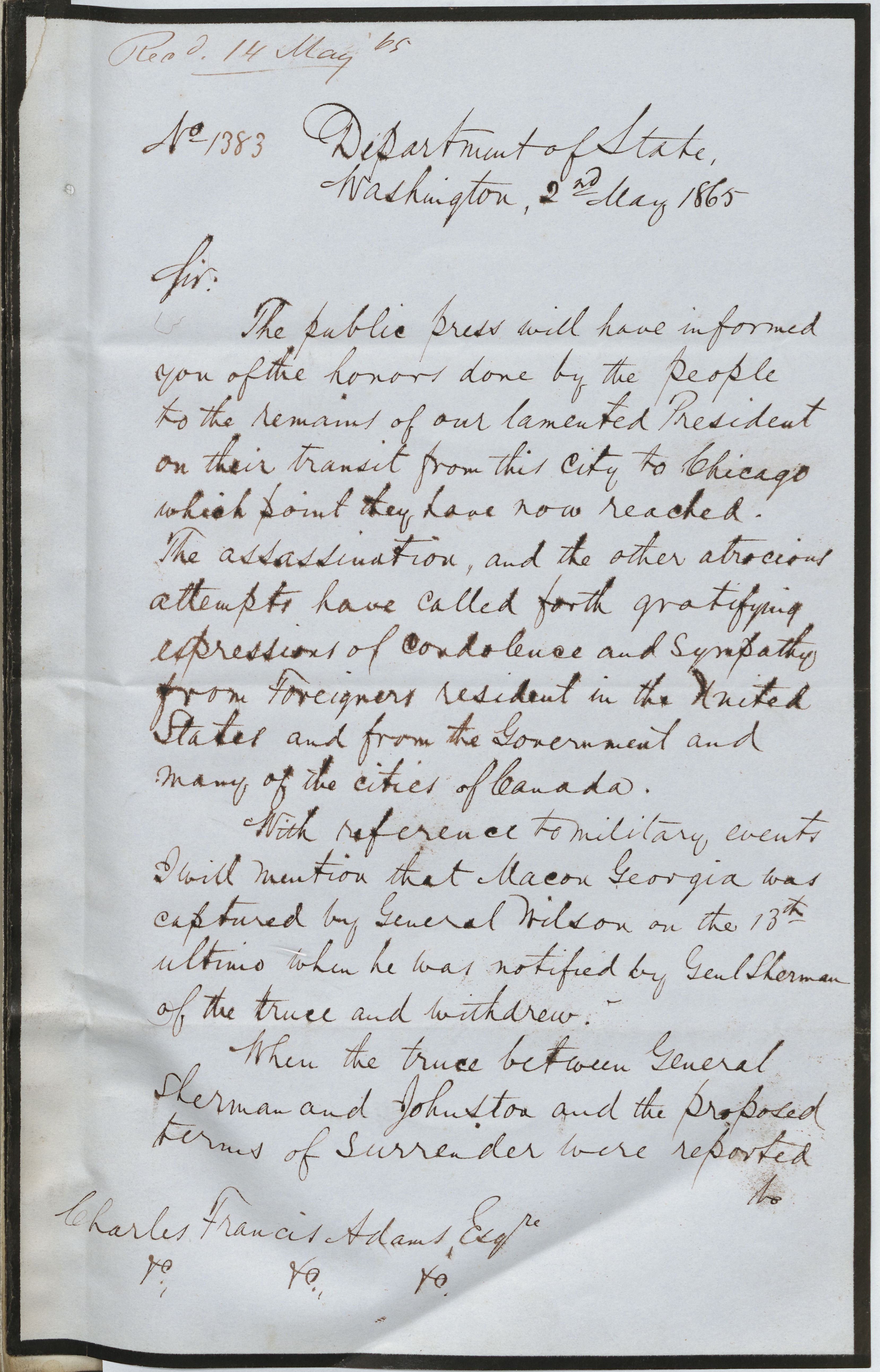
Dispatch from Acting Secretary of State William H. Hunter to Charles Francis Adams, U.S. Minister to the United Kingdom, concerning the latest news about the funeral of the assassinated President Abraham Lincoln (his body was in Chicago), the death of assassin John Wilkes Booth, and the surrender of Confederate General Joseph Johnston.
-
Transcription
Recd 14 May 1865
No 1383 Department of State Washington, 2nd May 1865
Sir:
The public press will have informed you of the honor done by the people to the remains of our lamented President on their transit of this city to Chicago which point they have now reached. The assassination, and the other atrocious attempt, have called forth gratifying expressions of condolence and sympathy from foreigners resident in the United States and from the Government and many of the cities of Canada.
With reference to military events I will mention that Macon Georgia was captured by General Wilson on the 13th ultimo when he was notified by Genl Sherman of the truce and withdrew.
When the truce between General Sherman and Johnston and the proposed terms of surrender were reported
Charles Francis Adams Esqre
[Transcription by: Taryn S. and her father David, Mr. Rude’s class, New Hampton Middle School, New Hampton, Iowa.]
-
Source
Office of the Historian, U.S. Department of State and National Archives, Record Group 84
-
Rights
This item is in the public domain and may be reproduced and used for any purpose, including research, teaching, private study, publication, broadcast or commercial use, with proper citation and attribution.
-
Tags
-
Cite this Item
William Hunter. "State Department Instruction 1383: William Hunter to Charles Francis Adams". Remembering Lincoln. Web. Accessed April 3, 2026. https://rememberinglincoln.fords.org/node/748
-
Creator
William Hunter
-
Date
May 2, 1865
from May. 2, 1865
State Department Instruction 1383: William Hunter to Charles Francis Adams
-
Description
Dispatch from Acting Secretary of State William H. Hunter to Charles Francis Adams, U.S. Minister to the United Kingdom, concerning the latest news about the funeral of the assassinated President Abraham Lincoln (his body was in Chicago), the death of assassin John Wilkes Booth, and the surrender of Confederate General Joseph Johnston.
-
Source
Office of the Historian, U.S. Department of State and National Archives, Record Group 84
-
Rights
This item is in the public domain and may be reproduced and used for any purpose, including research, teaching, private study, publication, broadcast or commercial use, with proper citation and attribution.
-
Creator
William Hunter
-
Date
May 2, 1865
from Apr. 17, 1865
Instruction, Hunter to Adams
-
Full Title
State Department Instruction 1352: William Hunter to Charles Francis Adams
-
Description
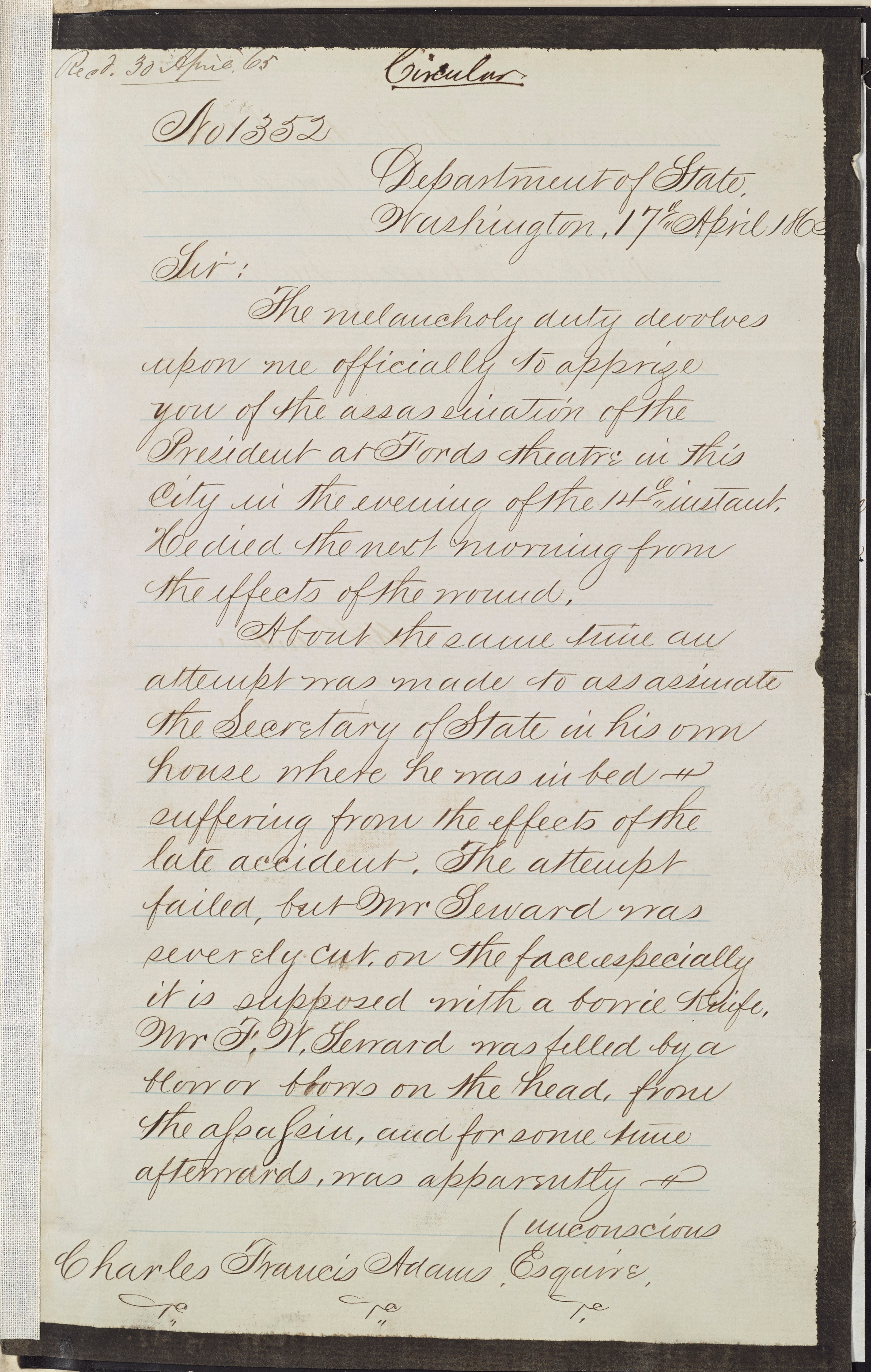
Official dispatch from William H. Hunter to Charles Francis Adams, U.S. Minister to the United Kingdom, informing him of Lincoln's assassination and the attempt on Secretary of State William H. Seward's life. Hunter notes that William and Frederick Seward are both expected to recover, but that, in the meanwhile, Hunter is serving as Acting Secretary of State. Because the Transatlantic telegraph cable was no longer functioning, Adams received this dispatch on April 30.
-
Transcription
Read. 30 Apr. 65.
Circular
No. 1352
Department of state.
Washington. 17th April 1865
Sir:
The melancholy duty devolves
upon me officially to apprise
You of the assassination of the
president at Ford’s theatre in this
city in the evening of the 14th instant.
He died the next morning from
the effects of the wound.
About the same time an
attempt was made to assassinate
the Secretary of State in his own
house where he was in bed &
Suffering from the effects of the
late accident. The attempt failed, but Mr. Seward was
severely cut, on the face especially
it is supposed with a bowie knife.
Mr J; H, Seward was felled by a
blow or blows on the head, from
the assassin, and for some time
afterwards was apparently
Unconscious
Charles Francis Adam, Esquire,
Next page
Unconscious. Both the Secretary
and assistant Secretary are better
especially the former.
Andrew Johnson has formally
entered upon the duties of
President.
I have been authorized
temporarily to act as Ssecretary
of State.
[[?]], Sir
Your obedient servant
W.J. Hunter
Acting Secretary
[Transcription Team: Joshua H., Caleb D., Conner R., Carson B.]
[New Hampton Middle School, New Hampton, Iowa]
-
Source
Office of the Historian, U.S. Department of State and National Archives, Record Group 84
-
Rights
This item is in the public domain and may be reproduced and used for any purpose, including research, teaching, private study, publication, broadcast or commercial use, with proper citation and attribution.
-
Tags
-
Cite this Item
William Hunter. "State Department Instruction 1352: William Hunter to Charles Francis Adams". Remembering Lincoln. Web. Accessed April 3, 2026. https://rememberinglincoln.fords.org/node/744
-
Creator
William Hunter
-
Date
April 17, 1865
from Apr. 17, 1865
State Department Instruction 1352: William Hunter to Charles Francis Adams
-
Description
Official dispatch from William H. Hunter to Charles Francis Adams, U.S. Minister to the United Kingdom, informing him of Lincoln's assassination and the attempt on Secretary of State William H. Seward's life. Hunter notes that William and Frederick Seward are both expected to recover, but that, in the meanwhile, Hunter is serving as Acting Secretary of State. Because the Transatlantic telegraph cable was no longer functioning, Adams received this dispatch on April 30.
-
Source
Office of the Historian, U.S. Department of State and National Archives, Record Group 84
-
Rights
This item is in the public domain and may be reproduced and used for any purpose, including research, teaching, private study, publication, broadcast or commercial use, with proper citation and attribution.
-
Creator
William Hunter
-
Date
April 17, 1865
from Apr. 15, 1865
Stanton Dispatch to Charles Francis Adams
-
Full Title
Dispatch, Edwin Stanton to Charles Francis Adams
-
Description
The official dispatch from U.S. Secretary of War Edwin Stanton to Charles Francis Adams, U.S. Minister to the United Kingdom, notifying the latter of the assassination of President Abraham Lincoln. Because the Transatlantic telegraph line was no longer operational, Adams did not receive the news for 11 days.
-
Transcription
Recd. 26 April, 1865
Charles Francis Adams
United States Minister, London
Washington, DC 15 April, 1865
Sir.
It has become my distressing duty to announce to you that last night His Excellency Abraham Lincoln President of The United States, was assassinated, about the hour of half past 10 o’clock, in his private box at Ford’s Theatre, in this city. The President about eight o’clock accompanied Mrs. Lincoln to the theatre. Another lady and gentleman were with them in the box. About half past ten during a pause in the performance, the assassin entered the box, the door of which was unguarded, hastily approached the President from behind, and discharged a pistol at his head. The bullet entered the back of his head, and penetrated nearly through. The assassin then leaped from the box upon the stage, brandishing a large knife or dagger, and exclaiming ‘Sic semper tyrannis!’ and escaped in the rear of the theatre. Immediately upon the discharge the President fell to the floor insensible, and continued in that state until 20 minutes past 7 o’clock this morning when he breathed his last. About the same time the murder was being committed at the Theatre another assassin presented himself at the door of Mr. Seward’s residence, gained admission by representing he had a prescription from Mr. Seward’s physicians which he was directed to see administered and hurried up to the third story chamber where Mr. Seward was lying. He here discovered Mr. Frederick Seward, struck him over the head, inflicting several wounds, and fracturing the skull in two places, inflicting, it is feared mortal wounds. He then rushed into the room where Mr. Seward was in bed, attended by a young daughter and a male nurse. The male attendant was stabbed through the lungs, and it is believed will die. The assassin then struck Mr. Seward with a knife or dagger twice in the throat and twice in the face, inflicting terrible wounds. By this time Major Seward, eldest son of the Secretary, and another attendant reached the room, and rushed to the rescue of the Secretary; they were also wounded in the conflict, and the assassin escaped. No artery or important blood vessel was severed by any of the wounds inflicted upon him, but he was for a long time insensible from the loss of blood. Some hope of his possible recovery is entertained. Immediately upon the death of the President notice was given to Vice President Johnson, who happened to be in the City, and upon whom the office of President now devolves. He will take the office and assume the functions of President to-day. The murderer of the President has been discovered, and evidence obtained that these horrible crimes were committed in execution of conspiracy deliberately planned and set on foot by rebels on pretence of avenging the South and aiding the rebel cause; but it is hoped that the (?) perpetrators will be caught.
The feeling occasioned by these atrocious crimes is so great, sudden, and overwhelming that I cannot at present do more than communicate them to you. At the earliest moment yesterday the late President called a Cabinet meeting, at which General Grant was present. He was more cheerful and happy than I had ever seen him, rejoiced at the near prospect of firm and durable peace at home and abroad, manifested in a marked degree the kindness and humanity of his disposition, and the tender and forgiving spirit that so eminently distinguished him. Public notice had been given that he and General Grant, would be present at the Theatre, and the opportunity of adding the Lieutenant General to the number of victims to be murdered was no doubt seized for the fitting occasion of executing the plans that appear to have been in preparation for some weeks, but General Grant was compelled to be absent, and thus escaped the designs upon him. It is needless for me to say anything in regard to the influence which this atrocious murder of the President may exercise upon the affairs of this country, but I will only add that, horrible as are the atrocities that have been resorted to by the enemies of the country, they are not likely in any degree to impair the public spirit, or postpone the complete and final overthrow of the rebellion. In profound grief for the events, which it has become my duty to communicate to you,
I have the honor to be
Very respectfully
Your obt. Servant
Edwin M. Stanton
[Transcription by Dale Anderson.] -
Source
Office of the Historian, U.S. Department of State and National Archives, Record Group 84
-
Rights
This item is in the public domain and may be reproduced and used for any purpose, including research, teaching, private study, publication, broadcast or commercial use, with proper citation and attribution.
-
Tags
-
Cite this Item
Edwin Stanton. "Dispatch, Edwin Stanton to Charles Francis Adams". Remembering Lincoln. Web. Accessed April 3, 2026. https://rememberinglincoln.fords.org/node/743
-
Creator
Edwin Stanton
-
Date
April 15, 1865
from Apr. 15, 1865
Dispatch, Edwin Stanton to Charles Francis Adams

-
Description
The official dispatch from U.S. Secretary of War Edwin Stanton to Charles Francis Adams, U.S. Minister to the United Kingdom, notifying the latter of the assassination of President Abraham Lincoln. Because the Transatlantic telegraph line was no longer operational, Adams did not receive the news for 11 days.
-
Source
Office of the Historian, U.S. Department of State and National Archives, Record Group 84
-
Rights
This item is in the public domain and may be reproduced and used for any purpose, including research, teaching, private study, publication, broadcast or commercial use, with proper citation and attribution.
-
Creator
Edwin Stanton
-
Date
April 15, 1865
from Apr. 19, 1865
Willie Clark to Ida Clark
-
Full Title
Willie Clark to Ida Clark
-
Description
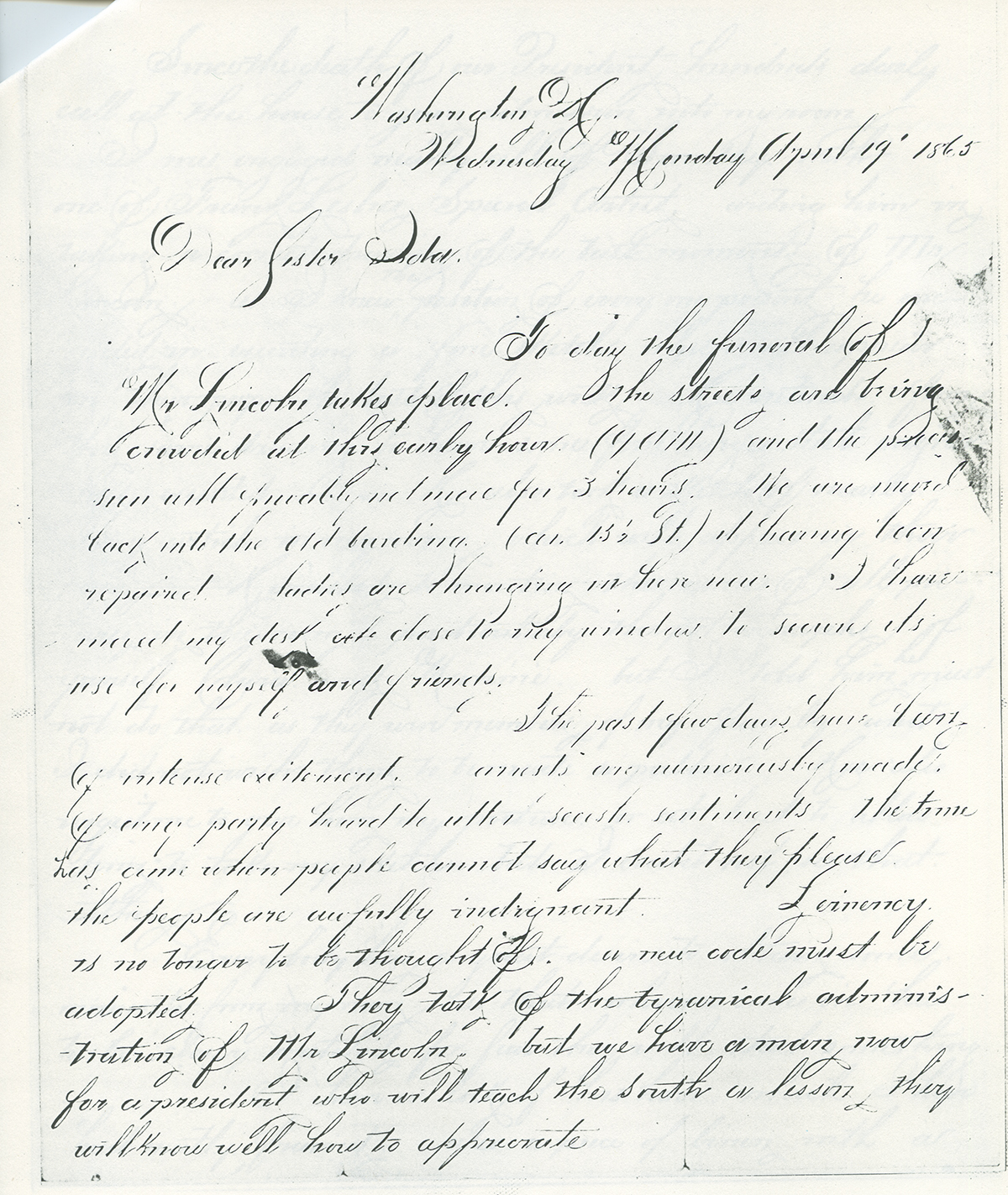
Willie Clark, the Petersen House boarder who lived in the room in which President Lincoln died, wrote to his sister four days after Lincoln's death. He described the scene in Washington, including funeral preparations, the hunt for the killers, and, most notably, souvenir hunters who daily came into his room. Clark himself kept some souvenirs, and sent others to his sister.
-
Transcription
Washington, DC
Wednesday Monday April 19, 1865
Dear Sister Ida.
To day the funeral of Mr. Lincoln takes place, the streets are being crowded at this early hour. (9 A M) and the procession will probably not move for 3 hours. We are moved back into the old building (Cor. 15 1/2.) It having been repaired. Ladies are thronging in here now, I have moved my desk close to my window to secure its use for myself and friends.
The past few days have been of intense excitement. Arrests are numerously made, of any party heard to utter secesh sentiments. The time has come when people cannot say what they please, the people are awfully indignant. Leinency is no longer to be thought of. A new code must be adopted.
They talk of the tyranical administration of Mr. Lincoln, but we have a man now for a president who will teach the south a lesson they will know well how to appreciate.
Since the death of our president hundreds daily call at the house to gain admission into my room.
I was engaged nearly all of Sunday with one of Frank Leslies Special Artist aiding him viz making a correct drawing of the last moments of Mr. Lincoln, as I knew the position of every one present he succeeded in executing a fine sketch, which will appear in their paper the last of this week. He intends, from this same drawing to have some fine large steel engravings executed. He also took a sketch of nearly every article in my room which will appear in their paper. He wished to mention the names of all in the room particularly the pothographs of yourself, Clara and Nannie, but I told him he must not do that, as they were members of my family and I did not wish them to be made so public. He also urged me to give him my picture or at least to allow him to take my sketch, but I could not see that. either.
Everybody has a great desire to obtain some memento from my room so that whoever comes in has to be closely watched for fear they will steal something.
I have a lock of his hair which I have had neatly framed, also a piece of linen with a portion of his brain, the pillow and case upon which he lay when he died and nearly all his wearing apparel but the latter I intend to send to Robt Lincoln as soon as the funeral is over, as I consider him the one most justly entitled to them.
The same matrass is on my bed, and the same coverlit covers me nightly that covered him while dying.
Enclosed you will find a piece of lace that Mrs. Lincoln wore on her head during the evening and was dropped by her while entering my room to see her dying husband It is worth keeping for its historical value.
The cap worked by Clara and the cushion by you, you little dreamed would be so historically connected with such an event.
I received your letter but before I answer it I must see what I can do. With that exception I have not received any letters although you blame me for not writing when to my knowledge I have written four, and you must be aware I am very anxious to hear about mothers health which in your letter you did not mention.
I wrote auntie a letter about a week ago and enclosed a love letter to Ella promising to marry her when I get to be 21.
Remember me to Henry Littlefield. Tell him I shall write him soon. Remember to Mrs . Little and family and all enquiring friends.
Love to father mother
and Clara, and dont forget you have a brother and send me a longer note soon.
I will write again soon.
Your affe. Brother
Willie
Please not give away any of this lace, out of our own family.
Envelope addressed to Miss Ida F. Clark, No. 7 Warren Street,
Boston Mass.
-
Source
National Park Service, Ford's Theatre National Historic Site; transcription by Richard Sloan, Surratt Courier, April 1991
-
Rights
This item is in the public domain and may be reproduced and used for any purpose, including research, teaching, private study, publication, broadcast or commercial use, with proper citation and attribution.
-
Tags
-
Cite this Item
William Clark. "Willie Clark to Ida Clark". Remembering Lincoln. Web. Accessed April 3, 2026. https://rememberinglincoln.fords.org/node/707
-
Creator
William Clark
-
Date
April 19, 1865
from Apr. 19, 1865
Willie Clark to Ida Clark
-
Description
Willie Clark, the Petersen House boarder who lived in the room in which President Lincoln died, wrote to his sister four days after Lincoln's death. He described the scene in Washington, including funeral preparations, the hunt for the killers, and, most notably, souvenir hunters who daily came into his room. Clark himself kept some souvenirs, and sent others to his sister.
-
Source
National Park Service, Ford's Theatre National Historic Site; transcription by Richard Sloan, Surratt Courier, April 1991
-
Rights
This item is in the public domain and may be reproduced and used for any purpose, including research, teaching, private study, publication, broadcast or commercial use, with proper citation and attribution.
-
Creator
William Clark
-
Date
April 19, 1865
from Apr. 24, 1865
B. B. Emory to Unknown
-
Full Title
B. B. Emory to Unknown
-
Description
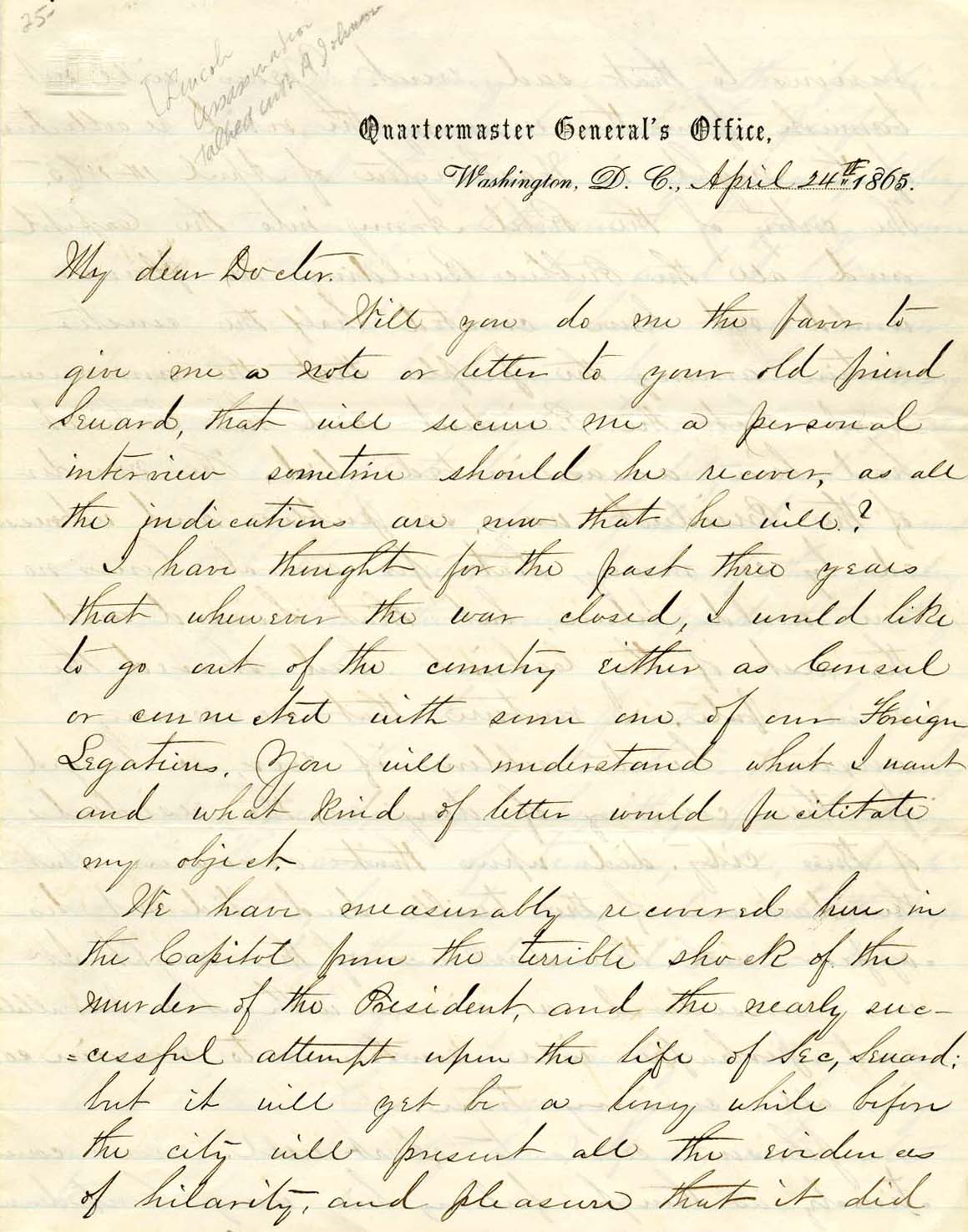
Emory writes to an unnamed doctor, asking for letter of recommendation to Secretary of State William H. Seward for a consular position. In his letter, Emory discusses the assassination of Abraham Lincoln, the public mood in Washington, D.C., as well as the actions of President Andrew Johnson.
-
Transcription
Lincoln Assassination talked with A Johnson
Quartermaster General's Office,
Washington, D. C., April 24th 1865.
My dear Doctor.
Will you do me the favor to give me a note or letter to your old friend Seward, that will secure me a personal interview sometime should he recover, as all the indications are now that he will?
I have thought for the past three years that whenever the war closed, I would like to go out of the country either as Consul or can we elect with some one of our Foreign Legations. You will understand what I want and what kind of letter would facilitate my object.
We have measurably recovered here in the Capitol from the terrible shock of the murder of the President, and the nearly successful attempt upon the life of Sec, Seward: but it will yet be a long while before the city will present all the evidences of hilarity, and pleasure that it did previous to that sad event. News will not banish from the memory the vivid recollectiv of the night in Washington of April 14. 1865. The entry of the Rebel Army into the Capitol and all the Public Buildings in flames would not have created half the consternation among the people that the announcement that the President and his Cabinet had been assassinated did. The murder of the President was so public and witnessed by so many, that for several hours no one would believe, but that Seward and the rest of the Cabinet had shared the same fate. I venture that so many anxious hearts seldom if ever, so longed for the coming of day as the residents of this city did upon that occasion. But the darkness of the terrible deed did not disappear with the darkness of the night. It was considered a crime without a parallell and perhaps will continue to remain so, in all coming time. Johnson seems to start well. moves cautiously as though feeling his way. Confidence in him is increasing among the public men of the government and the people generally and the cloud is gradually lifting I think Johnson is determined to fully recover himself with the country and I believe he will succeed. I saw him and conversed with him half an hour the evening of the day upon which he was inaugurated. I liked his spirit, his humility, and above all his dependence upon God and his earnest desire that the Christian part of the country would give him the same support, that they gave Mr Lincoln.
There is at least one point in his policy that is more than indicated. this country will be made exceedingly unhealthy for leading traitors. The crime of treason, will, under his administration, be much more odious to the people of this country than it would under Mr Lincolns policy. But I am unintentionally writing a long letter. Can I serve you any way, in any capacity here? If so, intimate to me how. I have seen two notices of your last Book, in the Adwente, but the Book I have not seen, the excitement here has been so intense and constant for a month past that nearly everthing else has been overlooked.
What can I do in regard to it?
As Ever
Truly yours.
B. B. Emory
I send two Confederate Bonds, taken from the Treasury Dept in Richmond, the day our troops entered. They are genuine, and were brought dinot to me by my friend Rev J. M. Vincent of Chicago Ill
If any of your Copperhead friends are in a speculating mood I advise you to sell if they will give the face of the Bonds, The Coupons on one as you see was already signed.
Seward is much better. - quite out of danger, but his son is still in a critical condition
E.
April 25, 65
5 OClock. P.M -
Source
B. B. Emory Letter
-
Rights
The Abraham Lincoln Presidential Library and Museum holds all rights and permissions.
-
Tags
-
Cite this Item
Emory, B. B.. "B. B. Emory to Unknown". Abraham Lincoln Presidential Library and Museum. Remembering Lincoln. Web. Accessed April 3, 2026. https://rememberinglincoln.fords.org/node/705

-
Creator
Emory, B. B.
-
Publisher
Abraham Lincoln Presidential Library and Museum
-
Date
April 24th, 1865
-
Material
paper and ink
-
Dimensions
39 x 25 cm
from Apr. 24, 1865
B. B. Emory to Unknown
-
Description
Emory writes to an unnamed doctor, asking for letter of recommendation to Secretary of State William H. Seward for a consular position. In his letter, Emory discusses the assassination of Abraham Lincoln, the public mood in Washington, D.C., as well as the actions of President Andrew Johnson.
-
Source
B. B. Emory Letter
-
Rights
The Abraham Lincoln Presidential Library and Museum holds all rights and permissions.
-
Creator
Emory, B. B.
-
Publisher
Abraham Lincoln Presidential Library and Museum
-
Date
April 24, 1865
-
Material
paper and ink
-
Dimensions
39 x 25 cm
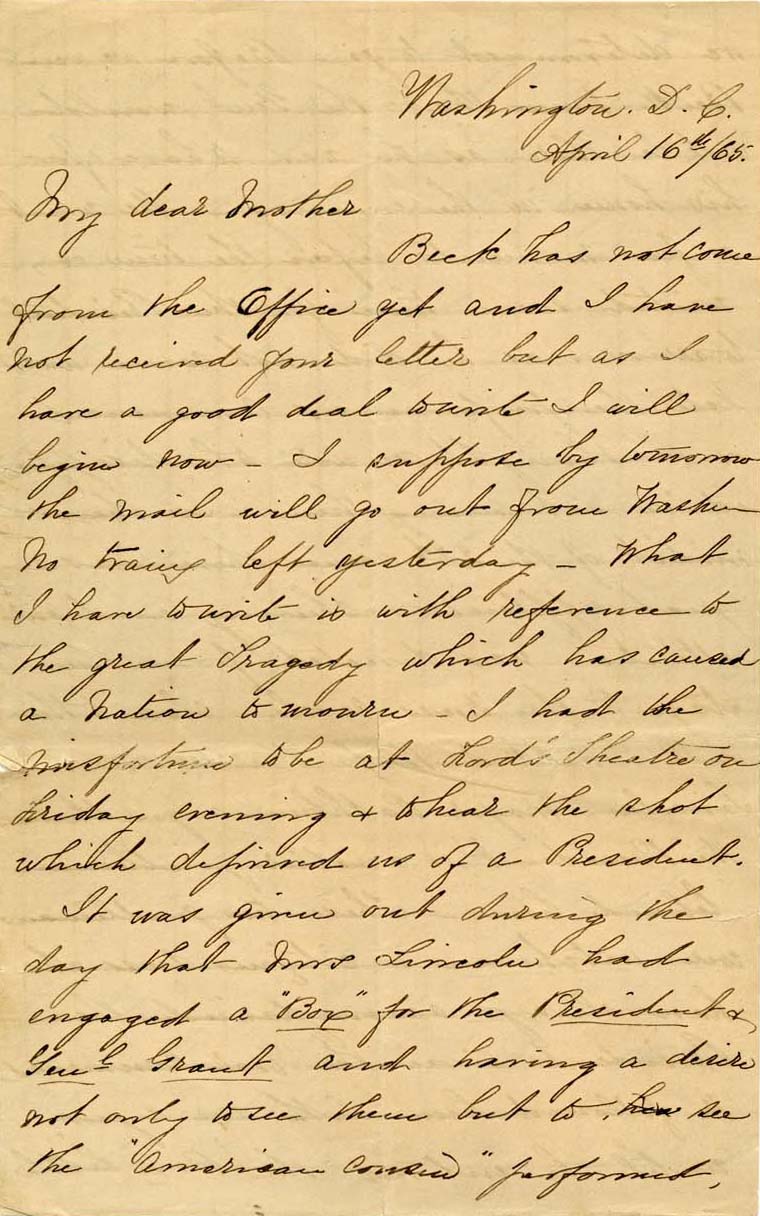
from Apr. 16, 1865
Helen DuBarry to Ann Bratt
-
Full Title
Helen Augusta Bratt DuBarry to Ann A. Lamoureaux Bratt
-
Description
Helen DuBarry writes to her mother, providing a detailed account of the assassination of President Lincoln, which Helen witnessed as a member of the audience at Ford's Theatre on the night of April 14, 1865.
-
Transcription
Washington. D. C.
April 16th/65.
My dear mother
Beck has not come from the Office yet and I have not received your letter but as I have a good deal to write I will begin now. I suppose by tomorrow the mail will go out from Washington no trains left yesterday. What I have to write is with reference to the great tragedy which has caused a nation to mourn. I had the misfortune to be at Ford's Theatre on Friday evening & to hear the shot which deprived us of a President.
It was given out during the day that Mr Lincoln had engaged a "Bop" for the President & Genl Grant and having a desire not only to see them but to see the "American Cousin" performed, we determined to go. Before we went Beck knew that the Genl would not be there as he was to leave for his home in the evening. We went a few moments before the time & waited some time for the President to arrive & as he did not come until late the performances Commenced & we thought we were to be disappointed in not seeing him. In the midst of the 2nd scene there was a great applause & cheering and our attention was directed from the stage to the Dress Circle, close to the wall, walked Miss Harris, Mrs Lincoln, Major Rathbone, a gentleman the President & another gentleman behind him. These two gentleman were watchman in citizens dress who have always accompanied the President since the War commenced We followed him with our eyes until he entered the Box little thinking we were looking for the last time at him. He sat looking on the stage his back to us and out of our sight behind the flags except occasionnally when he would lean forward. Mrs Lincoln was in front of him and we only saw her occasionally. We saw her smile & turn towards him several times. It was while every one's attention was fastened upon the stage that a pistol shot was heard causing every one to jump (as an unexpected shot will) & look up at the President's Box merely because that was the direction of the sound and supposing it to be part of the performance we all looked again on the stage, when a man suddenly vaulted over the railing of the box, turned back & then leaped to the stage, striking on his heels & falling backward but recovered himself in an instant and started across the stage to behind the scenes florishing a knife, the blade of which appeared in the reflection of the bright lights to be half as long as a man's arm, and making use of the expressions you have seen in the Papers. He had nearly disappeared before we could understand what it was or what had happened. We first thought it was a crazy man, When he jumped on to the stage we all jumped to our feet & stood spellbound, as he crossed the stage some few started toward the stage crying, our President! our President is shot! Mrs Harris was seen to lean over the railing for water & that was all that broke the stillness in that box. If those watch had called out as soon as the man jumped to give us an idea of what had happened he could have been caught as he stopped to recover himself after the fall. There was not a sould to be seen in the Box and perfect stillness there, which all added to our bewilderment. One man got up on a chair on hearing that the man was caught & said "take out the ladies & hang him here on the spot". Beck fearing a mob hurried me out, leaving the audience still standing awed & speechless. We waited outside until a young man came out & said He is dead, no doubt about it!"
Before we got out of the door someone said "It was J. Wilkes Booth" and before I got out, the idea that our Chief was gone, almost our sole dependence, overcame me & I could not control myself & sobbed aloud we met several outside the door first coming in asking "For God's sake tell me is it true? as if they had heard already rumors of the great tragedy. The reason that we could not suddenly realize what had occurred was because we could not anticipate that an assassin could be in the Box with the President. His only danger seemed to be from a shot fired by one of the audience
Booth entered the front door and asked some one there if Genl Grant was there that night, then went along to the door of the Box, just where we had seen the President enter, knocked at the door & to the watch who opened it, said he wished to speak to the President, that he had a Communication for him showing an Official envelope & giving him a card with the name of a Senator written on it. The watch stepped aside & the assassin entered & fired immediately while Mr Lincoln was looking on the stage
The excitement that night was intense & a mob of about 2000 went to the Old Capitol Prison to burn it & they called upon the people to come out & see the rebels burn. The Police & troops were out & put a stop to it or it would have been done. The assassin at Sewards first stabbed the nurse through the lungs & killed him I believe, knocked in the skull of Fred Seward with a butt of a pistol & stabbed another son, all had opposed his entrance and the old man hearing the scuffle at the door & thinking it was some one after him, rolled out of bed on to the floor and the assassin had to lean over the bed to stab him so he only had two cuts, on his neck & face, which will not prove serious if he has strength after his former sickness. There is no doubt that it was Booth who killed the President. Laura Keene says she can testify that it was him
The secessionists here have all draped their houses in crape, and acknowledge that it was the worst thing for the South that ever happened. their best friend is gone & Andy J will be more severe than Mr Lincoln was. Andy Johnson joined the Temperance Society after the Inaugaration and every one who saw him at his own Inaugaration were much pleased with his manner as he seemed impressed with the responsibility before him.
There are rumored changes to be made in the Cabinet already there was a strange coincidence at the Theatre Friday evening. In the play the American Cousin won the prize at Archery and on recieving the medal was congratualted. He said he "had but done nothing, all it required was a steady hand a clear eye, to pull the trigger & the mark was hit" as he said it he looked right up at the President
That was in the play & he looked there merely because he was the principal person present but afterwards it struck everyone as a strange coincidence
On Friday Beck recieved a letter from Duane who is a prisoner at Point Lookout begging him to forget the Past & to find out for him if he would be allowed to take the oath of Allegiance to the U. S. that he was sick enough of the Confederacy and very sorry he had ever had any thing to do with it. That afternoon Beck went to the Comd Genl of prisoners but he was out, and of course after the awful tragedy Beck did not feel like interceding for a rebel I do not know what he will do now, he may go to Genl Grant if Hoffman won't do anything Don't say anything about it.
I suppose you have read all I have told you, in the Papers but being there myself I supposed you would like to hear it over just as I saw it. The Authorities think that there is no chance for the assassins to escape but I think it is like hunting for a needle in a haystack. Your letter did not come today and when ever it does not come by Sunday it is because you have left it to tell the latest news of adile and when you wrote last she was a little troubled with her throat. I took a letter from Maggie today
I will send this letter today before getting your's. If you send me word how much cloth it takes for adile's sacque I can buy it here & make it if I had the pattern. I have forgotten how wide the material was that Mrs Foster bought, but if I know the length of her sacque & the width of the half at the bottom I can tell how much it would take when I see Mrs Foster about the width of the material. We are well & send love, with kissess to adile.
Your aff daughter
Helen DuB. -
Source
Helen A. Bratt DuBarry Letters
-
Rights
The Abraham Lincoln Presidential Library and Museum holds all rights and permissions.
-
Tags
-
Cite this Item
DuBarry, Helen Augusta Bratt, 1839-1925. "Helen Augusta Bratt DuBarry to Ann A. Lamoureaux Bratt". Abraham Lincoln Presidential Library and Museum. Remembering Lincoln. Web. Accessed April 3, 2026. https://rememberinglincoln.fords.org/node/702
-
Creator
DuBarry, Helen Augusta Bratt, 1839-1925
-
Publisher
Abraham Lincoln Presidential Library and Museum
-
Date
April 16th, 1865
-
Material
paper and ink
-
Dimensions
13 x 20 cm
from Apr. 16, 1865
Helen Augusta Bratt DuBarry to Ann A. Lamoureaux Bratt
-
Description
Helen DuBarry writes to her mother, providing a detailed account of the assassination of President Lincoln, which Helen witnessed as a member of the audience at Ford's Theatre on the night of April 14, 1865.
-
Source
Helen A. Bratt DuBarry Letters
-
Rights
The Abraham Lincoln Presidential Library and Museum holds all rights and permissions.
-
Creator
DuBarry, Helen Augusta Bratt, 1839-1925
-
Publisher
Abraham Lincoln Presidential Library and Museum
-
Date
April 16, 1865
-
Material
paper and ink
-
Dimensions
13 x 20 cm
from Apr. 25, 1865
Helen DuBarry to Ann Bratt
-
Full Title
Helen Augusta Bratt DuBarry to Ann A. Lamoureaux Bratt
-
Description
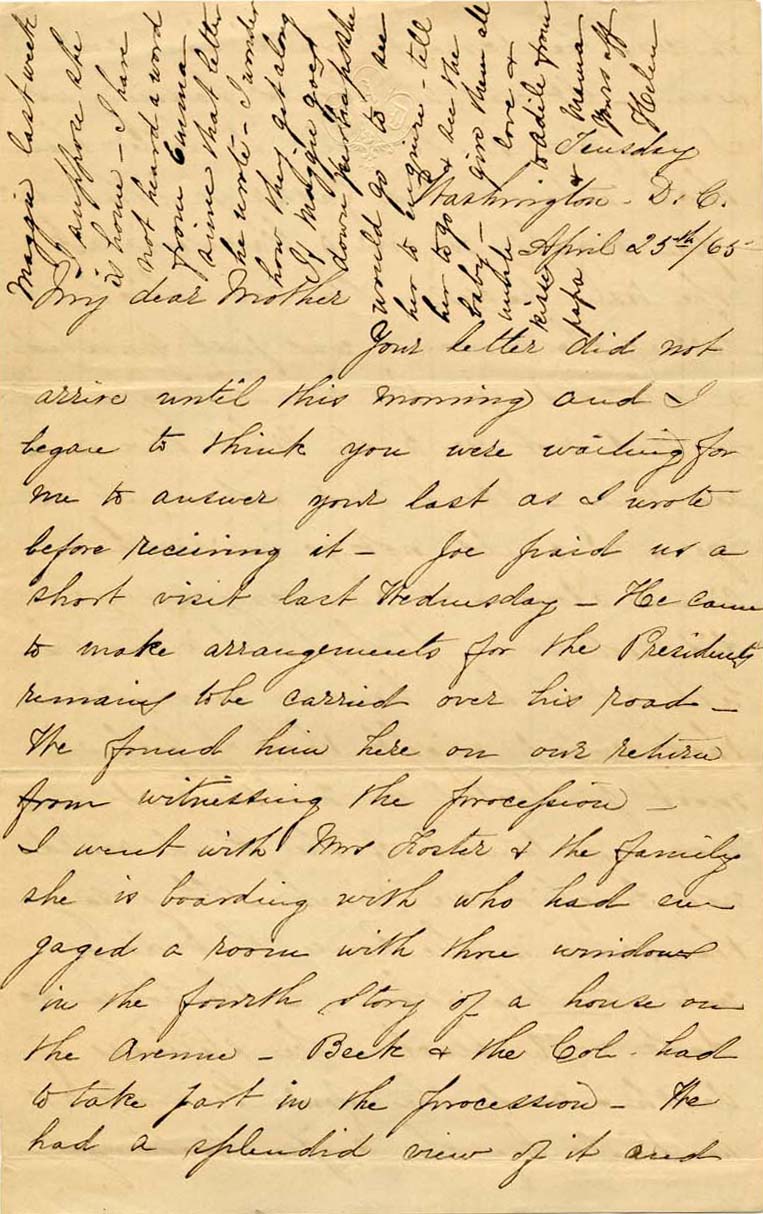
In the wake of Lincoln's assassination, Helen DuBarry writes her mother about witnessing Lincoln's funeral procession in Washington, D.C.
-
Transcription
Teusday
Washington - D. C.
April 25th/65
My dear Mother
Your letter did not arrive until this morning and I began to think you were waiting for me to answer your last as I wrote before recieving it. Joe paid us a short visit last Wednesday. He came to make arrangements for the President's remains to be carried over his road. We found him here on our return from witnessing the procession. I went with Mrs Foster & the family she is boarding with who had engaged a room with three windows in the fourth story of a house on the Avenue. Beck & the Col. had to take part in the procession. We had a splendid view of it and it was the largest one I had ever seen. It was two hours passing us. I suppose W. Y. will do better than that today. Did father go to the City? You might go over to Garrison's as the train passes. The car which carries the remains was first finished & intended for his use living.
I did not go to the White House to see him. Beck did not want to go & I would not go in such a Crowd alone. I am very sorry I did not go. perhaps it is for the best as I have been so nervous since that awful night that I feel almost prostrated in health and any more excitement of the kind would not benefit me much. They say the scene in the house that day were terribly solemn. the house so dark with black. the stillness of death. and the four Generals as sentinels by the Corpse looking solemn & sad. all made the people realize more forcibly what a dreadful thing had happened. Poor Mrs Lincoln has not left her bed since he died & they had to close the doors a half hour before the appointed time as the steady tramp tramp of the people was making her wild so that she did not recognize he own son. To think that his wife's presence did not stay the murderers hand. It is thought by a few who pretend to know that Booth is surely Caught and the Authority do'nt wish it known. There is a great deal known that is not allowed to be published
There is a family of Greenes under arrest for having kept him all night on Friday. They are a good family here & live by the Potomac
Joe staid all night with us and left early the next morning. I have not heard from Carrie in some time. There is an advertised letter for me in the P. O. which they say they are not ready to deliver yet. It is very funny. they must be examining letters. Has Mrs De Janon got to W. P. yet? I see Lou Florishing about here with Officers. I saw her with one at Church Sunday. We think of going next Sunday to Alexandria to attend the church that Genl Washington attended. It will be an interesting trip. Col. Foster gave us two bonds of the Confederate loan which he brought us from Charleston. I have finished my green dress and it looks good as new. I am in the pink plaid pineapple. putting a lining in the skirt & flouncing it. I am rather glad the trunk holds off as there is enough work here to keep me busy. You need not send the claret silk as I shall not need it before Fall. If you write as soon as you get this it will bring the letters all right again. I had a letter from Maggie last week I suppose she is home - I have not heard a word from Gmma since that letter she wrote. I wonder how they get along If Maggie goes down perhaps she would go to see her to enquire - tell her to go & see the baby - give them all much love & kisses to Adile from papa & Mama
yours aff
Helen -
Source
Helen A. Bratt DuBarry Letters
-
Rights
The Abraham Lincoln Presidential Library and Museum holds all rights and permissions.
-
Tags
-
Cite this Item
DuBarry, Helen Augusta Bratt, 1839-1925. "Helen Augusta Bratt DuBarry to Ann A. Lamoureaux Bratt". Abraham Lincoln Presidential Library and Museum. Remembering Lincoln. Web. Accessed April 3, 2026. https://rememberinglincoln.fords.org/node/701
-
Creator
DuBarry, Helen Augusta Bratt, 1839-1925
-
Publisher
Abraham Lincoln Presidential Library and Museum
-
Date
April 25th, 1865
-
Material
paper and ink
-
Dimensions
26 x 22 cm
from Apr. 25, 1865
Helen Augusta Bratt DuBarry to Ann A. Lamoureaux Bratt
-
Description
In the wake of Lincoln's assassination, Helen DuBarry writes her mother about witnessing Lincoln's funeral procession in Washington, D.C.
-
Source
Helen A. Bratt DuBarry Letters
-
Rights
The Abraham Lincoln Presidential Library and Museum holds all rights and permissions.
-
Creator
DuBarry, Helen Augusta Bratt, 1839-1925
-
Publisher
Abraham Lincoln Presidential Library and Museum
-
Date
April 25, 1865
-
Material
paper and ink
-
Dimensions
26 x 22 cm
from Apr. 17, 1865
Hugh McCulloch to Treasury Department
-
Full Title
Hugh McCulloch to the Employees of the Treasury Department
-
Description
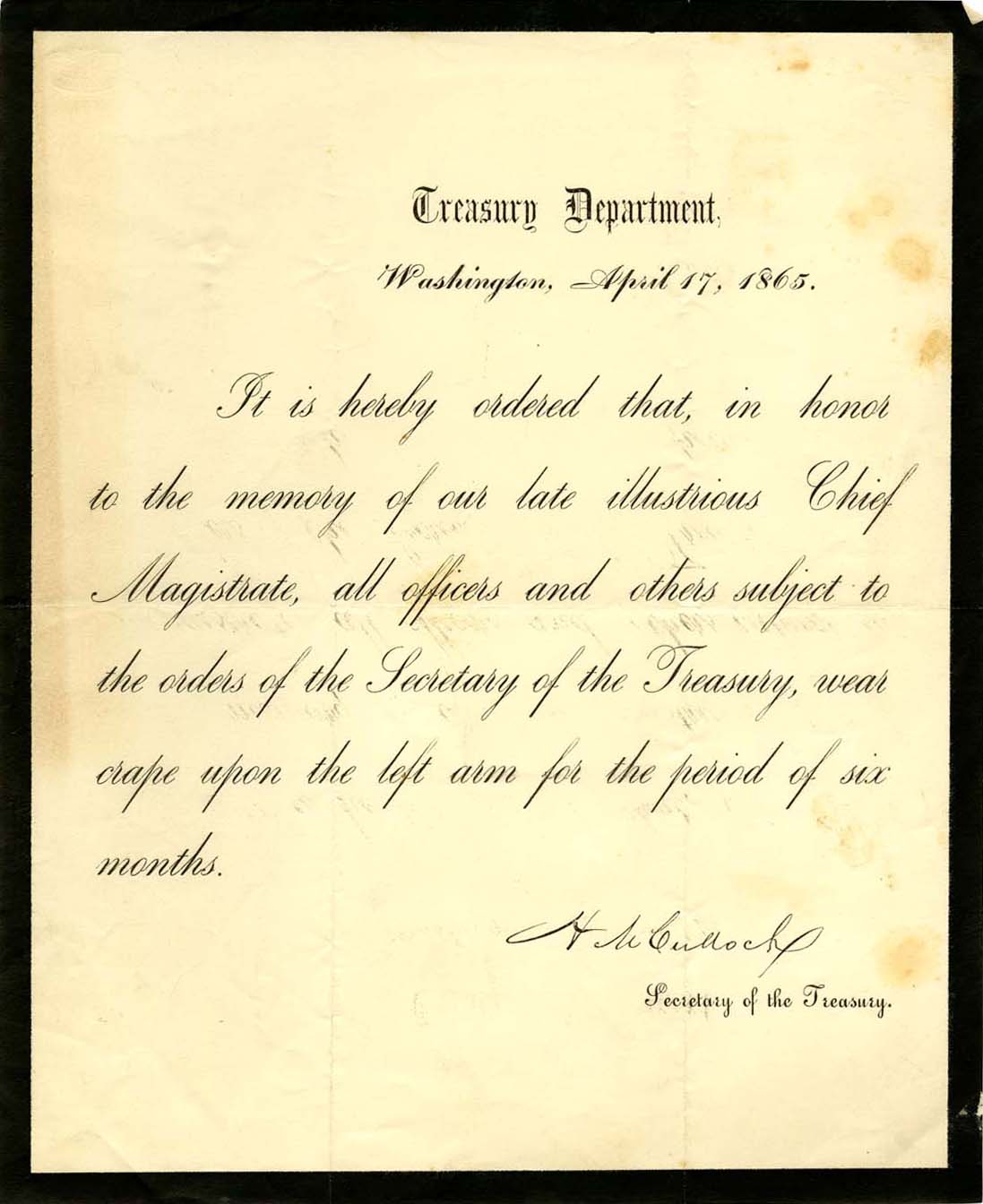
Secretary of the Treasury Hugh McCulloch signed this notice requiring all members of the U.S. Department of the Treasury to wear black crepe bands on their left arm for a period of six months in honor of the memory of President Lincoln.
-
Transcription
Treasury Department.
Washington, April 17, 1865.
It is hereby ordered that, in honor to the memory of our late illustrious Chief Magistrate, all officers and others subject to the orders of the Secretary of the Treasury, wear crape upon the left arm for the period of six months.
H McCulloch
Secretary of the Treasury -
Source
Hugh McCulloch Letter
-
Rights
The Abraham Lincoln Presidential Library and Museum holds all right and permissions.
-
Tags
-
Cite this Item
McCulloch, Hugh, 1808-1895. "Hugh McCulloch to the Employees of the Treasury Department". Abraham Lincoln Presidential Library and Museum. Remembering Lincoln. Web. Accessed April 3, 2026. https://rememberinglincoln.fords.org/node/700
-
Creator
McCulloch, Hugh, 1808-1895
-
Publisher
Abraham Lincoln Presidential Library and Museum
-
Date
April 17th, 1865
-
Material
paper and ink
-
Dimensions
19 x 23 cm
from Apr. 17, 1865
Hugh McCulloch to the Employees of the Treasury Department
-
Description
Secretary of the Treasury Hugh McCulloch signed this notice requiring all members of the U.S. Department of the Treasury to wear black crepe bands on their left arm for a period of six months in honor of the memory of President Lincoln.
-
Source
Hugh McCulloch Letter
-
Rights
The Abraham Lincoln Presidential Library and Museum holds all right and permissions.
-
Creator
McCulloch, Hugh, 1808-1895
-
Publisher
Abraham Lincoln Presidential Library and Museum
-
Date
April 17, 1865
-
Material
paper and ink
-
Dimensions
19 x 23 cm
from Apr. 25, 1865
Preston King to Unknown
-
Full Title
Preston King to Unknown
-
Description
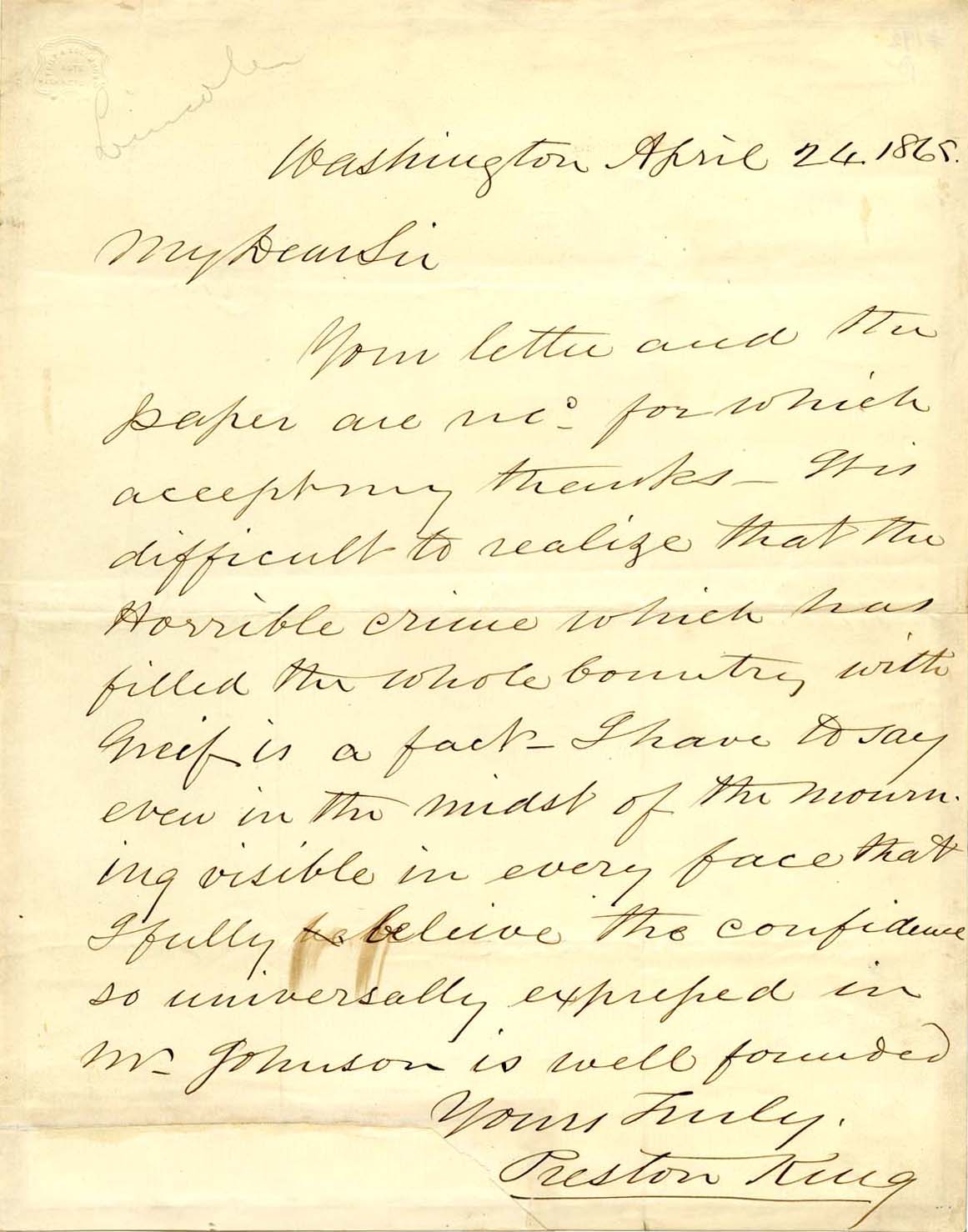
Preston King, a former U.S. Senator from New York, comments on the shock and grief gripping the nation in the wake of the assassination of President Lincoln. King also expresses his confidence in President Andrew Johnson.
-
Transcription
Lincoln
Washington April 24 1865.
My Dear Sir
Your letter and the paper are recd, for which accepting thanks. It is difficult to realize that the Horrible crime which has filled the Whole Country with Greif is a fact. I have to say even in the midst of the mourning visible in every face that I fully beleive the confidence so universally expressed in Mr. Johnson is well founded
Yours Truly,
Preston King -
Source
Preston King Letter
-
Rights
The Abraham Lincoln Presidential Library and Museum holds all rights and permissions.
-
Tags
-
Cite this Item
King, Preston, 1806-1865. "Preston King to Unknown". Abraham Lincoln Presidential Library and Museum. Remembering Lincoln. Web. Accessed April 3, 2026. https://rememberinglincoln.fords.org/node/698
-
Creator
King, Preston, 1806-1865
-
Publisher
Abraham Lincoln Presidential Library and Museum
-
Date
April 25th, 1865
-
Material
paper and ink
-
Dimensions
20 x 25 cm
from Apr. 25, 1865
Preston King to Unknown
-
Description
Preston King, a former U.S. Senator from New York, comments on the shock and grief gripping the nation in the wake of the assassination of President Lincoln. King also expresses his confidence in President Andrew Johnson.
-
Source
Preston King Letter
-
Rights
The Abraham Lincoln Presidential Library and Museum holds all rights and permissions.
-
Creator
King, Preston, 1806-1865
-
Publisher
Abraham Lincoln Presidential Library and Museum
-
Date
April 25, 1865
-
Material
paper and ink
-
Dimensions
20 x 25 cm
from Apr. 30, 1865
Horatio Nelson Taft Diary, April 30, 1865
-
Full Title
Horatio Nelson Taft Diary, April 30, 1865
-
Description
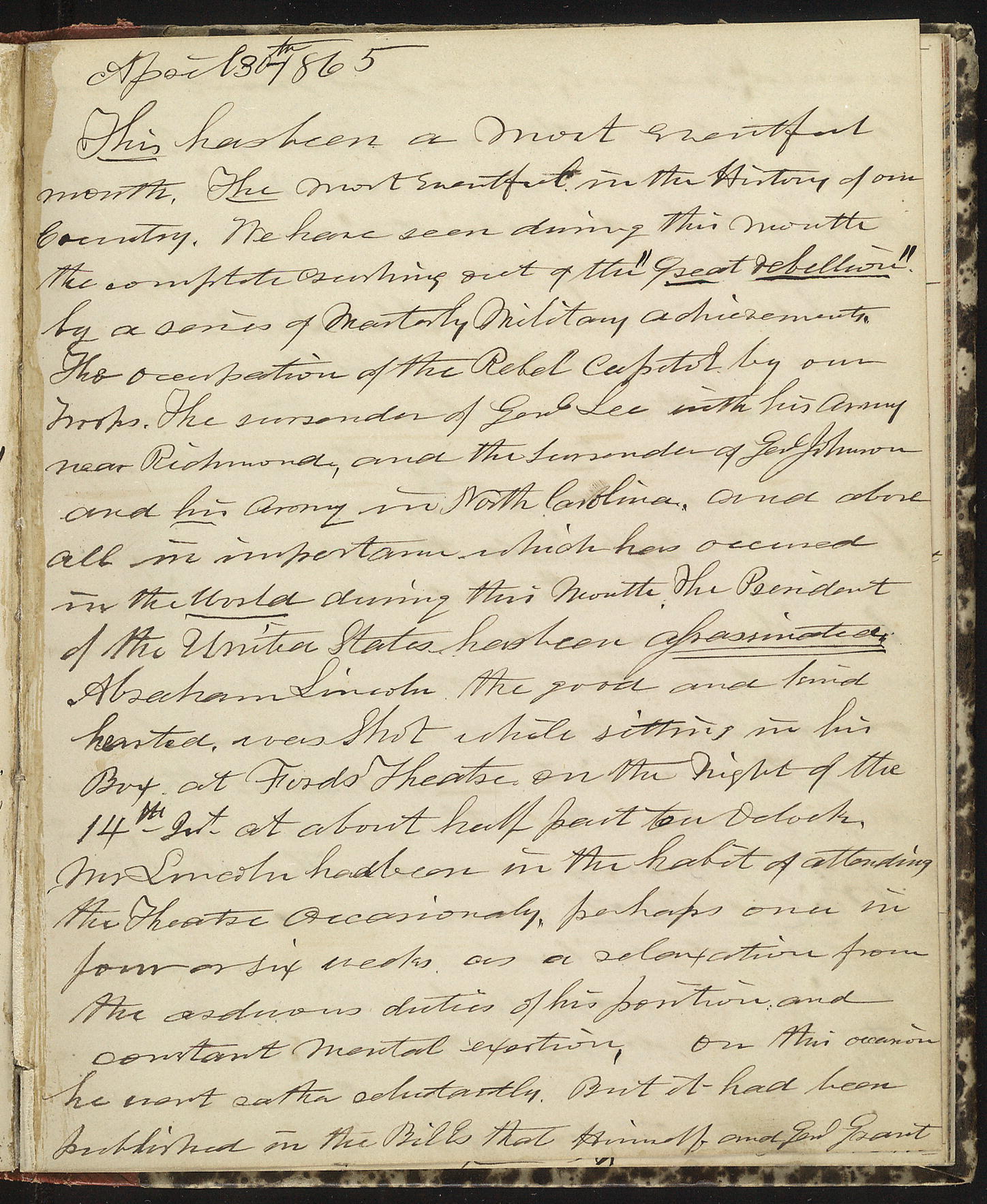
Patent examiner Horatio Nelson Taft discussed the events of the previous month, calling April 1865 "the most eventful in the History of our Country."
-
Transcription
April 30th 1865
This has been a most eventful month. The most eventful in the History of our Country. We have seen during this month the complete crushing out of the “Great rebellion” by a series of masterly Military achievements. The occupation of the Rebel Capitol by our troops. The surrender of Genl Lee with his Army near Richmond, and the surrender of Genl Johnson and his Army in North Carolina, and above all in importance which has occured in the World during this month, The President of the United States has been assassinated. Abraham Lincoln, the good and kind hearted, was Shot while sitting in his Box at Fords Theatre on the night of the 14th Int at about half past ten O'clock. Mr Lincoln had been in the habit of attending the Theatre occasionaly, perhaps once in four or six weeks, as a relaxation from the arduous duties of his position and constant mental exertion. On this occasion he went rather reluctantly. But it had been published in the Bills that Himself and Genl Grant would be present, and Genl Grant having left the City in the evening train for Phila, the President said that he did not “wish the people to be disappointed” and so went with his Lady arriving about ½ past 8. Miss Harris (daughter of Hon Ira Harris) and Maj Rathbone of Albany were also in the same Box, which was a double one, two being thrown into one. This Box was in the 2nd Tier and entered from the Dress circle through a narrow corridor some three feet wide and eight or ten long. There was a door at the dress circle end and at the other end there were two doors, one for each Box but now the two Boxes being thrown into one, one of the doors was closed. The other was open, and all of them unguarded. The assassin J Wilkes Booth had made his arrangements in the most deliberate manner (probably during that day). He had fixed a bar across the door leading into the dress circle and had cut a hole through the closed door leading to the Box, which enabled him to see the exact position of the President and others in the Box without being seen himself. At about ½ past 10, he entered the corridor from the Dress circle, bared the door to prevent any one from entering, examined the position of Mr Lincoln through the hole in the closed door. Then entered the Box behind all who were there (as they were looking toward the stage) and standing within three or four feet of Mr Lincoln, Shot him in the back of the head. The ball entering about two inches from the left ear near the base of the skull and lodging in the brain about two inches back of the right eye. His head was probably inclined forward at the time. The Murderer rushed to the front of the Box with a dagger in his hand. Major Rathbone caught his coat but Booth struck him on the arm with the dagger wounding him severely, which compelled him to let go his hold. Booth vaulted over the front of the Box and as he did so exclaimed “Sic Semper Tyranis” (Thus To Tyrants). As he Jumped from the box his spur cau[gh]t in the flag and as he struck the to see the exact position of the President and others in the Box without being seen himself. At about ½ past 10, he entered the corridor from the Dress circle, bared the door to prevent any one from entering, examined the position of Mr Lincoln through the hole in the closed door. Then entered the Box behind all who were there (as they were looking toward the stage) and standing within three or four feet of Mr Lincoln, Shot him in the back of the head. The ball entering about two inches from the left ear near the base of the skull and lodging in the brain about two inches back of the right eye. His head was probably inclined forward at the time. The Murderer rushed to the front of the Box with a dagger in his hand. Major Rathbone caught his coat but Booth struck him on the arm with the dagger wounding him severely, which compelled him to let go his hold. Booth vaulted over the front of the Box and as he did so exclaimed “Sic Semper Tyranis” (Thus To Tyrants). As he Jumped from the box his spur cau[gh]t in the flag and as he struck the Stage he came to a crouching position from the effect of the concussion, his hands striking the floor but he recovered himself in a moment and flourishing his dagger he strode across the Stage some forty feet in sight of the spectators and past some of the actors, and reaching the back door which opens into a lane, he mounted a fleet horse and escaped. The lane enters F St betwen 9th & 10 Sts. The audience was paralized for some seconds, but rushed on to the Stage. A Surgeon was called for and Charles S Taft a Surgeon being present was lifted up from the Stage to the Box by those present. Before this the bar had been removed by Maj Rathbone and several men had reached the Box. When Chas reached the Box the President was lying upon the floor. Water and stimulants were used immediately but without avail in attempts to revive him. He was taken up and carried from the Theatre to the House opposite in
about fifteen minutes after he was shot. A Dr Leale from Armory Square Hospital was the first Surgeon in the box. But Chas did not know that there was any Surgeon but himself present until the President was removed from the Theatre. Chas had charge of him until Dr Stone (the Presidents family Physician) arrived which was half an hour after he was placed on a bed at the House of Mr Peterson, opposite. When the shot was fired Mrs Lincoln was sitting near her husband with her hand on his knee. She says she saw the flash and heard the report of the pistol, thinking it was in some way connected with the the Play. She leaned forward to see what it was, and then looked to Mr Lincoln to see where he was looking. He was sitting with his head droped down and eyes shut. She was not alarmed at this, he sometimes held his head in that way when in deep thought, but she put her hand on his forehead and he not stirring she put it on the back of his head and feeling it wet she immediately withdrew it covered with blood. She then screamed and that is the last she remembered that took place in the Theatre. She says, as she put her hand on his head she recollects that something suddenly brushed past her and rubbing off her Shawl. It was Booth as he jumped from the Box. The President made no noise, nor attempted to speak, nor Stirred a limb after he was shot, nor was he conscious for one moment from that time until he died. When his skin was touched or his hand was taken, there was a slight quiver or tremor of the muscles, but that was all. Mustard paste was applied nearly all over the body and stimulants were given as long as he could swallow in hopes to revive him but entirely without avail. His pulse ceased to beat at 22 minutes past Seven. Chas had his hand on his heart, he said it fluttered or trilled for 10 seconds longer. It was the opinion of the Surgeons that the wound would have killed most men instantly, or in a very few minutes. But Mr Lincoln had so much vitality that he lived nearly nine hours. There were four Surgeons in immediate or active attendance. Dr Stone, The Surgeon Genl Dr Barnes, The Assistant Surgeon Genl Dr Crane and Charles. Some others were present whose services were not required. Most of the members of the Cabinet were there all night. Chief Justice Chase and other distinguished men. Mr Senator Sumner with Robert Lincoln leaning on his shoulder near the head of the bed. Sec'y Stanton was active in giving directions and writing dispatches all night. Genl Meigs Stood at the door to keep out all who were not wanted or to see that the room was not crowded. The room is at the end of the entrance Hall about 9 feet by 15, with two windows and three doors, one door entering from the Hall, one at the left as you enter, opening to an open porch or piazza, and the other at the farther end of the room, opening into another small room from which stairs decended to to [sic] the Basement. Some few individuals came in to the room through that door clandestinely. Mrs Lincoln occupied a room near by with some of her friends who were there. She went in frequently to see the President with Doct Gurley (The family Pastor) who had been sent for about 3 O'clock. She was not in the room when he died. Robert Lincoln was there and Dr Gurley, the two private Secretaries of the President Nicolay and Hay. Upon one occasion when Mrs L went in and saw her husband she fainted and was carried out insensible. It was thought best for her not to be there when he died. Dr Gurley prayed by the bedside of the President when he first arrived (at 3 o'clock). Then went into the room where Mrs Lincoln was and prayed with her, and remained with her most of the time, accompanying her and supporting her into the room of the dying President when she visited it. After the death Dr Gurley who was standing near Mr Stanton said shall we have any religious exercises here or elsewhere now? Yes said Mr Stanton offer Prayer ________ now and here. For the last half hour before the death, the utmost stillness had prevailed in the room, not a word, not a whisper was heard. The President of the United States dying, surrounded by his Cabinet and many of the first men in the Nation standing like statues around the bed presented a scene for an artist seldom equaled for solemn grandeur. It is to be hoped that it will yet be transfered to Canvass. After the President died Dr Gurley went to Mrs L and told her “the President is dead.” O - why did you not let me know? Why did you not tell me? “Your friends thought it was not best. You must be resigned to the will of God. You must be calm and trust in God and in your friends.” She soon after left, with Dr G for her Home. She was asked during the night if her son “Tad” (Thaddeus) (a boy about twelve years old) should be sent for. “O, my poor “Taddy” what will become of him? O do not send for him, his violent grief would disturb the House.” When they reached the Presidents house “Tad” met them on the Portico. “Where is my Pa? Where is my Pa? He kept repeating the question till they got into the room of Mrs Lincoln. He had heard that his Pa had been shot but evidently expected him when his mother came. He was very much excited and alarmed but had not thought that his Pa could be dead. “Taddy” your Pa is dead” said Dr Gurley. He was not prepared for this. He screamed in an agony of grief “O what shall I do? What shall I do? My Brother is dead. My Father is dead. O what shall I do? What will become of me? O what shall I do? O mother you will not die will you. O don't you die Ma. You wont die will you Mother? If you die I shall be all alone. O dont die Ma.” Dr Gurley said that up to that time he himself had not shed a tear, but he could not witness “Tads” grief unmoved and the Tears flowed freely. He said, when I got back to my own house at about 10 o'clock that morning, “I felt as though I had been engaged all night in a terrible Battle and had but just strength enough left to drag myself off the field.” -
Source
-
Rights
This item is in the public domain and may be reproduced and used for any purpose, including research, teaching, private study, publication, broadcast or commercial use, with proper citation and attribution.
-
Tags
-
Cite this Item
Horatio Nelson Taft. "Horatio Nelson Taft Diary, April 30, 1865". Remembering Lincoln. Web. Accessed April 3, 2026. https://rememberinglincoln.fords.org/node/691
-
Creator
Horatio Nelson Taft
-
Date
April 30, 1865
from Apr. 30, 1865
Horatio Nelson Taft Diary, April 30, 1865
-
Description
Patent examiner Horatio Nelson Taft discussed the events of the previous month, calling April 1865 "the most eventful in the History of our Country."
-
Source
-
Rights
This item is in the public domain and may be reproduced and used for any purpose, including research, teaching, private study, publication, broadcast or commercial use, with proper citation and attribution.
-
Creator
Horatio Nelson Taft
-
Date
April 30, 1865