from Apr. 16, 1865
Lincoln's Assassination Told by an Eye Witness
-
Full Title
Lincoln's Assassination Told by an Eye Witness
-
Description
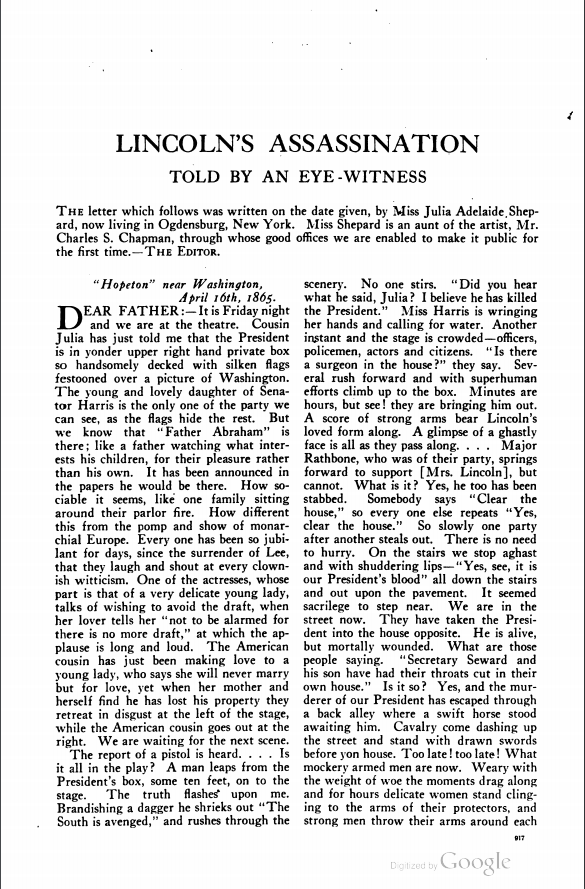
A letter written by Julia Adelaide Shepard who was in attendance at Ford's Theatre on April 14, 1865. She wrote to her father on the 16th recounting the Lincoln Assassination. It was printed in The Century Illustrated Monthly Magazine Volume 77 (Nov. 1908 - April 1909)
-
Transcription
LINCOLN’S ASSASSINATION
TOLD BY AN EYE-WITNESS
The letter which follows was written on the date given, by Miss Julia Adelaide Shepard, now living in Ogdensburg, New York. Miss Shepard is an aunt of the artist, Mr. Charles S. Chapman, through whose good offices we are enabled to make it public the first time. – THE EDITOR.
“Hopeton” near Washington.
April 16, 1865
DEAR FATHER: - It is Friday night and we are at the theatre. Cousin Julia has just told me that the President is in yonder upper right hand private box so handsomely decked with silken flags festooned over a picture of Washington. The young and lovely daughter of Senator Harris is the only one of the party we can see, as the flags hide the rest. But we know that “Father Abraham” is there; like a father watching what interests his children, for their pleasure rather than his own. It has been announced in the papers that he would be there. How sociable it seems, like one family sitting around their parlor fire. How different this from the pomp and show of monarchial Europe. Every one has been so jubilant for days, since the surrender of Lee, that they laugh and shout at every clown-ish witticism. One of the actresses, whose part is that of a very delicate young lady, talks of wishing to avoid the draft, when her lover tells “not to be alarmed for there is no more draft, “ at which the applause is long and loud. The American cousin has just been making love to a young lady, who says she will never marry but for love, yet when her mother and herself find he has lost his property they retreat in disgust at the left of the stage, while the American cousin goes out at the right. We are waiting for the next scene.
The report of a pistol is heard…. Is it all in the play? A man leaps from the President’s box, some ten feet, on to the stage. The truth flashes upon me. Brandishing a dagger he shrieks out “The South is avenged,” and rushes through the scenery. No one stirs. “Did you hear what he said, Julia? I believe he has killed the President.” Miss Harris is wringing her hands and calling for water. Another instant and the stage is crowded – officers, policemen, actors and citizens. “Is there a surgeon in the house?” they say. Several rush forward and with superhuman efforts climb up to the box. Minutes are hours, but see! they are bringing him out. A score of strong arms bear Lincoln’s loved form along. A glimpse of a ghastly face is all as they pass along…. Major Rathbone, who was of their party, springs forward to support [Mrs. Lincoln], but cannot. What is it? Yes, he too has been stabbed. Somebody says “Clear the house,” so every one else repeats “Yes, clear the house.” So slowly one party after another steals out. There is no need to hurry. On the stairs we stop aghast and with shuddering lips – “Yes, see, it is our President’s blood” all down the stairs and out upon the pavement. It seemed sacrilege to step near. We are in the street now. They have taken the President into the house opposite. He is alive, but mortally wounded. What are those people saying, “Secretary Seward and his son have had their throats cut in their own house.” Is it so? Yes, and the mur-derer of our President has escaped through a back alley where a swift horse stood awaiting him. Cavalry come dashing up the street and stand with drawn swords before yon house. Too late! too late! What a mockery armed men are now. Weary with the weight of woe the moments drag along and for hours delicate women stand cling-ing to the arms of their protectors and strong men throw their arms around each other’s necks and cry like children, and passing up and down enquire in low agon-ized voices “Can he live? Is there no hope?” They are putting out the street lamps now. “What a shame! not now! not to-night!” There they are lit again. Now the guard with the drawn swords forces the crowd backward. Great, strong Cousin Ed says “This unnerves me; let’s go up to Cousin Joe’s.” We leave Julia and her escort there and at brother Joe’s gather together in an upper room and talk and talk with Dr. Webb and his wife who were at the theatre. Dr. W. was one of the surgeons who answered the call. He says “I asked Dr. ____ when I went in what it was, and putting his hand on mine he said, “There!” I looked and it was ‘brains.’ “
After a while Julia and Mr. W came in and still we talked and listened to the cavalry rushing through the echoing street. Joe was determined to go out, but his wife couldn’t endure the thought of any one going out of the house. It was only in the early hours of the dawn that the gentlemen went to lie down, but Julia sat up in a rocking chair and I lay down on the outside of the bed beside Cousin Ginny for the rest of the night, while Cousin Joe and his wife’s young brother sat nodding in chairs opposite. There were rooms waiting for us but it seemed safer to be together. He was still living when we came out to Hopeton, but we had scarcely choked down our break-fast next morning when the tolling bells announced the terrible truth.
Last Thursday evening we drove to the city, and all along our route the city was one blaze of glorious light. From the humble cabin of the contraband to the brilliant White House light answered light down the broad avenue. The sky was ablaze with bursting rockets. Calcium lights shone from afar on the public buildings. Bonfires blazed in the streets and every device that human Yankee ingenuity could suggest in the way of mottoes and decoration made noon of midnight. Then as candles burned low and rockets ceased, we drove home through the balmy air and it seemed as though Heaven smiled upon the rejoic-ings, and Nature took up the illumination with a glory of moonlight that tran-scended all art.
To-day I have been to church through the same streets and the suburbs with the humble cottages that were so bright that night shone through the murky morning, heavy with black hangings, and on and on, down the streets only the blackness of darkness. The show of mourning was as universal as the glorying had been, and when we were surrounded by the sol-emn and awe-stricken congregation in the church, it seemed as through my heart had stopped beating. I feel like a fright-ened child. I wish I could go home and have a good cry. I can’t bear to be alone. You will hear all of this from the papers, but I can’t help writing it for things seen are mightier than things heard. It seems hard to write now. I dare not speak of our great loss. Sleeping or waking, that terrible scene is before me.
[Transcription by Alicia B., Ford's Theatre Society.] -
Source
-
Rights
This item is in the public domain and may be reproduced and used for any purpose, including research, teaching, private study, publication, broadcast or commercial use, with proper citation and attribution.
-
Tags
-
Cite this Item
Julia Adelaide Shepard. "Lincoln's Assassination Told by an Eye Witness ". The Century Company, New York. Remembering Lincoln. Web. Accessed April 3, 2026. https://rememberinglincoln.fords.org/node/1169
-
Creator
Julia Adelaide Shepard
-
Publisher
The Century Company, New York
-
Date
April 16, 1865
from Apr. 16, 1865
Lincoln's Assassination Told by an Eye Witness
-
Description
A letter written by Julia Adelaide Shepard who was in attendance at Ford's Theatre on April 14, 1865. She wrote to her father on the 16th recounting the Lincoln Assassination. It was printed in The Century Illustrated Monthly Magazine Volume 77 (Nov. 1908 - April 1909)
-
Source
-
Rights
This item is in the public domain and may be reproduced and used for any purpose, including research, teaching, private study, publication, broadcast or commercial use, with proper citation and attribution.
-
Creator
Julia Adelaide Shepard
-
Publisher
The Century Company, New York
-
Date
April 16, 1865
from Apr. 19, 1865
Lincoln's funeral procession on Pennsylvania AvE
-
Full Title
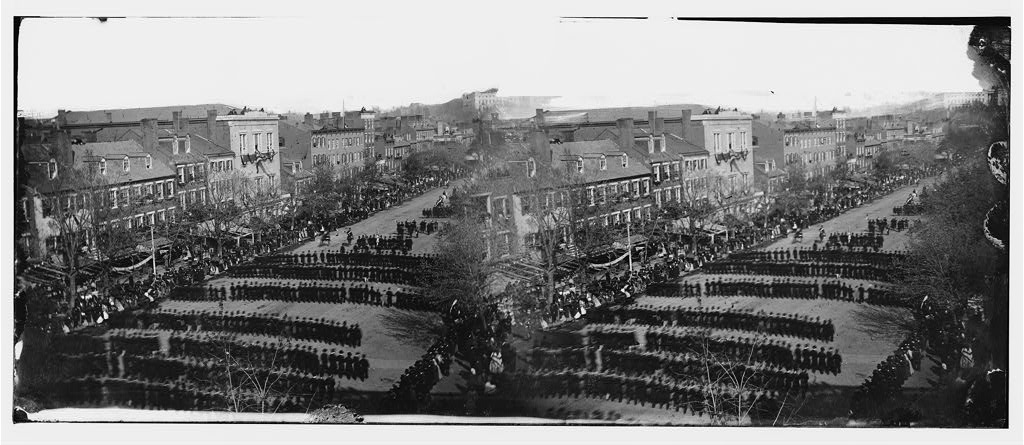
Washington, D.C. President Lincoln's funeral procession on Pennsylvania Avenue
-
Description
A stereograph of.Lincoln's Washington, D.C Funeral Procession on Pennsylvania Avenue.
-
Source
Library of Congress, Prints and Photographs Division, LC-DIG-cwpb-00593
-
Rights
This item is in the public domain and may be reproduced and used for any purpose, including research, teaching, private study, publication, broadcast or commercial use, with proper citation and attribution.
-
Tags
-
Cite this Item
unknown. "Washington, D.C. President Lincoln's funeral procession on Pennsylvania Avenue". Remembering Lincoln. Web. Accessed April 3, 2026. https://rememberinglincoln.fords.org/node/1161
-
Creator
unknown
-
Date
April 19, 1865
-
Material
glass, stereograph, and wet collodion
-
Dimensions
4 x 10 in
from Apr. 19, 1865
Washington, D.C. President Lincoln's funeral procession on Pennsylvania Avenue
-
Description
A stereograph of.Lincoln's Washington, D.C Funeral Procession on Pennsylvania Avenue.
-
Source
Library of Congress, Prints and Photographs Division, LC-DIG-cwpb-00593
-
Rights
This item is in the public domain and may be reproduced and used for any purpose, including research, teaching, private study, publication, broadcast or commercial use, with proper citation and attribution.
-
Creator
unknown
-
Date
April 19, 1865
-
Material
glass, stereograph, and wet collodion
-
Dimensions
4 x 10 in
from May. 1, 1865
Lincoln's funeral
-
Full Title
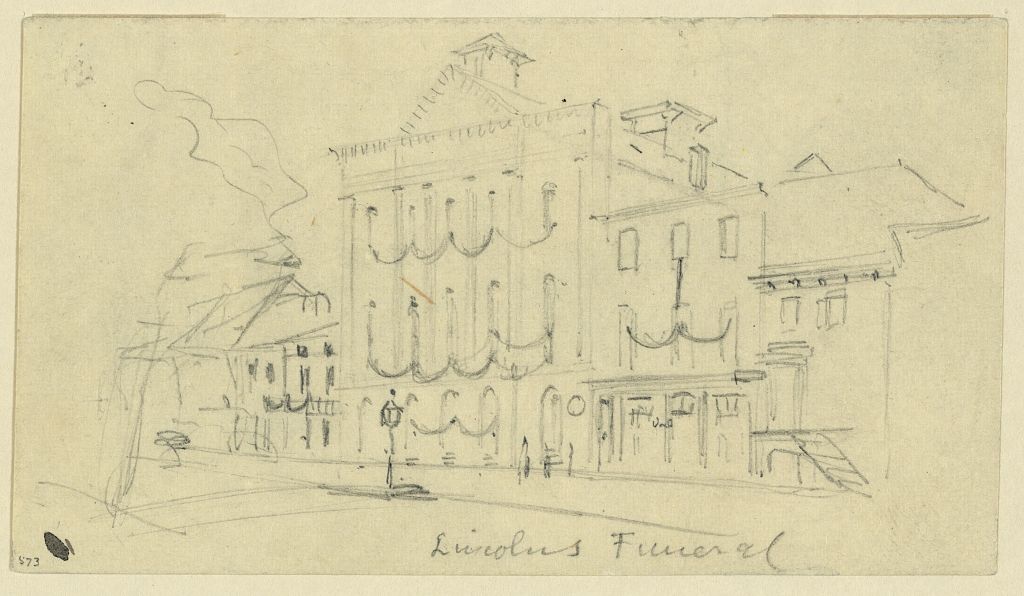
Lincoln's funeral
-
Description
A sketch by Civil War artist correspondent, Alfred Waud, of Ford's Theatre and neighboring buildings decorated in funeral bunting for Lincoln's Washington funeral.
-
Source
Library of Congress, Prints and Photographs Division, LC-DIG-ppmsca-20065
-
Rights
This item is in the public domain and may be reproduced and used for any purpose, including research, teaching, private study, publication, broadcast or commercial use, with proper citation and attribution.
-
Tags
-
Cite this Item
Alfred Rudolph Waud. "Lincoln's funeral". Remembering Lincoln. Web. Accessed April 3, 2026. https://rememberinglincoln.fords.org/node/1159
-
Creator
Alfred Rudolph Waud
-
Date
April 1865
-
Material
cream paper and pencil
-
Dimensions
6.0 x 10.9 cm
from May. 1, 1865
Lincoln's funeral
-
Description
A sketch by Civil War artist correspondent, Alfred Waud, of Ford's Theatre and neighboring buildings decorated in funeral bunting for Lincoln's Washington funeral.
-
Source
Library of Congress, Prints and Photographs Division, LC-DIG-ppmsca-20065
-
Rights
This item is in the public domain and may be reproduced and used for any purpose, including research, teaching, private study, publication, broadcast or commercial use, with proper citation and attribution.
-
Creator
Alfred Rudolph Waud
-
Date
May 1, 1865
-
Material
cream paper and pencil
-
Dimensions
6.0 x 10.9 cm
from Apr. 19, 1865
Lincoln in the East Room
-
Full Title
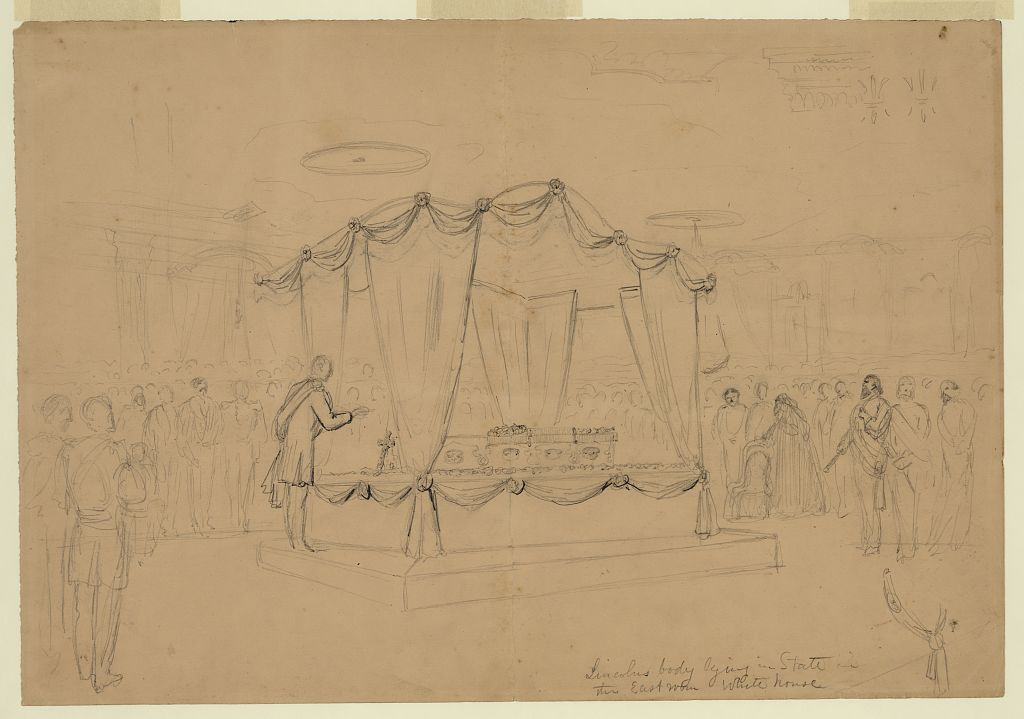
Lincoln's body lying in state in the East room White house
-
Description
Lincoln lying in state in the East Room of the White House, April 1965, by Civil War artist correspondent, Alfred R. Waud.
-
Source
Library of Congress, Prints and Photographs Division, LC-DIG-ppmsca-19403
-
Rights
This item is in the public domain and may be reproduced and used for any purpose, including research, teaching, private study, publication, broadcast or commercial use, with proper citation and attribution.
-
Tags
-
Cite this Item
Alfred Rudolph Waud. "Lincoln's body lying in state in the East room White house". Harper's Weekly. Remembering Lincoln. Web. Accessed April 3, 2026. https://rememberinglincoln.fords.org/node/1153
-
Creator
Alfred Rudolph Waud
-
Publisher
Harper's Weekly
-
Date
April 19, 1865
-
Material
pink paper and pencil
-
Dimensions
34.9 x 50.4 cm
from Apr. 19, 1865
Lincoln's body lying in state in the East room White house
-
Description
Lincoln lying in state in the East Room of the White House, April 1965, by Civil War artist correspondent, Alfred R. Waud.
-
Source
Library of Congress, Prints and Photographs Division, LC-DIG-ppmsca-19403
-
Rights
This item is in the public domain and may be reproduced and used for any purpose, including research, teaching, private study, publication, broadcast or commercial use, with proper citation and attribution.
-
Creator
Alfred Rudolph Waud
-
Publisher
Harper's Weekly
-
Date
April 19, 1865
-
Material
pink paper and pencil
-
Dimensions
34.9 x 50.4 cm
from Apr. 14, 1865
the death bed scene
-
Full Title
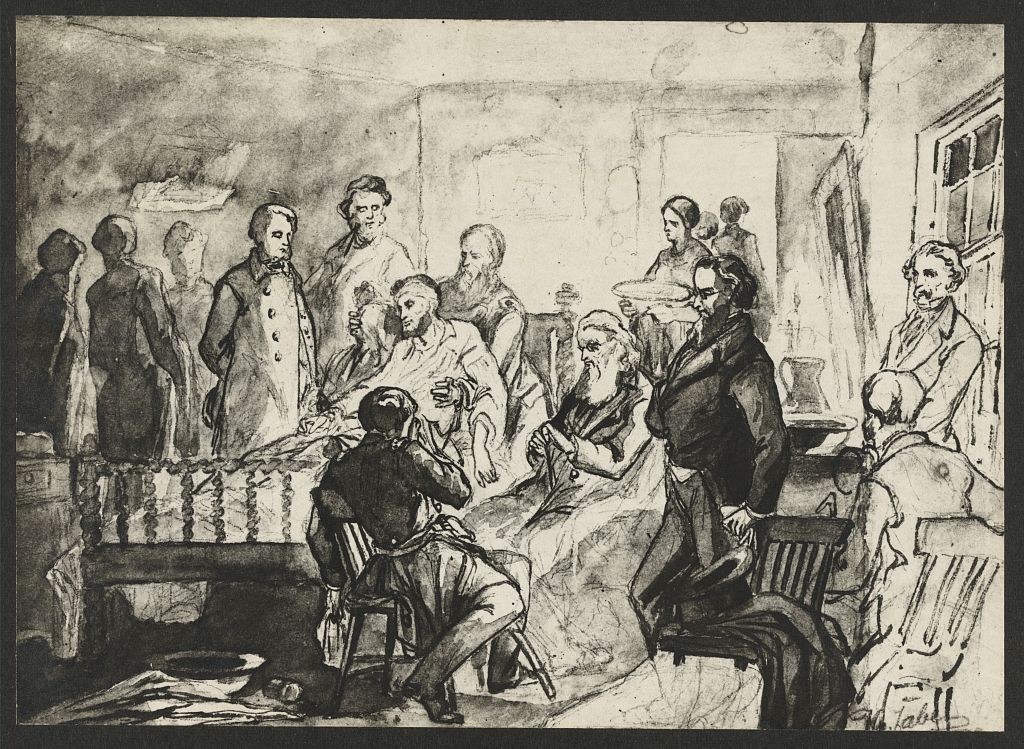
Drawing of the death bed scene of President Abraham Lincoln, with a man holding Lincoln
-
Description
A photograph of a drawing by Hermann Faber. Faber served as an artist on the Surgeon General's staff of the Union Army during the Civil War and illustrated the medical records. His position allowed him to make two drawings of Lincoln's deathbed scene, including this one.
-
Source
Library of Congress, Prints and Photographs Division, LC-DIG-ppmsca-23858
-
Rights
This item is in the public domain and may be reproduced and used for any purpose, including research, teaching, private study, publication, broadcast or commercial use, with proper citation and attribution.
-
Tags
-
Cite this Item
Hermann Faber. "Drawing of the death bed scene of President Abraham Lincoln, with a man holding Lincoln". Remembering Lincoln. Web. Accessed April 3, 2026. https://rememberinglincoln.fords.org/node/1144
-
Creator
Hermann Faber
-
Date
April 14, 1865
from Apr. 14, 1865
Drawing of the death bed scene of President Abraham Lincoln, with a man holding Lincoln
-
Description
A photograph of a drawing by Hermann Faber. Faber served as an artist on the Surgeon General's staff of the Union Army during the Civil War and illustrated the medical records. His position allowed him to make two drawings of Lincoln's deathbed scene, including this one.
-
Source
Library of Congress, Prints and Photographs Division, LC-DIG-ppmsca-23858
-
Rights
This item is in the public domain and may be reproduced and used for any purpose, including research, teaching, private study, publication, broadcast or commercial use, with proper citation and attribution.
-
Creator
Hermann Faber
-
Date
April 14, 1865
from Apr. 15, 1865
Letter from "Mary" to "Sister"
-
Full Title
Letter from "Mary" to "Sister"
-
Description
In this Letter a young woman, Mary, living in Washington, D.C. writes her sister, expressing her grief over Lincoln's assassination and tells of the atmosphere of mourning in the city. She goes on to relate her own account of the night of the assassination.
-
Transcription
Saturday Morning
Washington April 15th 1865
My Dear Sister
Long ere this reaches you the news of the Nations terrible calamity will have flashed to the remotest corner of the United States of the dastardly murder of our dearly beloved President not in Richmond among his enemies but in Washington and among his avowed friends. The heart of the an nation throbs with greif at a loss it cannot soon repair but if you could look into the faces of those here today you would see that he was loved most dearly by those who knew him best. I have just passed in sight of the house where little less than an hour ago the nations heart and life ceased to beat for its welfare. Oh the agony depicted on the faces of that crowd. Men actualy tearing their hair from very greif and agony. The state of feeling is such that it is impossible to tell what it may lead to after what is past it is not safe to judge what a day may bring forth. The streets are patroled to keep the people (and its not the roughs) from assasinating every known simpathizer with the rebelion. The whole city is being draped in the heaviest mourning the bells are tolling and every-thing and every-body wears the sadest aspect a human eye ever looked upon.
I was at Grovers Theatre at the time this desperately wicked act was perpetrated at Fords. The alarm was given and instantly the people rushed to the doors supposing the building was on fire people were thrown down stairs and the wildest confusion prevailed. I was never more frightend in my life yet I stood back thinking it was as well to stand my chance of escaping the fire as to be killed in the dense crowd when the excitement had subsided the audience took their seats without knowing what had occured and the play went on for about 15 minutes when the manager came forward and announced that the President had been assasinated and a scene ensued beyond description strong men wept like little children it was a scene which I shall remember to my latest breath. there were few pillows that were not wet with tears of true sorrow while none were visited with sleep, of those who knew of it words would fail to express the horror and indignation which pervades the entire community
What a change in one short day. Yesterday all was bright and joyous today, gloom and sorrow cover a nation.
Yesterday was a lovely day, today is dark and cloudy. It seems as if the sun refused to shine on the dark deed.
I must close for I am nervous and hardly know how I have written what I have. I have changed my boarding place so you must direct to the pension Office give my love to Mother write me if she is not well for I have felt worried since her last letter she wrote so sadly. write soon. from yours
Off, Mary
-
Source
National Park Service, Ford's Theatre National Historic Site
-
Rights
This item is in the public domain and may be reproduced and used for any purpose, including research, teaching, private study, publication, broadcast or commercial use, with proper citation and attribution.
-
Tags
-
Cite this Item
Mary . "Letter from "Mary" to "Sister"". Remembering Lincoln. Web. Accessed April 3, 2026. https://rememberinglincoln.fords.org/node/1131
-
Creator
Mary
-
Date
April 15, 1865
from Apr. 15, 1865
Letter from "Mary" to "Sister"

-
Description
In this Letter a young woman, Mary, living in Washington, D.C. writes her sister, expressing her grief over Lincoln's assassination and tells of the atmosphere of mourning in the city. She goes on to relate her own account of the night of the assassination.
-
Source
National Park Service, Ford's Theatre National Historic Site
-
Rights
This item is in the public domain and may be reproduced and used for any purpose, including research, teaching, private study, publication, broadcast or commercial use, with proper citation and attribution.
-
Creator
Mary
-
Date
April 15, 1865
from Jul. 4, 1865
Colored People's Educational Monument Association Celebration
-
Full Title
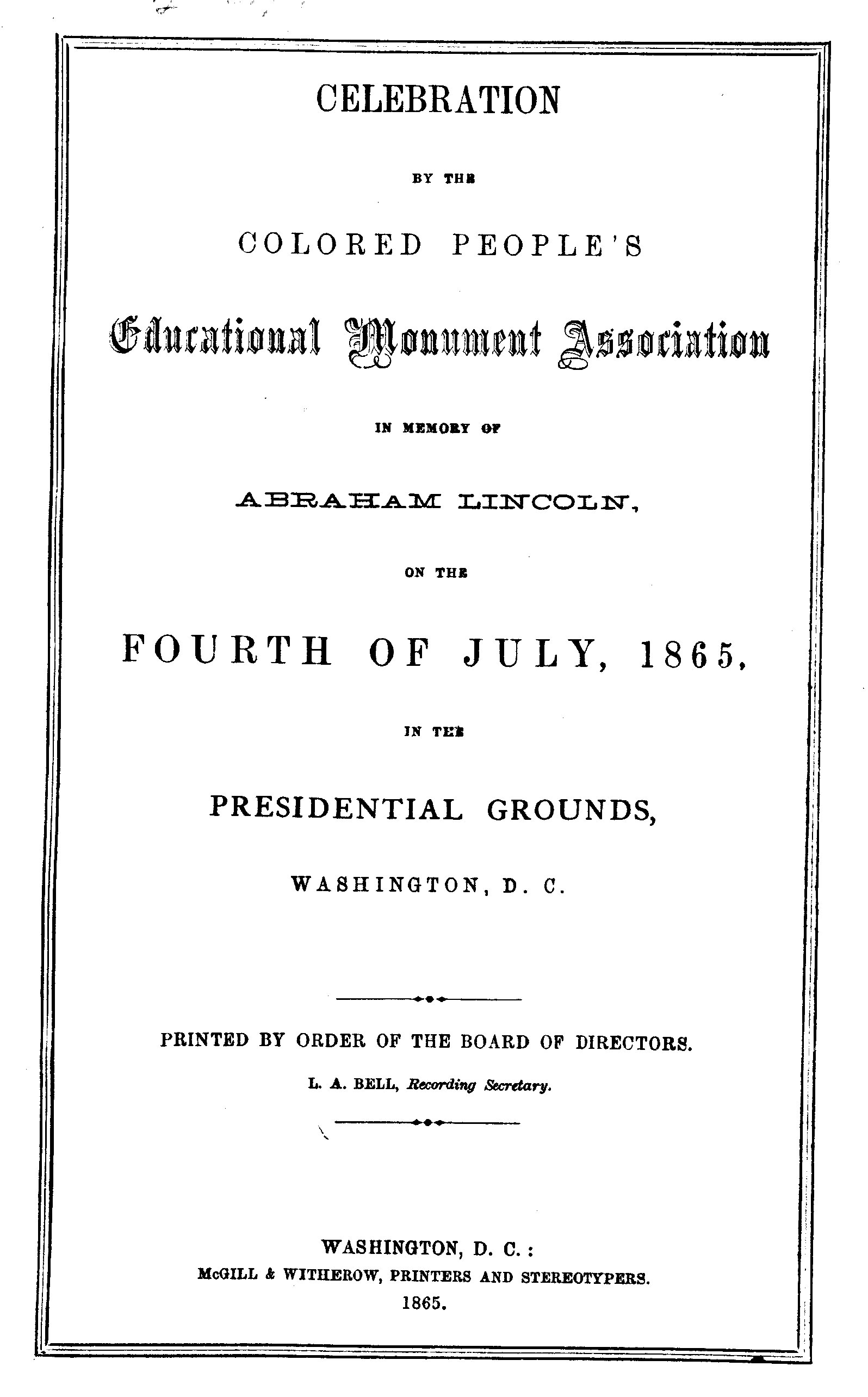
Celebration by the Colored People's Educational Monument Association in Memory of Abraham Lincoln
-
Description
On July 4, 1865--the first Independence Day after Lincoln's assassination--the Colored People's Educational Monument Association held a celebration in Washington, D.C., in commemoration of Lincoln, featuring speeches by prominent individuals such as Elder D.W. Anderson, the pastor of Washington's Nineteenth Street Baptist Church, William Howard Day, Senator Henry Wilson of Massachusetts, Senator Michael Hahn of Louisiana, and General Edgar Gregory. The speakers reflected on what the past year's events had meant.
-
Source
-
Rights
This item is in the public domain and may be reproduced and used for any purpose, including research, teaching, private study, publication, broadcast or commercial use, with proper citation and attribution.
-
Tags
-
Cite this Item
Colored People's Educational Monument Association. "Celebration by the Colored People's Educational Monument Association in Memory of Abraham Lincoln". McGill & Witherow. Remembering Lincoln. Web. Accessed April 3, 2026. https://rememberinglincoln.fords.org/node/1128
-
Creator
Colored People's Educational Monument Association
-
Publisher
McGill & Witherow
-
Date
July 4, 1865
from Jul. 4, 1865
Celebration by the Colored People's Educational Monument Association in Memory of Abraham Lincoln
-
Description
On July 4, 1865--the first Independence Day after Lincoln's assassination--the Colored People's Educational Monument Association held a celebration in Washington, D.C., in commemoration of Lincoln, featuring speeches by prominent individuals such as Elder D.W. Anderson, the pastor of Washington's Nineteenth Street Baptist Church, William Howard Day, Senator Henry Wilson of Massachusetts, Senator Michael Hahn of Louisiana, and General Edgar Gregory. The speakers reflected on what the past year's events had meant.
-
Source
-
Rights
This item is in the public domain and may be reproduced and used for any purpose, including research, teaching, private study, publication, broadcast or commercial use, with proper citation and attribution.
-
Creator
Colored People's Educational Monument Association
-
Publisher
McGill & Witherow
-
Date
July 4, 1865
from Apr. 18, 1865
President Abraham Lincoln's Washington, DC Funeral Directions and Notes
-
Full Title
President Abraham Lincoln's Washington, DC Funeral Directions and Notes
-
Description
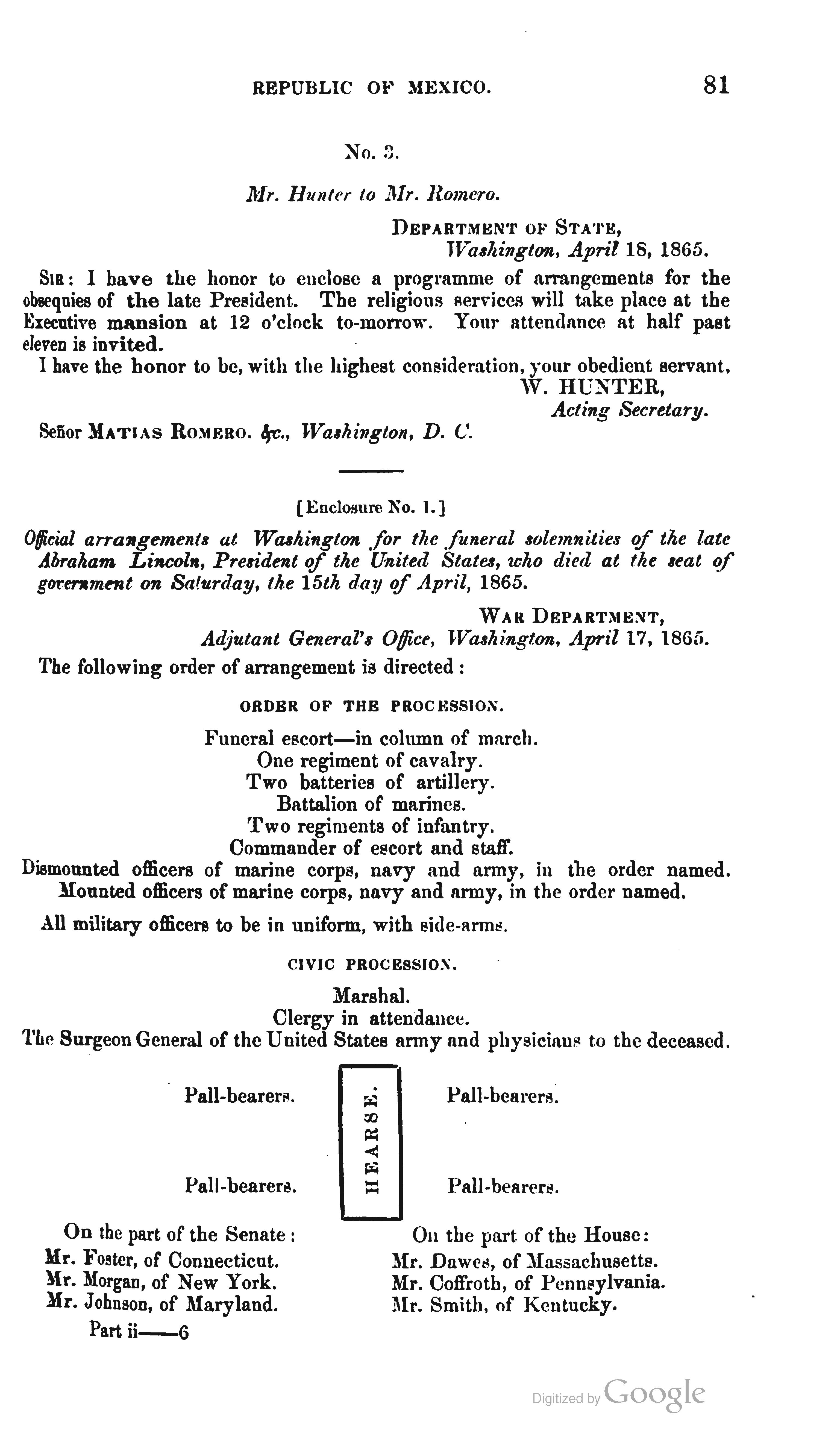
This is a letter and invitation to Matias Romero, the minister of the Mexican Republic, to the funeral of President Abraham Lincoln at the White House. It includes the funeral procession, schedule and list of pallbearers.
-
Transcription
REPUBLIC OF MEXICO. 81
No. 3.
Mr. Hunter to Mr. Romero.
DEPARTMENT OF STATE,
Washington, April 18, 1865.
Sir: I have the honor to enclose a programme of arrangements for the obsequies of the late President. The religious services will take place at the Executive mansion at 12 o'clock to-morrow. Your attendance at half past eleven is invited.
I have the honor to be, with the highest consideration, your obedient servant,
W. HUNTER,
Acting Secretary.
Señor MATIAS ROMERO. &c., Washington, D. C.
_________
[Enclosure No. 1.]
Official arrangements at Washington for the funeral solemnities of the late Abraham Lincoln, President of the United States, who died at the seat of government on Saturday, the 15th day of April, 1865.
WAR DEPARTMENT,
Adjutant General’s Office, Washington, April 17, 1865.
THe following order of arrangements is directed:
ORDER OF THE PROCESSION.
Funeral escort—in column of march.
One regiment of cavalry.
Two batteries of artillery,
Battalion of marines.
Two regiments of infantry.
Commander of escort and staff.
Dismounted officers of marine corps, navy and army, in the order named.
Mounted officers of marine corps, navy army, in the order named.
All military officers to be in uniform, with side-arms.
CIVIC PROCESSION.
Marshal.
Clergy in attendance.
The Surgeon General of the United States army and physicians to to the deceased.
Pall-bearers. HEARSE. Pall-bearers.
Pall-bearers. Pall-bearers.
On the part of the Senate : On the part of the House :
Mr. Foster, of Conecticut, Mr. Dawes, of Massachusetts.
Mr. Morgan, of New York. Mr. Coffroth, of Pennsylvania.
Mr. Johnson, Maryland. Mr. Smith, of Kentucky.
Part ii----6
82 REPUBLIC OF MEXICO.
Mr. Yates of Illinois. Mr. Colfax, of Indiana.
Mr. Wade, of Ohio, Mr. Worthington, of Nevanda.
Mr. Conness, of California. Mr. Washburne, of Illinois.
Army: Navy:
Lieutenant General U. S. Grant Vice-Admiral D. G. Farragut.
Major General H. W. Halleck. Rear-Admiral W. B. Subrick.
Brevet Brigadier General W. A. Nichols. Colonel Jocab Zeilin, marine corps.
Civilians:
O. H. Browning. Thomas Corwin.
George Ashmun. Simon Cameron
Family.
Relatives.
The delegations of the States of Illinois and Kentucky, as mourners.
The President.
The cabinet ministers.
The diplomatic corps.
Ex-Presidents.
The Chief Justice and Associate Justices of the Supreme Court.
The Senate of the United States, preceded by their officers.
Members of the House of Representatives of the United States.
Governors of the several States and Territories.
Legislatures of the several States and Territories.
The federal judiciary and the judiciary of the several States and Territories.
The Assistant Secretaries of State, Treasury, War, Navy, Interior, and the
Assistant Postmaster General, and the Assistant Attorney General.
Officers of the Smithsonian Institution.
The members and officers of the Sanitary and Christian Commissions.
Corporate authorities of Washington, Georgetown, and other cities.
Delegations of the several States.
The reverend the clergy of the various denominations.
The clerks and employés of the several departments and bureaus, preceded by
The heads of such bureaus and their respective chief clerks.
Citizens and strangers.
The troops designated to form the escort will assemble in the avenue, north of the President’s House, and form line precisely at 11 o'clock a. m., on Wednesday, the 19th instant, with the left resting on Fifteenth street. The procession will move precisely at 2 o’clock p. m., on the conclusion of the religious services at the Executive Mansion, (appointed to commence at 12 o’clock, meridian,) when minute-guns will be fired by detachments of artillery stationed near St. John’s Church, the City Hall, and at the Capitol. At the same hour the bells of the several churches in Washington, Georgetown, and Alexandria will be tolled.
At sunrise on Wednesday, the 19th instant, a federal salute will be fired from the military stations in the vicinity of Washington, minute-guns between the house of 12 and 3 o’clock, and a national salute at the setting of the sun.
The usual badge of mourning will be worn on the left arm and on the hilt of the sword.
By order of the secretary of War:
W. A. NICHOLS,
Assistant Adjutant General
[Transcription by: Grace C., Dr. Susan Corbesero’s Class, Ellis School, Pittsburgh, Pennsylvania] -
Source
Google Books
-
Rights
This item is in the public domain and may be reproduced and used for any purpose, including research, teaching, private study, publication, broadcast or commercial use, with proper citation and attribution.
-
Tags
-
Cite this Item
William Hunter. "President Abraham Lincoln's Washington, DC Funeral Directions and Notes ". Government Printing Office. Remembering Lincoln. Web. Accessed April 3, 2026. https://rememberinglincoln.fords.org/node/1126
-
Creator
William Hunter
-
Publisher
Government Printing Office
-
Date
April 18, 1865
from Apr. 18, 1865
President Abraham Lincoln's Washington, DC Funeral Directions and Notes
-
Description
This is a letter and invitation to Matias Romero, the minister of the Mexican Republic, to the funeral of President Abraham Lincoln at the White House. It includes the funeral procession, schedule and list of pallbearers.
-
Source
Google Books
-
Rights
This item is in the public domain and may be reproduced and used for any purpose, including research, teaching, private study, publication, broadcast or commercial use, with proper citation and attribution.
-
Creator
William Hunter
-
Publisher
Government Printing Office
-
Date
April 18, 1865
from Apr. 17, 1867
Monument to Lincoln
-
Full Title
A Monument to Mr. Lincoln
-
Description
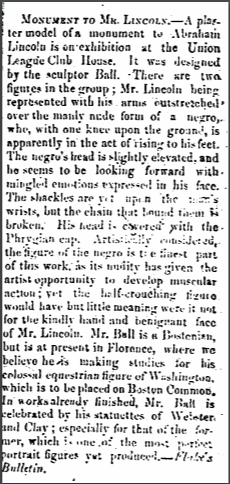
This article from the San Antonio Express, published in April of 1867, describes a monument to Abraham Lincoln on display at the Union League Club House. The monument depicts Lincoln with arms outstretched toward a black man rising from a kneeling position to his feet. The sculpture is said to have been created by Mr. Ball, from Boston.
-
Source
infoweb.newsbank.com
-
Rights
N/A
-
Tags
-
Cite this Item
San Antonio Express. "A Monument to Mr. Lincoln". San Antonio Express. Remembering Lincoln. Web. Accessed April 3, 2026. https://rememberinglincoln.fords.org/node/1101

-
Creator
San Antonio Express
-
Publisher
San Antonio Express
-
Date
April 17, 1867
-
Material
newspaper
from Apr. 17, 1867
A Monument to Mr. Lincoln
-
Description
This article from the San Antonio Express, published in April of 1867, describes a monument to Abraham Lincoln on display at the Union League Club House. The monument depicts Lincoln with arms outstretched toward a black man rising from a kneeling position to his feet. The sculpture is said to have been created by Mr. Ball, from Boston.
-
Source
infoweb.newsbank.com
-
Rights
N/A
-
Creator
San Antonio Express
-
Publisher
San Antonio Express
-
Date
April 17, 1867
-
Material
newspaper
from Apr. 14, 1865
Diary of Orville Hickman Browning
-
Full Title
Diary of Orville Hickman Browning, Friend of Lincoln - Excerpts from April 14-19, 1865
-
Description
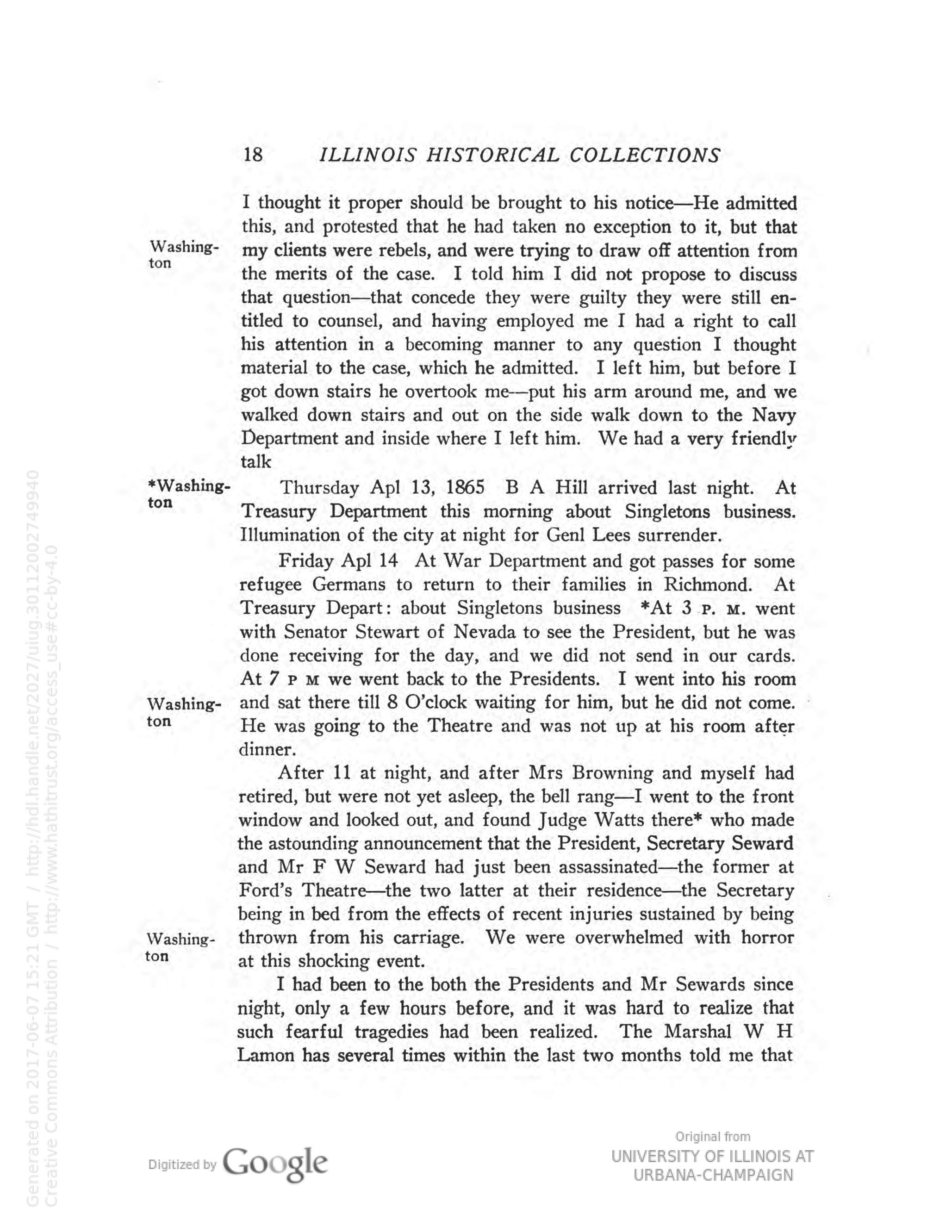
These are the diary entries of former U.S. Senator and friend of President Lincoln, Orville Hickman Browning, the day of Lincoln's assassination up to the funeral in Washington, DC on April 19, 1865. Browning discusses how he heard about the attacks and incorrectly states the Secretary of State Seward was killed. He talks about how Lincoln was the South's best ally within the government and speculates who the attacker was. Over the next few days he visits the White House and describes the body of the fallen president. These excerpts are part of the “Diary of Orville Hickman Browning Volume II: 1865-1881,” published in 1925 by the Illinois State Historical Library. Born in Kentucky in 1806, Browning moved to Quincy, Illinois to become a lawyer. Later he served as a U.S. Senator, adviser to Abraham Lincoln and Andrew Johnson, and even a cabinet minister. Browning and Lincoln became friends while serving in the state legislature; both were members of the Whig party. Browning served as an ally for Lincoln during his presidency.
-
Source
Hathi Trust Digital Library
-
Rights
The written permission of the copyright owners and/or other rights holders (such as publicity and/or privacy rights) is required for distribution, reproduction, or other use of protected items beyond that allowed by fair use or other statutory exemptions.
-
Tags
-
Cite this Item
Orville Hickman Browning. "Diary of Orville Hickman Browning, Friend of Lincoln - Excerpts from April 14-19, 1865". Illinois State Historical Library. Remembering Lincoln. Web. Accessed April 3, 2026. https://rememberinglincoln.fords.org/node/1098
-
Creator
Orville Hickman Browning
-
Publisher
Illinois State Historical Library
-
Date
April 14, 1865
-
Dimensions
22 cm.
from Apr. 14, 1865
Diary of Orville Hickman Browning, Friend of Lincoln - Excerpts from April 14-19, 1865
-
Description
These are the diary entries of former U.S. Senator and friend of President Lincoln, Orville Hickman Browning, the day of Lincoln's assassination up to the funeral in Washington, DC on April 19, 1865. Browning discusses how he heard about the attacks and incorrectly states the Secretary of State Seward was killed. He talks about how Lincoln was the South's best ally within the government and speculates who the attacker was. Over the next few days he visits the White House and describes the body of the fallen president. These excerpts are part of the “Diary of Orville Hickman Browning Volume II: 1865-1881,” published in 1925 by the Illinois State Historical Library. Born in Kentucky in 1806, Browning moved to Quincy, Illinois to become a lawyer. Later he served as a U.S. Senator, adviser to Abraham Lincoln and Andrew Johnson, and even a cabinet minister. Browning and Lincoln became friends while serving in the state legislature; both were members of the Whig party. Browning served as an ally for Lincoln during his presidency.
-
Source
Hathi Trust Digital Library
-
Rights
The written permission of the copyright owners and/or other rights holders (such as publicity and/or privacy rights) is required for distribution, reproduction, or other use of protected items beyond that allowed by fair use or other statutory exemptions.
-
Creator
Orville Hickman Browning
-
Publisher
Illinois State Historical Library
-
Date
April 14, 1865
-
Dimensions
22 cm.