from Feb. 12, 1866
Memorial Address by George Bancroft
-
Full Title
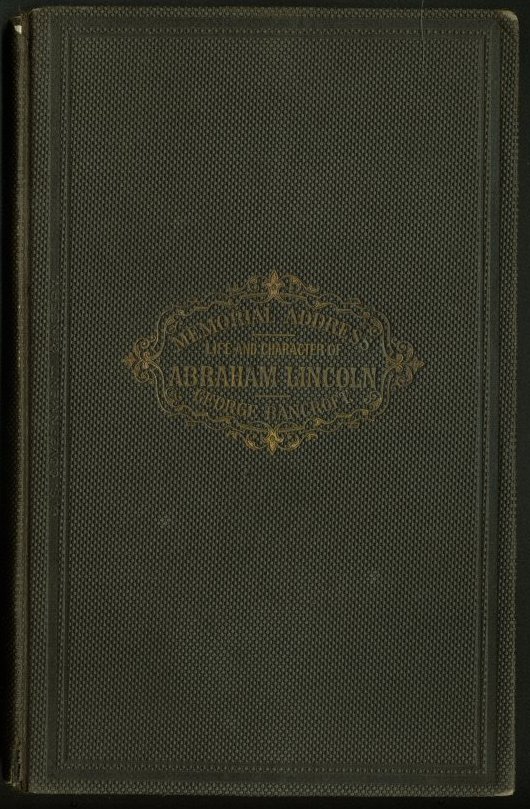
Memorial Address: Life and Character of Abraham Lincoln By George Bancroft
-
Description
American historian and statesman, George Bancroft, was chosen by Congress to deliver a special eulogy for President Lincoln on February 12, 1866. Bancroft addressed both Houses and spoke about the "Life and Character" of the President.This booklet includes a transcription of Bancroft's speech as well as an appendix of Congressional meetings and letters generated after the first news of the President's death in 1865.
-
Transcription
A full scan of this pamphlet is available through the Internet Archive, www.archive.org.
-
Source
The Abraham Lincoln Foundation of The Union League of Philadelphia (Object ID: XI.2.009)
-
Rights
Use of this item for research, teaching and private study is permitted with proper citation and attribution, as “Courtesy of The Abraham Lincoln Foundation of The Union League of Philadelphia.” Reproduction of this item for publication, broadcast or commercial use requires written permission. For permission, please contact The Abraham Lincoln Foundation.
-
Tags
-
Cite this Item
George Bancroft . "Memorial Address: Life and Character of Abraham Lincoln By George Bancroft". Government Printing Office . Remembering Lincoln. Web. Accessed April 3, 2026. https://rememberinglincoln.fords.org/node/1015

-
Creator
George Bancroft
-
Publisher
Government Printing Office
-
Date
February 12, 1866
-
Material
Ink and Paper
from Feb. 12, 1866
Memorial Address: Life and Character of Abraham Lincoln By George Bancroft
-
Description
American historian and statesman, George Bancroft, was chosen by Congress to deliver a special eulogy for President Lincoln on February 12, 1866. Bancroft addressed both Houses and spoke about the "Life and Character" of the President.This booklet includes a transcription of Bancroft's speech as well as an appendix of Congressional meetings and letters generated after the first news of the President's death in 1865.
-
Source
The Abraham Lincoln Foundation of The Union League of Philadelphia (Object ID: XI.2.009)
-
Rights
Use of this item for research, teaching and private study is permitted with proper citation and attribution, as “Courtesy of The Abraham Lincoln Foundation of The Union League of Philadelphia.” Reproduction of this item for publication, broadcast or commercial use requires written permission. For permission, please contact The Abraham Lincoln Foundation.
-
Creator
George Bancroft
-
Publisher
Government Printing Office
-
Date
February 12, 1866
-
Material
Ink and Paper
from Apr. 15, 1865
Lincoln Shirt Fragment
-
Full Title
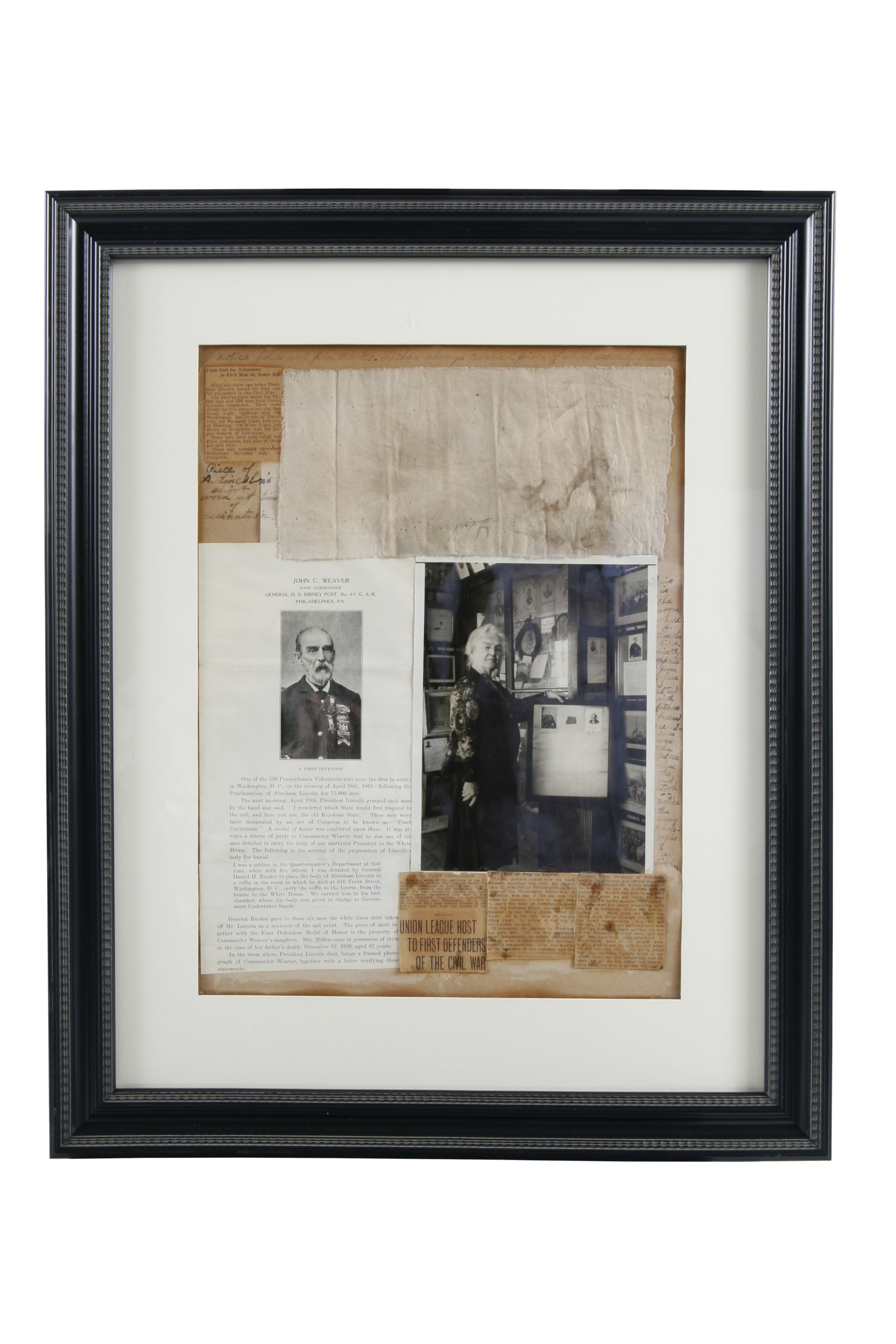
Fragment of Abraham Lincoln's Shirt from the Night of His Assassination
-
Description
On April 15, 1865, a detail of six Union soldiers transported the body of Abraham Lincoln from the Petersen House to the White House, where a Union surgeon performed an autopsy. In recognition of the extraordinary task performed by these soldiers, their commander, General Daniel Rucker, cut six pieces of President Lincoln’s undershirt and gave a piece to each soldier. One of these soldiers was John C. Weaver from Schuylkill County, Pennsylvania, who was assigned to the Quartermasters Corps at the time of President Lincoln's assassination. Weaver's piece of Lincoln's undershirt was given to his granddaughter, Ellen Millen, who complied a collage that incorporated the cloth fragment, printed documentation about Weaver, photographs and annotations.
-
Source
The Abraham Lincoln Foundation of The Union League of Philadelphia (Object ID: 2007.1.1)
-
Rights
Use of this item for research, teaching and private study is permitted with proper citation and attribution, as “Courtesy of The Abraham Lincoln Foundation of The Union League of Philadelphia.” Reproduction of this item for publication, broadcast or commercial use requires written permission. For permission, please contact The Abraham Lincoln Foundation.
-
Tags
-
Cite this Item
Unknown. "Fragment of Abraham Lincoln's Shirt from the Night of His Assassination". Remembering Lincoln. Web. Accessed April 3, 2026. https://rememberinglincoln.fords.org/node/1000
-
Creator
Unknown
-
Date
April 15, 1865
-
Material
Cotton
-
Dimensions
4.625 x 9.625
from Apr. 15, 1865
Fragment of Abraham Lincoln's Shirt from the Night of His Assassination
-
Description
On April 15, 1865, a detail of six Union soldiers transported the body of Abraham Lincoln from the Petersen House to the White House, where a Union surgeon performed an autopsy. In recognition of the extraordinary task performed by these soldiers, their commander, General Daniel Rucker, cut six pieces of President Lincoln’s undershirt and gave a piece to each soldier. One of these soldiers was John C. Weaver from Schuylkill County, Pennsylvania, who was assigned to the Quartermasters Corps at the time of President Lincoln's assassination. Weaver's piece of Lincoln's undershirt was given to his granddaughter, Ellen Millen, who complied a collage that incorporated the cloth fragment, printed documentation about Weaver, photographs and annotations.
-
Source
The Abraham Lincoln Foundation of The Union League of Philadelphia (Object ID: 2007.1.1)
-
Rights
Use of this item for research, teaching and private study is permitted with proper citation and attribution, as “Courtesy of The Abraham Lincoln Foundation of The Union League of Philadelphia.” Reproduction of this item for publication, broadcast or commercial use requires written permission. For permission, please contact The Abraham Lincoln Foundation.
-
Creator
Unknown
-
Date
April 15, 1865
-
Material
Cotton
-
Dimensions
4.625 x 9.625
from Apr. 15, 1865
Clara Barton's Diary
-
Full Title
Clara Barton's Diary
-
Description
Clara Barton, who in 1865 was directing the Missing Soldiers Office answering families' pleas for information on their loved ones, responded with few words to the Lincoln assassination. The Missing Soldiers Office was located three blocks east of Ford's Theatre. In few words, she described the confusion that Washingtonians felt after the event and the anguish that she felt, both over the death of the president as well as the death of her nephew the previous week–sometimes conflating the two.
-
Transcription
Friday, April 14, 1865
Assassination of President
Lincoln
Was returning from a call at
Mr. Upperman’s when it was
Rumored on the street.
Saturday, April 15, 1865
President Lincoln died at
7- o clock this morning
the whole city in gloom
no one knows what to do
Dr. Sidney came
Vice President Johnson
Inaugurated President
Sunday, April 16, 1865
Assassins not detected.
Known to be J. Wilks Booth,
The attempted murder of Mr.
Seward + family was sup-
posed to be by one Surrat-
I was quiet all day.
Monday, April 17, 1865
Attempted to offer some help
Went to Surg Genl office
Could get no one.
The President embalmed in
Preparation to be laid in state
Tomorrow,
Mailed 100 letters
Tuesday, April 18, 1865
President Lincoln laid in
State—dept went in bodies
To see him. Resolutaions passed
at the Mars rooms in
Honor of the President and
Commemoration of poor Irving
Fannie not returned –
Heard this evening that
The assassination of Mr. Seward[?]
Had been arrested at –
2 o clock this morning
- dressed as a laborer, on HE st –
Borrowed some tables to write on
Wednesday, April 19, 1865
Funeral of President Lincoln
I remained in doors all day.
Thursday, April 20, 1865
President lain in state
At the capital
Sally + Fannie + Vester
Return from Mas.
Poor Bubby is at rest –
Friday, April 21, 1865
President Lincoln remains
taken on to Baltimore
great search for Booth -
[Transcription provided by the National Museum of Civil War Medicine and Clara Barton Missing Soldiers Office Museum.] -
Source
-
Rights
This item is in the public domain.
-
Tags
-
Cite this Item
Clara Barton. "Clara Barton's Diary". Remembering Lincoln. Web. Accessed April 3, 2026. https://rememberinglincoln.fords.org/node/997
-
Creator
Clara Barton
-
Date
April 15, 1865
from Apr. 15, 1865
Clara Barton's Diary

-
Description
Clara Barton, who in 1865 was directing the Missing Soldiers Office answering families' pleas for information on their loved ones, responded with few words to the Lincoln assassination. The Missing Soldiers Office was located three blocks east of Ford's Theatre. In few words, she described the confusion that Washingtonians felt after the event and the anguish that she felt, both over the death of the president as well as the death of her nephew the previous week–sometimes conflating the two.
-
Source
-
Rights
This item is in the public domain.
-
Creator
Clara Barton
-
Date
April 15, 1865
from May. 11, 1865
William H. White Letter, May 11, 1865
-
Full Title
Letter from William H. White to his sister, May 11, 1865
-
Description
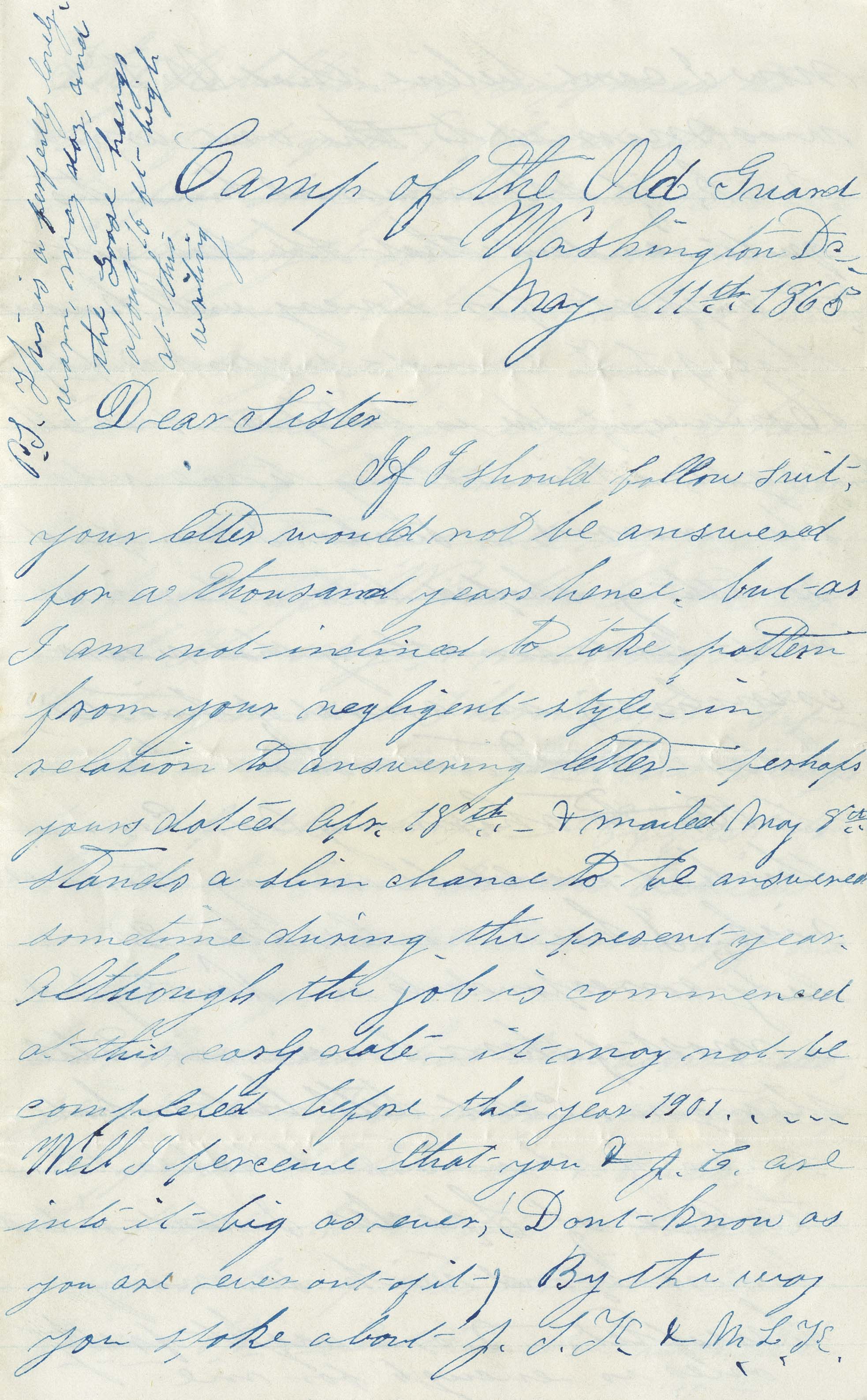
Letter written by William H. White from Camp of the Old Grand, Washington, D.C, to his sister in Milwaukee, Wisconsin, describing the reaction of the soldiers to the assassination of President Lincoln.
-
Transcription
[Page 1]
Camp of the Old Grand
Washington DC
May 11th 1865
{P.S. This is a perfectly lovely, warm, May day, and the gorse[?] hangs about- 16 ft- high at this writing}
Dear Sister
If I should follow suit, your letter would not be answered for a thousand years hence but as I am not inclined to take pattern from your negligent style in relation to answering letters, perhaps yours dated Apr. 18th & mailed May 8th stands a slim chance to be answered sometime during the present year. Although the job is commenced at this early date, it may not be completed before the year 1901. . . Well I perceive that you & J.G. are into it big as ever, (Dont [sic] know as you are ever out of it) By the way you spoke about J. T. K. & M. L. K.
[Page 2]
now I cant [sic] believe that M. L. K. was married to the one armed Jack, if she married him, ‘tis quite evident that she has got him to support for I very well know that J. T. K. cannot support a fly. However, if she is satisfied, it is all right, it is nothing to me who she marries. Reckon I can find something shaped like a feminine [sic] (or at least something that wears crinolines) in course of time! I dare not venture a letter to charming M. C.— think it would be running too much risk, I have no less than 20 lady correspondents in New England –most of them however are total strangers, cant [sic] tell but what some of them are blacker than the Ace of Hades. I dont [sic] intend to correspond with so many hereafter, 2 or 3 right pretty ones is enough for me.
[Page 3]
The Rebellion is supposed to be (if not quite) played out. Suppose some of the volunteers will be discharged soon, I havet [sic] think that Hancocks rect’s [recruits] will stand much show to get out of the service before their year expires. I have something less than 8 months yet to serve to complete my year. My Reg D left Winchester VA last week Thursday, & marched to Washington via Thoroughfare Gap---(distance 100 miles— took us 5 days to make the trip.—Expect to be to the Grand Reaiew Review which is expected to come off one of these days. . .
Our President has been assassinated yes, & the Nation mouurns the loss of it’s [sic] greatest Statesman & Ruler & the people both North & South mourns loss of their Truest, best friend. President Lincoln was like
[Page 4]
a Father & Brother to us all, & the Nation mournings is sincere, & heartfelt, Booth has been is caught, & has paid with his life, for the foul deed. The South have lost their best friend. They will be likely to find in Johnson a hard master to deal with . . . . Our Country is safe. Freedom shall live in America.
I must now begin to taper off a little else get another sheet—the latter will not pay for I havent much of anything more to pawn this time. You must try & answer this right off. Remember now, right off. Let me know about family affairs, etc. etc.
Address as before
Co. B 1st N.J. Nat.-Vol. Inf
Hancocks Corps
Washington D.C.
Yours in great haste
W. H. White
P.S. Regards to all inquiring friends.
-
Source
Samuel White Papers, 1862-1865. University of Wisconsin-Milwaukee Libraries, Archives Department
-
Rights
This item is in the public domain. As a service to other researchers, we request that users credit the University of Wisconsin-Milwaukee Libraries as the source.
-
Tags
-
Cite this Item
White, William. "Letter from William H. White to his sister, May 11, 1865". Remembering Lincoln. Web. Accessed April 3, 2026. https://rememberinglincoln.fords.org/node/937
-
Creator
White, William
-
Date
May 11, 1865
from May. 11, 1865
Letter from William H. White to his sister, May 11, 1865
-
Description
Letter written by William H. White from Camp of the Old Grand, Washington, D.C, to his sister in Milwaukee, Wisconsin, describing the reaction of the soldiers to the assassination of President Lincoln.
-
Source
Samuel White Papers, 1862-1865. University of Wisconsin-Milwaukee Libraries, Archives Department
-
Rights
This item is in the public domain. As a service to other researchers, we request that users credit the University of Wisconsin-Milwaukee Libraries as the source.
-
Creator
White, William
-
Date
May 11, 1865
from Apr. 15, 1865
Tanner Manuscript
-
Full Title
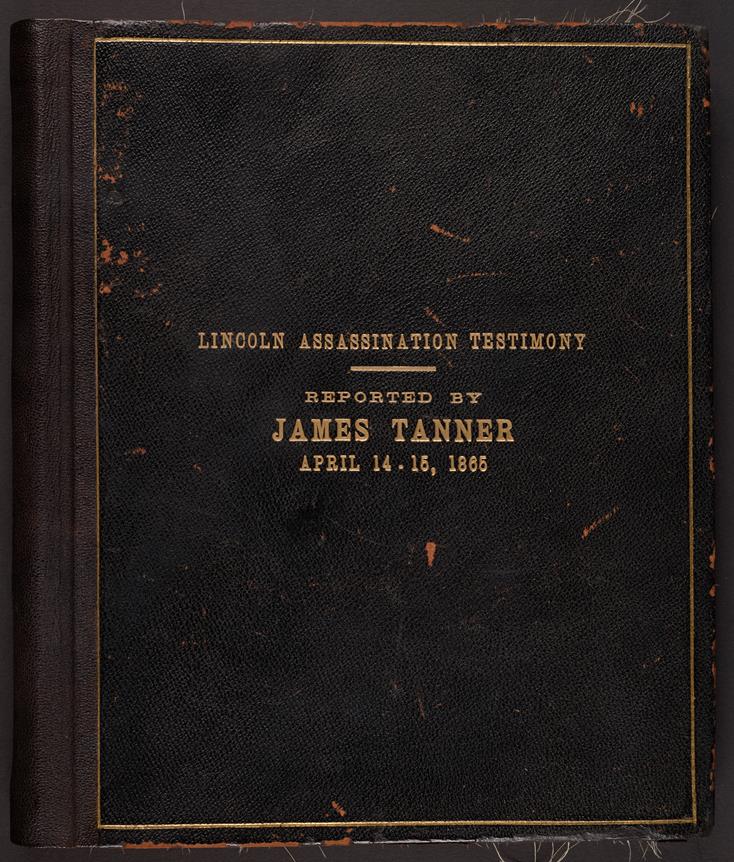
The James Tanner Manuscript
-
Description
In 1865 Corporal James Tanner was a disabled Civil War veteran working as a clerk in the Ordnance Bureau of the War Department and living in an apartment next to the Petersen House in Washington, D.C. On April 14th, President Abraham Lincoln was shot during a theatre performance at Ford’s Theatre. The mortally wounded President was taken to the Petersen House. Because he had stenography skills, Tanner was called into the Petersen House. While Lincoln lay dying in the bedroom, Tanner sat in the parlor and recorded eyewitness testimony as given to Secretary of War Edwin Stanton and David Kellogg Cartter, Chief Justice of the Supreme Court of the District of Columbia. The interrogation of the witnesses took place between midnight and 1:30 A.M. "In fifteen minutes I had testimony enough to hang Wilkes Booth, the assassin, higher than ever Haman hung" noted Tanner. While still in the parlor, Tanner transcribed his shorthand notes into longhand, finishing his task at 6:45 A.M. Tanner returned to his apartment and, dissatisfied with the quality of the first transcription, began a second copy which he left with an aide of Stanton's at his office in the War Department. Tanner retained the original testimony. The copy deposited at the War Department was lost. In 1905, Tanner’s son took his father’s first transcription and mounted each sheet on linen and bound them. In November 1917, as the Union League prepared to celebrate its 55th anniversary and dedicate the Lincoln Memorial Room, Corporal James Tanner wrote to UL President John Gribbell to offer his bound volume of testimony to the League’s collection: "believing that they are of considerable interest to the general public owing to the circumstances surrounding their creation and believing they will become more so as the years pass, I write to say that if you care to give the volume a place among the treasures you may now possess or may naturally gather in the future regarding President Lincoln, I shall be glad to present them to you in perpetuity, limited only to the life of the Union League." Digitization courtesy of the Schoenberg Center for Electronic Text and Image, University of Pennsylvania Libraries.
-
Transcription
Scroll down to "Related Resources" for a downloadable transcription with page breaks that match the original manuscript.
-
Source
The Abraham Lincoln Foundation of The Union League of Philadelphia (Object ID: XI.2.1917.2)
-
Rights
Use of this item for research, teaching and private study is permitted with proper citation and attribution, as “Courtesy of The Abraham Lincoln Foundation of The Union League of Philadelphia.” Reproduction of this item for publication, broadcast or commercial use requires written permission. For permission, please contact The Abraham Lincoln Foundation.
-
Tags
-
Cite this Item
James Tanner. "The James Tanner Manuscript". Remembering Lincoln. Web. Accessed April 3, 2026. https://rememberinglincoln.fords.org/node/892
-
Creator
James Tanner
-
Date
April 15, 1865
-
Material
Paper, board, cloth
-
Dimensions
11" H x 9.5" W
from Apr. 15, 1865
The James Tanner Manuscript
-
Description
In 1865 Corporal James Tanner was a disabled Civil War veteran working as a clerk in the Ordnance Bureau of the War Department and living in an apartment next to the Petersen House in Washington, D.C. On April 14th, President Abraham Lincoln was shot during a theatre performance at Ford’s Theatre. The mortally wounded President was taken to the Petersen House. Because he had stenography skills, Tanner was called into the Petersen House. While Lincoln lay dying in the bedroom, Tanner sat in the parlor and recorded eyewitness testimony as given to Secretary of War Edwin Stanton and David Kellogg Cartter, Chief Justice of the Supreme Court of the District of Columbia. The interrogation of the witnesses took place between midnight and 1:30 A.M. "In fifteen minutes I had testimony enough to hang Wilkes Booth, the assassin, higher than ever Haman hung" noted Tanner. While still in the parlor, Tanner transcribed his shorthand notes into longhand, finishing his task at 6:45 A.M. Tanner returned to his apartment and, dissatisfied with the quality of the first transcription, began a second copy which he left with an aide of Stanton's at his office in the War Department. Tanner retained the original testimony. The copy deposited at the War Department was lost. In 1905, Tanner’s son took his father’s first transcription and mounted each sheet on linen and bound them. In November 1917, as the Union League prepared to celebrate its 55th anniversary and dedicate the Lincoln Memorial Room, Corporal James Tanner wrote to UL President John Gribbell to offer his bound volume of testimony to the League’s collection: "believing that they are of considerable interest to the general public owing to the circumstances surrounding their creation and believing they will become more so as the years pass, I write to say that if you care to give the volume a place among the treasures you may now possess or may naturally gather in the future regarding President Lincoln, I shall be glad to present them to you in perpetuity, limited only to the life of the Union League." Digitization courtesy of the Schoenberg Center for Electronic Text and Image, University of Pennsylvania Libraries.
-
Source
The Abraham Lincoln Foundation of The Union League of Philadelphia (Object ID: XI.2.1917.2)
-
Rights
Use of this item for research, teaching and private study is permitted with proper citation and attribution, as “Courtesy of The Abraham Lincoln Foundation of The Union League of Philadelphia.” Reproduction of this item for publication, broadcast or commercial use requires written permission. For permission, please contact The Abraham Lincoln Foundation.
-
Creator
James Tanner
-
Date
April 15, 1865
-
Material
Paper, board, cloth
-
Dimensions
11" H x 9.5" W
from Apr. 23, 1865
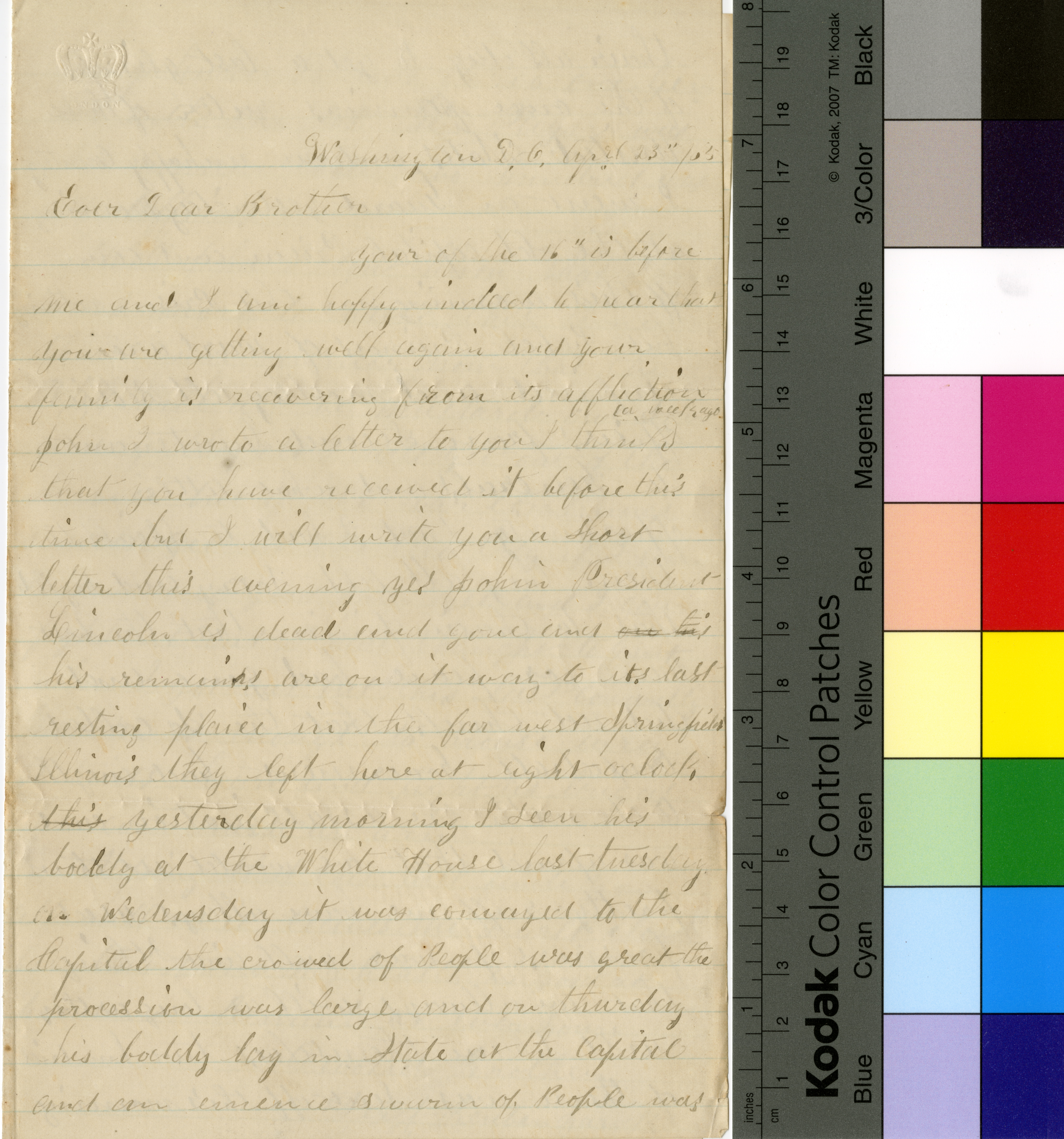
Letter to John Yarick from Reuben Yarick, April 23, 1865
-
Full Title
Handwritten Letter to John Yarick from his brother, Reuben Yarick, April 23, 1865
-
Description
Handwritten letter from Reuben Yarick, at Washington, D.C., to his brother, John Yarick, in Suffield, Portage County, Ohio. The letter describes Reuben's fears and feelings about the assassination of President Lincoln and visiting his body in the White House. This letter is part of Papers of John Yarick, 1854-1864. Reuben enlisted in Company G, 1st Michigan Infantry as a Sergeant on July 2, 1861 at Jackson (Mich.) age 25. He was wounded in action in 1864 and hospitalized at the U.S. Hospital, Hampton, Virginia. He was discharged from Company B, 24th VRC at Washington, D.C., on July 28, 1865. (This information is from Reuben's service record.)
-
Transcription
Page One
Washington, D. C., Aprl 23, 1865
Ever Dear Brother
Yours of the 16th is before
me and I am happy indeed to hear that
you are getting well again and your
family is recovering from its affliction
John I wrote a letter to you I think [inserted: two weeks ago]
that you have received it before this
time but I will write you a short
letter this evening yes John President
Lincoln is dead and you and [crossed out illegible words]
his remains are on it[sic] way to its last
resting place in the far west Springfield
Illinois they left here at eight -oclock
this [crossed out] yesterday morning I seen his
boddy [sic] at the White House last tuesday
or Wedensday [sic] it was conveyed to the
Capital the crowd of People was great the
procession was large and on thurday [sic]
his boddy [sic] lay in State at the Capital [sic]
and an emence [sic] swarm of People was
Page Two
their [sic] all day to get a last glimpse
of the once famous ruler of these
United States and our unhappy country
I went on Guard yesterday morning
at the old capital Prison and came
off this morning in the Prison nothing
but Rebel Prisoners of war are
confined and mostley [sic] all Rebell [sic]
officers from Second Lieutenant
to Generals and what little
opportunity that I had to speak to
them they all felt sorry and sayed [sic]
that to their opinion that the best
man for peace had gone and
did not think that the so called
Confederate Government had eneything [sic]
to do with the assassination and
was afraid that we would use them
pretty ruff [sic] we have allays [sic] used
prisoners of war well and I thing [sic]
that we allways [sic] will as long as they
will behave themselves two hundred
of these was sent off this morning
Page Three
for Johnson Island Ohio one Gen
was with the lot Gen Payn was
his name those two hundred was
all Officers.
Well John I don't know that i have
much more to write this time
their [sic] is a rumor now that the
V.R.C. will be mustard [sic] out soon
and if they do I will get out of the
Service but if the war continues
I will get in the Cavlrey [sic] if I can
I have one good arm yet and I can
fight it out had thought to quit
when I got out but this last cowardly
murder is enough to arouse evrey [sic]
Patriot's heart and fight as long as
he can raise an arm
Hoping that this will finde [sic] you
all well as it leaves me I will close
for this time my health is good at
present Remain as ever your
Devoted Brother
Sergt. Reuben Yarick
-
Source
Clarke Historical Library, Central Michigan University, John Yarick Papers, 1854-1864
-
Rights
This item may be reproduced and used for any purpose, including research, teaching, private study, publication, broadcast or commercial use, with proper citation and attribution.
-
Tags
-
Cite this Item
Yarick, Reuben. "Handwritten Letter to John Yarick from his brother, Reuben Yarick, April 23, 1865". Remembering Lincoln. Web. Accessed April 3, 2026. https://rememberinglincoln.fords.org/node/847
-
Creator
Yarick, Reuben
-
Date
1865
-
Material
Letter
-
Dimensions
8x10 inches
from Apr. 23, 1865
Handwritten Letter to John Yarick from his brother, Reuben Yarick, April 23, 1865
-
Description
Handwritten letter from Reuben Yarick, at Washington, D.C., to his brother, John Yarick, in Suffield, Portage County, Ohio. The letter describes Reuben's fears and feelings about the assassination of President Lincoln and visiting his body in the White House. This letter is part of Papers of John Yarick, 1854-1864. Reuben enlisted in Company G, 1st Michigan Infantry as a Sergeant on July 2, 1861 at Jackson (Mich.) age 25. He was wounded in action in 1864 and hospitalized at the U.S. Hospital, Hampton, Virginia. He was discharged from Company B, 24th VRC at Washington, D.C., on July 28, 1865. (This information is from Reuben's service record.)
-
Source
Clarke Historical Library, Central Michigan University, John Yarick Papers, 1854-1864
-
Rights
This item may be reproduced and used for any purpose, including research, teaching, private study, publication, broadcast or commercial use, with proper citation and attribution.
-
Creator
Yarick, Reuben
-
Date
April 23, 1865
-
Material
Letter
-
Dimensions
8x10 inches
from Apr. 17, 1865
Lesson of the hour
-
Full Title
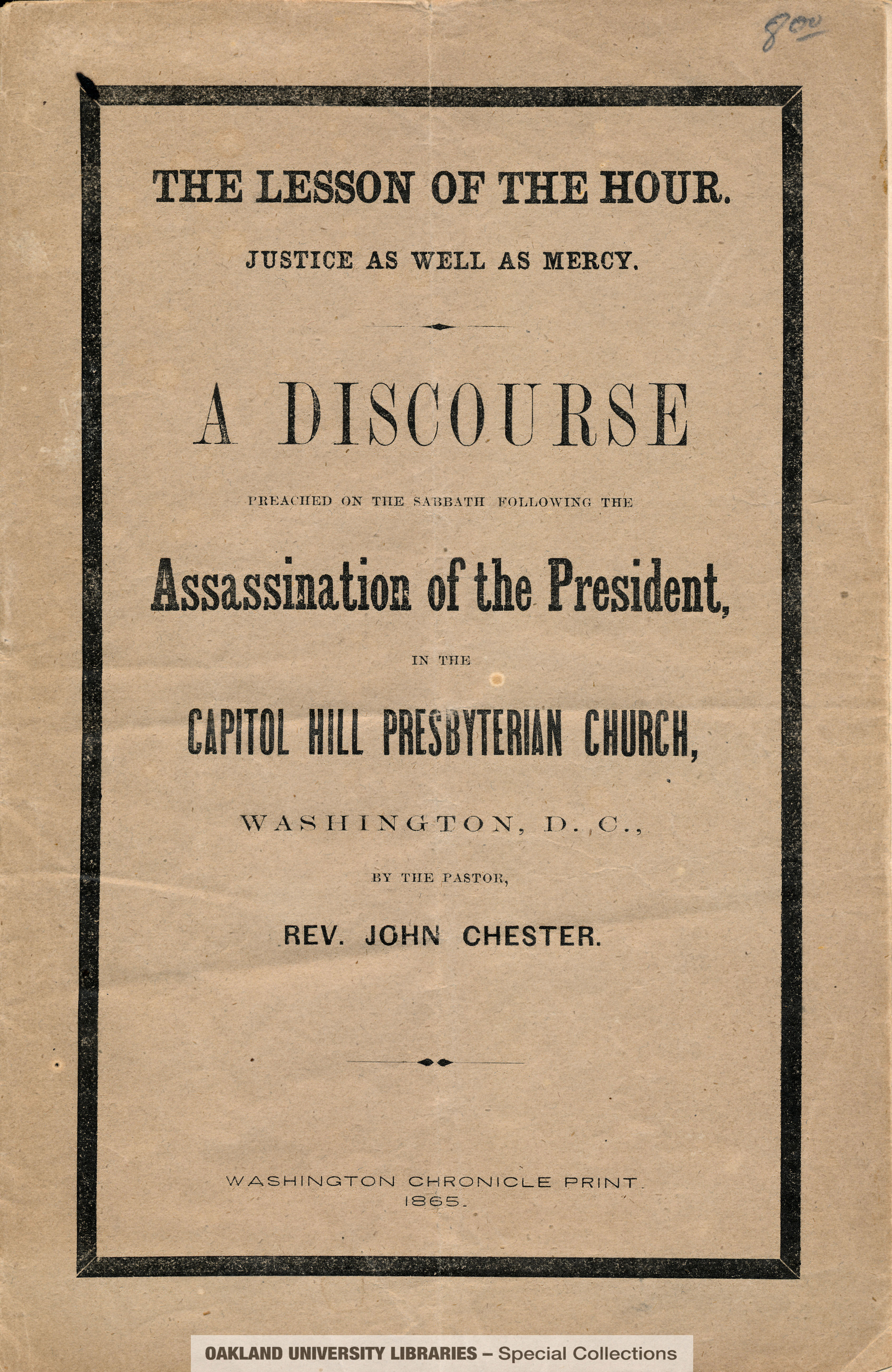
The Lesson of the hour. Justice as well as mercy.
-
Description
A discourse preached on the sabbath following the assassination of the President, in the Capitol Hill Presbyterian Church, Washington, D.C., by the Pastor, Rev. John Chester. 300 copies of this eulogy were distributed. The author intended it as an appeal to the consciences of all supporters of the Union.
-
Source
Springer Collection, Oakland University Special Collections
-
Rights
This item may be reproduced and used for any purpose, including research, teaching, private study, publication, broadcast, or commercial use, with proper citation and attribution.
-
Tags
-
Cite this Item
John Chester. "The Lesson of the hour. Justice as well as mercy.". Washington Chronicle Print . Remembering Lincoln. Web. Accessed April 3, 2026. https://rememberinglincoln.fords.org/node/815

-
Creator
John Chester
-
Publisher
Washington Chronicle Print
-
Date
April 17, 1865
-
Material
paper
-
Dimensions
8 3/4"h x 5 5/8"w
from Apr. 17, 1865
The Lesson of the hour. Justice as well as mercy.
-
Description
A discourse preached on the sabbath following the assassination of the President, in the Capitol Hill Presbyterian Church, Washington, D.C., by the Pastor, Rev. John Chester. 300 copies of this eulogy were distributed. The author intended it as an appeal to the consciences of all supporters of the Union.
-
Source
Springer Collection, Oakland University Special Collections
-
Rights
This item may be reproduced and used for any purpose, including research, teaching, private study, publication, broadcast, or commercial use, with proper citation and attribution.
-
Creator
John Chester
-
Publisher
Washington Chronicle Print
-
Date
April 17, 1865
-
Material
paper
-
Dimensions
8 3/4"h x 5 5/8"w
from Apr. 16, 1865
The Martyr President
-
Full Title
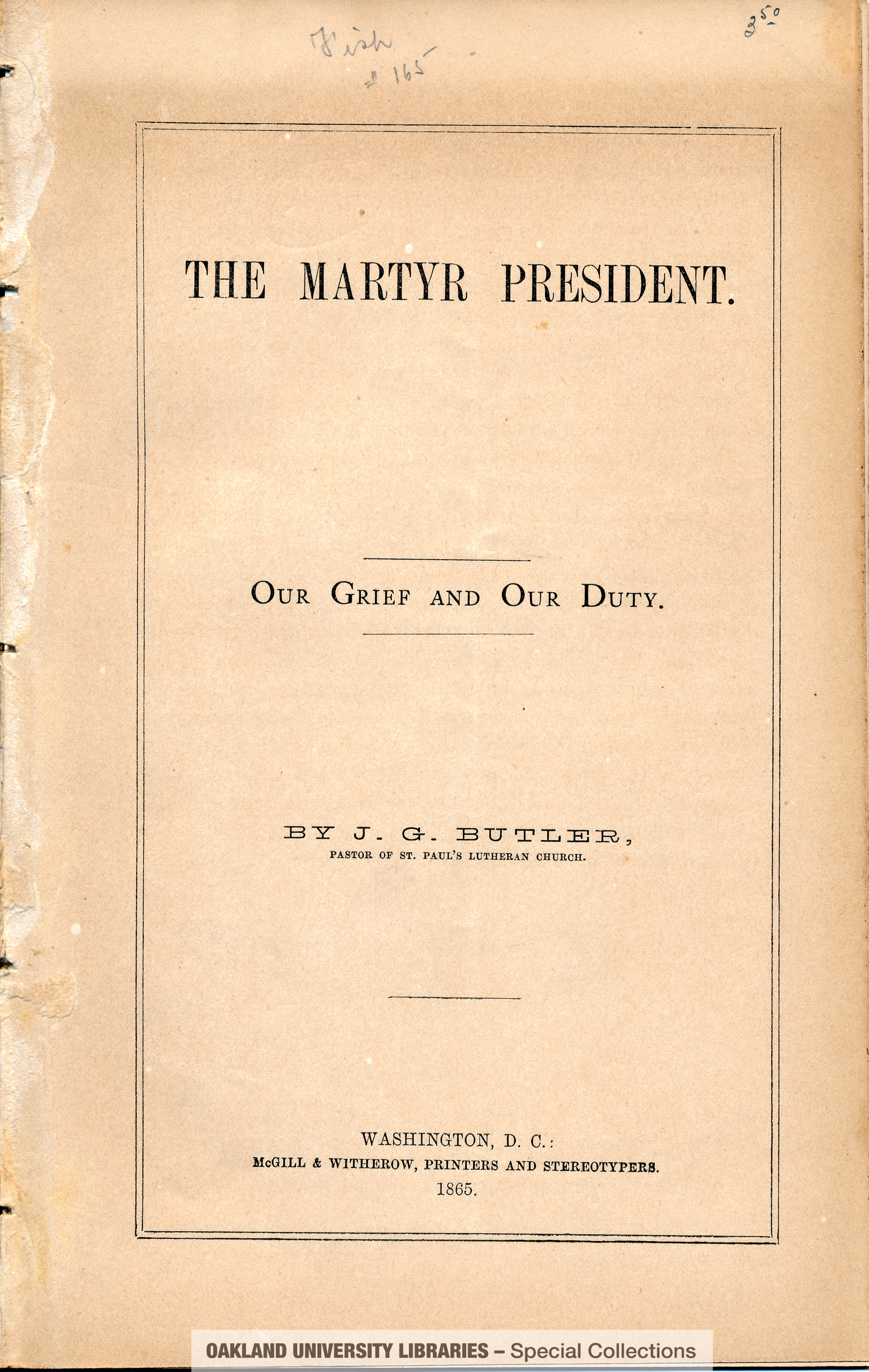
The Martyr President: Our Grief and Our Duty
-
Description
Memorial oratory delivered by J.G. Butler, Pastor of St. Paul's Church on Easter Sunday Apr. 16, 1865.
-
Source
Springer Collection, Oakland University Special Collections
-
Rights
This item may be reproduced and used for any purpose, including research, teaching, private study, publication, broadcast, or commercial use, with proper citation and attribution.
-
Tags
-
Cite this Item
J.G. Butler. "The Martyr President: Our Grief and Our Duty". McGill&Witherow. Remembering Lincoln. Web. Accessed April 3, 2026. https://rememberinglincoln.fords.org/node/814
-
Creator
J.G. Butler
-
Publisher
McGill&Witherow
-
Date
April 16, 1865
-
Material
paper
-
Dimensions
8 1/2"h x 5 1/2"w
from Apr. 16, 1865
The Martyr President: Our Grief and Our Duty
-
Description
Memorial oratory delivered by J.G. Butler, Pastor of St. Paul's Church on Easter Sunday Apr. 16, 1865.
-
Source
Springer Collection, Oakland University Special Collections
-
Rights
This item may be reproduced and used for any purpose, including research, teaching, private study, publication, broadcast, or commercial use, with proper citation and attribution.
-
Creator
J.G. Butler
-
Publisher
McGill&Witherow
-
Date
April 16, 1865
-
Material
paper
-
Dimensions
8 1/2"h x 5 1/2"w
from Feb. 12, 1866
In Memoriam of Abraham Lincoln
-
Full Title
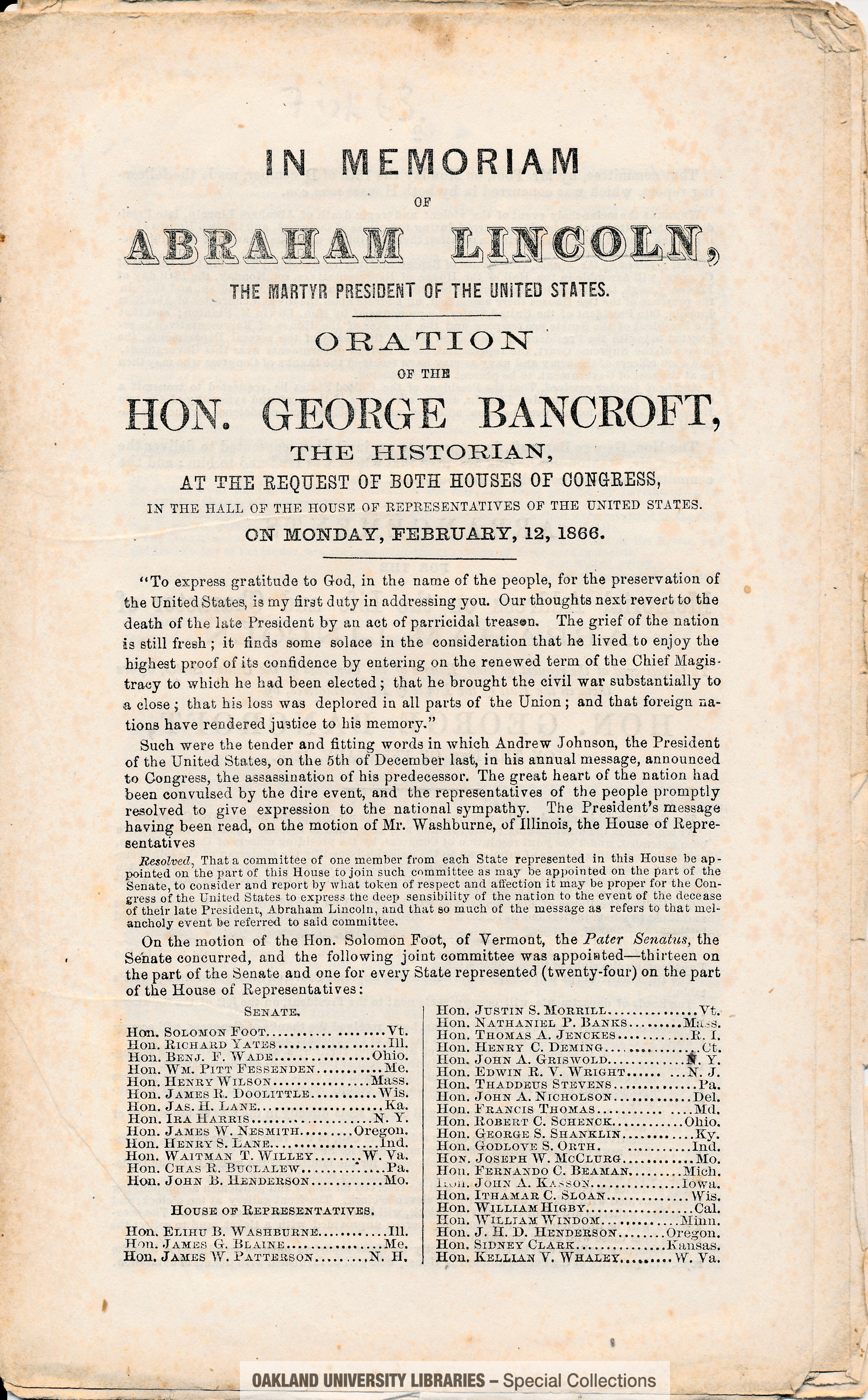
In Memoriam of Abraham Lincoln, the Martyr President of the United States
-
Description
Eulogy delivered by the famous historian and statesman George Bancroft at the request of Congress in front of the House of Representatives on February 12, 1866. Originally published by the Government Printing Office, it was reprinted numerous times.
-
Source
Springer Collection, Oakland University Special Collections
-
Rights
This item may be reproduced and used for any purpose, including research, teaching, private study, publication, broadcast, or commercial use, with proper citation and attribution.
-
Tags
-
Cite this Item
George Bancroft. "In Memoriam of Abraham Lincoln, the Martyr President of the United States". L. Towers. Remembering Lincoln. Web. Accessed April 3, 2026. https://rememberinglincoln.fords.org/node/813
-
Creator
George Bancroft
-
Publisher
L. Towers
-
Date
February 12, 1866
-
Material
paper
-
Dimensions
9 1/2"h x 6"w
from Feb. 12, 1866
In Memoriam of Abraham Lincoln, the Martyr President of the United States
-
Description
Eulogy delivered by the famous historian and statesman George Bancroft at the request of Congress in front of the House of Representatives on February 12, 1866. Originally published by the Government Printing Office, it was reprinted numerous times.
-
Source
Springer Collection, Oakland University Special Collections
-
Rights
This item may be reproduced and used for any purpose, including research, teaching, private study, publication, broadcast, or commercial use, with proper citation and attribution.
-
Creator
George Bancroft
-
Publisher
L. Towers
-
Date
February 12, 1866
-
Material
paper
-
Dimensions
9 1/2"h x 6"w
from Apr. 17, 1865
Proceedings of a Called Meeting
-
Full Title
Proceedings of a called meeting of ministers of all religious denominations in the District of Columbia, in the First Baptist Church on Thirteenth Street, Monday, April 17
-
Description
Minutes of a meeting of ministers of various denominations in Washington, D.C. to organize a response to the assassination and burial of President Lincoln. Includes remarks by Rev. Gurley, who was a close friend of the Lincolns during his time as Chaplain of the United States Senate. He preached the funeral sermon at the White House on April 19.
-
Source
Springer Collection, Oakland University Special Collections
-
Rights
This item may be reproduced and used for any purpose, including research, teaching, private study, publication, broadcast, or commercial use, with proper citation and attribution.
-
Tags
-
Cite this Item
Phineas Densmore Gurley. "Proceedings of a called meeting of ministers of all religious denominations in the District of Columbia, in the First Baptist Church on Thirteenth Street, Monday, April 17". McGill & Witherow. Remembering Lincoln. Web. Accessed April 3, 2026. https://rememberinglincoln.fords.org/node/805
-
Creator
Phineas Densmore Gurley
-
Publisher
McGill & Witherow
-
Date
April 17, 1865
-
Material
paper
-
Dimensions
9" h x 5 5/8" w
from Apr. 17, 1865
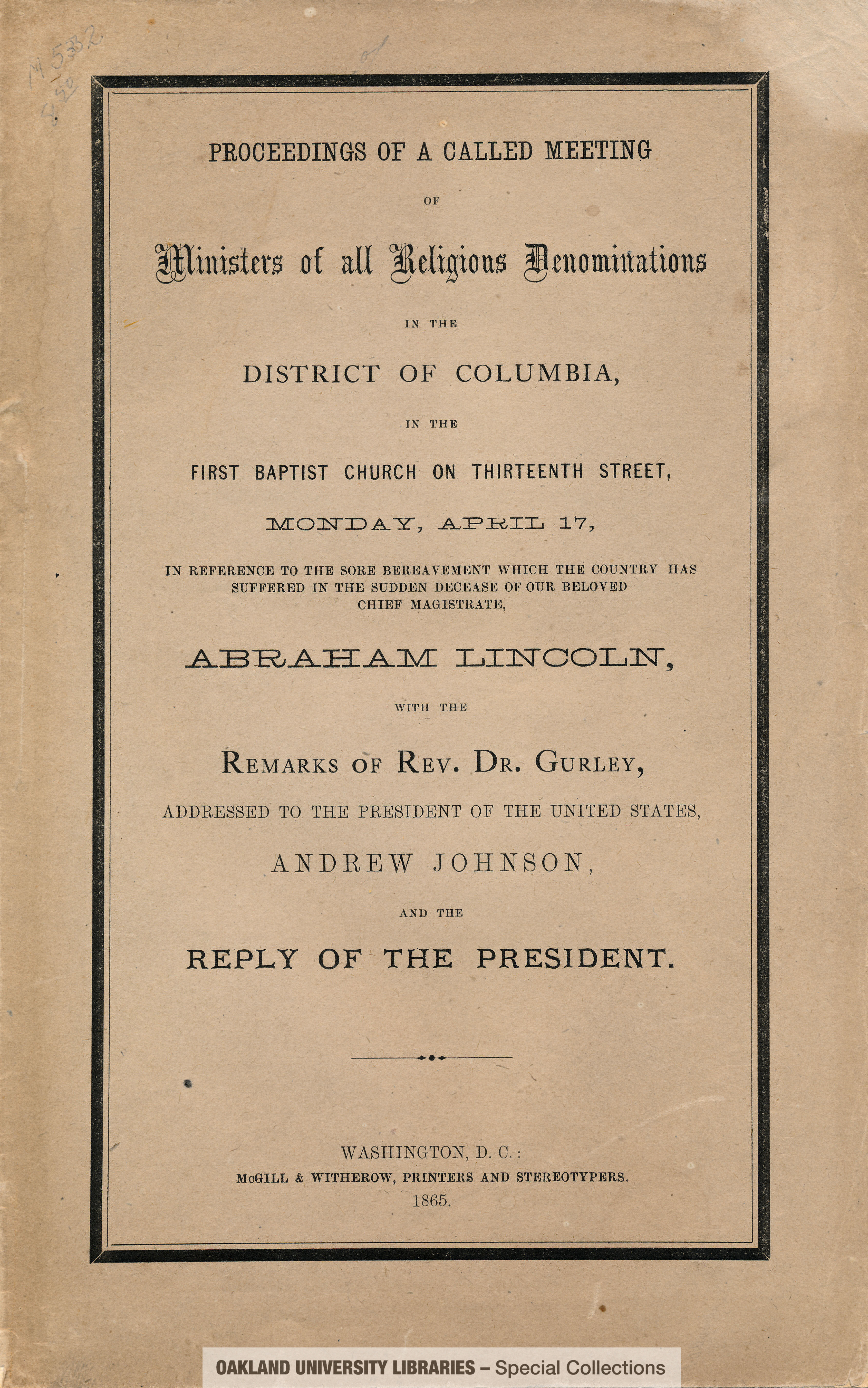
Proceedings of a called meeting of ministers of all religious denominations in the District of Columbia, in the First Baptist Church on Thirteenth Street, Monday, April 17
-
Description
Minutes of a meeting of ministers of various denominations in Washington, D.C. to organize a response to the assassination and burial of President Lincoln. Includes remarks by Rev. Gurley, who was a close friend of the Lincolns during his time as Chaplain of the United States Senate. He preached the funeral sermon at the White House on April 19.
-
Source
Springer Collection, Oakland University Special Collections
-
Rights
This item may be reproduced and used for any purpose, including research, teaching, private study, publication, broadcast, or commercial use, with proper citation and attribution.
-
Creator
Phineas Densmore Gurley
-
Publisher
McGill & Witherow
-
Date
April 17, 1865
-
Material
paper
-
Dimensions
9" h x 5 5/8" w