from Apr. 22, 1865
P.W. Oakley to Norman Henry Ives
-
Full Title
P.W. Oakley to Norman Henry Ives
-
Description
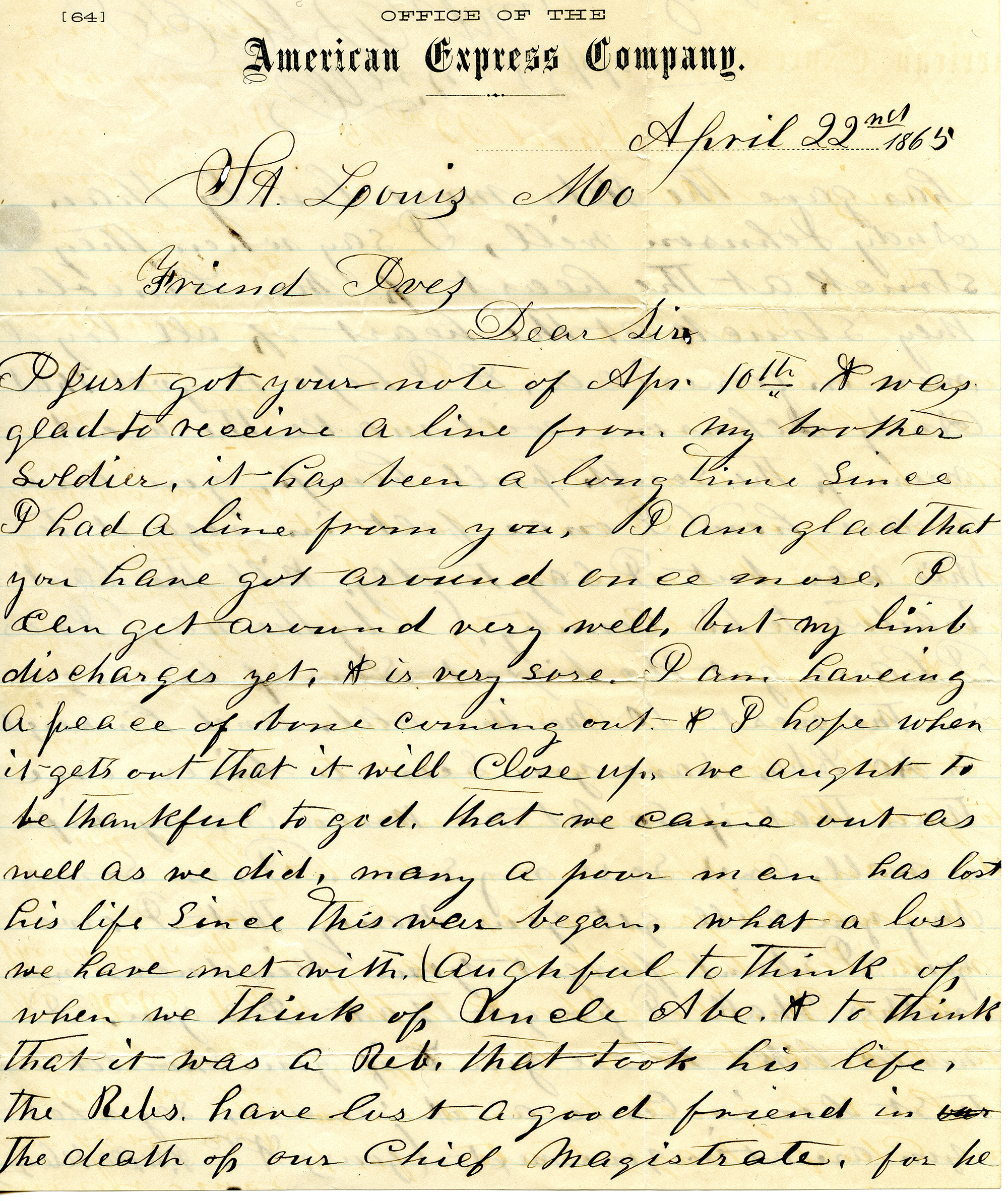
P.W. Oakley of St. Louis, Missouri, wrote this letter to Norman Henry Ives in Nashville, Tennessee, on April 22, 1865, a week after John Wilkes Booth assassinated President Abraham Lincoln. Oakley and Ives shared the bond of having been injured during the Civil War--Ives, a native of Illinois, had been discharged from the U.S. Army after suffering a leg wound at the Battle of Pea Ridge in 1862. Oakley begins the letter by discussing his injury. He then turns to his thoughts about the assassination of Lincoln, referring to the slain president as "Uncle Abe." Oakley suggests that Lincoln would have shown more lenience to Confederates than his successor, Andrew Johnson, would (speculation that would prove untrue). He also expresses hope that Confederate leadership would "pull hemp"--be hanged--for the assassination. Oakley then goes on to brag about the size of his 10-month-old son. Ives kept this letter and eventually passed it down through his family. His great-great-granddaughter Arlis Groves, a social science teacher at Toby Johnson Middle School in Elk Grove, California, now holds this letter and contributed it to Remembering Lincoln.
-
Transcription
April 22, 1865
St. Louis Mo
Friend Ives
Dear Sir,
I just got your note of Apr. 10th. I was glad to receive a line from my brother soldier. It has been a long time since I had a line from you. I am glad that you have got around once more. I can get around very well, but my limb discharges yet. It is very sore. I am haveing a peace of bone coming out, & I hope when it gets out that it will close up. We aught to be thankful to god that we came out as well as we did, many a poor man has lost his life since this war began. What a loss we have met with. (Aughful to think of, when we think of Uncle Abe. & to think that it was a Reb. that took his life. The Rebs. have lost a good friend in the death of our Chief Magistrate, for he has gave the Rebs more lenity than Andy Johnson will. I say when they struck at the heart of Mr. Lincoln they struck at the heart of all loyal men in America, & I hope to god that Andy Johnson will make the head men of the south pull hemp. You are aware how I once felt in regard to this war. But, I say today, kill the last traitor to his country. By the way, Ives, I have got the bigist son of his age in the west. 10 months old and his weight is 40 lbs. Have you seen a biger one than that? If so, let me know it. My wife is well. And so is my son. Ives, some day you will get your money that I owe you. I shant forget your kindness nor nether shall I forget that I ow you. I would like to see you & if you should come to St Louis, come and see me. Say what you are at in your next.
Yours &c,
P.W. Oakley -
Source
Arlis Groves, great-great-granddaughter of Norman Henry Ives
-
Rights
This item is in the public domain and may be reproduced and used for any purpose, including research, teaching , private study, publication, broadcast or commercial use, with proper citation and attribution.
-
Tags
-
Cite this Item
P.W. Oakley. "P.W. Oakley to Norman Henry Ives". Remembering Lincoln. Web. Accessed June 3, 2026. https://rememberinglincoln.fords.org/node/1016
-
Creator
P.W. Oakley
-
Date
April 22, 1865
from Apr. 22, 1865
P.W. Oakley to Norman Henry Ives
-
Description
P.W. Oakley of St. Louis, Missouri, wrote this letter to Norman Henry Ives in Nashville, Tennessee, on April 22, 1865, a week after John Wilkes Booth assassinated President Abraham Lincoln. Oakley and Ives shared the bond of having been injured during the Civil War--Ives, a native of Illinois, had been discharged from the U.S. Army after suffering a leg wound at the Battle of Pea Ridge in 1862. Oakley begins the letter by discussing his injury. He then turns to his thoughts about the assassination of Lincoln, referring to the slain president as "Uncle Abe." Oakley suggests that Lincoln would have shown more lenience to Confederates than his successor, Andrew Johnson, would (speculation that would prove untrue). He also expresses hope that Confederate leadership would "pull hemp"--be hanged--for the assassination. Oakley then goes on to brag about the size of his 10-month-old son. Ives kept this letter and eventually passed it down through his family. His great-great-granddaughter Arlis Groves, a social science teacher at Toby Johnson Middle School in Elk Grove, California, now holds this letter and contributed it to Remembering Lincoln.
-
Source
Arlis Groves, great-great-granddaughter of Norman Henry Ives
-
Rights
This item is in the public domain and may be reproduced and used for any purpose, including research, teaching , private study, publication, broadcast or commercial use, with proper citation and attribution.
-
Creator
P.W. Oakley
-
Date
April 22, 1865
from May. 1, 1865
Abraham Lincoln Gefallen durch Mörderhand (Abraham Lincoln Fallen at/by the hand of an Assassin)
-
Full Title
Abraham Lincoln Gefallen durch Mörderhand (Abraham Lincoln Fallen at/by the hand of an Assassin)
-
Description
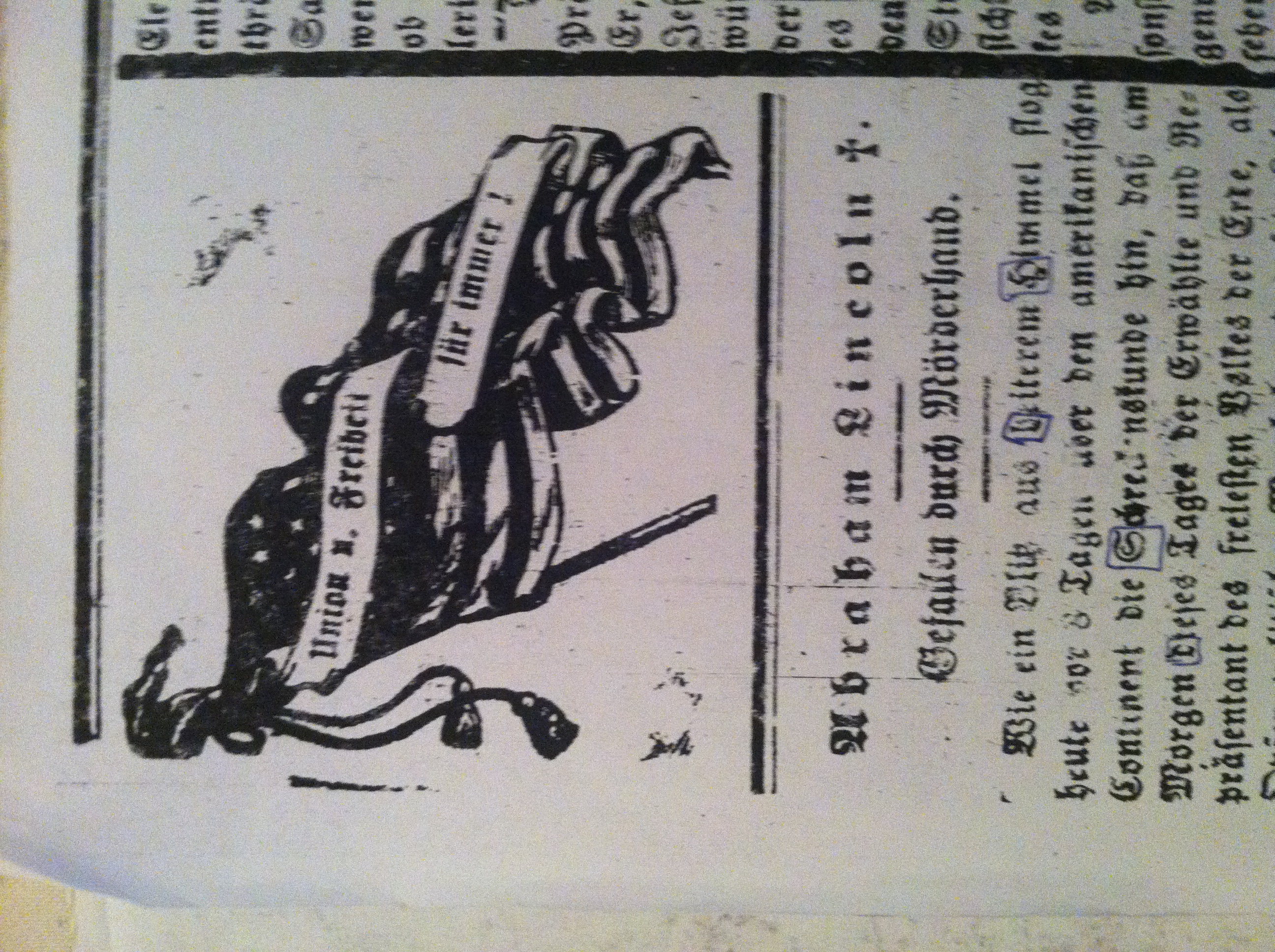
This weekly Milwaukee German newspaper’s article recounts the events surrounding Lincoln’s Assassination and reflects on Lincoln’s legacy. The article strongly praises Lincoln saying he was a martyr for his country, equality, and freedom. Written in the folds of the flag above the headline is written Union and freedom forever which is showing of how Germans viewed the war. The article also expresses that people believe that President Johnson will get revenge for Lincoln’s assassination when it says that Johnson would hang Jeff Davis. The article continually comes back to praising Lincoln for his actions as leader of the country saying he was a true servant and leader of the people and portrays Lincoln in a very positive manner. The article is still being fully translated.
-
Rights
The article is on microfilm at the Milwaukee Public Library and may be reproduced and used for any purpose, including research, teaching, private study, publication, broadcast or commercial use, with proper citation and attribution.
-
Tags
-
Cite this Item
Milwaukee Herald. "Abraham Lincoln Gefallen durch Mörderhand (Abraham Lincoln Fallen at/by the hand of an Assassin)". Remembering Lincoln. Web. Accessed June 3, 2026. https://rememberinglincoln.fords.org/node/935

-
Creator
Milwaukee Herald
-
Date
1865
from May. 1, 1865
Abraham Lincoln Gefallen durch Mörderhand (Abraham Lincoln Fallen at/by the hand of an Assassin)
-
Description
This weekly Milwaukee German newspaper’s article recounts the events surrounding Lincoln’s Assassination and reflects on Lincoln’s legacy. The article strongly praises Lincoln saying he was a martyr for his country, equality, and freedom. Written in the folds of the flag above the headline is written Union and freedom forever which is showing of how Germans viewed the war. The article also expresses that people believe that President Johnson will get revenge for Lincoln’s assassination when it says that Johnson would hang Jeff Davis. The article continually comes back to praising Lincoln for his actions as leader of the country saying he was a true servant and leader of the people and portrays Lincoln in a very positive manner. The article is still being fully translated.
-
Rights
The article is on microfilm at the Milwaukee Public Library and may be reproduced and used for any purpose, including research, teaching, private study, publication, broadcast or commercial use, with proper citation and attribution.
-
Creator
Milwaukee Herald
-
Date
May 1, 1865
from May. 10, 1865
Trail of the Murderers
-
Full Title
Trail of the Murderers
-
Description
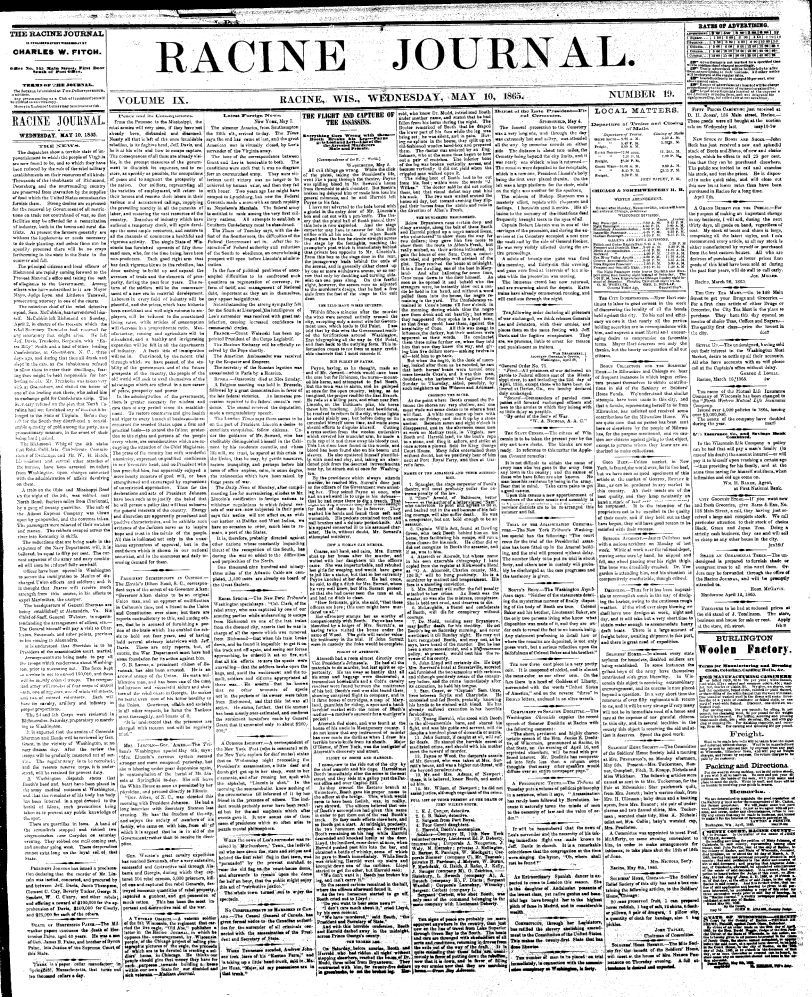
This newspaper article from May 10, 1865, contains reactions from Racine, Wisconsin's point of view. This article contains excerpts about the escape route of John Wilkes Booth, and the plans he had, as well as the actions that he took on his journey. It also contains, a account from both Mrs. Lincoln, and Vice President Andrew Johnson. In these two excerpts both Johnson and Mrs. Lincoln explain there reactions. Johnson's reaction was placing a proclamation in action that gave a reward to those who captured the killers. Mrs. Lincoln reacted through shock as she fought through the mourning of her husbands death. Finally, there is an excerpt about the funeral ceremony that explains how long and widely attended Lincoln's procession was.
-
Rights
This item is in the public domain and may be reproduced and used for any purpose, including research, teaching, private study, publication, broadcast or commercial use, with proper citation and attribution.
-
Tags
-
Cite this Item
Racine Journal. "Trail of the Murderers". Racine Journal. Remembering Lincoln. Web. Accessed June 3, 2026. https://rememberinglincoln.fords.org/node/925
-
Creator
Racine Journal
-
Publisher
Racine Journal
-
Date
May 10, 1865
from May. 10, 1865
Trail of the Murderers
-
Description
This newspaper article from May 10, 1865, contains reactions from Racine, Wisconsin's point of view. This article contains excerpts about the escape route of John Wilkes Booth, and the plans he had, as well as the actions that he took on his journey. It also contains, a account from both Mrs. Lincoln, and Vice President Andrew Johnson. In these two excerpts both Johnson and Mrs. Lincoln explain there reactions. Johnson's reaction was placing a proclamation in action that gave a reward to those who captured the killers. Mrs. Lincoln reacted through shock as she fought through the mourning of her husbands death. Finally, there is an excerpt about the funeral ceremony that explains how long and widely attended Lincoln's procession was.
-
Rights
This item is in the public domain and may be reproduced and used for any purpose, including research, teaching, private study, publication, broadcast or commercial use, with proper citation and attribution.
-
Creator
Racine Journal
-
Publisher
Racine Journal
-
Date
May 10, 1865
from Jun. 8, 1865
Trial of the Assassins
-
Full Title
Trial of the Assassins
-
Description
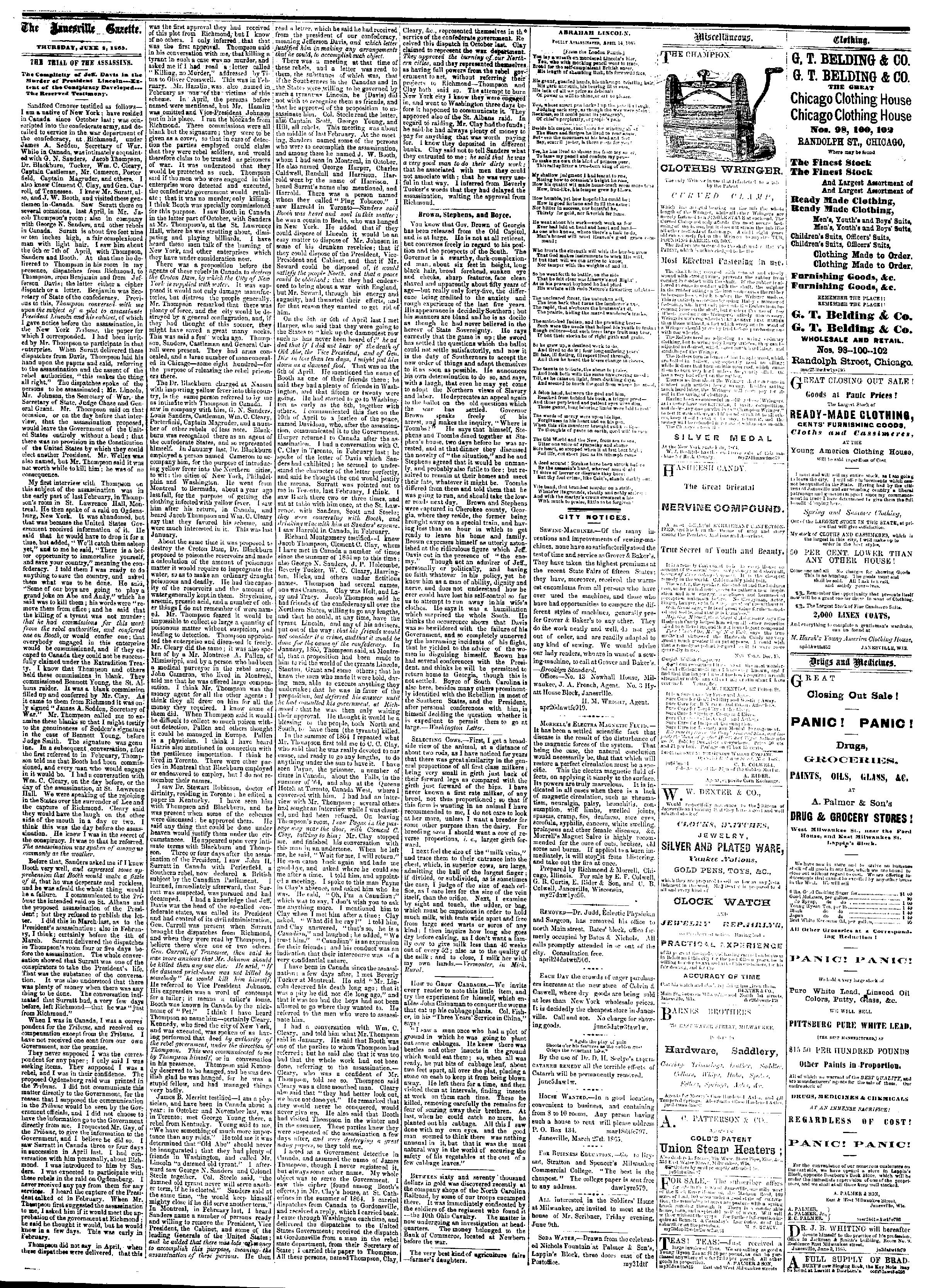
This file is a newspaper entry, from Thursday, June 8, 1865, regarding the trial of the men and woman involved in the assassination of President Lincoln. This article contains direct statements from people involved, it also details the extent of the conspiracy and its members. Specifically, the involvement of confederate officials like Jefferson Davis. The article begins with statements made by Sandford Conover.
-
Transcription
The Trial of the Assassins.
The Complicity of Jeff. Davis in the Murder of President Lincoln—Extent of the Conspiracy Developed—The Reserved Testimony,
Sandford Conover testified as follows—I am a native of New York; have resided in Canada since October last, was conscripted into the confederate army, and detailed to service in the war department of the confederacy, at Richmond, under James A. Sedden, Secretary of War. While in Canada, was intimately acquainted with G.N. Sanders, Jacob Thompson, Dr. Blackburn, Tucker, Wm. C. Cleary, Captain Castleman, Mr. Cameron, Porterfield, Captain Magruder, and others. I also know Clement C. Clay, and Gen. Carroll, of Tennessee. I knew Mr. Surrat, also, and J.W. Booth, and visited these gentlemen in Canada. Saw Surrat there on several occasions, last April, in Mr. Jacob Thompson’s room; also in company with George N. Sanders, ant other rebels in Canada. Surrat is about five feet nine or ten inches high, a fair complexioned man with light hair. I saw him about the 6th or 7th of April with Thompson, Sanders, and Booth. At that time he delivered to Thompson in his room in my presence, dispatches from Richmond, to Thompson, from Benjamin and from Jefferson Davis; the latter either a cipher dispatch or a letter. Benjamin was Secretary of State of the confederacy. Previous to this, Thompson conversed with me upon the subject of a plot to assassinate President Lincoln and his cabinet, of which I gave notice before the assassination, in the New York Tribune, the paper for which I corresponded. I had been invited by Mr. Thompson to participate in that enterprise. When Surrat delivered these dispatches from Davis, Thompson laid his hand upon the papers and said, referring to the assassination and the assent of the rebel authorities, “this makes the thing all right.” The dispatches spoke of the persons to be assassinated; Mr. Lincoln, Mr. Jonson, the Secretary of War, the Secretary of State, Judge Chase and General Grant. Mr. Thompson said on that occasion, or on the day before the interview, that the assassination proposed, would leave the Government of the United States entirely without a head; that there was no provision in the Constitution of the United States by which they could elect another President. Mr. Welles was also named, but Mr. Thompson said it was not worth while to kill him; he was of no consequence.
My first interview with Thompson on this subject of the assassination was in the early part of last February, in Thompson’s room in St. Lawrence Hall, Montreal. He then spoke of a raid on Ogdensburg, New York. It was abandoned, but that was because the United States Government received information of it. He said that he would have to drop it for a time, but added, “We’ll catch them asleep yet,” and to me he said, “There is a better opportunity to immortalize yourself, and save your country, “Meaning the confederacy. I told them I was ready to do anything to save the county, and asked them what was to be done. He said, “Some of our boys are going to play a grand joke on Abe and Andy,” which he said was to kill them; his words were “remove them from office; and he said that the killing of a tyrant was not murder, that he had commissions for this work from the rebel authorities, and conferred one on, Booth, or would confer one; that everybody engaged in this enterprise would be commissioned, and if they escaped to Canada they could not be successfully claimed under the Extradition Treaty. I know that Thompson and others held these commissions in blank. They commissioned Bennett Young, the St. Albans raider. It was a blank commission filled up and conferred by Mr. Clay. As it came to them from Richmond it was only signed “James A Seddon, Secretary of War.” Mr. Thompson called me to examine these blanks to that I might testify to the genuineness of Seddon’s signature in the case of Bennett Young, before Judge Smith. The signature was genuine. In a subsequent conversation, after the first referred to in February, Thompson told me that Booth had been commissioned, and every man who would engage in it would be. I had a conversation with Wm. C. Cleary, on the day before, or the day of the assassination, at St. Lawrence Hall. We were speaking of the rejoicing in the States over the surrender of Lee and the capture of Richmond. Cleary said they would have the laugh on the other side of the mouth in a day or two. I think this was the day before the assassination. He knew I was in the secret of the conspiracy. It was to that he referred. The assassination was spoken of among us commonly as the weather.
Before that, Sanders asked me if I knew Both very well, and expressed some apprehension that Booth would make a fizzle of it, that he was desperate and reckless, and he was afraid the whole thing would be a failure. I communicated to the Tribune the intended raid on St. Albans and the proposed assassination of the President; but they refused to publish the letter. I did this in March last, as to the President’s assassination; also in February, I think; certainly before the 4th of March. Surratt delivered the dispatches in Thompson’s room four or five days before the assassination. The whole conversation showed that Surratt was one of the conspirators to take the President’s life. That was the substance of the conversation. It was also understood that there was plenty of money when there was any thing to be done. The conversation intimated that Surratt had, a very few days before, left Richmond—that he was “just from Richmond.”
When I was in Canada, I was a correspondent for the Tribune, and received no compensation except from the Tribune. I have not received one cent from our own Government, nor the promise.
They never supposed I was the correspondent for any paper; I only said I was seeking items. They supposed I was a rebel, and I was in their confidence. The proposed Ogdensburg raid was printed in the Tribune. I did not communicate this matter directly to the Government, for the reason that I supposed the communication in the Tribune would be seen by the Government officials, and I did not choose to have the information go to the Government directly from me. I requested Mr. Gay, of the Tribune, to give the information to the Government, and I believe he did so. I saw Surratt in Canada three or four days in succession in April last. I had conversation with him personally, about Richmond. I was introduced to him by Sanders. I was expected to participate with these rebels in the raid on Ogdensburg. I never received any pay from them for any services. I heard the capture of the President talked of in February. When Mr. Thompson first suggested the assassination to me, I asked him if it would meet the approbation of the government at Richmond; he said he thought it would, but he would know in a few days. This was clearly in February.
Thompson did not say in April, when these dispatches were delivered, that this was the first approval they had received of this plot from Richmond, but I know of no others. I only inferred that that was the first approved. Thompson said in his conversation with me, that killing a tyrant in such a case was no murder, and asked me if I had read a letter called “Killing, no Murder,” addressed by Titus to Oliver Cromwell. This was in February. Mr. Hamlin was also named in February as one of the victims of this scheme. In April, the persons before named were mentioned, but Mr. Hamlin was omitted and Vice-President Johnson put in his place. I ran the blockade from Richmond. These commissions were all blank but the signature; they were to be given as a cover, so that in case of detection the parties employed could claim that they were rebel soldiers, and would therefore claim to be treated as prisoners of war. It was understood that they would be protected as such. Thompson said if the men who were engaged in this enterprise were detected and executed, the confederate government would retaliate; that it was no murder; only killing. I think Booth was specially commissioned for this purpose. I saw Booth in Canada in the latter part of October, with Sanders at Mr. Thompson’s, at the St. Lawrence Hall, where he was strutting about, dissipating and playing billiards. I have heard these men talk to the burning of New York, and other enterprises which they have under consideration ow.
There was a proposition before the agents of these rebels in Canada to destroy the Croton Dam, by which the City of New York is supplied with water. It was supposed it would not only damage manufactories, but distress the people generally. Mr. Thompson remarked that there was plenty of force, and the city would be destroyed by a general conflagration, and, if they had thought of this sooner, they might have saved a great many necks. This was said a few weeks ago. Thompson, Sanders, Castleman and General Carroll were present. They had arms concealed, and a large number of men concealed in Chicago—some eight hundred—for the purpose of releasing the rebel prisoners there.
The Dr. Blackburn charged at Nassan with importing yellow fever into his country, is the same person referred to by me as intimate with Thompson in Canada. I saw in company with him, G. N. Sanders, Louis Sanders, Castleman, Wm. C. Cleary, Porterfield, Captain Magruder, and a number o fother rebels of less note. Blackburn was recognized there as an agent of the confederate States, and so represented himself. In January last, Dr. Blackburn employed a person named Cameron to accompany him, for the purpose of introducing yellow fever into the Northern cities, to wit: the cities of New York, Philadelphia and Washington. He went from Montreal to Bermuda, about a year ago last fall, for the purpose of getting the clothing infected with yellow fever. I saw him after his return, in Canada, and heard Jacob Thompson and Wm. C. Cleary say that they favored his scheme, and were much interested in it. This was last January.
About the same time it was proposed to destroy the Croton Dam, Dr. Blackburn proposed to poison the reservoirs and made a calculation of the amount of poisonous matter it would require to impregnate the water, so as to make an ordinary draught poisonous and deadly. We had the capacity of the reservoirs and the amount of water generally kept in the. Stryemine, arsenic, prussic acid, and a number of other things I do not remember were named. Mr. Thompson feared it would be impossible to collect so large a quantity of poisonous matter without suspicion, and leading to the detection. Thompson approbated the enterprise and discussed it freely. Mr. Cleary did the same; it was also spoken of by a Mr. Montrose A. Pallen, of Mississippi, and a person who had been a medical purveyor in the rebel army. John Cameron, who lived in Montreal, told me that he was offered a large compensation. I think Mr. Thompson was the money agent for all the other agents: I think they all drew on him for all the money they required. I know some of them did. When Thompson said it would be difficult to collect so much poison without detection, Pallen and others thought it could be managed in Europe. Pallen is a physician. I think I have heard Harris also mentioned in connection with the pestilence importation. I think he lived in Toronto. There were other parties in Montreal that Blackburn complied or endeavored to employ, but I do not remember their names.
I saw Dr. Stewart Robinson, doctor of divinity, residing in Toronto; he edited a paper in Kentucky. I have seen him with Thompson and Blackburn, and he was present when some of the schemes were discussed he approved them. He said any thing that could be done under heaven would justify them under the circumstance. He appeared upon very intimate terms with Blackburn and Thompson. Three or four days after the assassination of the President, saw John H. Surrat in Canada with Perierfield, a Southern rebel, now declared a British subject by the Canadian Parliament. I learned, immediately afterward, that Surrat was suspected, was pursued and had decamped. I had a knowledge that Jeff. Davis was the head of the so-called confederated states, was called its President and had control of its civil administration. Gen. Carroll was present when Surratt brought the dispatches from Richmond, and when they were read by Thompson, I believe there were one or two others. Gen. Carroll, of Tennessee, then said he was more anxious that Mr. Johnson should be killed than anyone else. He said, “If the damned prick-louse was not killed by somebody” he would kill him himself. He referred to Vice President Johnson. His expression was a word of contempt for a tailor; it means a tailor’s louse. Booth was known in Canada by the nickname of “Pet.” I think I have heard Thompson so name him—certainly Cleary. Kennedy, who fired the City of New York, and was executed, was spoken of as having performed that deed by authority of the rebel government, under the direction of Thompson. This was communicated to me by Thompson himself, or in conversation in his presence. Thompson said Kennedy deserved to be hanged, and he was devilish glad he was hanged, for he was a stupid fellow, and had managed things very badly.
James B. Merritt testified—I am a physician, and have been in Canada about a year: in October and November last, was in Toronto: met George Young there, a rebel from Kentucky. Young said to me, “We have something of much more importance than any raids.” He told me it was determined that “Old Abe” should never be inaugurated; that they had plenty of friends in Washington and called Mr. Lincoln a “damned old tyrant.” I afterwards saw George N. Sanders and Colonel Steel together. Col. Steel said, “the damned old tyrant never will serve another term, if he is elected.” Sanders said at the same time, “he would keep himself mighty close if he did serve another term.” In Montreal, in February last, I heard Sanders name a number of persons ready and willing to remove the President, Vice President, the Cabinet, and some of the leading General of the United States; and he added that there were lots of money to accomplish this purpose, meaning the assassination of these persons. He then read a letter, which he said he had received from the president of our confederacy, meaning Jefferson Davis, and which letter justified him in making any arrangements that he could, to accomplish such object.
There was a meeting at that time of these rebels, and a latter was read to them, the substance of which was, that if the Southerners in the Canadas and in the States were willing to be governed by such a tyrant as Lincoln he (Davis) did not wish to recognize them as friends, and that he approved of the proposition to assassinate him. Col. Steel read the letter, also Captain Scott, George Young, and Hill, all rebels. This meeting was about the middle of last February. At the meeting, Sanders named some of the persons who were to accomplish the assassination, and among them he named J. W. Booth, whom I had seen in Montreal, in October. He also named George Harper, Charles Caldwell, Randall and Harrison. Harrold went by the name of Harrison. I heard Surratt’s name also mentioned, and Harrold. There was a person named whom they called “Plug Tobacco.” I saw Harrold in Toronto—Sanders said Booth was heart and soul in this matter: he was a cousin to Beale, who was hanged in New York. He added that if they could dispose of Lincoln it would be an easy matter to dispose of Mr. Johnson in some of his drunken revelries; that if they could dispose of the President, Vice President and Cabinet, and that if Mr. Seward could be disposed of, it would satisfy the people of the North, and that a peace could be obtained: that they had endeavored to bring about a war with England, but Mr. Seward, through his energy and sagacity, had thwarted their efforts, and for that reason they wanted to get rid of him.
On the 5th or the 6th of April last I met Harper, who said that they were going to the States to “kick up the damndest row such as has never been heard of:” he added that if I did not hear of the death of Old Abe, the Vice President, and of Gen. Dix in less than ten days, I might put him down as a damned fool. That was on the 5th of April. He mentioned the name of Booth as one of their friends there; he said they had a plenty of friends in Washington, and that fifteen or twenty were going. He had started to go to Washington as early as the 8th, together with the others. I communicated this fact on the 10th of April to a justice of the peace, named Davidson, who, after the assassination, communicated it to the Government. Harper returned to Canada after the assassination. I had a conversation with C. C. Clay in Toronto, in February last; he spoke of the letter of Davis which Sanders had exhibited; he seemed to understand the character of the letter perfectly, and said he thought the end would justify the means. Surratt was pointed out to me in Toronto, last February, I think. I saw Booth there two or three more times, and sat at table with him once, at the St. Lawrence with Sanders, Scott, and Steele; they were conversing with Booth, and drinking wine with him at Sanders’ expense. I saw Harrold in Canada, in February.
Richard Montgomery testified—I knew Jacob Thompson, Clement C. Clay, whom I have met in Canada a number of times since the summer of 1864 up to this time: also George N. Sanders, J. P. Holcombe, Beverly Tucker, W. C. Cleary, Harrington, Hicks, and others under fictitious names. Thompson had several names, one was Cranson. Clay was Hold, and Lacy and Tracy. Jacob Thompson said he had friends of the confederacy all over the Northern States, willing to go to any lengths, and that he could, at any times, have the tyrant Lincoln, and any of his advisers, put out of the way: that his friends would not consider it a crime, and that it would be done for the cause of the confederacy. In January, 1865, Thompson said, at Montreal, that a proposition had been made to him to rid the world of the tyrants Lincoln, Stanton, Grant and some others; that he knew the men who made it were bold, daring men, able to execute anything they undertake; that he was in favor of the proposition, last deferred his answer until he had consulted his government, at Richmond: that he was only waiting their approval. He thought it would be a blessing to the people, both North and South, to have them (the tyrants) killed.
In the summer of 1864, I repeated what Mr. Thompson first told me to C. C. Clay, who said that he was really devoted to our cause, and ready to go any lengths, to do anything under the sun to have it. I have seen Payne, the prisoner, a number of times in Canada, about the Falls, in the summer of ’64, and also at the Queens Hotel in Toronto, Canada West, where I conversed with him. I had had an interview with Mr. Thompson; several others had sought and interview while I was closeted, and had been refused. On leaving Thompson’s room, I saw Payne in the passage way near the door, with Clement C. Clay, talking to him; Mr. Clay stopped me, and finished his conversation with this man in an undertone. When he left me, he said, “Wait for me, I will return.” He soon came back again and bade me good-bye, and asked where he could see me after a time. I told him and appointed a meeting. I spoke to this man Payne in Clay’s absence, and asked him who he was. He said, “Oh, I’m a Canadian.” Which was to say, I don’t wish you to ask me anything more.” I mentioned him to Clay when I met him after a time; Clay asked, “What did he say?” I told him, and Clay answered, “that’s so, he is a Canadian,” and laughed; he added, “We trust him.” “Canadian” is an expression for their friends: and his conduct was an indication that their intercourse was of a very confidential nature.
I have been in Canada since the assassination: a few days after, I met Beverly Tucker at Montreal. He said “Mr. Lincoln deserved his death long ago; that it was a pity he did not die long ago,” and that it was too bad the boys had not been allowed to go where they wanted to. He referred to the men who were to assassinate him.
I had a conversation with Wm. C. Cleary, and told him what Mr. Thompson said in January. He said that Booth was one of the parties to whom Thompson had referred; but he said also that it was too bad that the whole work had not been done, referring to the assassination—Cleary, who was a confident of Mr. Thompson, told me so. Thompson said Clearly was a close mouthed man. Clearly also said that “they had better look out, we have not done yet.” He remarked that they would never be conquered, would never give up. He also said that Booth had visited Thompson in the winter and in the summer. These parties knew they were suspected of the assassination a few days after, and were destroying a great many papers, so they told me.
I acted as a Government detective in Canada, and assumed the name of James Thompson, though I never registered it, but always some other name. My whole object was to serve the Government. I saw this cipher (found among Booth’s effects” in Mr. Clay’s house, at St. Catherines in the summer of 1864. I carried dispatches from Canada to Gordonsville, and received a reply, which I carried back. I came through Washington each time, and delivered the dispatches to the United States Government; received the dispatch from Gordonsville from a man in the rebel state department, from their Secretary of State, I carried this paper to Thompson. All these persons, named Thompson, Clay, Cleary, etc., represented themselves in the service of the confederate government. Received this dispatch in October last. Clay claimed to represent the war department. They approved the burning of our Northern cities, and they represented themselves as having full powers from the rebel government act, without referring their projects to Richmond—Thompson and Clay both said so. The attempt to burn New York city I know they were engaged in, and went to Washington three days before it happened to communicate it. They approved also of the St. Albans raid. In regard to raiding, Mr. Clay had the funds; he said he had always plenty of money to pay for anything that was worth paying for. I know they deposited in different banks. Clay said not to tell Sanders what they entrusted to me; he said that he was a very good man to do their dirty work; that he associated with men they could not associate with; that he was very useful in that way. I inferred from Beverly Tucker’s words that they had delayed the assassination, waiting for the approval from Richmond.
[Transcription by Larinda Agee, Berea Community Middle School] -
Source
Newspaper Archive
-
Rights
This item is in the public domain and may be reproduced and used for any purpose, including research, teaching, private study, publication, broadcast or commercial use, with proper citation and attribution.
-
Tags
-
Cite this Item
Janesville Gazette. "Trial of the Assassins". Janesville Gazette. Remembering Lincoln. Web. Accessed June 3, 2026. https://rememberinglincoln.fords.org/node/924
-
Creator
Janesville Gazette
-
Publisher
Janesville Gazette
-
Date
June 8, 1865
from Jun. 8, 1865
Trial of the Assassins
-
Description
This file is a newspaper entry, from Thursday, June 8, 1865, regarding the trial of the men and woman involved in the assassination of President Lincoln. This article contains direct statements from people involved, it also details the extent of the conspiracy and its members. Specifically, the involvement of confederate officials like Jefferson Davis. The article begins with statements made by Sandford Conover.
-
Source
Newspaper Archive
-
Rights
This item is in the public domain and may be reproduced and used for any purpose, including research, teaching, private study, publication, broadcast or commercial use, with proper citation and attribution.
-
Creator
Janesville Gazette
-
Publisher
Janesville Gazette
-
Date
June 8, 1865
from Apr. 19, 1865
Charles A. Jewell to Parents
-
Full Title
Charles A. Jewell
-
Description
Charles Adolphus Jewell II was born September 8, 1839 near East Jaffray, New Hampshire. In 1842, the family migrated to southern Michigan, settling near the town of Lime Creek. Charles later attended the newly formed Michigan Agricultural College, and in 1862, was a member of the second graduating class. Shortly thereafter, he joined the Union Army, serving in the 18th Michigan Volunteer Regiment until July,1865. Jewell describes the public mourning of Lincoln in Huntsville, Alabama, and the sorrow felt by the Union soldiers. He then discusses his involvement in violent retribution exacted upon anyone accused of celebrating the assassination. Jewell recounts an evening when Union soldiers patrolled the streets for "demonstrations of joy" and upon hearing such an act, tracked the supposed perpetrator to the home of a wealthy man. The soldiers broke in and threatened to kill the man, but he convinced them he said nothing against Lincoln. Jewell notes that a feeling of fear is palpable among Confederate sympathizers because they are afraid that African Americans working in their home may turn them in to Union authorities, but he also acknowledges that many southerners express grief over Lincoln's death because he was a relatively moderate politician. Then, Jewell details the funeral procession and his belief that the assassination has reinvigorated morale among overworked, underpaid Union soldiers.
-
Transcription
[Written sideways across top of page]
letter by the last mail that came through, from Jimmy. He was, and had been well,
We anxiously hope to see
those boys back with us
very soon. Churchill from Medina is here
and assigned to Co.
K. We have one recruit
from Monroe Co.
Those who ran away from
the draft will feel mean
enough now that the
recruiting is stopped.
They ought to be held
in deep disgrace by all,
hereforth. The Col.
Doolittle has not got
his Commission yet.
so Horner Hulburd and
Hinkly cannot muster
Cap Babcock has gone home,
Love to all
Charles
PS I forgot to say that my
money is almost all
gone. And no signs of
Pay-master, if [illegible in original]
is [illegible in original] still, or any body
else, please send me
$25.00 and if you don’t
get another letter
with news from the Pay master
within a week from the time
you get this, and no oppor
tunity offers of sending other
wise, please send the same by mail.
Charles
[End]
Huntsville Ala
April 19th 1865
Dearest Parents:
The mail is finally through
again, after long long days of waiting and
I have got the earnestly looked for letter from
you. The bridges have been on
both roads between here and Nashville
and we have had no news-absolutely
nothing – except the very little by telegraph.
What doleful times! For three days, we
have mourned the death of that great
good man, Abraham Lincoln.
The deep mouthed cannon have boomed
the bells have tolled, the Band has played
his funeral dirge. The soldiers are
heart-broken, I can scarcely repress tears
of grief as I write. We trusted him with
the implicit faith of a father. We knew he
was the soldier’s truest friend. Every thing
seemed confused-lost-bewildered, and the
nation like an orphan child.
[Written upside down on first lines of page]
The Detroit Tribune came this morning and I was very much pleased
to see the article on the Agricultural College. It seemed to be progressing finely.
[End]
Indignation knew no bounds. Men of
great temperament- Christians, -men of no
passionate character- all soldiers, were ready
to sacrifice the life and property of any who
showed by word or deed, any signs of joy.
We would have burned that town I verily believe
I would not have hesitated to shoot any citizens
or burn any dwelling, had I heard murder
and treason, combined, from any lips. I was
never so exasperated. Officers and men paraded
the streets – I might say patroled- armed; on
purpose to spy out any demonstrations of joy.
In the dim twilight- A voice was heard to execrate
his name and express joy at his death. The soldiers
rushed for the man- they thought they tracked him
to a splendid residence! they threw open the doors,
seized a man –who was sitting, reading, by the
hair, brandishing their bayonets, and some
shouting “kill him” ! but they dragged him to
the light – and became convinced he was not the
man. He says he fully expected to die, for a
few moments. The citizens are trembling, They
don’t know but their negroes may have over
heard some word of joy. Most of the really intelligent
citizens are far from joyous, for they see plainly
how the bloody – dastardly act has widened, deepened
the abyss between the Northern masses, and the
Southern fire-eaters. They see that unless peace is
hastily made now – no mercy can be expected.
We will burn, pillage, annihilate if necessary- but
such a red-bloody- dastardly, political party must
not live in these U.S. Should the news reach Sherman
on the eve of a battle with Johnson, what earthly power
could stop them- they would show no mercy!
The procession here yesterday was the most
solemn I ever witnessed! The whole military force
was out marching in open order- with arms
reversed, and with slow and solemn tread,
keeping time to the sweet- tho mournful- deeply
sadly mournful music of the Band, And the
deep-toned cannon-every half-hour thundered
forth something of the fierce-determined, spirit of
vengeance, that filled the hardened breasts of those
who had witnessed many scenes before, that stir
men’s souls. Yet I never saw such terrible feeling.
It was not the noisy, frothy [ebullitious?] that broke forth
when Sumpter fell, nor yet the common sorrow that
all felt at Bull Run. It was like the silent heaving
of the volcano. Men who have been waiting so patient
ly for these expirations of their term of service, whom no money can
hire to reenlist, who spurn the price of a substitute – said in
a subdued tone – low but terrible – between their teeth- “I” am
ready to re-enlist as long as any murderers are left.” and they
would have done it. The feeling is universal. Men who
have not supported the President feel as deeply as we, who do. &
have. It was a foul stab at the Nation’s honor!
We don’t get news from Johnson & Sherman – indeed get no
papers, yet. By telegraph, we learn that Mobile is ours. –and from
the rebels that Forrest is badly defeated. How can the war last?
If we must devastate the whole South, and exterminate the
whole population of fire-eaters give us the word, and we will
form a skirmish line, and burn the country. But who is
to ‘give the word’? – Alas! our Commander in Chief –our
beloved leader is no more and who is left that can so
well, bring peace to us? God grant that this mantle may
fall upon his successor. He has nothing of the natural
ability of Abraham Lincoln.
Andrew has just arrived and has been in to see me. He
left the sugar which is delicious and means much more
to me than the mere gratification of appetite. It assures me
that “they miss me at home.” God bless you all, for your
love, and thoughtfulness of me. I do not know how Will
feels but I think he has given up the Regular Army, and
I do not see any opportunity for myself, tho I am still of
the opinion, that, should an opportunity occur, of joining with
my present rank, it would be the best opening for me.
I should be continually miserable in the neighborhood
of soldiers if I were not with them. The drills, the music,
the marching, the very buttons of the uniform are dear to me,
and I feel such thrills of pride, sometimes, on parade
and marching, and guard-mountings! as I never expect
to feel from any other employment. But I expect to give it
up, and be a farmer. My name has gone forward for
promotion to the 1st Let. I was not consulted – I am not aware
that any influence was exerted with the Col. since the Adju
-nct says he simply stated the facts to him. I am to go in
ahead of Lee-Baron. The prospect of a speedy closing of the war
induced me to let the thing run tho I didn’t know of it till the
recommendation was mailed, to the A.G. of Mich. My com
-mission has not arrived. You are entirely mistaken, my
dearest mother, in regard to my health. – I was never in better health. X
the reason you have not heard from me, is partly because we have
been off on a number of Raids (which I have not had room to recount)
and then because the mail has been stopped by the floods. If the mails
are only regular, I will try to write as often as once each week. I got only
your letter tonight- but it was I wished most to see. I read a
[letter continues to left side Scan 1]
-
Source
UA.10.3.5 - Charles A. Jewell II Papers
-
Rights
Educational use only, no other permissions given. Copyright to this resource is held by Michigan State University and is provided here for educational purposes only. It may not be reproduced or distributed in any format without written permission of the University Archives & Historical Collections, Michigan State University.
-
Tags
-
Cite this Item
Charles Adolphus Jewell II. "Charles A. Jewell". Michigan State University Archives & Historical Collections. Remembering Lincoln. Web. Accessed June 3, 2026. https://rememberinglincoln.fords.org/node/869
-
Creator
Charles Adolphus Jewell II
-
Publisher
Michigan State University Archives & Historical Collections
-
Date
April 19, 1865
-
Material
Ink and Paper
-
Dimensions
8" x 10"
from Apr. 19, 1865
Charles A. Jewell

-
Description
Charles Adolphus Jewell II was born September 8, 1839 near East Jaffray, New Hampshire. In 1842, the family migrated to southern Michigan, settling near the town of Lime Creek. Charles later attended the newly formed Michigan Agricultural College, and in 1862, was a member of the second graduating class. Shortly thereafter, he joined the Union Army, serving in the 18th Michigan Volunteer Regiment until July,1865. Jewell describes the public mourning of Lincoln in Huntsville, Alabama, and the sorrow felt by the Union soldiers. He then discusses his involvement in violent retribution exacted upon anyone accused of celebrating the assassination. Jewell recounts an evening when Union soldiers patrolled the streets for "demonstrations of joy" and upon hearing such an act, tracked the supposed perpetrator to the home of a wealthy man. The soldiers broke in and threatened to kill the man, but he convinced them he said nothing against Lincoln. Jewell notes that a feeling of fear is palpable among Confederate sympathizers because they are afraid that African Americans working in their home may turn them in to Union authorities, but he also acknowledges that many southerners express grief over Lincoln's death because he was a relatively moderate politician. Then, Jewell details the funeral procession and his belief that the assassination has reinvigorated morale among overworked, underpaid Union soldiers.
-
Source
UA.10.3.5 - Charles A. Jewell II Papers
-
Rights
Educational use only, no other permissions given. Copyright to this resource is held by Michigan State University and is provided here for educational purposes only. It may not be reproduced or distributed in any format without written permission of the University Archives & Historical Collections, Michigan State University.
-
Creator
Charles Adolphus Jewell II
-
Publisher
Michigan State University Archives & Historical Collections
-
Date
April 19, 1865
-
Material
Ink and Paper
-
Dimensions
8" x 10"
from Sep. 9, 2015
"Great Sorrow" & "Ford's Theater"
-
Full Title
Grand Rapids Herald Articles
-
Description
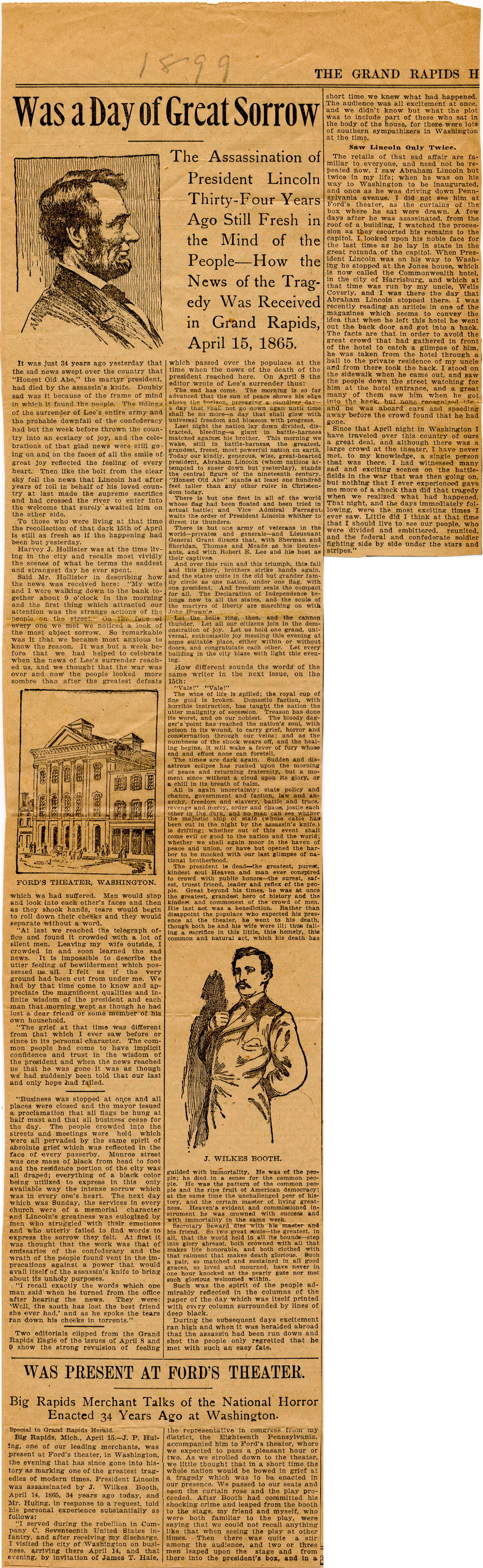
In a retrospective, the Grand Rapids Herald sought the perspectives of local residents who remembered the day Lincoln was assassinated. Harvey J. Hollister recalled the intense grief felt by many in Grand Rapids and the ways in which they practiced collective, public mourning. Next, the article quoted extensively from two editorials by the Grand Rapids Eagle, one on the day the war ended on April 8, 1865, and one immediately after the assassination on the 15th. These were included to be representative of the broader shift in Northern public opinion from optimism to disillusionment in this short span of time. In the subsequent article, Big Rapids, Michigan, resident J. P. Huling described his memories of being an audience member at Ford’s Theater the night of the assassination. Furthermore, he remembered details of Lincoln’s funeral as well as the two times he saw Lincoln before the president’s death.
-
Transcription
[penciled in at top of page] [1899] The Grand Rapids H[cut off]
Was a Day of Great Sorrow
----------
The Assassination of
President Lincoln
Thirty-Four Years
Ago Still Fresh in
the Mind of the
People—How the
News of the Trag-
edy Was Received
in Grand Rapids,
April 15, 1865.
It was just 34 years ago yesterday that
the sad news swept over the country that
“Honest Old Abe,” the martyr president,
had died by the assassin’s knife. Doubly
sad was it because of the frame of mind
in which it found the people. The tidings
of the surrender of Lee’s entire army and
the probably downfall of the confederacy
had but the week before thrown the cou-
try into an ecstacy of joy, and the cele-
brations of that glad news were still go-
ing on and on the faces of all the smile of
great joy reflected the feeling of every
heart. Then like the bolt from the clear
sky fell the news that Lincoln had after
years of toil in behalf of his loved coun-
try at last made the supreme sacrifice
and had crossed the river to enter into
the welcome that surely awaited him on
the other side.
To those who were living at that time
the recollection of that dark 15th of April
is still as fresh as if the happening had
been but yesterday.
Harvey J. Hollister was at the time liv-
ing in the city and recalls most vividly
the scenes of what he terms the saddest
and strangest day he ever spent.
Said Mr. Hollister in describing how
the news was received here: “My wife
and I were walking down to the bank to-
gether about 9 o’clock in the morning
and the first thing which attracted our
attention was the strange actions of the
people on the street. On the face of
every one we met we notice a look of
the most abject sorrow. So remarkable
was it that we became most anxious to
know the reason. It was but a week be-
fore that we had helped to celebrate
when the news of Lee’s surrender reach-
ed us, and we thought that the war was
over and now the people looked more
somber than after the greatest defeats
[illustration of Ford’s Theater]
[Caption] [FORD’S THEATER, WASHINGTON]
which we had suffered. Men would stop
and look into each other’s faces and then
as they shook hands, tears would begin
to roll down their cheeks and they would
separate without a word.
“At last we reached the telegraph of-
fice and found it crowded with a lot of
silent men. Leaving my wife outside, I
crowded in and soon learned the sad
news. It is impossible to describe the
utter feeling of bewilderment which pos-
sessed us all. I felt as if the very
ground had been cut from under me. We
had by that time come to know and ap-
preciate the magnificent qualities and in-
finite wisdom of the president and each
man that morning wept as though he had
lost a dear friend or some member of his
own household.
“The grief at that time was different
from that which I ever saw before or
since in its personal character. The com-
on people had come to have implicit
confidence and trust in the wisdom of
the president and when the news reached
us that he was gone it was as though
we had suddenly been told that our last
and only hope had failed.
---------
“Business was stopped at once and all
places were closed and the mayor issued
a proclamation that all flags be hung at
half mast and that all business cease for
the day. The people crowded into the
streets and meetings were held which
were all pervaded by the same spirit of
absolute grief which was reflected in the
face of every passerby. Monroe street
was one mass of black from head to foot
and the residence portion of the city was
all draped: everything of a black color
being utilized to express in this only
available way the intense sorrow which
was in every one’s heart. The next day
which was Sunday, the services in every
church were of a memorial character
and Lincoln’s greatness was eulogized by
men who struggled with their emotions
and who utterly failed to find the words to
express the sorrow they felt. At first it
was thought that the work was that of
emissaries of the confederacy and the
wrath of the people found vent in the im-
precations against a power that would
avail its unholy purposes.
“I recall exactly the words which one
man said when he turned from the office
after hearing the news. They were:
‘Well, the south has lost the best friend
she ever had,’ and as he spoke the tears
ran down his cheeks in torrents.”
---------
Two editorials clipped from the Grand
Rapids Eagle of the issues of April 8 and
9 show the strong revulsion of feeling
which passed over the populace at the
time when the news of the death of the
president reached here. On April 8 the
editor wrote of Lee’s surrender thus:
[written in smaller font] [The end has come. The morning is so far
advanced that the sun of peace shows his edge
above the horizon, presaging a cloudless day—
a day that shall not go down again until time
shall be no more—a day that shall glow with
universal freedom and blossom with progress.
Last night the nation lay down divided, dis-
tracted, bleeding—a giant in battle-harness
matched against his brother. This morning we
wake, still in battle-harness, the greatest.
grandest, freest, most powerful nation on earth.
Today our kindly, generous, wise, great-hearted
president, Abraham Lincoln (whom nations at-
tempted to sneer down but yesterday), stands
the central figure of the nineteenth century.
“Honest Old Abe” stands at least one hundred
feet taller than any other ruler in Christen-
dom today.
There is but one fleet in all of the world
whose flag had been floated and been tried in
actual battle; and Vice Admiral Farragut
waits the order of President Lincoln wither to
direct its thunders.
There is but one army of veterans in the
world—privates and generals—and Lieutenant
General Grant directs that, with Sherman and
Sheridan, Thomas and Meade as his lieuten-
ants, and with Robert E. Lee and his host as
their captives.
And over this ruin and this triumph, this fall
and this glory, brothers strike hands again,
and the states unite in the old but grander fam-
ily circle as one nation, under one flag, with
one president. And freedom seals the compact
for all. The Declaration of Independence be-
longs now to all the states, and the souls of
the martyrs of liberty are marching on with
John Brown’s.
Let the bells ring, then, and the cannon
thunder. Let all our citizens join in the dem-
onstration of joy. Let us hold one grand, uni-
versal, enthusiastic joy meeting this evening at
some suitable place, either within or without
doors, and congratulate each other. Let every
building in the city blaze with light this even-
ing.]
How different sounds the words of the
same writer in the next issue, on the
15th:
[written in smaller font] [“Vale!” “Vale!”
The wine of life is spilled; the royal cup of
fine gold is broken. Domestic faction, with
horrible instruction, has taught the nation the
utter malignity of secession. Treason has done
its worst, and on our noblest. The bloody dag-
ger’s point has reached the nation’s soul, with
poison in its wound, to carry grief, horror and
consternation through our veins; and as the
numbness of the shock wears off, and the heal-
ing begins, it will wake a fever of fury whose
end and effect none can foretell.
The times are dark again. Sudden and dis-
astrous eclipse has rushed upon the morning
of peace and returning fraternity, but a mo-
ment since without a cloud upon its glory, or
a chill in its breath of balm.
All is again uncertainty; state policy and
chance, government and faction, law and an-
archy, freedom and slavery, battle and truce,
revenge and mercy, order and chaos, jostle each
other in the dark, and no man can see whther
the majestic ship of state (whose cable has
been cut in the night by the assassin’s knife,)
is drifting; whether out of this event shall
come evil or good to the nation and the world;
whether we shall again moor in the haven of
peace and union, or have but opened the har-
bor to be mocked with out last glimpse of na-
tional brotherhood.
The president is dead—the greatest, purest,
kindest soul Heaven and man ever conspired
to crowd with public honors—the surest, saf-
est, truest friend, leader and reflex of the peo-
ple. Great beyond his times, he was at once
the greatest, grandest hero of history and the
kindest and commonest of the crowd of men.
his last act was a benediction. Rather than
disappoint the populace who expected his pres-
ence at the theater, he went to his death,
though both he and his wife were ill; thus fall-
ing a sacrifice in this little, this homely, this
common and natural act, which his death has
[illustration of John Wilkes Booth]
[Caption] [J. WILKES BOOTH]
guilded with immortality. He was of the peo-
ple; he died in a sense for the common peo-
ple. He was the pattern of the common peo-
ple and the ripe fruit of American democracy;
at the same time the unchallenged peer of his-
tory, and the certain master of living great-
ness. Heaven’s evident and commissioned in-
strument he was crowned with success and
with immortality in the same week.
Secretary Seward dies with his master and
his friend. So two great souls—the greatest, in
all, that the world held in all its bounds—step
into glory abreast, both crowned with all that
makes life honorable, and both clothed with
that raiment that makes death glorious. Such
a pair, so matched and sustained in all good
graces, so loved and mourned, have never in
one hour knocked at the pearly gate nor met
such glorious welcomed within.]
Such was the spirit of the people ad-
mirably reflected in the columns of the
paper of the day which was heralded abroad
that the assassin had been run down and
shot the people only regretted that he
met with such an easy fate.
WAS PRESENT AT FORD’S THEATER.
---------------------
Big Rapids Merchant Talks of the National Horror
Enacted 34 Years Ago at Washington.
[written in smaller font] [Special to Grand Rapids Herald.]
Big Rapids, Mich., April 15.—J. P. Hul-
ing, one of our leading merchants, was
present at Ford’s theater, in Washington,
the evening that has since gone into his-
tory as marking one of the greatest trag-
edies of modern times. President Lincoln
was assassinated by J. Wilkes Booth,
April 14, 1865, 34 years ago today, and
Mr. Huling, in response to a request, told
his personal experience substantially as
follows:
“I served during the rebellion in Com-
pany C, Seventeenth United States in-
fantry, and after receiving my discharge,
I visited the city of Washington on bus-
iness, arriving there April 14, and that
evening, by invitation of James T. Hale,
the representative in congress from my
district, the Eighteenth Pennsylvania,
accompanied him to Ford’s theater, where
we expected to pass a pleasant hour or
two. As we strolled down to the theater,
we little thought that in a short time the
whole nation would be bowed in grief at
a tragedy which was to be enacted in
our presence. We passed to our seats and
soon the curtain rose and the play pro-
ceded. After Booth had committed his
shocking crime and leaped from the booth
to the stage, my friend and myself, who
were both familiar with the play, were
saying that we could not recall anything
like that when seeing the play at other
times. Then there was quite a stir
among the audience, and two or three
men leaped upon the stage and from
there into the president’s box, and in a
short time we knew what had happened.
The audience was all excitement at once,
and we didn’t know but what the plot
was to include part of these who sat in
the body of the house, for there were lots
of southern sympathizers in Washington
at the time.
[boldface] [Saw Lincoln Only Twice.]
The retails of that sad affair are fa-
miliar to everyone, and need not be re-
peated now. I saw Abraham Lincoln but
twice in my life; when he was on his
way to Washington to be inaugurated,
and once as he was driving down Penn-
Sylvania avenue. I did not see him at
Ford’s theater, as the curtains of the
box where he sat were drawn. A few
days after he was assassinated, from the
roof of a building, I watched the process-
sion as they escorted his remains to the
capitol. I looked upon his noble face for
the last time as he lay in state in the
great rotunda of the capitol. When Pres-
ident Lincoln was on his way to Wash-
ing he stopped at the Jones house, which
is now called the Commonwealth hotel,
in the city of Harrisburg, and which at
that time was run by my uncle, Wells
Coverly, and I was there the day that
Abraham Lincoln stopped there. I was
recently reading an article in one of the
magazines which seems to convey the
idea that when he left this hotel he went
out the back door and got into a hack.
The facts are that in order to avoid the
great crowd that had gathered in front
of the hotel to catch a glimpse of him,
he was taken from the hotel through a
hall to the private residence of my uncle
and from there took the hack. I stood on
the sidewalk when he came out, and saw
the people down the street watching for
him at the hotel entrance, and a great
many of them saw him when he got
into the hack, but none recognized him
and he was aboard cars and speeding
away before the crowd found that he had
gone.
Since that April night in Washington I
have traveled over this country of ours
a great deal, and although there was a
large crowd at the theater, I have never
met, to my knowledge, a single person
that was there. I had witnessed many
sad and exciting scenes on the battle-
fields in the war that was then going on,
but nothing that I ever experienced gave
me more of a shock than did that tragedy
when we realized what had happened.
That night, and the days immediately fol-
owing, were the most exciting times I
ever saw. Little did I think at that time
that I should live to see our people, who
were divided and embittered, reunited,
and the federal and confederate soldier
fighting side by side under the stars and
stripes.”
-
Source
c.00130 - John Edison Papers
-
Rights
Educational use only, no other permissions given. Copyright to this resource is held by Michigan State University and is provided here for educational purposes only. It may not be reproduced or distributed in any format without written permission of the University Archives & Historical Collections, Michigan State University.
-
Tags
-
Cite this Item
Grand Rapids Herald. "Grand Rapids Herald Articles". Michigan State University Archives & Historical Collections. Remembering Lincoln. Web. Accessed June 3, 2026. https://rememberinglincoln.fords.org/node/859
-
Creator
Grand Rapids Herald
-
Publisher
Michigan State University Archives & Historical Collections
-
Date
April 16, 1899
-
Material
Newspaper
-
Dimensions
6.75" x 22.25"
from Sep. 9, 2015
Grand Rapids Herald Articles
-
Description
In a retrospective, the Grand Rapids Herald sought the perspectives of local residents who remembered the day Lincoln was assassinated. Harvey J. Hollister recalled the intense grief felt by many in Grand Rapids and the ways in which they practiced collective, public mourning. Next, the article quoted extensively from two editorials by the Grand Rapids Eagle, one on the day the war ended on April 8, 1865, and one immediately after the assassination on the 15th. These were included to be representative of the broader shift in Northern public opinion from optimism to disillusionment in this short span of time. In the subsequent article, Big Rapids, Michigan, resident J. P. Huling described his memories of being an audience member at Ford’s Theater the night of the assassination. Furthermore, he remembered details of Lincoln’s funeral as well as the two times he saw Lincoln before the president’s death.
-
Source
c.00130 - John Edison Papers
-
Rights
Educational use only, no other permissions given. Copyright to this resource is held by Michigan State University and is provided here for educational purposes only. It may not be reproduced or distributed in any format without written permission of the University Archives & Historical Collections, Michigan State University.
-
Creator
Grand Rapids Herald
-
Publisher
Michigan State University Archives & Historical Collections
-
Date
September 9, 2015
-
Material
Newspaper
-
Dimensions
6.75" x 22.25"
from Sep. 1, 2015
James L. Lucas Recollection
-
Full Title
The Burial of John Wilkes Booth and Trial of the Lincoln Conspirators
-
Description
This manuscript was typed by Paul S. Lucas from James Lucas' narration. In the manuscript, James Lucas describes the American political scene in the 1850's and the coming of the Civil War. He gives an eyewitness account of Washington in the war years, including a description of Lincoln in great detail. Lucas spent three years with the 12th Veteran Reserve Corps, who served as guards for the Old Capitol Prison, where the Lincoln conspirators were held. Lucas also served as a court messenger during the prisoners' trial, and he describes the conspirators as well as the trial itself. In addition, Lucas tells of guarding the body of John Wilkes Booth on the monitor "Montauk" and of the secret burial of the assassin's body in the Old Capitol prison.
-
Source
c.00086 - James L. Lucas Manuscript
-
Rights
Educational use only, no other permissions given. Copyright to this resource is held by Michigan State University and is provided here for educational purposes only. It may not be reproduced or distributed in any format without written permission of the University Archives & Historical Collections, Michigan State University.
-
Tags
-
Cite this Item
As Told by James L. Lucas to Paul S. Lucas. "The Burial of John Wilkes Booth and Trial of the Lincoln Conspirators". Michigan State University Archives & Historical Collections. Remembering Lincoln. Web. Accessed June 3, 2026. https://rememberinglincoln.fords.org/node/855
-
Creator
As Told by James L. Lucas to Paul S. Lucas
-
Publisher
Michigan State University Archives & Historical Collections
-
Date
date unknown
-
Material
Typed on Paper
-
Dimensions
8" x 11"
from Sep. 1, 2015
The Burial of John Wilkes Booth and Trial of the Lincoln Conspirators
-
Description
This manuscript was typed by Paul S. Lucas from James Lucas' narration. In the manuscript, James Lucas describes the American political scene in the 1850's and the coming of the Civil War. He gives an eyewitness account of Washington in the war years, including a description of Lincoln in great detail. Lucas spent three years with the 12th Veteran Reserve Corps, who served as guards for the Old Capitol Prison, where the Lincoln conspirators were held. Lucas also served as a court messenger during the prisoners' trial, and he describes the conspirators as well as the trial itself. In addition, Lucas tells of guarding the body of John Wilkes Booth on the monitor "Montauk" and of the secret burial of the assassin's body in the Old Capitol prison.
-
Source
c.00086 - James L. Lucas Manuscript
-
Rights
Educational use only, no other permissions given. Copyright to this resource is held by Michigan State University and is provided here for educational purposes only. It may not be reproduced or distributed in any format without written permission of the University Archives & Historical Collections, Michigan State University.
-
Creator
As Told by James L. Lucas to Paul S. Lucas
-
Publisher
Michigan State University Archives & Historical Collections
-
Date
September 1, 2015
-
Material
Typed on Paper
-
Dimensions
8" x 11"
from Aug. 26, 2015
Reverend Leonard Francis Smith
-
Full Title
Reverend Leonard Francis Smith
-
Description
Reverend Leonard Francis Smith was a Methodist preacher appointed to the Girard, Illinois, circuit at the time of Lincoln's death. He traveled to Lincoln's hometown of Springfield, Illinois, two days after the assassination and observed the collective mourning. Smith also held a service in his church the day Lincoln's ceremonial burial service was held in Washington D.C. In his diary, Smith recalls these events and comments on the progress of the hunt for Lincoln's killer and the person who attempted to murder Secretary of State, William H. Seward.
-
Transcription
April 1865
[continued from previous page] W R Constant & Christian Commission Annual Report. Another dona-
tion. 2 dresses for wife 7.85. J C Drake donator. Prayer meeting.
Lovely day for the first in sometime. Things are growing some.
Friday 14 This is Good Friday & tenaciously observed by some
as the time for planting potatoes & other roots to have a good
crop. This is the day the redeemer was led to Cavalry & suffered
in our stead. The just for the unjust that he might bring us to
God. Sure such an event is fraught with great importance to us &
should make a deep impression on our minds & consciences. Am free
to confess it does not today have that regard it was worthy of.
Pardon me, O Lord. Busied myself in writing & reading today. Took
some shoulder & potatoes to W Morris. It is now raining.
Satruday 15 Sat night & I am yet alive. Have performed most of
the duties of the day & evening. Attended Masonic Lodge. Felt de-
pressed on account of the sad news reached us of the death of
Abraham Lincoln & Secy Seward. Lincoln attended a theatre last
night & was shot through the head & died this morning. Seward was
murdered in his bed. It was the secessionist work. They are dirty
devils. What a suddn unsuspected affair. Sold 1 bush. and a half
of potatoes to Aylsworth & Kendalls. Bot sugar $1. Sent letter to
Father in law. Paid out to treas. of Lodge 95¢. Rained today.
Sunday 16 Easter Sunday. Christ the first fruits of them that
slept arose from the dead. A pledge of our Resurrection. Though the
skeptic & materialist may deny the resurrection of the dead, etc.
yet the testimony of the Apostles & his appearances at different
times is sufficient evidence of his being resurrected. Over 47 at
S S this a.m. in Wmsville. Recd of Mother Aylsworth 35¢ on papers.
35 of Keagle for Golden Chain; 35 of Drakes for Chain. Covers &
J Constants each dr for Chain. Let Schliffe at Bices have Chain &
Quest. Book 15¢. Broughtons, Chain 35. Hickmans, G T, dr to Chain
35. Coll. at Wmsville 5.75. Bices S H large turn out. Recd one into
church, Mary Waters. Miss. Anniversary. Raised 6.05. Joanna Ramey,
Mary Miller & Eli Blue went to Bices with me. Lovely day indeed.
Monday 17 Visited Springfield this day. Most all the stores &
businesses as well as many private residences were draped in
mourning. The people everywhere are speaking of the great loss, &
the people are nearly as a whole sad at the loss of so great a man
as Abraham Lincoln. He sleeps in death. Secy Seward who was re-
ported dead is still alive & probably will recover. Bot Journal
with all the particulars 10¢. Bot at Kimbers me a hat 3.25. Corsets,
gaiters, trimming etc. hoop skirts, veil, -----& comb amounting in
all to 24.70. Paid Kimber 2.50 owed before . Bot halter stem 75¢.
Fare on R R 1.80. Bot envelopes & stamps for Lodge. Sent summons
to Cantrell, Thompson, Canterbury, McLeod, Mitter, Lawrence & Winn.
Ramey brought us bag of flour 20lbs. Oranges 60¢. Lovely day.
Windy. Rain at night. Home in the rain & mud.
474
April 1865
Thursday 18 Lincoln, brave, honest & great. Abraham Lincoln is
dead. He died a martyr. Yea he lived to set menfree. He rests from
labor. His body will shortly be buried. His memory will be cher-
ished through the future ages. He was the country’s friend. Has
fallen. The wretch is not as yet captured. Vengeance will yet over-
take him. Good news. Mobile is ours. Johnston negotiating. Recd
dispatch from Elkhart inviting me to officiate tomorrow. Signed
D L Dana. Letter from Jesse K. Sent letter to George Smith, Rev
Simms, P Cartwright. Recd 75¢ of C Brest & $2 quarterage, Sister
Purce;$10 donation of Wm. Mount. Beans of Council. Paper 10¢.
Planted beans & potatoes. Quite warm. Rain 8:30.
Wednesday 19 Today the citizens of the town & country assembled
in our church to commemorate the burial of Abraham Lincoln at
Washington. Services were opened by reading from 2 Sam 1:17 and
Psa 46. Then singing & prayer, then sketch of his life, the speech
by Jacob Beck, then singing, then Bro Todd spoke. Took text. Then
I read his Farewell Address at Springfield. Then a little talk &
resolutions which were adopted by all save a few Copperheads.
Church was draped in mourning. Recd sub. to Central, Fletcher
Council, & 2$ through Bro Laucke. Had some eggs etc. exchanged.
Set a hen. Paid Olsen $5 which pays till June 26. Recd letter etc
Planted some corn. Quite summer like. Peaches are out in blossom.
Thursday 20 The supposed assassin of Seward caught. Should be
hanged up till dead, dead. Sent letter to Capt J B Jenkins, Baton
Rouge. Indebted to Lodge 72.00 & 61/2 yrs interest. Bot stamps 25¢.
Sent letter to Mason, Bloomington. Recd one from Kittie Lowe & $10
in it. Were aroused at 3 a.m. by neighbors. Pickerell Bices store
& two dwelling were burned by some incendiaries. Planted corn,
beets, squashes, butter beans, cymblings [cabbage sprouts] and
transplanted some hemp. Prayer meeting. Dr Winn joined on Prob.
& Langley & wife by letter. Rained by spells some today.
Friday 21 Fasting primitively was regarded by the Saviour as
essential to the casting out of stubborn devils or dumb spirits.
The directions for fasting were important. Examples worthy of
notice in reference to fasting are given us. The blessed Master &
his Disciples & Apostles fasted often. We do not fast as often now
since we do not have such humble views of ourselves as we ought to
have. Since we are not as holy nor as useful. Letter from Rev
Gooding. His babe died. Circular Syrian Lodge No 333. Bought sugar
(white) 4 lbs $1. Coal oil 1. per gal. Recd 35¢ for Chain. Bot
Tribune 10¢. Put some cucumber seed in the ground. Heard opening
sermon at the Presbytery. Rev Marcus, Micah 7:7. Bro Bishop Haller
supped with us. Rained by times all day.
Saturday 22 Lamentations 3:26: It is good for man – Dr Cartwright
preached at 11 a.m. from that text to small assembly at Yocums S H
Dined at Wm Yocums. Quarterly Conf. Recd of Wmsville this quarter
$28, 4. already allowed; of Fancy Creek 37. quarterage & 5.00
Donation; & $11 for potatoes; of Yocums 9.00; of Wolfe Creek
475
-
Source
HC.00190 - Reverend Leonard Smith Diaries Collection
-
Rights
Educational use only, no other permissions given. Copyright to this resource is held by Michigan State University and is provided here for educational purposes only. It may not be reproduced or distributed in any format without written permission of the University Archives & Historical Collections, Michigan State University.
-
Tags
-
Cite this Item
Reverend Leonard Francis Smith. "Reverend Leonard Francis Smith ". Michigan State University Archives & Historical Collections. Remembering Lincoln. Web. Accessed June 3, 2026. https://rememberinglincoln.fords.org/node/851
-
Creator
Reverend Leonard Francis Smith
-
Publisher
Michigan State University Archives & Historical Collections
-
Date
April 15, 1865
-
Material
Typed on Paper
-
Dimensions
8" x 10"
from Aug. 26, 2015
Reverend Leonard Francis Smith
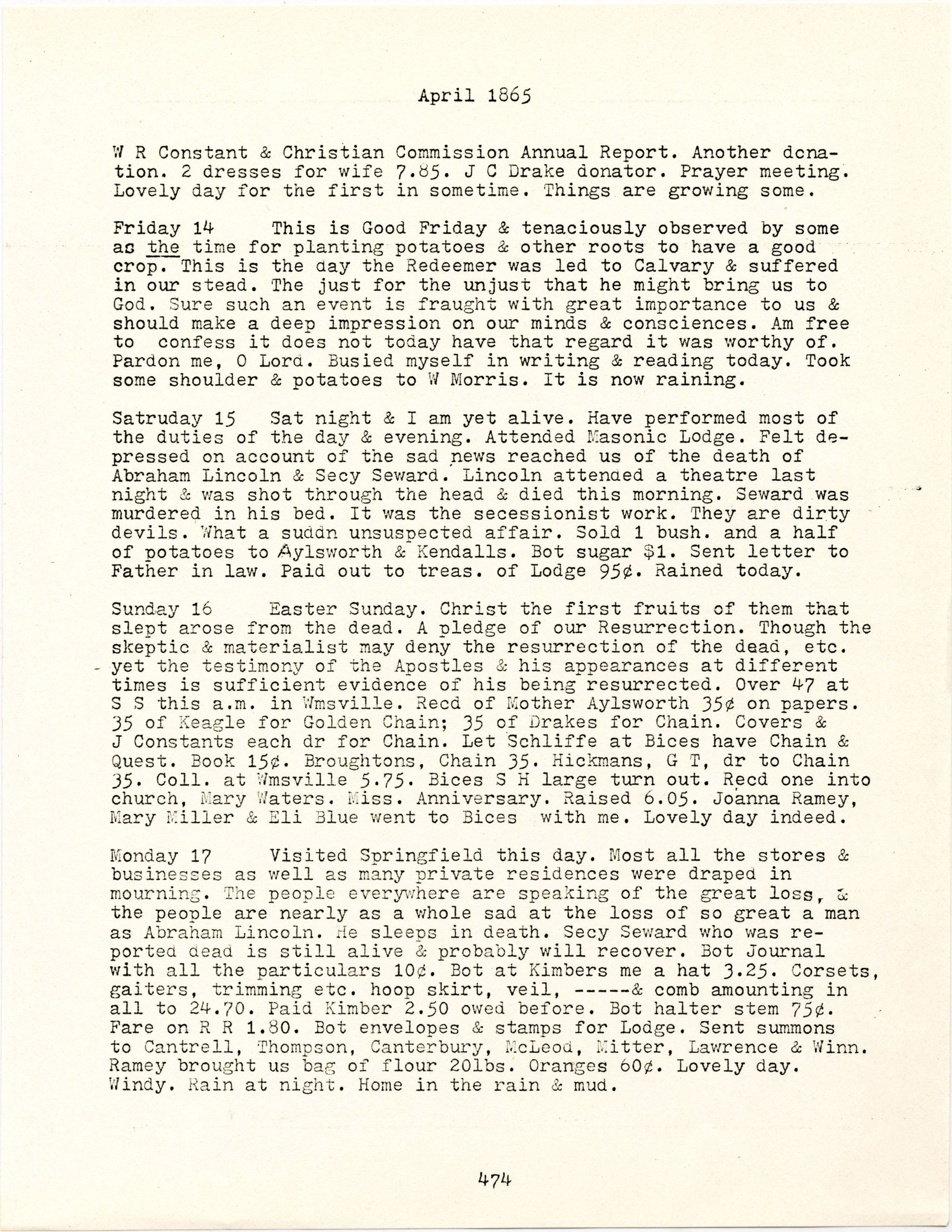
-
Description
Reverend Leonard Francis Smith was a Methodist preacher appointed to the Girard, Illinois, circuit at the time of Lincoln's death. He traveled to Lincoln's hometown of Springfield, Illinois, two days after the assassination and observed the collective mourning. Smith also held a service in his church the day Lincoln's ceremonial burial service was held in Washington D.C. In his diary, Smith recalls these events and comments on the progress of the hunt for Lincoln's killer and the person who attempted to murder Secretary of State, William H. Seward.
-
Source
HC.00190 - Reverend Leonard Smith Diaries Collection
-
Rights
Educational use only, no other permissions given. Copyright to this resource is held by Michigan State University and is provided here for educational purposes only. It may not be reproduced or distributed in any format without written permission of the University Archives & Historical Collections, Michigan State University.
-
Creator
Reverend Leonard Francis Smith
-
Publisher
Michigan State University Archives & Historical Collections
-
Date
August 26, 2015
-
Material
Typed on Paper
-
Dimensions
8" x 10"
from Apr. 16, 1865
Letter to his parents from J. D. McClure, April 16, 1865
-
Full Title
Handwritten Letter to Dear Parents from J. D. McClure, April 16, 1865
-
Description
Letter to his Dear (Unidentified) Parents from their son, J. D. McClure, April 16, 1865. McClure was in Memphis (Tenn.) setting up a business. He may have been from Iowa originally. McClure writes at first about moving to Memphis and having a tour of the town. Then he abruptly and emotionally transitions to having heard about the assassinations of President Lincoln, Seward, and Son that day from the boat coming from Cairo. He writes of the flags in town being at half-mast and draped in mourning [bunting]. McClure refers to the Secessionists as demons who will be destroyed by God. He then returns to the story of his tour of town, trying to help a lady find her husband at an unknown address, viewing the strong fortifications, battery, and garrison with lots of Union soldiers, the warm temperature and advanced state of growth in the trees and vegetables compared to those in the North, and how at present he has little business.
-
Transcription
Page One
Memphis, Tenn.
April 16th, 1865
Dear Parents:
I am here in the
beautiful city of Memphis in
the far flung South. I have
just got into the hotel from
a walk through the city
with a gentleman lawyer from
Michigan who has come
here to practice his profession.
Being acquainted he showed
many points of interest through
town. But Oh! Horror to
think of the awful calamnity [sic]
that has befallen our city[crossed out]
beloved country. In the assass-
ination of Lincoln Seward
and Son! The cold chills would
course my blood when first the
sad news reached my ears.
Page Two
2
The news first reached here this
morning on the boat from
Cairo. The news flew like
magic throughout the place
and the flags of the city were
hung at half mast, and
draped in mourning. What
horror to think our nation’s loss,
to see our Star Spangled banner
draped in mourning! “Whom
God will destroy he first maketh
mad”, and these demons, [of secession-inserted] are
surely sufficiently mad for
distruction [sic]. If possible I
will drive these thoughts away
for the present and write some-thing else. I got a carriage
this morning for Mrs. Billings
of Keohrels [sp?] who came down on
the same boat to visit her
husband. We rode for one hour
but did not succeed in finding
Page Three
3
as we had neither the name of
the street nor its number. But
we did see many most magnificent
business houses, Churches and residen-
ces. True I have not seen all
of the place by a considerable in
my hours ride, and two hours
walk. I have had a faint view
of the fortifications as I can have
now from my window. Yet,
Pickering is so situated as to
deal out distruction [sic] at a tremen-
dous rate to any foe the might
dare to approach from below or
above on the river, and it could
turn its mighty power from the
city to its utter demolition and
very hasty too. I see the large
guns standing upon the battery
ready at a single moments
warning, with its garrison of
over 3,000 soldiers within its
walls.
Page Four
Then how different the atmos-
phere here; the Sun is almost at
its meridian high to shining
forth its [genial-inserted] rays of warmth and
gladness. It is as warm here
as in June there, yet it is neither
sultry nor hot, but as I enhale [sic]
the atmosphere it seems cool
and embracing, much like we
sometimes have North just ater [sic]
a shower in a sultry hot
August day or the purer are [air-sic]
while the dew is rising in a
summers morning.
Then again how different
vegetation here; when I left
there was scarsely [sic] any of the
tees were putting forth their leaves
or buds, but before we reached this
point the peach and apple trees
had fruit put forth their blooms and
had fallen off. And to-day
the leaves on the oak and other
trees are almost full ground
and the gardens and yards are
green with grass and vegetables.
Page Four
But with all this I can’t tell
how I shall like the place.
I may not like the climate, the
the [sic] city, the practice to be had,
the people, nor the manner
of living. I do not know that
I have any occasion to be
discouraged unless it may be
from the high price of living.
It is Sunday and the most of
business is closed of course and
I am doing [sic] nothing in the way
of business. It will brobably [sic]
be one or two or perhaps three
weeks before I shall know
what to do. In the mean time
I shall enquire and remain
as contented as possible.
I guess it is dinner time.
I will write again when I
get more settled in business.
Your Affectionate son, J. D. McClure
-
Source
Clarke Historical Library, Central Michigan University, J. D. McClure Correspondence, 1865
-
Rights
This item may be reproduced and used for any purpose, including research, teaching, private study, publication, broadcast or commercial use, with proper citation and attribution.
-
Tags
-
Cite this Item
McClure, J. D.. "Handwritten Letter to Dear Parents from J. D. McClure, April 16, 1865". Remembering Lincoln. Web. Accessed June 3, 2026. https://rememberinglincoln.fords.org/node/848
-
Creator
McClure, J. D.
-
Date
1865
-
Material
Letter
-
Dimensions
8x9.5 inches
from Apr. 16, 1865
Handwritten Letter to Dear Parents from J. D. McClure, April 16, 1865
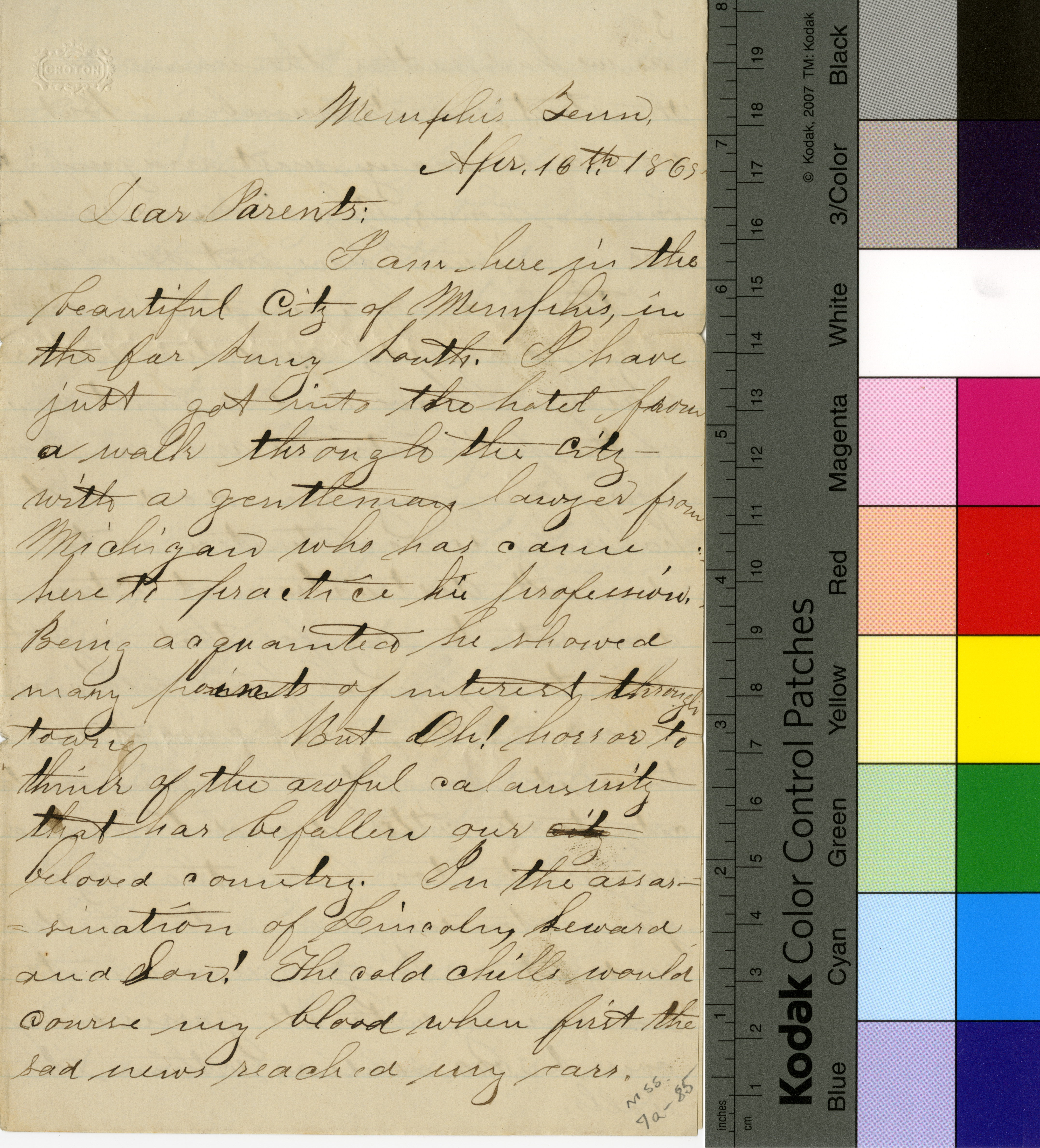
-
Description
Letter to his Dear (Unidentified) Parents from their son, J. D. McClure, April 16, 1865. McClure was in Memphis (Tenn.) setting up a business. He may have been from Iowa originally. McClure writes at first about moving to Memphis and having a tour of the town. Then he abruptly and emotionally transitions to having heard about the assassinations of President Lincoln, Seward, and Son that day from the boat coming from Cairo. He writes of the flags in town being at half-mast and draped in mourning [bunting]. McClure refers to the Secessionists as demons who will be destroyed by God. He then returns to the story of his tour of town, trying to help a lady find her husband at an unknown address, viewing the strong fortifications, battery, and garrison with lots of Union soldiers, the warm temperature and advanced state of growth in the trees and vegetables compared to those in the North, and how at present he has little business.
-
Source
Clarke Historical Library, Central Michigan University, J. D. McClure Correspondence, 1865
-
Rights
This item may be reproduced and used for any purpose, including research, teaching, private study, publication, broadcast or commercial use, with proper citation and attribution.
-
Creator
McClure, J. D.
-
Date
April 16, 1865
-
Material
Letter
-
Dimensions
8x9.5 inches
from Apr. 15, 1865
James S. Knox to his Father
-
Full Title
James S. Knox to his Father
-
Description
James S. Knox, a witness to the assassination, writes a detailed letter to his father describing the event, as well as the attacks at the Seward home, and the national feeling, saying that "the nation is aroused and terrible will be its vengeance."
-
Transcription
Ac 9360
Washington, DC
April 15, 1865
Dear Father,
It is with sad feeling that I take up my pen to address you. Last Friday night at 10 oclock, I witnessed the saddest tragedy ever was had in this country. Notwithstanding my promise to you not to visit the theatre, I cannot resist the temptation to see General Grant and the President, and when the curtain at Ford’s rose on the play of Our American Cousin my room mate and I were seated on the second row of the orchestra seats, just beneath the President’s box. The President entered the theatre at 8 ½ o’ck, amid deafening cheers and the rising of all. Everything was cheerful, and never was our magistrate more enthusiastically welcomed. Or more happy. Many pleasant allusions were made to him in the play, to which the audience gave deafening responses, while Mr. Lincoln laughed heartily and beamed frequently to the gratified people. Just after the 3rd Act, and before the scenes were shifted, a muffled pistol shot was heard, and a man sprang wildly from the national box, partially tearing down the flag, then shouting “ ‘sic semper tyrannis’, the south is avenged “ with brandished dagger, rushed across the stage and disappeared. The whole theatre was paralyzed. But two men sprang for the stage, a Mr. Stewart and myself. Both of us were familiar with the play, and suspected the fearful tragedy. We rushed after the murderer, and Mr. Stewart being familiar with the passages, reached the rear door in time to see him spring on his horse and ride off – I became lost amid the scenery and was obliged to return. My roommate had followed me and secured the murderer’s hat. The shrill cry of murder from Mrs. Lincoln first roused the horrified audience, and in an instant the uproar was terrible. The silence of death was broken by shouts of “kill him”, “hang him” and strong men wept and cursed, and tore the seats in the impotence of their anger, while Mrs. Lincoln, on her knees uttered shriek after shriek at the feet of the dying President. Finally the theatre was cleared and the President removed. Still greater was the excitement in the city. Rumors of the murder of Sec’y Seward and his son reached us as we gained the street – Mounted patrols dashed everywhere, bells tolled the alarm, and excited crowds rushed about the avenues, Despair was on every countenance, and black horror brooded over the city. Until long after midnight I was detained at Police Hd.Qrs., giving my evidence, and when I sought my room, in a distant part of the city – dark clouds had gathered in the heavens, and soldiers sternly paced their patrol. May I never see another such night. I could not sleep. I could only think, (but?) thought was weary, and in despair thought again.
Yesterday morning the President died. At 8 ½ ock, the kindest, noblest, truest heart ceased to beat, and Abraham Lincoln was dead. Let no man ever speak to me again about Southern Chivalry, or talk in sympathy with traitors. The events of last night can never be forgotten and while there is strength in my arm, I never can, never will, endure it – nor am I alone – the nation is aroused and terrible will be its new glower, Treason, pardoned, forgiven, patiently dealt with by our president, viper like, has stung the breast, that kindly treated it, and the traitor South has slain its bravest, noblest friend. Bitter, bitter will be the tears of repentance. But I cannot write of it – Andrew Johnson has been sworn, His speech was simple, “The duties now are mine, the results are God’s”. I trust he may perform his task faithfully, but, oh, for the Confidence, and the hope that we had in Lincoln, like a ship without a rudder is the nation tossed. Outwardly are we quiet, but in each heart, what horror, misgivings and despair-
But I must cease – (Lolita?) & Will R – left here Friday night. I presume by this time they are with you. By them you can learn of me better than I can write. Love to all.
Your affect son
James Knox
[Transcription by Dale Anderson.] -
Source
-
Rights
This item is in the public domain and may be reproduced and used for any purpose, including research, teaching , private study, publication, broadcast or commercial use, with proper citation and attribution
-
Tags
-
Cite this Item
James S. Knox. "James S. Knox to his Father". Remembering Lincoln. Web. Accessed June 3, 2026. https://rememberinglincoln.fords.org/node/753
-
Creator
James S. Knox
-
Date
April 15, 1865
from Apr. 15, 1865
James S. Knox to his Father
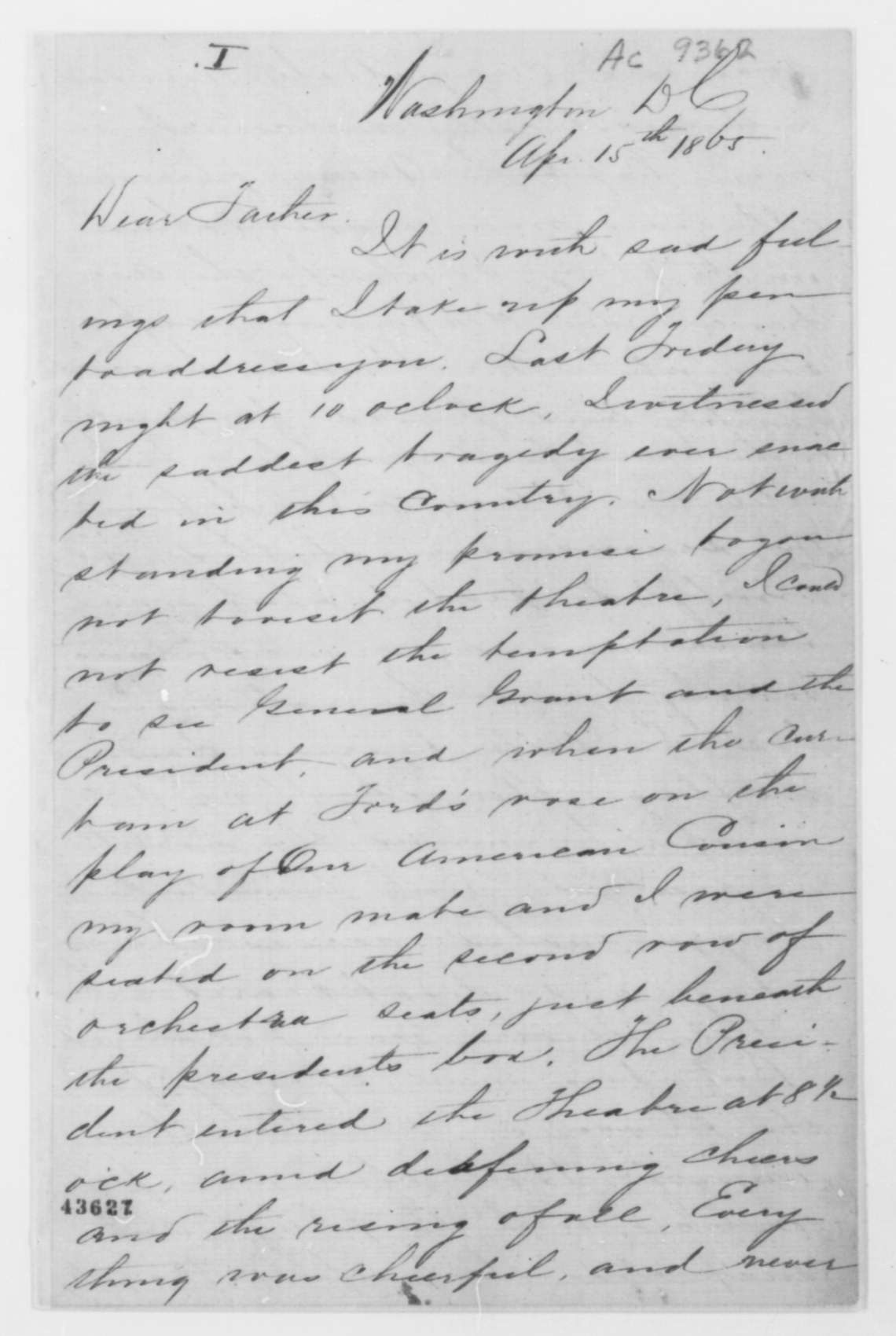
-
Description
James S. Knox, a witness to the assassination, writes a detailed letter to his father describing the event, as well as the attacks at the Seward home, and the national feeling, saying that "the nation is aroused and terrible will be its vengeance."
-
Source
-
Rights
This item is in the public domain and may be reproduced and used for any purpose, including research, teaching , private study, publication, broadcast or commercial use, with proper citation and attribution
-
Creator
James S. Knox
-
Date
April 15, 1865