from Apr. 15, 1865
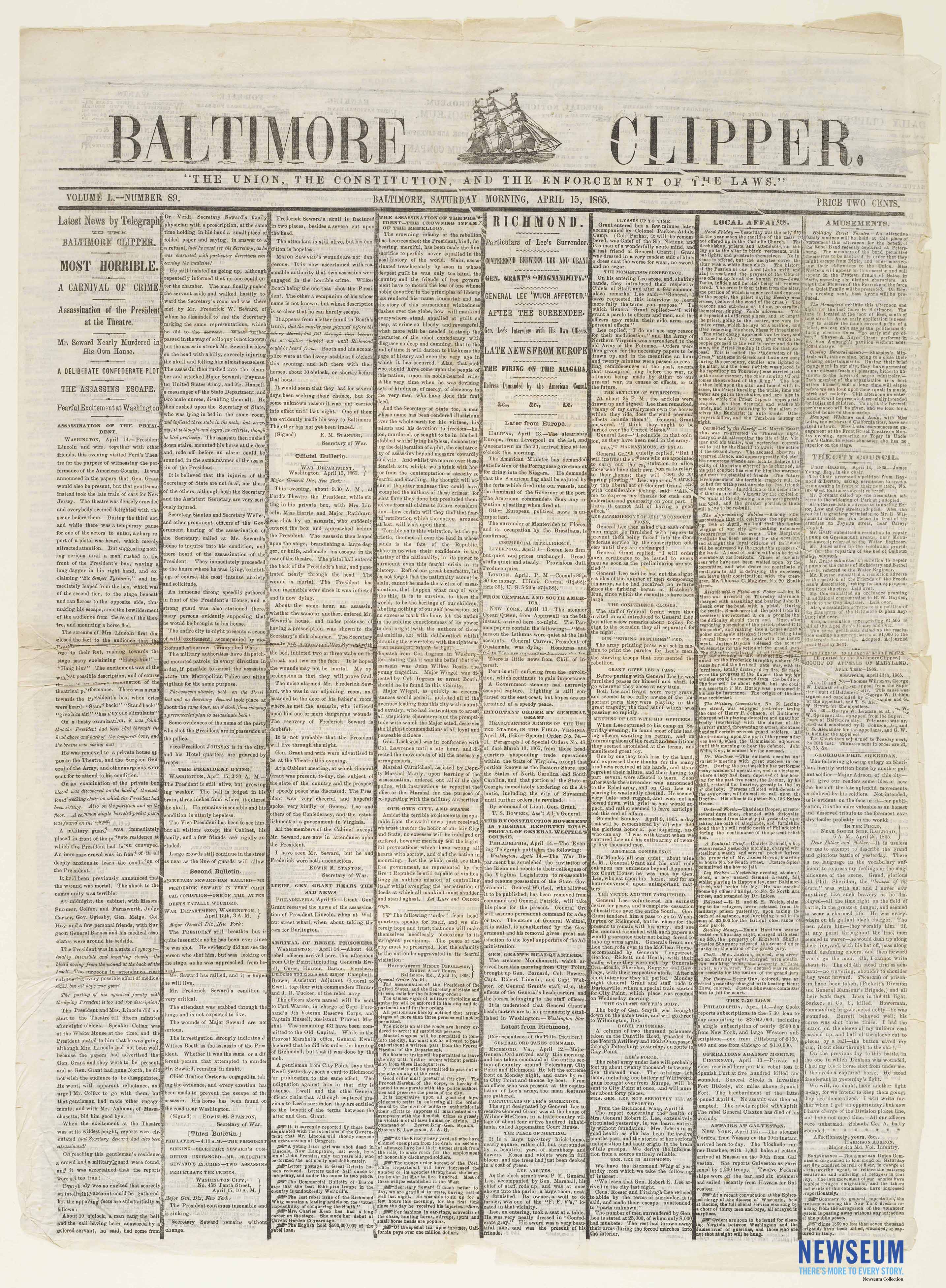
Baltimore Clipper, April 15, 1865
-
Full Title
Baltimore Clipper, April 15, 1865
-
Description
The Baltimore Clipper newspaper provides extensive details on the assassination of President Abraham Lincoln and the attempted assassination of Secretary William Henry Seward. It contains numerous official dispatches from Secretary of War Edwin M. Stanton to Major General John A. Dix about Lincoln's condition. Known as "mourning rules," the wide vertical lines between the newspaper columns represent grief over the loss of an important person.
-
Source
HN-1865-011058
-
Rights
Use of this item for research, teaching, and private study is permitted with proper citation and attribution as follows: Courtesy, Newseum Collection. Reproduction of this item for publication, broadcast, or commercial use requires written permission. For permission, please contact the Newseum.
-
Tags
-
Cite this Item
Bull & Tuttle. "Baltimore Clipper, April 15, 1865". Bull & Tuttle. Remembering Lincoln. Web. Accessed June 3, 2026. https://rememberinglincoln.fords.org/node/631

-
Creator
Bull & Tuttle
-
Publisher
Bull & Tuttle
-
Date
April 15, 1865
-
Material
Newspaper
from Apr. 15, 1865
Baltimore Clipper, April 15, 1865
-
Description
The Baltimore Clipper newspaper provides extensive details on the assassination of President Abraham Lincoln and the attempted assassination of Secretary William Henry Seward. It contains numerous official dispatches from Secretary of War Edwin M. Stanton to Major General John A. Dix about Lincoln's condition. Known as "mourning rules," the wide vertical lines between the newspaper columns represent grief over the loss of an important person.
-
Source
HN-1865-011058
-
Rights
Use of this item for research, teaching, and private study is permitted with proper citation and attribution as follows: Courtesy, Newseum Collection. Reproduction of this item for publication, broadcast, or commercial use requires written permission. For permission, please contact the Newseum.
-
Creator
Bull & Tuttle
-
Publisher
Bull & Tuttle
-
Date
April 15, 1865
-
Material
Newspaper
from Apr. 30, 1865
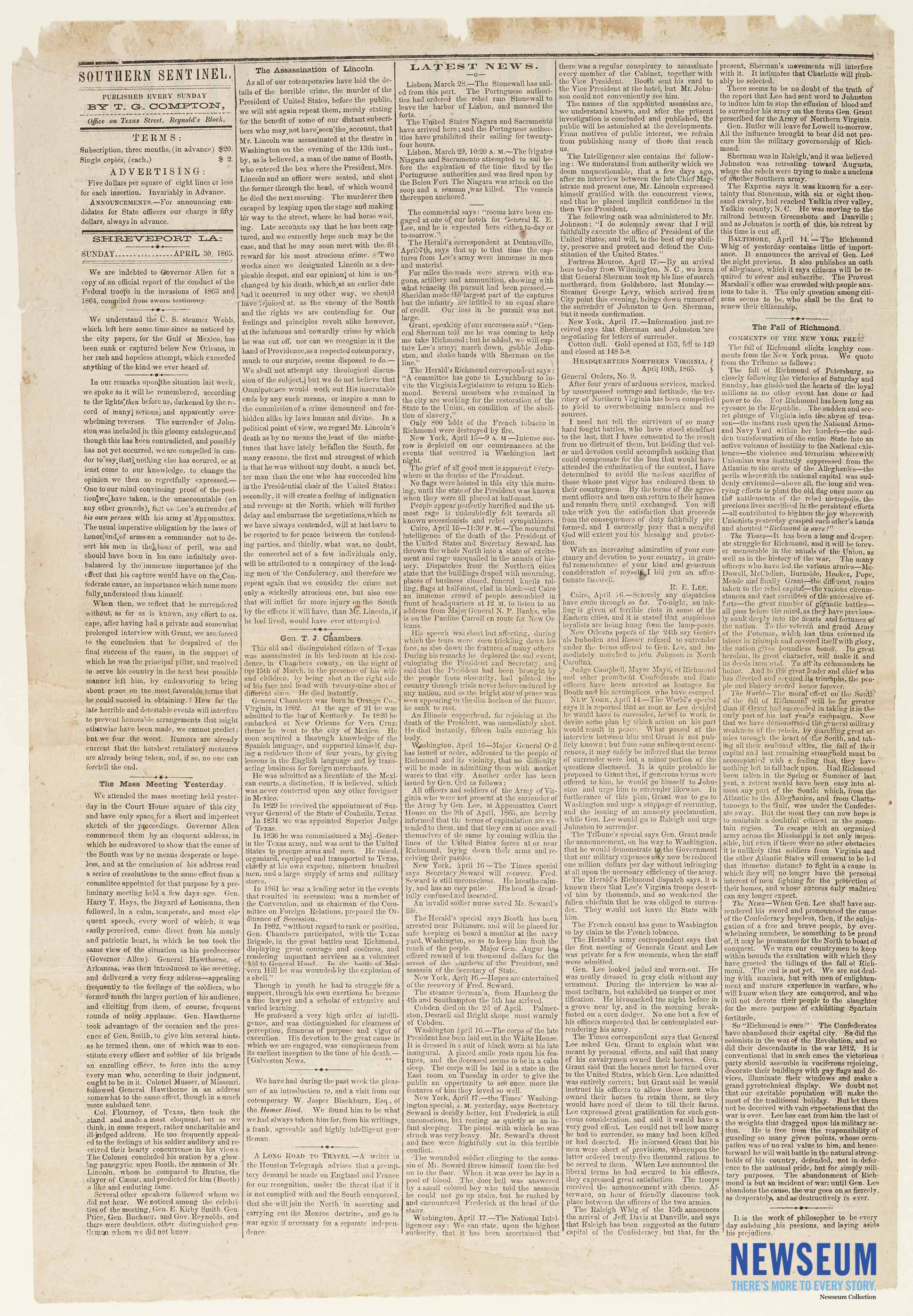
The Southern Sentinel, April 30, 1865
-
Full Title
The Southern Sentinel, April 30, 1865
-
Description
Confederate newspaper containing dispatches from various Northern newspapers regarding the assassination of President Abraham Lincoln and the attempted assassination of Secretary William H. Seward. Editorial titled "The Assassination of Lincoln" states: "Two weeks since we designated Lincoln as a despicable despot, and our opinion of him is unchanged by his death, which at an earlier date had it occurred in any other way, we should have rejoiced at, as the enemy of the South and the rights we are contending for. Our feelings and principles revolt alike however, at the infamous and cowardly crime by which he was cut off..."
-
Source
HN-1865-011152B
-
Rights
Use of this item for research, teaching, and private study is permitted with proper citation and attribution as follows: Courtesy, Newseum Collection. Reproduction of this item for publication, broadcast, or commercial use requires written permission. For permission, please contact us at artifacts@newseum.org.
-
Tags
-
Cite this Item
T.G. Compton. "The Southern Sentinel, April 30, 1865". T.G. Compton. Remembering Lincoln. Web. Accessed June 3, 2026. https://rememberinglincoln.fords.org/node/629
-
Creator
T.G. Compton
-
Publisher
T.G. Compton
-
Date
April 30, 1865
-
Material
Newspaper
from Apr. 30, 1865
The Southern Sentinel, April 30, 1865
-
Description
Confederate newspaper containing dispatches from various Northern newspapers regarding the assassination of President Abraham Lincoln and the attempted assassination of Secretary William H. Seward. Editorial titled "The Assassination of Lincoln" states: "Two weeks since we designated Lincoln as a despicable despot, and our opinion of him is unchanged by his death, which at an earlier date had it occurred in any other way, we should have rejoiced at, as the enemy of the South and the rights we are contending for. Our feelings and principles revolt alike however, at the infamous and cowardly crime by which he was cut off..."
-
Source
HN-1865-011152B
-
Rights
Use of this item for research, teaching, and private study is permitted with proper citation and attribution as follows: Courtesy, Newseum Collection. Reproduction of this item for publication, broadcast, or commercial use requires written permission. For permission, please contact us at artifacts@newseum.org.
-
Creator
T.G. Compton
-
Publisher
T.G. Compton
-
Date
April 30, 1865
-
Material
Newspaper
from Apr. 28, 1865
Illinois Daily State Journal, April 28, 1865
-
Full Title
Illinois Daily State Journal, April 28, 1865
-
Description
Interior page report in the Illinois Daily State Journal providing details on President Lincoln's funeral procession and his upcoming burial in Springfield, Illinois. The paper also reports extensively on the death of John Wilkes Booth and the capture of David E. Herold, including an official dispatch from Secretary of War Edwin M. Stanton to Major General John A. Dix. Known as "mourning rules," the wide vertical lines between the newspaper columns represent grief over the loss of an important person.
-
Source
HN-1865-011138B
-
Rights
Use of this item for research, teaching, and private study is permitted with proper citation and attribution as follows: Courtesy, Newseum Collection. Reproduction of this item for publication, broadcast, or commercial use requires written permission. For permission, please contact the Newseum.
-
Tags
-
Cite this Item
Baker & Phillips. "Illinois Daily State Journal, April 28, 1865". Baker & Phillips. Remembering Lincoln. Web. Accessed June 3, 2026. https://rememberinglincoln.fords.org/node/625
-
Creator
Baker & Phillips
-
Publisher
Baker & Phillips
-
Date
April 28, 1865
-
Material
Newspaper
from Apr. 28, 1865
Illinois Daily State Journal, April 28, 1865

-
Description
Interior page report in the Illinois Daily State Journal providing details on President Lincoln's funeral procession and his upcoming burial in Springfield, Illinois. The paper also reports extensively on the death of John Wilkes Booth and the capture of David E. Herold, including an official dispatch from Secretary of War Edwin M. Stanton to Major General John A. Dix. Known as "mourning rules," the wide vertical lines between the newspaper columns represent grief over the loss of an important person.
-
Source
HN-1865-011138B
-
Rights
Use of this item for research, teaching, and private study is permitted with proper citation and attribution as follows: Courtesy, Newseum Collection. Reproduction of this item for publication, broadcast, or commercial use requires written permission. For permission, please contact the Newseum.
-
Creator
Baker & Phillips
-
Publisher
Baker & Phillips
-
Date
April 28, 1865
-
Material
Newspaper
from Apr. 19, 1865
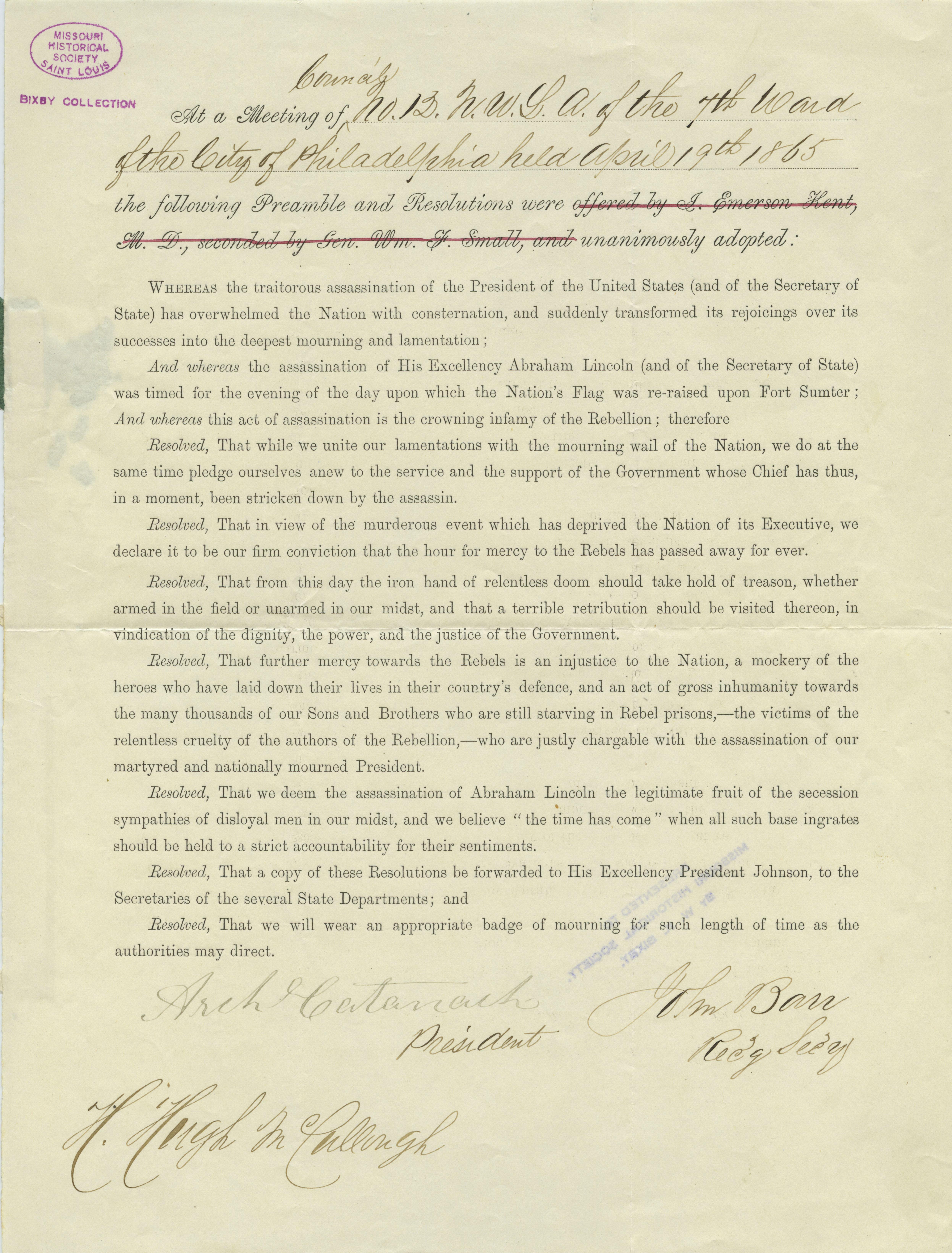
Resolution, 7th Ward, Philadelphia
-
Full Title
Resolution passed by the 7th Ward of the City of Philadelphia relating to the assassination of the late President Lincoln, April 19, 1865
-
Source
George R. Harrington Papers, Missouri History Museum Archives, St. Louis.
-
Rights
Please contact the Missouri History Museum at photo@mohistory.org for permission to publish this resource.
-
Tags
-
Cite this Item
Barr, John. "Resolution passed by the 7th Ward of the City of Philadelphia relating to the assassination of the late President Lincoln, April 19, 1865". Remembering Lincoln. Web. Accessed June 3, 2026. https://rememberinglincoln.fords.org/node/536
-
Creator
Barr, John
-
Date
April 19, 1865
from Apr. 19, 1865
Resolution passed by the 7th Ward of the City of Philadelphia relating to the assassination of the late President Lincoln, April 19, 1865
-
Source
George R. Harrington Papers, Missouri History Museum Archives, St. Louis.
-
Rights
Please contact the Missouri History Museum at photo@mohistory.org for permission to publish this resource.
-
Creator
Barr, John
-
Date
April 19, 1865
from May. 3, 1865
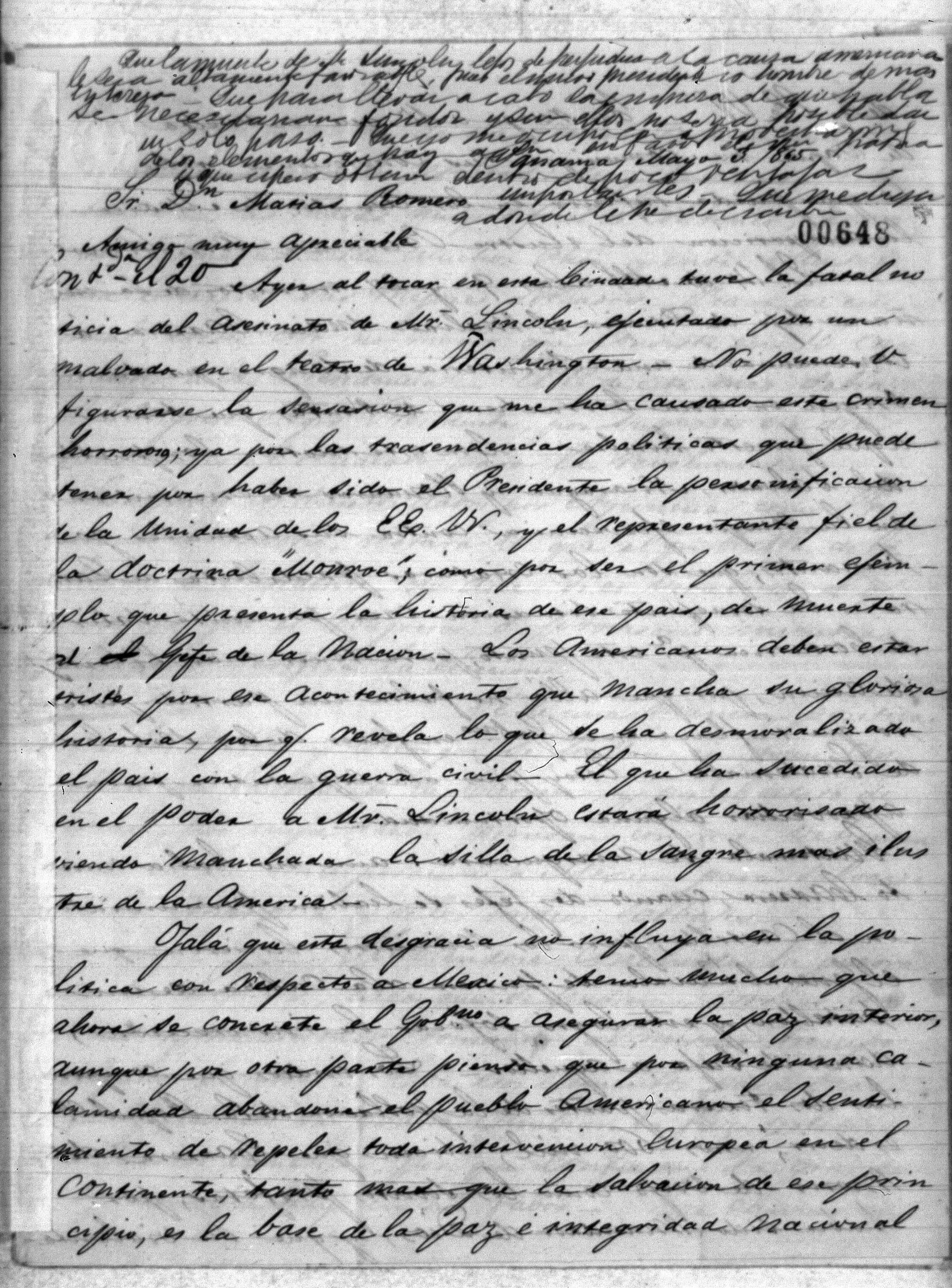
G. Barrios to Matias Romero
-
Full Title
Letter to Mexican diplomat Matias Romero from G. Barrios
-
Description
Barrios expresses shock at learning of Lincoln’s assassination at the theater. Description of Lincoln as “the personification of US unity and faithful representative of the Monroe Doctrine”. Hope that the assassination won’t influence policy toward Mexico negatively, though it’s likely nothing could lead the Americans to change their stance on European intervention in the hemisphere.
-
Source
Matias Romero: An Inventory of Microfilm of His Papers at the Benson Latin American Collection
-
Rights
This item may be reproduced and used for any purpose, including research, teaching, private study, publication, broadcast or commercial use, with the proper citation and attribution. Citation: Matías Romero: An Inventory of Microfilm of His Papers at the Benson Latin American Collection. LLILAS Benson Latin American Studies and Collections, the University of Texas at Austin.
-
Tags
-
Cite this Item
Barrios, G.. "Letter to Mexican diplomat Matias Romero from G. Barrios". Remembering Lincoln. Web. Accessed June 3, 2026. https://rememberinglincoln.fords.org/node/501

-
Creator
Barrios, G.
-
Date
May 3, 1865
from May. 3, 1865
Letter to Mexican diplomat Matias Romero from G. Barrios
-
Description
Barrios expresses shock at learning of Lincoln’s assassination at the theater. Description of Lincoln as “the personification of US unity and faithful representative of the Monroe Doctrine”. Hope that the assassination won’t influence policy toward Mexico negatively, though it’s likely nothing could lead the Americans to change their stance on European intervention in the hemisphere.
-
Source
Matias Romero: An Inventory of Microfilm of His Papers at the Benson Latin American Collection
-
Rights
This item may be reproduced and used for any purpose, including research, teaching, private study, publication, broadcast or commercial use, with the proper citation and attribution. Citation: Matías Romero: An Inventory of Microfilm of His Papers at the Benson Latin American Collection. LLILAS Benson Latin American Studies and Collections, the University of Texas at Austin.
-
Creator
Barrios, G.
-
Date
May 3, 1865
from May. 1, 1865
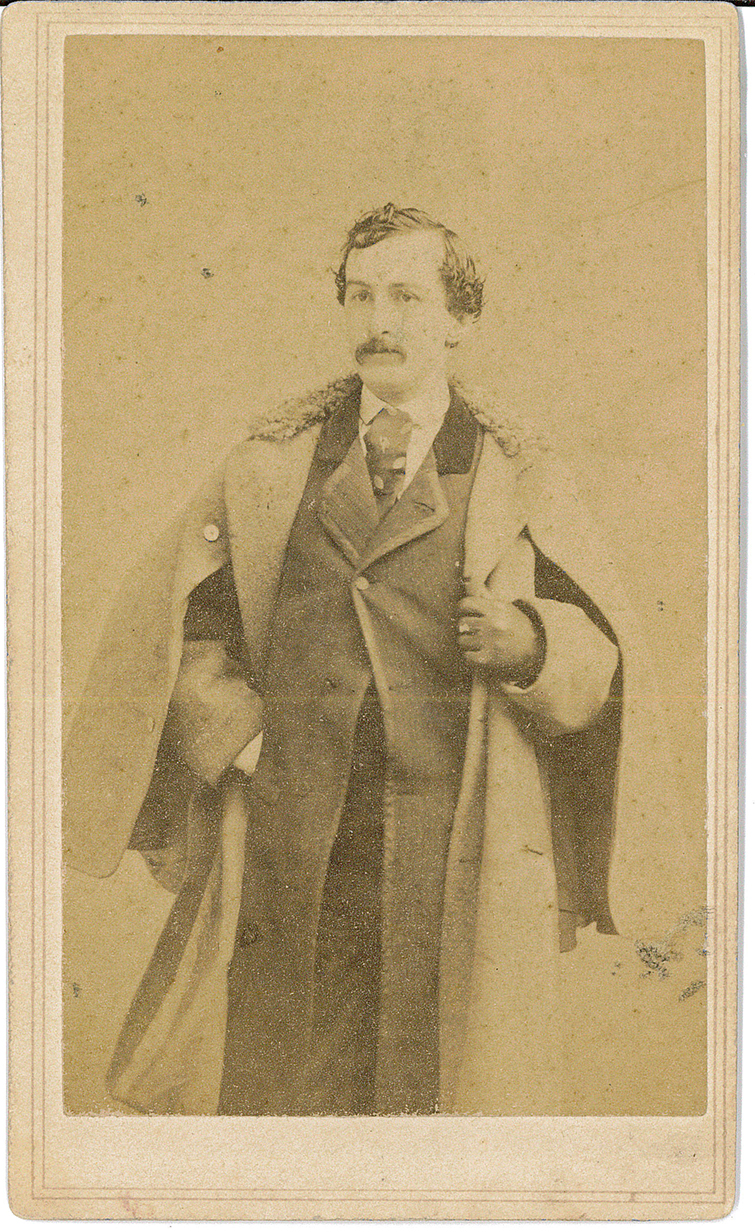
John Wilkes Booth standing with coat
-
Full Title
Card- Picture of John Wilkes Booth standing with coat (front)
-
Description
Photo of John Wilkes Booth with information on the back identifying him as the assassin of Abraham Lincoln.
-
Source
Tucker Collection care of Museum of the Grand Prairie
-
Rights
Use of this item for research, teaching and private study is permitted with proper citation and attribution to the Museum of the Grand Prairie, Champaign County Forest Preserve District. Reproduction of this item for publication, broadcast, or commercial use requires written permission. For permission please contact Museum of the Grand Prairie, Champaign County Forest Preserve District.
-
Tags
-
Cite this Item
Unknown. "Card- Picture of John Wilkes Booth standing with coat (front) ". Remembering Lincoln. Web. Accessed June 3, 2026. https://rememberinglincoln.fords.org/node/443

-
Creator
Unknown
-
Date
1865
from May. 1, 1865
Card- Picture of John Wilkes Booth standing with coat (front)
-
Description
Photo of John Wilkes Booth with information on the back identifying him as the assassin of Abraham Lincoln.
-
Source
Tucker Collection care of Museum of the Grand Prairie
-
Rights
Use of this item for research, teaching and private study is permitted with proper citation and attribution to the Museum of the Grand Prairie, Champaign County Forest Preserve District. Reproduction of this item for publication, broadcast, or commercial use requires written permission. For permission please contact Museum of the Grand Prairie, Champaign County Forest Preserve District.
-
Creator
Unknown
-
Date
May 1, 1865
from May. 1, 1865
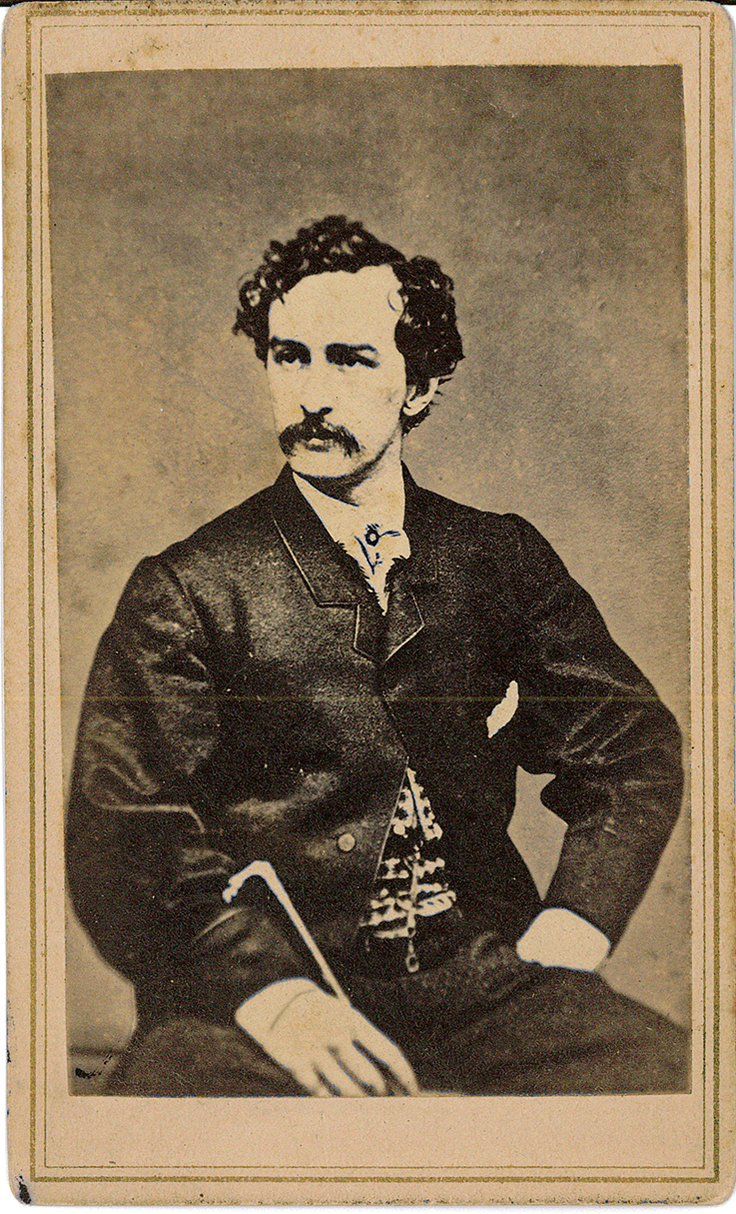
John Wilkes Booth sitting
-
Full Title
Card – photo of John Wilkes Booth sitting (front)
-
Description
Photo of John Wilkes Booth, identified on the back as being the assassin of Abraham Lincoln.
-
Source
Tucker Collection care of Museum of the Grand Prairie
-
Rights
Use of this item for research, teaching and private study is permitted with proper citation and attribution to the Museum of the Grand Prairie, Champaign County Forest Preserve District. Reproduction of this item for publication, broadcast, or commercial use requires written permission. For permission please contact Museum of the Grand Prairie, Champaign County Forest Preserve District.
-
Tags
-
Cite this Item
Unknown. "Card – photo of John Wilkes Booth sitting (front)". Remembering Lincoln. Web. Accessed June 3, 2026. https://rememberinglincoln.fords.org/node/442
-
Creator
Unknown
-
Date
1865
from May. 1, 1865
Card – photo of John Wilkes Booth sitting (front)
-
Description
Photo of John Wilkes Booth, identified on the back as being the assassin of Abraham Lincoln.
-
Source
Tucker Collection care of Museum of the Grand Prairie
-
Rights
Use of this item for research, teaching and private study is permitted with proper citation and attribution to the Museum of the Grand Prairie, Champaign County Forest Preserve District. Reproduction of this item for publication, broadcast, or commercial use requires written permission. For permission please contact Museum of the Grand Prairie, Champaign County Forest Preserve District.
-
Creator
Unknown
-
Date
May 1, 1865
from Apr. 18, 1865
Mary Farren to Solomon F. Smith
-
Full Title
Letter of Mary [Mary Farren], New York, to Uncle Sol [Solomon F. Smith], April 18, 1865
-
Description
Gives her reaction to the assassination of President Abraham Lincoln. States, ". . . .I presume the horrible occurance of last Friday, has thrown a gloom over St. Louis, as everywhere else. I fear the measures were so well taken that the principal criminal will escape. What a dreadful calamity to befall his family. His poor old Mother, had he no human feeling left, that he could crush her in her declining years with such a blow. Edwin [Edwin Booth] it is said is perfectly prostrated. His career in all probability blighted forever. . . .By the way the name of Actor is not in much favor here at present. I was told the Detectives watch them pretty closely. . . ."
-
Source
Missouri History Museum
-
Rights
This item is in the public domain.
-
Tags
-
Cite this Item
Farren, Mary. "Letter of Mary [Mary Farren], New York, to Uncle Sol [Solomon F. Smith], April 18, 1865". Remembering Lincoln. Web. Accessed June 3, 2026. https://rememberinglincoln.fords.org/node/314
-
Creator
Farren, Mary
-
Date
April 18, 1865
from Apr. 18, 1865
Letter of Mary [Mary Farren], New York, to Uncle Sol [Solomon F. Smith], April 18, 1865
![Letter of Mary [Mary Farren], New York, to Uncle Sol [Solomon F. Smith], April 18, 1865](https://rememberinglincoln.fords.org/sites/default/files/Mary%20Farren%20Letter%201.jpg)
-
Description
Gives her reaction to the assassination of President Abraham Lincoln. States, ". . . .I presume the horrible occurance of last Friday, has thrown a gloom over St. Louis, as everywhere else. I fear the measures were so well taken that the principal criminal will escape. What a dreadful calamity to befall his family. His poor old Mother, had he no human feeling left, that he could crush her in her declining years with such a blow. Edwin [Edwin Booth] it is said is perfectly prostrated. His career in all probability blighted forever. . . .By the way the name of Actor is not in much favor here at present. I was told the Detectives watch them pretty closely. . . ."
-
Source
Missouri History Museum
-
Rights
This item is in the public domain.
-
Creator
Farren, Mary
-
Date
April 18, 1865
from May. 1, 1865
Assassination Event
-
Full Title
Assassination Event
-
Description
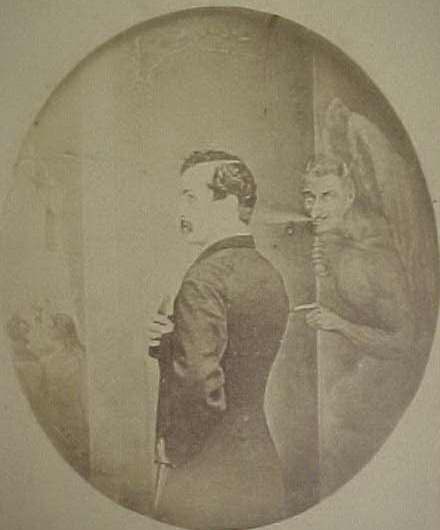
Carte-de-visite showing an armed Booth standing outside the Presidential Box at Ford's Theater. The devil is standing behind and to Booth's side, whispering into his ear. The box's occupants are visible beyond Booth's other side. Below the overlapped image is the legend, "John Wilkes Booth. The Assassin."
-
Source
-
Rights
Use of this item for research, teaching and private study is permitted with proper citation and attribution, as defined here. Reproduction of this item for publication, broadcast or commercial use requires written permission. For permission, please contact the Abraham Lincoln Library and Museum of Lincoln Memorial University, Harrogate, TN.
-
Tags
-
Cite this Item
anonymous. "Assassination Event ". Remembering Lincoln. Web. Accessed June 3, 2026. https://rememberinglincoln.fords.org/node/238
-
Creator
anonymous
-
Date
1865
-
Dimensions
4 inches high by 2 1/2 inches wide
from May. 1, 1865
Assassination Event
-
Description
Carte-de-visite showing an armed Booth standing outside the Presidential Box at Ford's Theater. The devil is standing behind and to Booth's side, whispering into his ear. The box's occupants are visible beyond Booth's other side. Below the overlapped image is the legend, "John Wilkes Booth. The Assassin."
-
Source
-
Rights
Use of this item for research, teaching and private study is permitted with proper citation and attribution, as defined here. Reproduction of this item for publication, broadcast or commercial use requires written permission. For permission, please contact the Abraham Lincoln Library and Museum of Lincoln Memorial University, Harrogate, TN.
-
Creator
anonymous
-
Date
May 1, 1865
-
Dimensions
4 inches high by 2 1/2 inches wide
from Jul. 3, 1865
"Mr. Davis and the Assassination."
-
Full Title
"Mr. Davis and the Assassination."
-
Description
Brief report of Jefferson Davis's response to the death of President Lincoln: "Mr. Davis said that he deplored the event, and trusted that an investigation would prove that no Southern man had any connection with it." Originally published in the Lynchburg Virginian; reprinted in the Montgomery Daily Post on July 3, 1865.
-
Source
Excerpt from the Montgomery Daily Mail, book number ADVCOL39. Catalog record for this title is available here.
-
Rights
Use of this item for research, teaching and private study is permitted with proper citation and attribution, as defined here. Reproduction of this item for publication, broadcast or commercial use requires written permission. For permission, please contact the Alabama Department of Archives and History.
-
Tags
-
Cite this Item
Montgomery Daily Post. ""Mr. Davis and the Assassination."". Remembering Lincoln. Web. Accessed June 3, 2026. https://rememberinglincoln.fords.org/node/211
-
Creator
Montgomery Daily Post
-
Date
July 3, 1865
from Jul. 3, 1865
"Mr. Davis and the Assassination."

-
Description
Brief report of Jefferson Davis's response to the death of President Lincoln: "Mr. Davis said that he deplored the event, and trusted that an investigation would prove that no Southern man had any connection with it." Originally published in the Lynchburg Virginian; reprinted in the Montgomery Daily Post on July 3, 1865.
-
Source
Excerpt from the Montgomery Daily Mail, book number ADVCOL39. Catalog record for this title is available here.
-
Rights
Use of this item for research, teaching and private study is permitted with proper citation and attribution, as defined here. Reproduction of this item for publication, broadcast or commercial use requires written permission. For permission, please contact the Alabama Department of Archives and History.
-
Creator
Montgomery Daily Post
-
Date
July 3, 1865