from May. 2, 1865
Inhabitants of Zurich
-
Full Title
Inhabitants of Zurich
-
Description
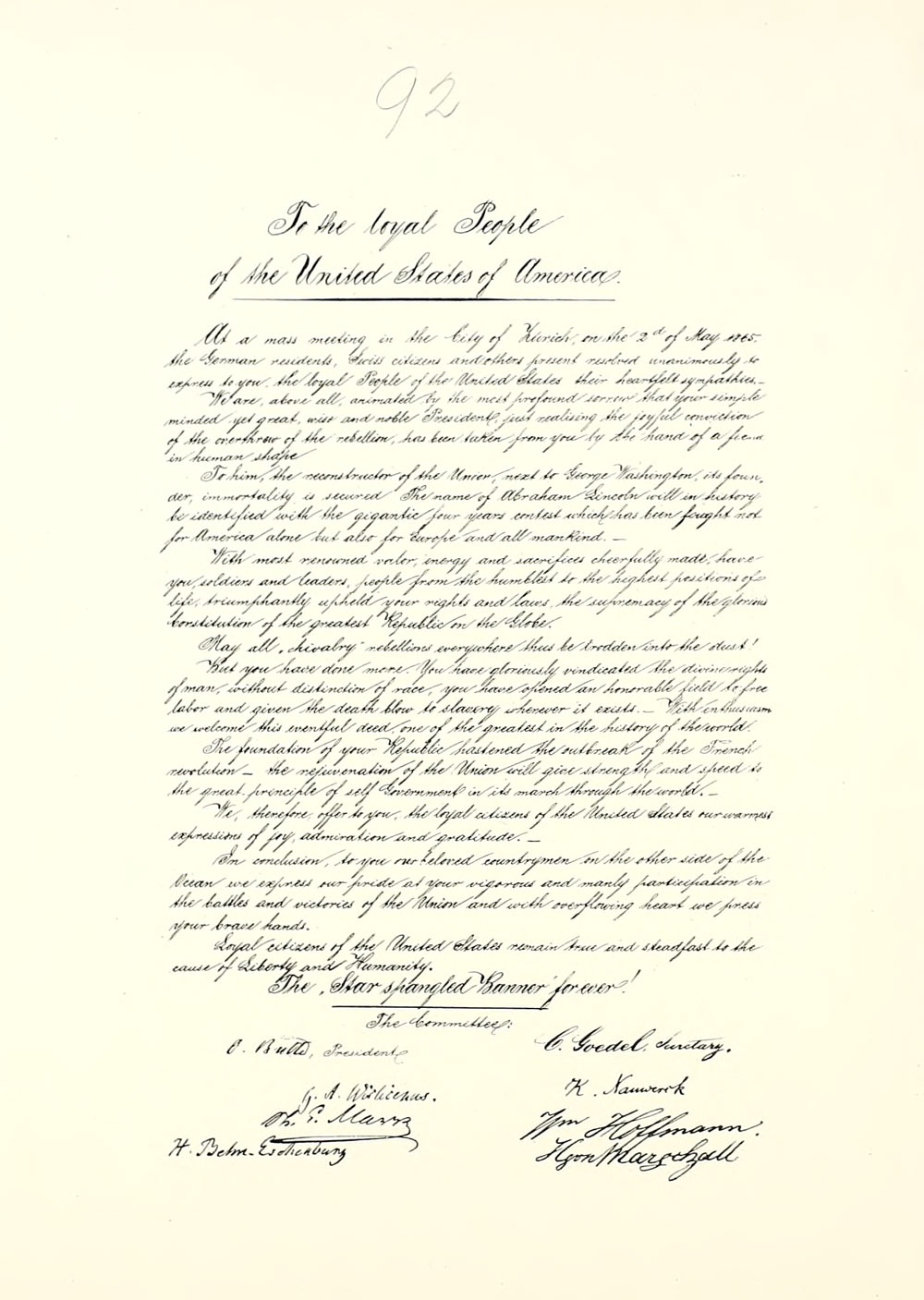
A letter of condolences written to the US Government by a committee of residents from the Swiss city of Zurich. The committee praises the Union victory over the Confederacy, noting its impacts on not only the United States but also "all mankind". While mourning Lincoln, the document makes comparisons between Lincoln's impact and the previous global political impact of the Revolutionary War and George Washington. This letter provides a window into global reactions to the end of the war, as well as international opinions on what the role of a post-war United States would look like.
-
Transcription
Transcription is available via the Department of State Office of the Historian.
-
Source
-
Rights
This item is in the public domain and may be reproduced and used for any purpose, including research, teaching, private study, publication, broadcast or commercial use, with proper citation and attribution.
-
Tags
-
Cite this Item
O. Bulle. "Inhabitants of Zurich". Remembering Lincoln. Web. Accessed June 3, 2026. https://rememberinglincoln.fords.org/node/1205
-
Creator
O. Bulle
-
Date
May 2, 1865
from May. 2, 1865
Inhabitants of Zurich
-
Description
A letter of condolences written to the US Government by a committee of residents from the Swiss city of Zurich. The committee praises the Union victory over the Confederacy, noting its impacts on not only the United States but also "all mankind". While mourning Lincoln, the document makes comparisons between Lincoln's impact and the previous global political impact of the Revolutionary War and George Washington. This letter provides a window into global reactions to the end of the war, as well as international opinions on what the role of a post-war United States would look like.
-
Source
-
Rights
This item is in the public domain and may be reproduced and used for any purpose, including research, teaching, private study, publication, broadcast or commercial use, with proper citation and attribution.
-
Creator
O. Bulle
-
Date
May 2, 1865
from Apr. 18, 1865
Office of Agent For C.S. Prisoners
-
Full Title
Office of Agent For C.S. Prisoners
-
Description
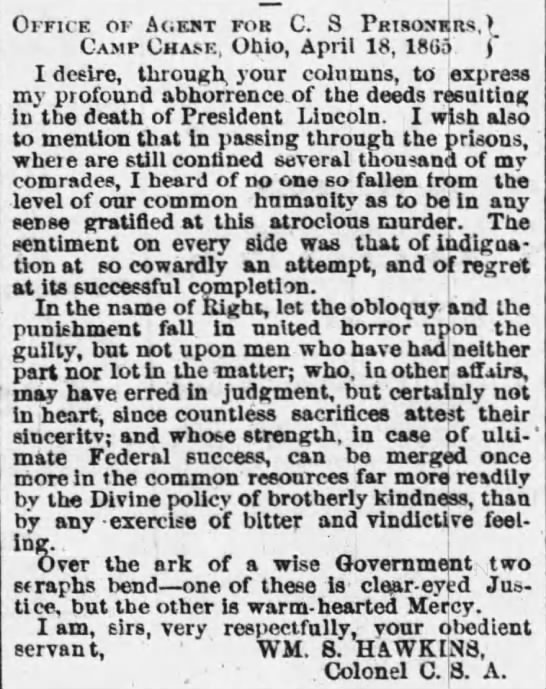
Letter sent by a Confederate prisoner of war named WM. S. Hawkins. Hawkins was a Confederate army colonel who was confined to Camp Chase, one of the largest POW camps in the Northern states. Hawkins expresses his regrets in regards to President Lincoln's fate, while voicing a desire for a post-war world in which the country was unified under principles of justice, mercy, and kindness.
-
Transcription
Office of Agent for C.S Prisoners, Camp Chase, Ohio, April, 18th 1865.
I desire, through your columns, to express my profound abhorrence of the deeds resulting in the death of President Lincoln. I wish also to mention that in passing through the prisons, where are still confined several thousand of my comrades, I heard of no one so fallen from the level of our common humanity as to be in any sense gratified at this atrocious murder. The sentiment on every side was that of indignation at so cowardly an attempt, and of regret at its successful completion.
In the name of Right, let the obloquy and the punishment fall in united horror upon the guilty, but not upon men who have had neither part nor lot in the matter; who, in other affairs, may have erred in judgement, but certainly not in heart, since countless sacrifices attest their sincerity; and whose strength, in case of ultimate Federal success, can be merged once more in the common resources far more readily by the Divine policy of brotherly kindness, than by any exercise of bitter and vindictive feeling.
Over the ark of a wise Government two seraphs bend - one of these is clear-eyed Justice, but the other is warm-hearted Mercy.
I am, sirs, very respectfully, your obedient servant,
WM. S. HAWKINS
Colonel, C.S.A. -
Rights
This item is in the public domain and may be reproduced and used for any purpose, including research, teaching, private study, publication, broadcast or commercial use, with proper citation and attribution.
-
Tags
-
Cite this Item
WM. S. Hawkins. "Office of Agent For C.S. Prisoners". The Louisville Daily Journal. Remembering Lincoln. Web. Accessed June 3, 2026. https://rememberinglincoln.fords.org/node/1204
-
Creator
WM. S. Hawkins
-
Publisher
The Louisville Daily Journal
-
Date
April 18, 1865
from Apr. 18, 1865
Office of Agent For C.S. Prisoners
-
Description
Letter sent by a Confederate prisoner of war named WM. S. Hawkins. Hawkins was a Confederate army colonel who was confined to Camp Chase, one of the largest POW camps in the Northern states. Hawkins expresses his regrets in regards to President Lincoln's fate, while voicing a desire for a post-war world in which the country was unified under principles of justice, mercy, and kindness.
-
Rights
This item is in the public domain and may be reproduced and used for any purpose, including research, teaching, private study, publication, broadcast or commercial use, with proper citation and attribution.
-
Creator
WM. S. Hawkins
-
Publisher
The Louisville Daily Journal
-
Date
April 18, 1865
from Apr. 16, 1865
Sermon Preached in the African Methodist Episcopal Zion Church
-
Full Title
Sermon Preached in the African Methodist Episcopal Zion Church
-
Description
Sermon preached by Rev. Jacob Thomas in the African Methodist Episcopal Zion Church, Troy, New York. In this sermon, Rev. Thomas addresses his congregation and praises Lincoln as a true friend of African Americans while discussing what his loss means for the future. Rev. Thomas reflects on the grief of the African American community in regards to the assassination and how this was enhanced by Lincoln's status as a "friend of the oppressed."
-
Transcription
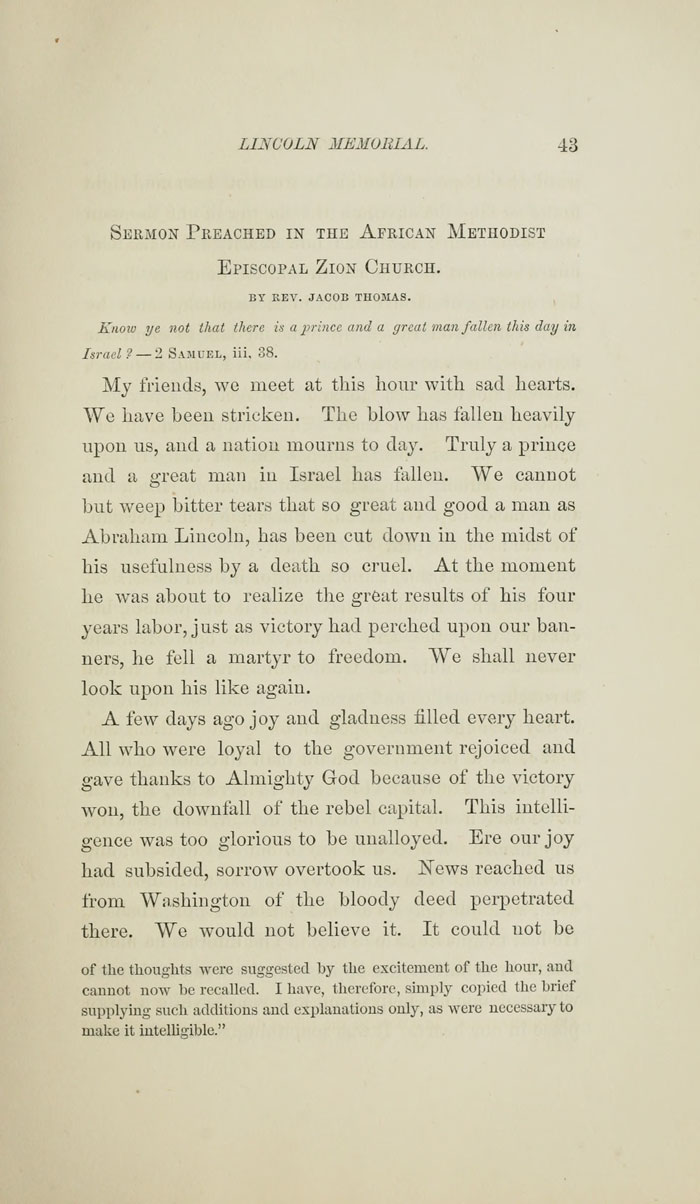
My friends, we meet at this hour with sad hearts. We have been stricken. The blow has fallen heavily upon us, and a nation mourns to day. Truly a prince and a great man in Israel has fallen. We cannot but weep bitter tears that so great and good a man as Abraham Lincoln, has been cut down in the midst of his usefulness by a death so cruel. At the moment he was about to realize the great results of his four years labor, just as victory had perched upon our banners, he fell a martyr to freedom. We shall never look upon his like again.
A few days ago joy and gladness filled every heart. All who were loyal to the government rejoiced and gave thanks to Almighty God because of the victory won, the downfall of the rebel capital. This intelligence was too glorious to be unalloyed. Ere our joy had subsided, sorrow overtook us. News reached us from Washington of the bloody deed perpetrated there. We would not believe it. It could not be possible that a creature in the form of man could be found so God-forsaken, as to take the life of the man who had malice for none but charity for all! The hours between the first rumor and the confirmation of the report, were hours of dreadful suspense. But the truth came at last. There was no longer room for doubt. It was too true, that on last Friday evening, whilst enjoying at a place of amusement a few moments of relaxation from toil, accompanied by his wife and a few friends, unconscious of danger near, he was brutally murdered — shot down by the cowardly hand of an assassin. Palsied be the tongue, withered be the arm of the guilty, execrable wretch who committed this, the blackest of all crimes. Yes, our dear President is no more. The beloved of his country, the father and friend of the oppressed, the champion of universal freedom, has fallen a victim to southern malice and revenge. Kind heaven weeps to-day over the bloody spectacle.
We, as a people, feel more than all others that we are bereaved. We had learned to love Mr. Lincoln as we have never loved man before. We idolized his very name. We looked up to him as our saviour, our deliverer. His name was familiar with our children, and our prayers ascended to God in his behalf. He had taught us to love him. The interest he manifested in behalf of the oppressed, the weak and those who had none to help them, had won for him a large place in our heart. It was something so new to us to see such sentiments manifested by the chief magistrate of the United States that we could not help but love him. Is it to be wondered at that we mourn today? Nay, we have seen old gray-headed men and young maidens weep because of this affliction. Had disease attacked him and he had passed away according to the natural course of nature, we could have consoled ourselves with the thought that it was God's will it should be so. But falling as he did by the hand of the wicked, we derive our consolation only from the assurance that by his uprightness, his honesty and his principles of Christianity, he is now enjoying that rest that remains for the just.
Our text is a fitting one for the occasion. A great man has fallen. From whatever stand-point we view Mr. Lincoln, we find in him the marks of true greatness. A few years ago this plain, homely lawyer was scarcely known outside of his own state. But how soon did he become the point of attraction. Not only was he the centre of observation in this country, but the civilized world was watching him. He far exceeded the expectations of all men. He became as the ark of safety to his country, the praise and glory of his fellow men. To us as a despised people, he was a second Moses — a second Daniel in wisdom. From a humble position in life he reached the very summit of honor, occupied the highest seat that it was in the power of the American people to give him, and filled that seat as no man ever filled it before him. The mind that conceived and drew up the Proclamation of Emancipation was a great mind. The results of this grand deed are patent to all. He was a philanthropist in the most extensive sense of the word — benevolent, kind, and ever ready to make others happy. One of the most prominent features in the character of our departed friend was his merciful disposition even towards his foes. He was strictly honest; this is admitted by his worst enemies. " Honest Abe," he was familiarly called by all classes. He was honest with his people, honest to himself, honest to his God. This is what God requires of all men, to be honest in heart. The exterior of this great man may have been plain, homely and awkward, but the interior was beautifully finished and furnished with Christian graces. It was his reliance upon God that carried him safely through the storm of four years duration. It was this that has made him blessed in the favor of God, forever.
Yes, Abraham Lincoln is no more, and we mingle our tears with those of the mourning widow and bereaved friend. We feel that in his loss our punishment is more that we can bear, yet in God is our consolation. Let us hope for the best. An all-wise God has permitted this great grief to come upon us. Let us look to him for deliverance in the time of our distress. We are humbled, we are mortified, we are brought very low. Our trust must be in God. Whilst we mourn, he whose, death we deplore, is enjoying the reward of his labor, happy with his God, mingling with those kindred spirits who went before him. The
two truest and greatest men that ever lived on earth, John Brown and Abraham Lincoln, have met in glory, and they cease not to give praise and honor to him that liveth forever and ever. The memory of Abraham Lincoln will ever be dear to us. It is engraved upon our hearts. It can never be effaced. He has been our true friend and we never can forget him. We feel as though God had raised him up for a special purpose, and that having accomplished the labor assigned him, he has gone to his rest. May God protect us and keep us from further evils. -
Source
A tribute of respect by the citizens of Troy, to the memory of Abraham Lincoln
-
Rights
This item is in the public domain and may be reproduced and used for any purpose, including research, teaching, private study, publication, broadcast or commercial use,with proper citation and attribution.
-
Tags
-
Cite this Item
Rev. Jacob Thomas. "Sermon Preached in the African Methodist Episcopal Zion Church". Young & Benson. Remembering Lincoln. Web. Accessed June 3, 2026. https://rememberinglincoln.fords.org/node/1203
-
Creator
Rev. Jacob Thomas
-
Publisher
Young & Benson
-
Date
1865
from Apr. 16, 1865
Sermon Preached in the African Methodist Episcopal Zion Church
-
Description
Sermon preached by Rev. Jacob Thomas in the African Methodist Episcopal Zion Church, Troy, New York. In this sermon, Rev. Thomas addresses his congregation and praises Lincoln as a true friend of African Americans while discussing what his loss means for the future. Rev. Thomas reflects on the grief of the African American community in regards to the assassination and how this was enhanced by Lincoln's status as a "friend of the oppressed."
-
Source
A tribute of respect by the citizens of Troy, to the memory of Abraham Lincoln
-
Rights
This item is in the public domain and may be reproduced and used for any purpose, including research, teaching, private study, publication, broadcast or commercial use,with proper citation and attribution.
-
Creator
Rev. Jacob Thomas
-
Publisher
Young & Benson
-
Date
April 16, 1865
from May. 1, 1865
Theory. Practice. Effect.
-
Full Title
Theory. Practice. Effect.
-
Description
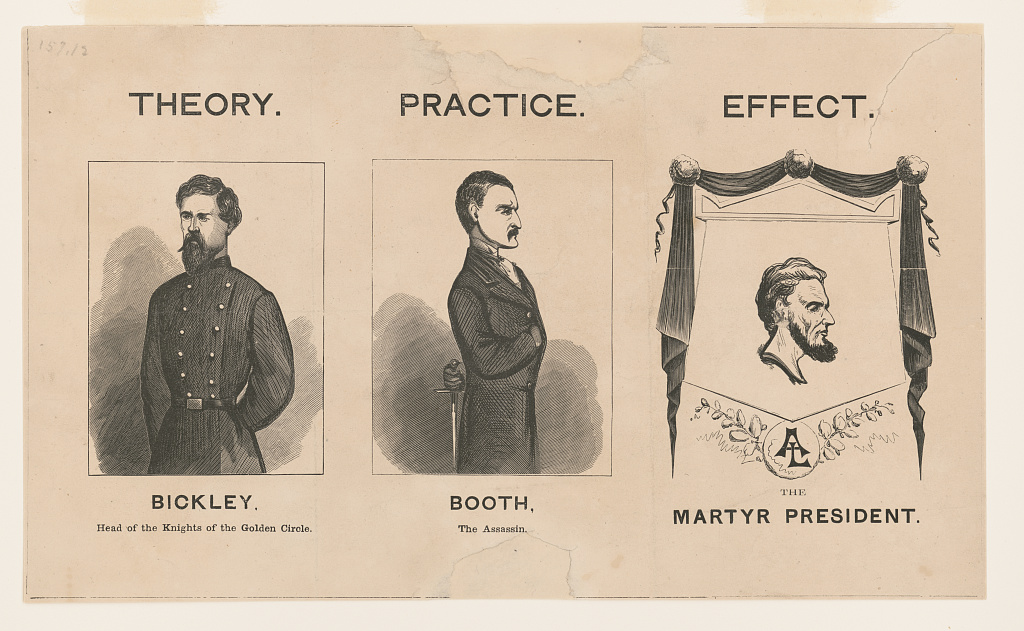
This print attributes John Wilkes Booth's assassination of Abraham Lincoln to the influence of the Knights of the Golden Circle, the proslavery secret society. The first panel labels "Theory" as George W. L. Bickley, the "Head of the Knights of the Golden Circle," standing in for the society's ideology. Under "practice" is John Wilkes Booth with a dagger behind his back with the "Effect" being the death of President Lincoln.
-
Source
Library of Congress, Prints and Photographs Division, LC-DIG-pga-13665
-
Rights
This item is in the public domain and may be reproduced and used for any purpose, including research, teaching, private study, publication, broadcast or commercial use, with proper citation and attribution.
-
Tags
-
Cite this Item
unknown. "Theory. Practice. Effect.". Remembering Lincoln. Web. Accessed June 3, 2026. https://rememberinglincoln.fords.org/node/1156
-
Creator
unknown
-
Date
1865
-
Material
wove paper and wood engraving
-
Dimensions
14 x 29.2 cm
from May. 1, 1865
Theory. Practice. Effect.
-
Description
This print attributes John Wilkes Booth's assassination of Abraham Lincoln to the influence of the Knights of the Golden Circle, the proslavery secret society. The first panel labels "Theory" as George W. L. Bickley, the "Head of the Knights of the Golden Circle," standing in for the society's ideology. Under "practice" is John Wilkes Booth with a dagger behind his back with the "Effect" being the death of President Lincoln.
-
Source
Library of Congress, Prints and Photographs Division, LC-DIG-pga-13665
-
Rights
This item is in the public domain and may be reproduced and used for any purpose, including research, teaching, private study, publication, broadcast or commercial use, with proper citation and attribution.
-
Creator
unknown
-
Date
May 1, 1865
-
Material
wove paper and wood engraving
-
Dimensions
14 x 29.2 cm
from Apr. 14, 1865
Diary of Orville Hickman Browning
-
Full Title
Diary of Orville Hickman Browning, Friend of Lincoln - Excerpts from April 14-19, 1865
-
Description
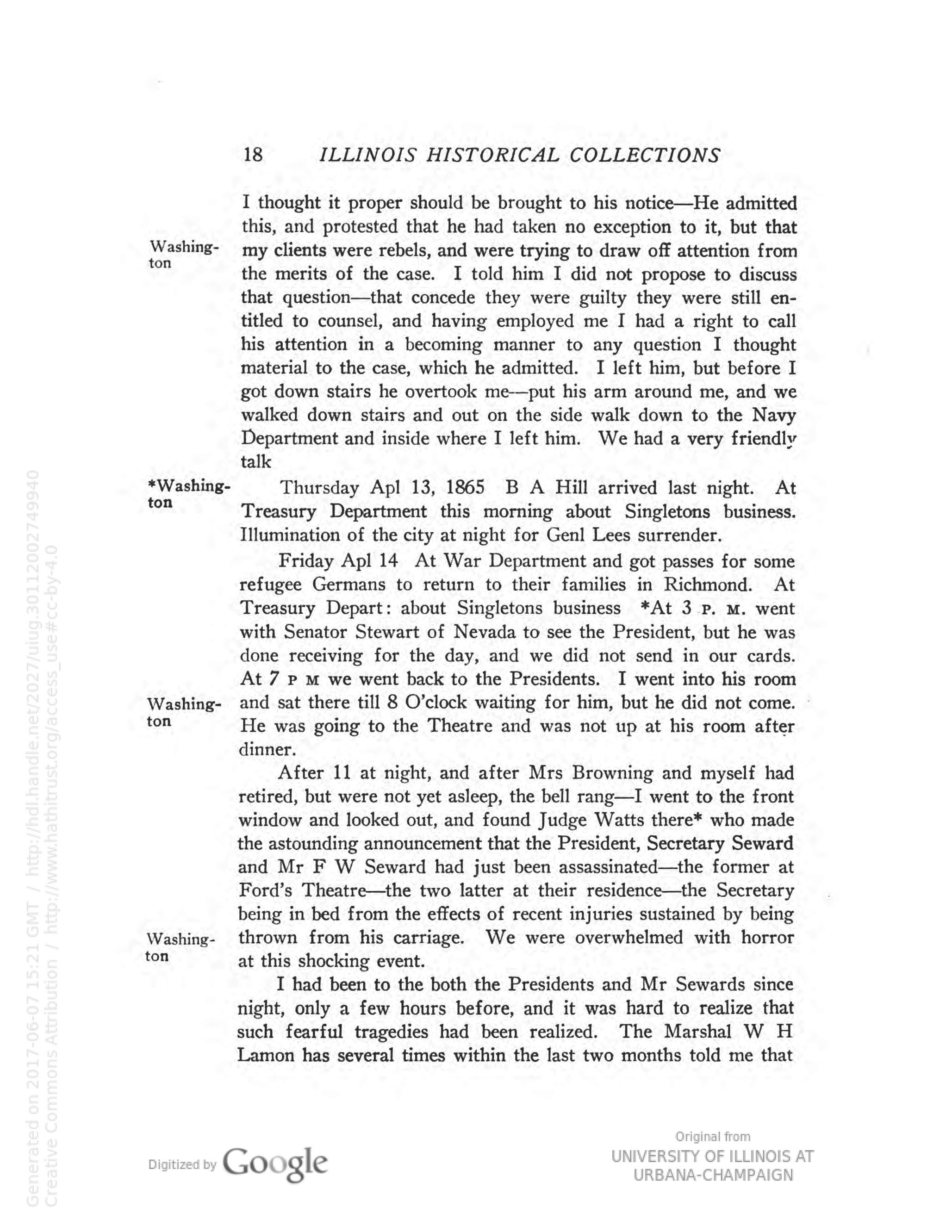
These are the diary entries of former U.S. Senator and friend of President Lincoln, Orville Hickman Browning, the day of Lincoln's assassination up to the funeral in Washington, DC on April 19, 1865. Browning discusses how he heard about the attacks and incorrectly states the Secretary of State Seward was killed. He talks about how Lincoln was the South's best ally within the government and speculates who the attacker was. Over the next few days he visits the White House and describes the body of the fallen president. These excerpts are part of the “Diary of Orville Hickman Browning Volume II: 1865-1881,” published in 1925 by the Illinois State Historical Library. Born in Kentucky in 1806, Browning moved to Quincy, Illinois to become a lawyer. Later he served as a U.S. Senator, adviser to Abraham Lincoln and Andrew Johnson, and even a cabinet minister. Browning and Lincoln became friends while serving in the state legislature; both were members of the Whig party. Browning served as an ally for Lincoln during his presidency.
-
Source
Hathi Trust Digital Library
-
Rights
The written permission of the copyright owners and/or other rights holders (such as publicity and/or privacy rights) is required for distribution, reproduction, or other use of protected items beyond that allowed by fair use or other statutory exemptions.
-
Tags
-
Cite this Item
Orville Hickman Browning. "Diary of Orville Hickman Browning, Friend of Lincoln - Excerpts from April 14-19, 1865". Illinois State Historical Library. Remembering Lincoln. Web. Accessed June 3, 2026. https://rememberinglincoln.fords.org/node/1098
-
Creator
Orville Hickman Browning
-
Publisher
Illinois State Historical Library
-
Date
April 14, 1865
-
Dimensions
22 cm.
from Apr. 14, 1865
Diary of Orville Hickman Browning, Friend of Lincoln - Excerpts from April 14-19, 1865
-
Description
These are the diary entries of former U.S. Senator and friend of President Lincoln, Orville Hickman Browning, the day of Lincoln's assassination up to the funeral in Washington, DC on April 19, 1865. Browning discusses how he heard about the attacks and incorrectly states the Secretary of State Seward was killed. He talks about how Lincoln was the South's best ally within the government and speculates who the attacker was. Over the next few days he visits the White House and describes the body of the fallen president. These excerpts are part of the “Diary of Orville Hickman Browning Volume II: 1865-1881,” published in 1925 by the Illinois State Historical Library. Born in Kentucky in 1806, Browning moved to Quincy, Illinois to become a lawyer. Later he served as a U.S. Senator, adviser to Abraham Lincoln and Andrew Johnson, and even a cabinet minister. Browning and Lincoln became friends while serving in the state legislature; both were members of the Whig party. Browning served as an ally for Lincoln during his presidency.
-
Source
Hathi Trust Digital Library
-
Rights
The written permission of the copyright owners and/or other rights holders (such as publicity and/or privacy rights) is required for distribution, reproduction, or other use of protected items beyond that allowed by fair use or other statutory exemptions.
-
Creator
Orville Hickman Browning
-
Publisher
Illinois State Historical Library
-
Date
April 14, 1865
-
Dimensions
22 cm.
from Apr. 20, 1865
Mayor's Proclamation on the Death of Abraham Lincoln - Brownville, Nebraska
-
Full Title
Brownville, Nebraska Territory Mayor's Proclamation on the Death of Abraham Lincoln
-
Description
The newly elected Mayor of Brownville, Nebraska Territory, Charles G. Dorsey, made a proclamation on the death of Abraham Lincoln, which was published in the Nebraska Advertiser the week after the President's death. The town of Brownville heard about Lincoln's death almost immediately. The city of Brownville was only about 10 years old at the time of Lincoln's assassination. The Nebraska Advertiser was founded in 1856 by a recent resident, Robert Wilkinson Furnas. Fumas was opposed to slavery and those views were often illustrated in the newspaper.
-
Source
-
Rights
This item is in the public domain and may be reproduced and used for any purpose, including research, teaching, private study, publication, broadcast or commercial use, with proper citation and attribution.
-
Tags
-
Cite this Item
Nebraska Advertiser. "Brownville, Nebraska Territory Mayor's Proclamation on the Death of Abraham Lincoln". Robert Wilkinson Furnas. Remembering Lincoln. Web. Accessed June 3, 2026. https://rememberinglincoln.fords.org/node/1097
-
Creator
Nebraska Advertiser
-
Publisher
Robert Wilkinson Furnas
-
Date
April 20, 1865
from Apr. 20, 1865
Brownville, Nebraska Territory Mayor's Proclamation on the Death of Abraham Lincoln

-
Description
The newly elected Mayor of Brownville, Nebraska Territory, Charles G. Dorsey, made a proclamation on the death of Abraham Lincoln, which was published in the Nebraska Advertiser the week after the President's death. The town of Brownville heard about Lincoln's death almost immediately. The city of Brownville was only about 10 years old at the time of Lincoln's assassination. The Nebraska Advertiser was founded in 1856 by a recent resident, Robert Wilkinson Furnas. Fumas was opposed to slavery and those views were often illustrated in the newspaper.
-
Source
-
Rights
This item is in the public domain and may be reproduced and used for any purpose, including research, teaching, private study, publication, broadcast or commercial use, with proper citation and attribution.
-
Creator
Nebraska Advertiser
-
Publisher
Robert Wilkinson Furnas
-
Date
April 20, 1865
from May. 13, 1865
Public Meeting at Peralta, NM - Resolution on the Death of President Lincoln
-
Full Title
Public Meeting at Peralta, NM - Resolution on the Death of President Lincoln, Santa Fe Weekly
-
Description
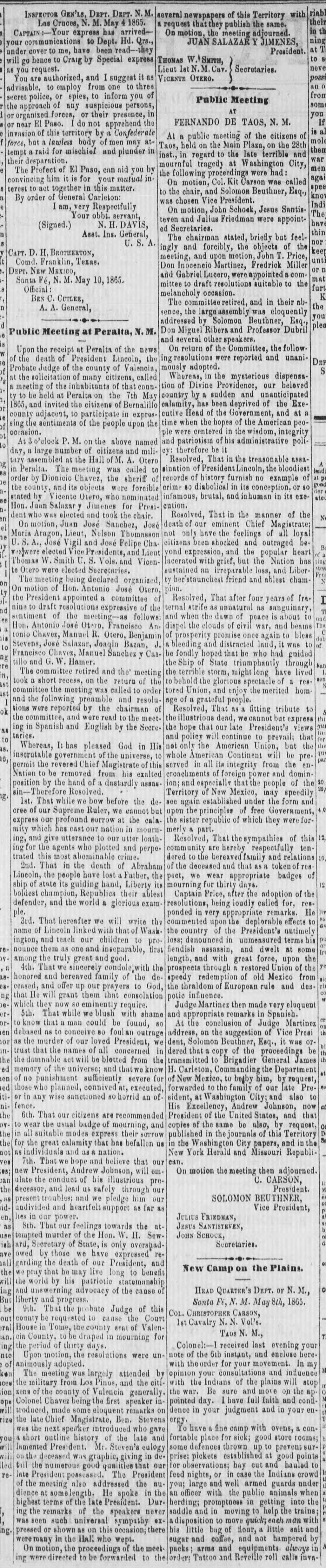
In May 1865, the Santa Fe Weekly Gazette published a summary of a meeting organized by the Probate Judge of Peralta, New Mexico. Peralta was named for the founder of Santa Fe, Don Pedro de Peralta, between 1607 and 1610. Both citizens of the county and Union military were present for the meeting to draft nine resolutions on the death of President Abraham Lincoln. The citizens expressed their sorrow and pledged their loyalty to the new president, Andrew Johnson. The resolutions were read in both Spanish and English. The meeting precedings were then sent to several newspapers throughout the territory, including the Santa Fe Weekly Gazette. The Santa Fe Weekly Gazette was in publication from April 1851 to September 1869 and was the most successful paper in the area up until that point, serving the capital of the province of New Mexico. The city had a population of about 4,500 by 1850. While in publication, the paper supported both Democratic and Republican causes. The paper's motto was "Independent in all things - neutral in nothing."
-
Source
Library of Congress Chronicling America
-
Rights
This item is in the public domain and may be reproduced and used for any purpose, including research, teaching, private study, publication, broadcast or commercial use, with proper citation and attribution.
-
Tags
-
Cite this Item
Santa Fe Weekly Gazette. "Public Meeting at Peralta, NM - Resolution on the Death of President Lincoln, Santa Fe Weekly". James L. Collins. Remembering Lincoln. Web. Accessed June 3, 2026. https://rememberinglincoln.fords.org/node/1095
-
Creator
Santa Fe Weekly Gazette
-
Publisher
James L. Collins
-
Date
May 13, 1865
from May. 13, 1865
Public Meeting at Peralta, NM - Resolution on the Death of President Lincoln, Santa Fe Weekly
-
Description
In May 1865, the Santa Fe Weekly Gazette published a summary of a meeting organized by the Probate Judge of Peralta, New Mexico. Peralta was named for the founder of Santa Fe, Don Pedro de Peralta, between 1607 and 1610. Both citizens of the county and Union military were present for the meeting to draft nine resolutions on the death of President Abraham Lincoln. The citizens expressed their sorrow and pledged their loyalty to the new president, Andrew Johnson. The resolutions were read in both Spanish and English. The meeting precedings were then sent to several newspapers throughout the territory, including the Santa Fe Weekly Gazette. The Santa Fe Weekly Gazette was in publication from April 1851 to September 1869 and was the most successful paper in the area up until that point, serving the capital of the province of New Mexico. The city had a population of about 4,500 by 1850. While in publication, the paper supported both Democratic and Republican causes. The paper's motto was "Independent in all things - neutral in nothing."
-
Source
Library of Congress Chronicling America
-
Rights
This item is in the public domain and may be reproduced and used for any purpose, including research, teaching, private study, publication, broadcast or commercial use, with proper citation and attribution.
-
Creator
Santa Fe Weekly Gazette
-
Publisher
James L. Collins
-
Date
May 13, 1865
from May. 1, 1865
Lincoln's grave
-
Full Title
Lincoln's grave
-
Description
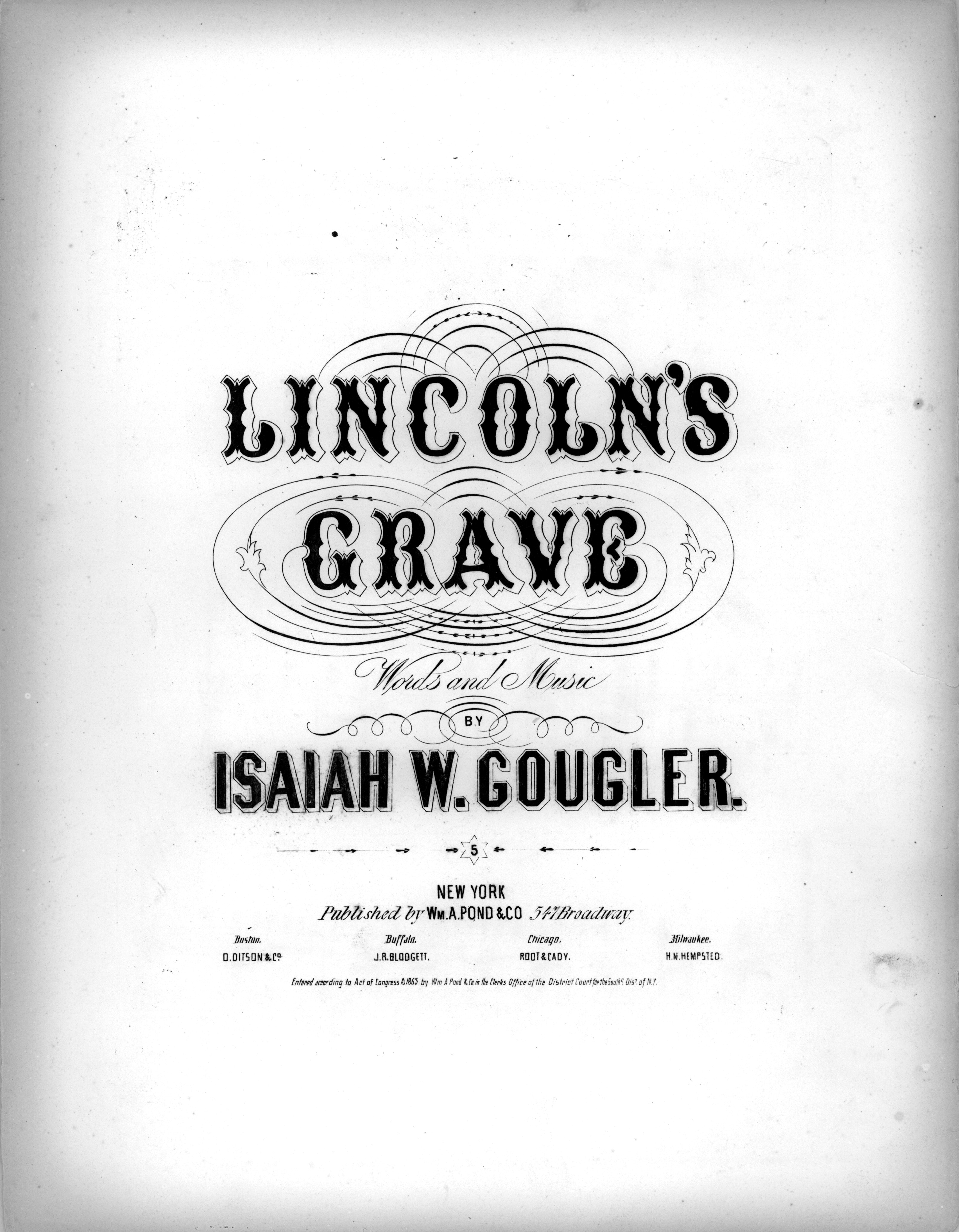
Song for high voice and piano that comments describes President Lincoln as a "martyr of freedom." Sheet music from the Alfred Whital Stern Collection of Lincolniana, Library of Congress Rare Book and Special Collections Division. Associated with the Union side.
-
Transcription
Verse 1
Far out on the plains of the beautiful west,
Whose glory and wonder Columbia adorn,
The martyr of freedom in triumph shall rest,
To bless all the living and all yet unborn;
The hand that hath slain him, how vile, O how vile!
To mar that fair visage so kind and so true!
No more shall assail him whose heart knew no guile,
But wither and perish a doom justly due.
But wither and perish a doom justly due.
Verse 2
O shade of the blessed, a nation in tears,
In sorrow and sadness its loss must deplore,
The God who hath led thee will quell all our fears,
His goodness that gave thee we still will adore;
Sweet peace, gentle sleeper, thy spirit attend,
While men, yes while angels thy praises shall sing,
Against thy blest mem'ry O who dare offend!
And not to its altar his best off'rings bring.
Verse 3
O spirit undying for death none the less,
But like Him who died that the earth might rejoice,
Thou risest victorious the nations to bless;
The bondman's delivrer, America's choice,
The hand that hath slain thee, how vile, O how vile!
To mar thy fair visage, so kind and so true,
No more shall assail thee whose heart knew no guile,
But wither and perish a doom justly due. -
Source
Sheet Music from the Alfred Whital Stern Collection of Lincolniana
-
Rights
Public Domain. Suggested credit line: Alfred Whital Stern Collection of Lincolniana, Library of Congress, Rare Book and Special Collections Division.
-
Tags
-
Cite this Item
Gougler, Isaiah W. (composer & lyricist). "Lincoln's grave". New York: Wm. A. Pond & Co., ca. 1865. Remembering Lincoln. Web. Accessed June 3, 2026. https://rememberinglincoln.fords.org/node/1034

-
Creator
Gougler, Isaiah W. (composer & lyricist)
-
Publisher
New York: Wm. A. Pond & Co., ca. 1865
-
Date
ca. 1865
-
Material
Sheet Music
from May. 1, 1865
Lincoln's grave
-
Description
Song for high voice and piano that comments describes President Lincoln as a "martyr of freedom." Sheet music from the Alfred Whital Stern Collection of Lincolniana, Library of Congress Rare Book and Special Collections Division. Associated with the Union side.
-
Source
Sheet Music from the Alfred Whital Stern Collection of Lincolniana
-
Rights
Public Domain. Suggested credit line: Alfred Whital Stern Collection of Lincolniana, Library of Congress, Rare Book and Special Collections Division.
-
Creator
Gougler, Isaiah W. (composer & lyricist)
-
Publisher
New York: Wm. A. Pond & Co., ca. 1865
-
Date
May 1, 1865
-
Material
Sheet Music
from May. 1, 1865
The Assassin's Vision
-
Full Title
The Assassin's Vision
-
Description
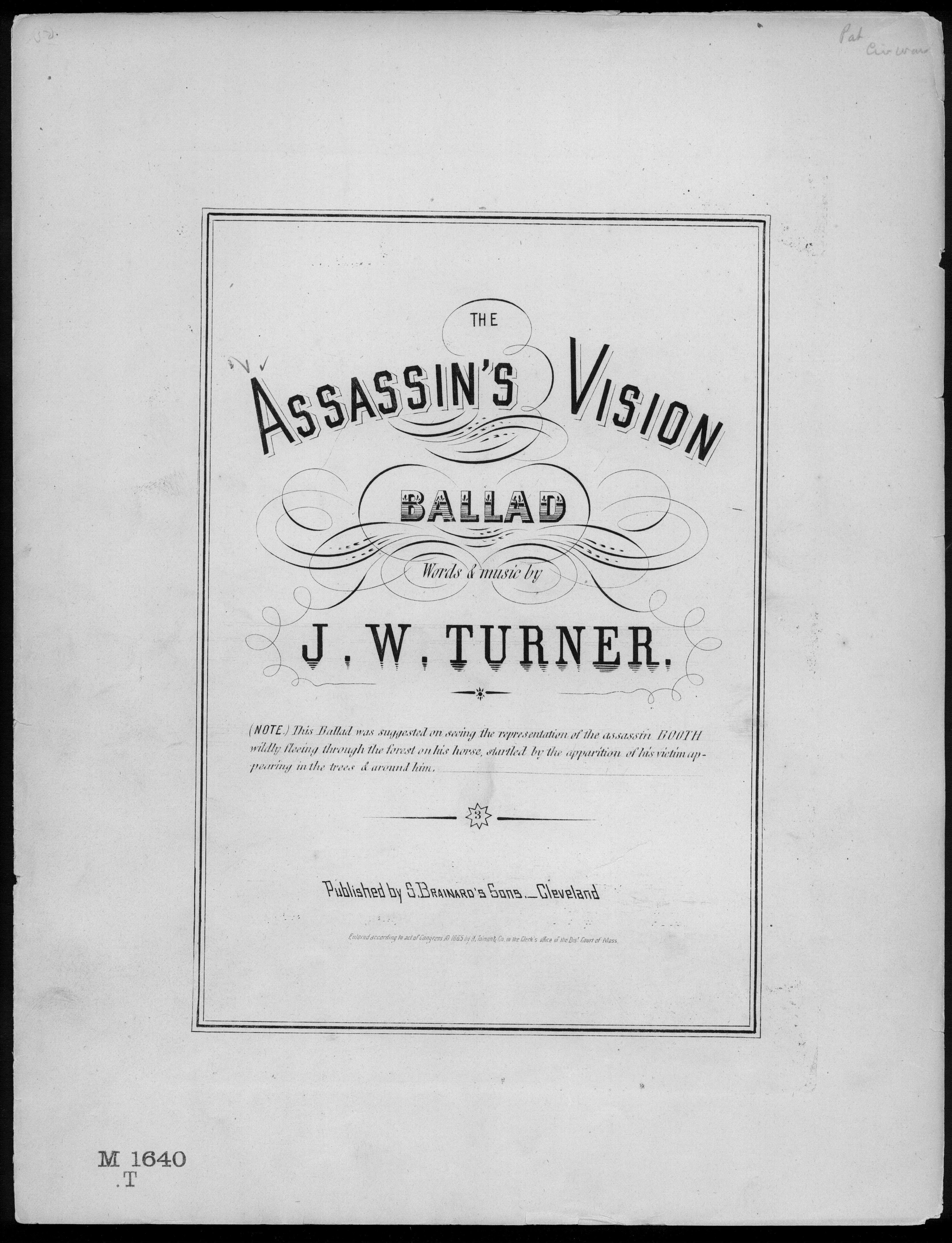
A song for medium or low voice and piano that describes the escape of President Lincoln's assassin, John Wilkes Booth. The lyrics convey that God will seek vengeance on the assassin, who will be haunted by his actions. The song has three verses that each utilize the exact same piano accompaniment, however the vocal line has slight rhythmic variations from verse to verse. The composer's note reads: "This Ballad was suggested on seeing the representation of the assassin BOOTH wildly fleeing through the forest on his horse, startled by the apparition of his victim appearing in the trees & around him." Part of the Library of Congress Civil War Sheet Music Collection, associated with the Union side.
-
Transcription
Verse 1
The Assassin rode on his fiery steed,
His murd'rous work was done
In the darksome night with fleeting speed,
Through woods his cours-'er run!
As he hurried away from the scene of death,
On his death, On his brow were looks of despair;
Before him! around him! The evenings breath
Told him God's vengeance was there!
Verse 2
The pale moon beamed as onward he fled,
The stars looked down from on high,
The hills and valleys were crimson red
As blood to the murd'rer's eye!
He shuddered! he trembled! And oft looked around,
And dreary seemed each passing breeze,
And lo! the assassin bound
Saw a vision appear in the trees.
Verse 3
Heaven had witnessed! he could not escape!
The assassin's fate was sealed--
"Vengeance is mine!" saith God in his might,
As the vision that night revealed.
The assassin rode on with trembling and fear,
And mournfully murmur'd the breeze;
Before him! around him! all vivid and drear,
The vision appeared in the trees. -
Source
-
Rights
Public Domain. Suggested credit line: Civil War Sheet Music Collection, Library of Congress, Music Division.
-
Tags
-
Cite this Item
Turner, J. W. (composer & lyricist). "The Assassin's Vision". Cleveland: S. Branard's Sons, 1865. Remembering Lincoln. Web. Accessed June 3, 2026. https://rememberinglincoln.fords.org/node/1029
-
Creator
Turner, J. W. (composer & lyricist)
-
Publisher
Cleveland: S. Branard's Sons, 1865
-
Date
1865
-
Material
Sheet Music
from May. 1, 1865
The Assassin's Vision
-
Description
A song for medium or low voice and piano that describes the escape of President Lincoln's assassin, John Wilkes Booth. The lyrics convey that God will seek vengeance on the assassin, who will be haunted by his actions. The song has three verses that each utilize the exact same piano accompaniment, however the vocal line has slight rhythmic variations from verse to verse. The composer's note reads: "This Ballad was suggested on seeing the representation of the assassin BOOTH wildly fleeing through the forest on his horse, startled by the apparition of his victim appearing in the trees & around him." Part of the Library of Congress Civil War Sheet Music Collection, associated with the Union side.
-
Source
-
Rights
Public Domain. Suggested credit line: Civil War Sheet Music Collection, Library of Congress, Music Division.
-
Creator
Turner, J. W. (composer & lyricist)
-
Publisher
Cleveland: S. Branard's Sons, 1865
-
Date
May 1, 1865
-
Material
Sheet Music
from May. 1, 1865
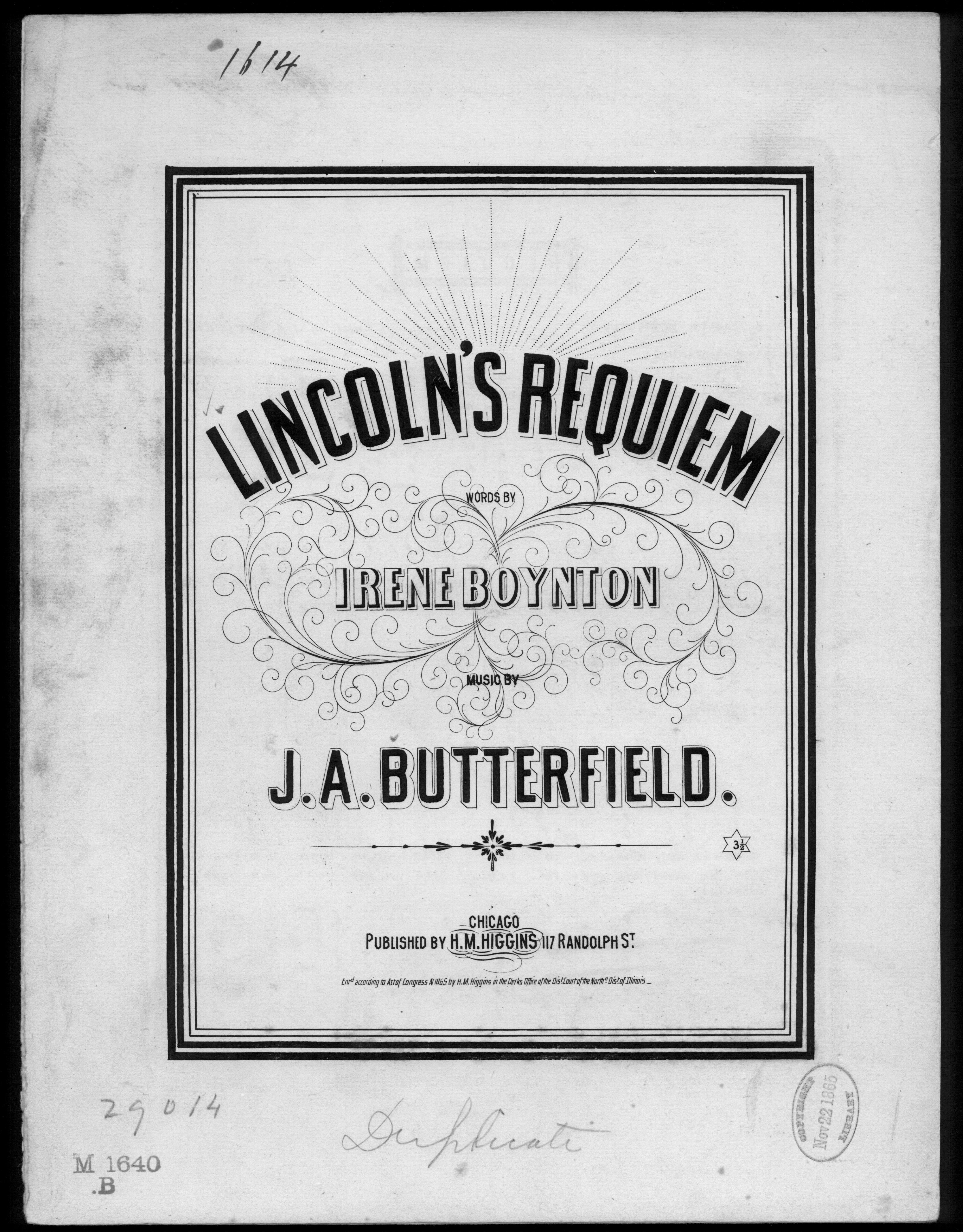
Lincoln's requiem
-
Full Title
Lincoln's requiem
-
Description
Lincoln's requiem was composed for chorus (mixed voices, 4 parts) and piano. Associated with the Union side, the song mourns President Lincoln's death and praises his legacy as an advocate for freedom and liberty. The lyrics consist of five verses and a refrain. Part of the Library of Congress Civil War Sheet Music Collection.
-
Transcription
Verse:
Dead! dead! how swift the dire news flies,
And wakes a nation's agonies!
From town to town, from mouth to mouth
Swift spreads the dreaded message forth;
In lowly cot, in lordly hall,
This grief enshrouds and covers all.
And on the breast drops ev'ry head,
In sorrow for the noble dead.
Chorus:
Oh, weep for fallen greatness! weep!
Let tears express our woes;
But while our Lincoln's soul doth sleep,
Brave men strike down his foes!
Verse:
Dead! dead! but not as warriors die,
He fell not shouting battle cry--
Not in the open light of heavn'--
Not in his home his soul was risen--
Not on the plain where hand to hand
The brave cross blade with foemen's brand,
But where the waves of pleasure flow,
Death aim'd his shaft thro' secret foe. [Chorus]
Verse:
Dead! dead! and now when hopes were high,
And wars dread curse was passing by,
When traitors had their madness stay'd,
And hero hands sheathed vegeful blade,
When homes and hearthstones gleamd afar,
To manly hearts grown tired of war,
And long wooed peace had left the sky,
It was no time for him to die. [Chorus]
Verse:
Dead! dead! and when the millions free
Sent up their shouts of liberty,
When from the depths of bondage wrung,
Sweet freedoms song, by freedmen sung,
When million hearts their thanks out pour'd
And angel ears in pleasure heard,
When words his hand has trac'd live on
It is not meet to mourn him gone. [Chorus]
Verse:
Dead! dead! and has he died in vain?
Shall we in lethargy remain?
His years of patriot toil forget
Shall unavenged his life sun set?
No! for this blow in treach'ry given,
The smoke of strife shall rise to heav'n,
And 'till our flag in triumph waves
His foes and ours find bloody graves! [Chorus]
-
Source
-
Rights
Public Domain. Suggested credit: Civil War Sheet Music Collection, Library of Congress, Music Division.
-
Tags
-
Cite this Item
Butterfield, J. A. (composer); Boynton, Irene (lyricist). "Lincoln's requiem". Chicago: H. M. Higgins, 1865. Remembering Lincoln. Web. Accessed June 3, 2026. https://rememberinglincoln.fords.org/node/1021
-
Creator
Butterfield, J. A. (composer); Boynton, Irene (lyricist)
-
Publisher
Chicago: H. M. Higgins, 1865
-
Date
1865
from May. 1, 1865
Lincoln's requiem
-
Description
Lincoln's requiem was composed for chorus (mixed voices, 4 parts) and piano. Associated with the Union side, the song mourns President Lincoln's death and praises his legacy as an advocate for freedom and liberty. The lyrics consist of five verses and a refrain. Part of the Library of Congress Civil War Sheet Music Collection.
-
Source
-
Rights
Public Domain. Suggested credit: Civil War Sheet Music Collection, Library of Congress, Music Division.
-
Creator
Butterfield, J. A. (composer); Boynton, Irene (lyricist)
-
Publisher
Chicago: H. M. Higgins, 1865
-
Date
May 1, 1865