from May. 14, 1865
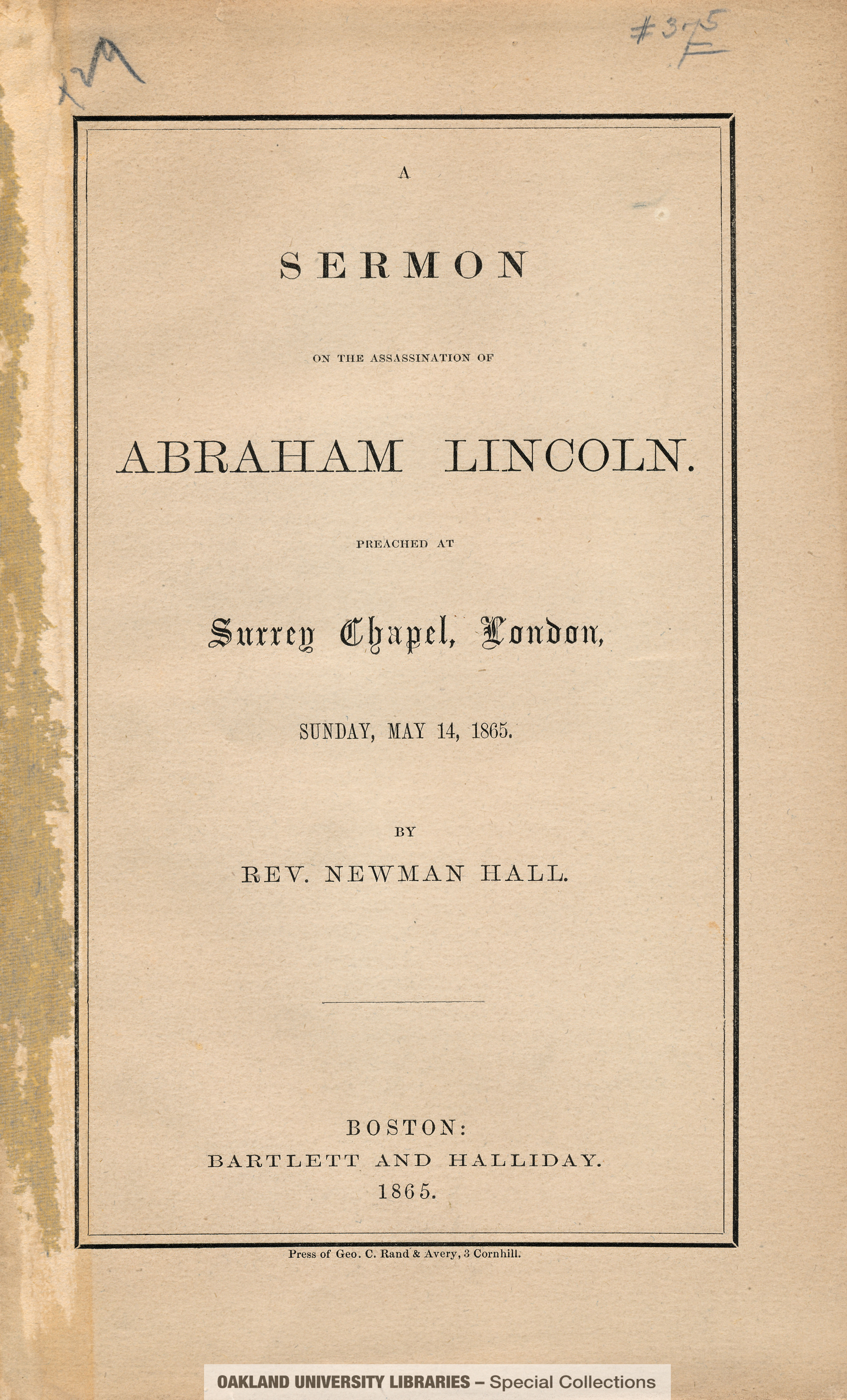
Sermon on the Assassination of Abraham Lincoln
-
Full Title
Sermon on the Assassination of Abraham Lincoln
-
Description
Sermon delivered by the pastor of the celebrated Surrey Chapel in London, a passionate opponent of slavery and supporter of Lincoln.
-
Source
Springer Collection, Oakland University Special Collections
-
Rights
This item may be reproduced and used for any purpose, including research, teaching, private study, publication, broadcast, or commercial use, with proper citation and attribution.
-
Tags
-
Cite this Item
Newman Hall. "Sermon on the Assassination of Abraham Lincoln". Bartlett and Halliday. Remembering Lincoln. Web. Accessed April 5, 2026. https://rememberinglincoln.fords.org/node/802

-
Creator
Newman Hall
-
Publisher
Bartlett and Halliday
-
Date
May 14, 1865
-
Material
paper
-
Dimensions
9 1/2h x 5 13/16"w
from May. 14, 1865
Sermon on the Assassination of Abraham Lincoln
-
Description
Sermon delivered by the pastor of the celebrated Surrey Chapel in London, a passionate opponent of slavery and supporter of Lincoln.
-
Source
Springer Collection, Oakland University Special Collections
-
Rights
This item may be reproduced and used for any purpose, including research, teaching, private study, publication, broadcast, or commercial use, with proper citation and attribution.
-
Creator
Newman Hall
-
Publisher
Bartlett and Halliday
-
Date
May 14, 1865
-
Material
paper
-
Dimensions
9 1/2h x 5 13/16"w
from May. 1, 1865
Funeral car item
-
Full Title
Piece of President Lincoln's Funeral Car
-
Description
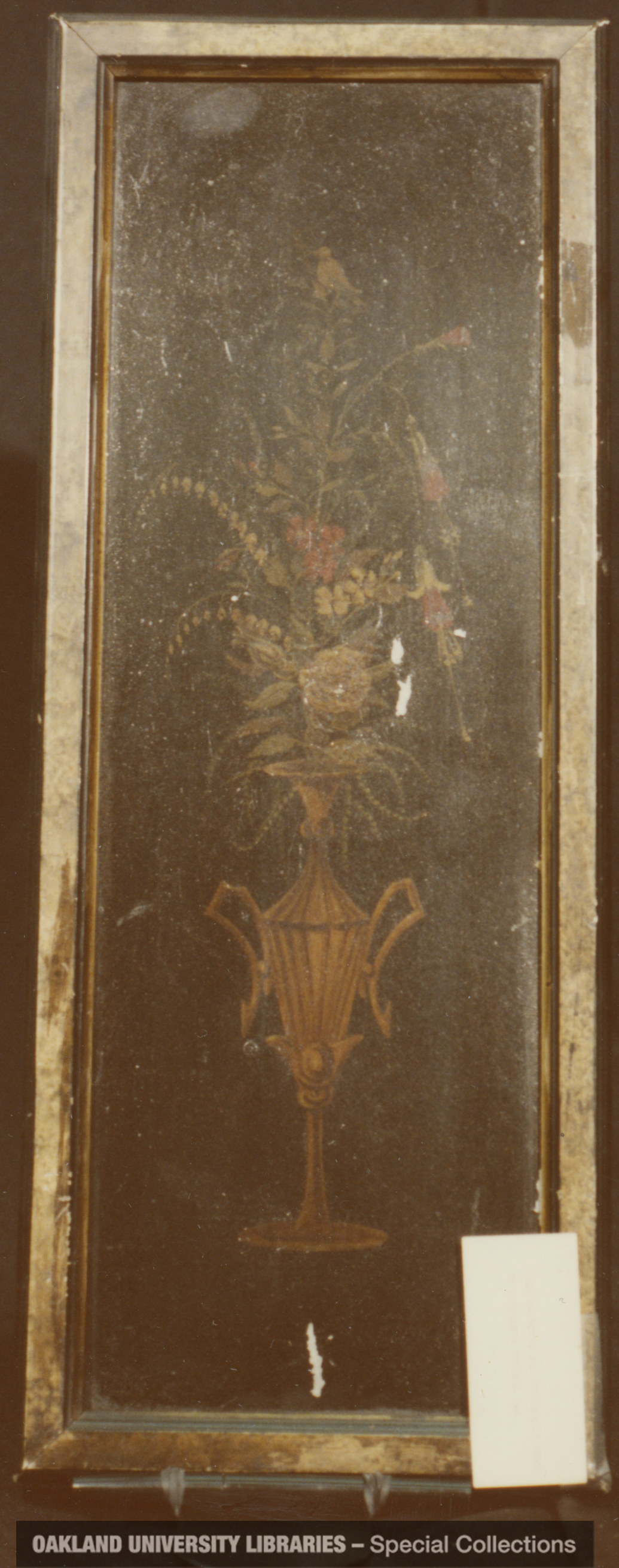
Painted metallic plate allegedly from the railroad car that carried President Lincoln's body back to Illinois. Floral composition in a classic urn against a black background. Label cites item piece of funeral car.
-
Source
Springer Collection, Oakland University Special Collections
-
Rights
This item may be reproduced and used for any purpose, including research, teaching, private study, publication, broadcast, or commercial use, with proper citation and attribution.
-
Tags
-
Cite this Item
anonymous. "Piece of President Lincoln's Funeral Car". Remembering Lincoln. Web. Accessed April 5, 2026. https://rememberinglincoln.fords.org/node/789
-
Creator
anonymous
-
Date
1865
-
Material
paint (coating), metal
-
Dimensions
21 1/2"h x 8 1/2"w
from May. 1, 1865
Piece of President Lincoln's Funeral Car
-
Description
Painted metallic plate allegedly from the railroad car that carried President Lincoln's body back to Illinois. Floral composition in a classic urn against a black background. Label cites item piece of funeral car.
-
Source
Springer Collection, Oakland University Special Collections
-
Rights
This item may be reproduced and used for any purpose, including research, teaching, private study, publication, broadcast, or commercial use, with proper citation and attribution.
-
Creator
anonymous
-
Date
May 1, 1865
-
Material
paint (coating), metal
-
Dimensions
21 1/2"h x 8 1/2"w
from Apr. 19, 1865
Faith in God
-
Full Title
Faith in God
-
Description
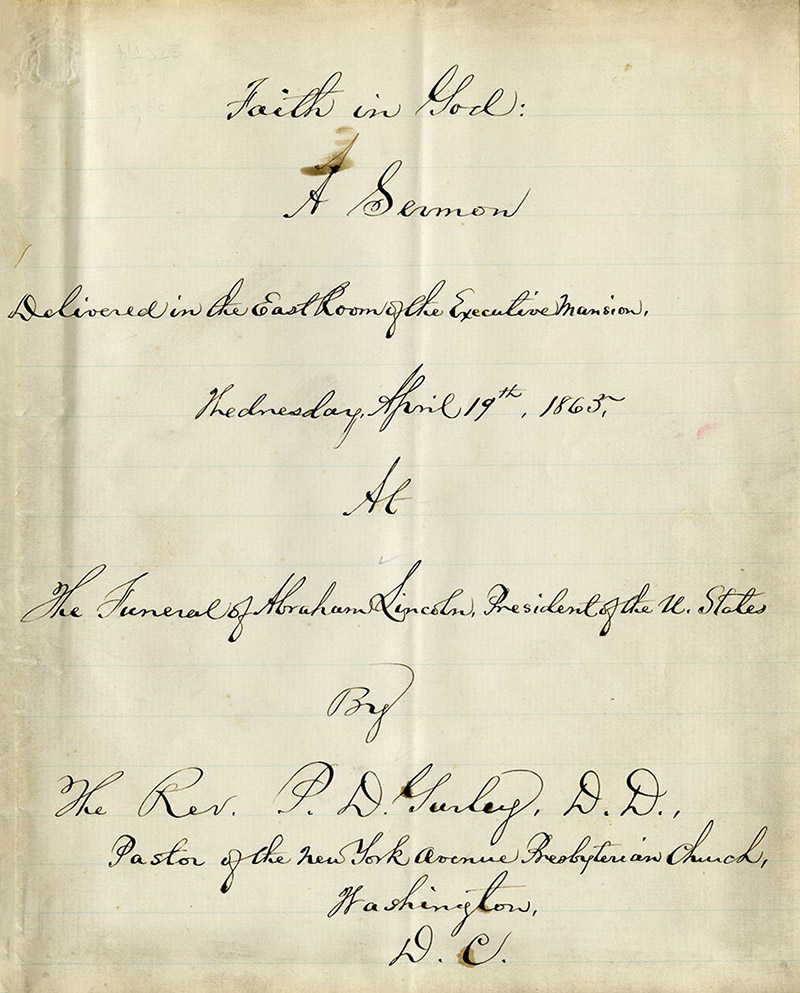
Manuscript sermon delivered in the East Room of the Executive Mansion, Wednesday, April 19, 1865, at the funeral of Abraham Lincoln, President of the U.S., by the Reverend Phineas Densmore Gurley, pastor of the New York Avenue Presbyterian Church, Washington, D.C.
-
Transcription
[Page 1]
Faith in God:
A Sermon
Delivered in the East Room of the Executive Mansion.
Wednesday, April 19th, 1863.
At
The Funeral of Abraham Lincoln, President of the U. States
By The Rev. P. D. Gurley. D. D..
Pastor of the New York Avenue Presbyterian Church, Washington,
D.C.
[Page 2] 1
Funeral Address.
Mark x1. 22.
“Have Faith in God.”
As we stand here to-day, mourners around this coffin and around the lifeless remains of our beloved Chief Magistrate, we recognize and we adore the sovereignty of God. His throne is in the heavens, and his kingdom ruleth over all. He hath done, and He hath permitted to be done, whatsoever He pleased. “Clouds and darkness are round about Him; righteousness and judgment are the habitations of his throne.” His way is in the sea, and his path in the great waters, and his footsteps are not known. “Canst thou by searching find out God? Canst thou find out the Almighty unto perfection? It is as high as heaven; what canst thou do? Deeper than hell; what canst thou know? The measure thereof if longer than the earth, and broader than the sea. If he cut off, and shut up, or gather together, then who can hinder Him? For He knoweth vain men; He seeth wickedness also; will
[Page 3]
2
He not then consider it? — We bow before before his infinite majesty. We bow, we weep, we worship.
“Where reasons fails, with all her powers,
There faith prevails, and love adores.”
It was a cruel, cruel hand, that dark hand of the assassin, which smote our honored, wise, and noble President, and filled the land with sorrow. But above and beyond that hand there is another which we must see and acknowledge. It is the chastening hand of a wise and faithful Father. He gives us this bitter cup. And the cup that our Father hath give us, shall we not drink it?
“God of the just, thou gavest us the cup:
We yield to thy behest, and drink it up.”
“Whom the Lord loveth he chasteneth.” O how these blessed words have cheered and strengthened and sustained us through all these long and weary years of civil strife, while our friends and brothers on so many ensanguined fields were falling and dying for the causes of Liberty
[Page 4]
3
and Union! Let them cheer, and strengthen, and sustain us to-day True, this new sorrow and chastening has come in such an hour and in such a way as we thought not, and it bears the impress of a rod that is very heavy, and of a mystery that is very deep. That such a life should be sacrificed, at such a time, by such a foul and diabolical agency; that the man at the head of the nation, whom the people had learned to trust with a confiding and a loving confidence, and upon whom more than upon any other were centred, under God, our best hopes for the true and speedy pacification of the country, the restoration of the Union, and the return of harmony and love; that he should be taken from us, and taken just as the prospect of peace was brightly opening upon our torn and bleeding country, and just as he was beginning to be animated and gladdened with the hope of ere long enjoying with the people the blessed fruit and reward of his and their toil, and care, and patience, and self-sacrificing devotion to the interests of Liberty and the Union—O it is a mysterious and
[Page 5]
4
a most afflicting visitation! But it is our Father in heaven, the God of our fathers, and our God, who permits us to be so suddenly and sorely smitten; and we know that his judgments are right, and that in faithfulness He has afflicted us. In the midst of our rejoicings we needed this stroke, this dealing, this discipline; and therefore He has sent it. Let us remember, our affliction has not come forth of the dust, and our trouble has not sprung out of the ground. Through and beyond all second causes let us look, and see the sovereign permissive agency of the great First Cause. It is his prerogative to bring light out of darkness and good out of evil. Surely the wrath of man shall praise Him, and the remainder of wrath He will restrain. In the light of a clearer day we may yet see that the wrath which planned and perpetrated the death of the President, was overruled by Him whose judgments are unsearchable, and his ways past finding out, for the highest welfare of all those interests which are so dear to the Christian patriot and philanthropist,
[Page 6]
5
and for which a loyal people have made such an unexampled sacrifice of treasure and of blood. Let us not be faithless, but believing.
“Blind unbelief is prone to err,
And scan his work in vain;
God is his own interpreter,
And He will make it plain.”
We will wait for his interpretation, and we will wait in faith, nothing doubting. He who has led us so well, and defended and prospered us so wonderfully, during the last four years of toil, and struggle, and sorrow, will not forsake us now. He may chasten, but He will not destroy. He may purify us more and more in the furnace of trial, but He will not consume us. No, no! He has chosen us as He did his people of old in the furnace of affliction, and He has said of us as He said of them, “This people have I formed for myself; they shall show forth my praise.” Let our principal anxiety now be that this new sorrow may be a sanctified sorrow; that it
[Page 7]
6
may lead us to deeper repentance, to a more humbling sense of our dependence upon God, and to the more unreserved consecration of ourselves and all that we have to the cause of truth and justice, of law and order, of liberty and good government, of pure and undefiled religion. Then, though weeping may endure for a night, joy will come in the morning. Blessed be God! despite of this great and sudden and temporary darkness, the morning has begun to dawn—the morning of a bright and glorious day, such as our country has never seen. That day will come and not tarry, and the death of an hundred Presidents and their Cabinets can never, never prevent it. While we are thus hopeful, however, let us also be humble. The occasion calls us to prayerful and tearful humiliation. It demands of us that we lie low, very low, before Him who has smitten us for our sins. O that all our rulers and all our people may bow in the dust to-day beneath the chastening hand of God! And may their voices go up to Him as one voice, and their hearts
[Page 8]
7
go up to Him as one heart, pleading with Him for mercy, for grace to sanctify our great and sore bereavement, and for wisdom to guide us in this our time of need. Such a united cry and pleading will not be in vain. It will enter into the ear and heart of Him who sits upon the throne, and He will say to us, as to His ancient Israel, “In a little wrath I hid my face from thee for a moment: but with everlasting kindness will I have mercy upon thee, saith the Lord, the Redeemer.”—
I have said that the people confided in the late lamented President with a full and a loving confidence. Probably no man since the days of Washington was ever so deeply and firmly embedded and enshrined in the very hearts of the people as Abraham Lincoln. Nor was it a mistaken confidence and love. He deserves is—deserved it well—deserved it all. He merited it by his character, by his acts, and by the whole tenor, and tone, and spirit of his life. He was simple and sincere, plain and honest, truthful and just, benevolent and kind. His perceptions were quick and clear, his
[Page 9]
8
Judgments were calm and accurate, and his purposes were good and pure beyond a question. Always and every where he aimed and endeavored to be right and to do right. His integrity was thorough, all-pervading, all-controlling, and incorruptible. It was the same in every place and relation, in the consideration and the control of matters great or small, the same firm and steady principle of power and beauty that shed a clear and crowning lustre upon all his other excellencies of mind and heart, and recommended him to his fellow citizens as the man, who, in a time of unexampled peril, when the very life of the nation was at stake, should be chosen to occupy, in the country and for the country, its highest post of power and responsibility. How wisely and well, how purely and faithfully, how firmly and steadily, how justly and successfully he did occupy that post and meet its grave demands in circumstances of surpassing trial and difficulty, is known to you all, known to the country and the world. He comprehended from the
[Page 10]
9
first the perils to which treason had exposed the freest and best Government in the world on the earth, the vast interests of liberty and humanity that were to be saved or lost forever in the urgent impending conflict; he rose to the dignity and momentousness of the occasion, saw his duty as the Chief Magistrate of a great and imperiled imperiled imperilled people and he determined to do his duty, and his whole duty, seeking the guidance and leaning upon the arm of Him of whom it is written, “Hee giveth power to the faint, and to them that have no might he increaseth strength.” Yes, he leaned upon His arm. He recognized and received the truth that the “kingdom is the Lord’s, and He is the governor among the nations.” He remembered that “God is in the history,” and he felt that nowhere had his hand and his mercy been so marvellously conspicuous as in the history of this nation. He hoped and he prayed that that same hand would continue to guide us, and that same mercy continue to abound to us in the time of our greatest need. I speak what I know, and testify what I have
[Page 11]
10
often heard him say, when I affirm that that guidance and mercy were the prop on which he humbly and habitually leaned; they were the best hope he had for himself and for his country. Hence, when he was leaving his home in Illinois, and coming to this city to take his seat in the executive chair of a distrubed and troubled nation, he said to the oldand tried friends who gathered tearfully around him and bade him farewell, “I leave you with this request: pray for me.” They did pray for him; and millions of others prayed for him; not did they pray in vain. Their prayer was heard, and the answer appears in all his subsequent history; it shines forth with a heavenly radiance in the whole course and tenor of his administration, from its commencement to its close. God raised him up for a great and glorious mission, furnished him for his work, and aided him in its accomplishment. Nor was it merely by strength of mind, and honesty of heart, and purity and pertinacity of purpose, that He furnished him; in addition to these
[Page 12]
11
things, He gave him a calm and abiding confidence in the overruling providence of God and in the ultimate triumph of truth and righteousness through the power and the blessing of God. This confidence strengthened him in all his hours of anxiety and toil, and inspired him with calm and cheering hope when others were inclining to despondency and gloom. Never shall I forget the emphasis and the deep emotion with which he said in this very room, to a company of clergymen and others, who called to pay him their respects in the darkest days of our civil conflict: “Gentlemen, my hope of success in this great and terrible struggle rests on that immutable foundation, the justice and goodness of God. And when events are very threatening, and prospects very dark, I still hope that in some way which man can not see all will be well in the end, because our course is just, and God is on our side.” Such was his sublime and holy faith, and it was an anchor to his soul, both sure and steadfast. It made him firm and strong. It em-
[Page 13]
12
boldened him in the pathway of duty, however rugged and perilous it might be. It made him valiant for the right; for the cause of God and humanity, and it held him in steady, patient, and unswerving adherence to a policy of administration which he thought, and which one all now think, both God and humanity required him to adopt. We admired and loved him on many accounts—for strong and various reasons: we admired his childlike simplicity, his freedom from guile and deceit, his staunch and sterling integrity, his kind and forgiving temper, his industry and patience, his persistent, self-sacrificing devotion to all the duties of his eminent position, from the least to the greatest, his readiness to hear and consider the cause of the poor and humble, the suffering and the oppressed; his charity toward those who questioned the correctness of his opinions and the wisdom of his policy his wonderful skill in reconciling differences among the friends of the Union, leading them away from abstractions, and inducing them to work together and harmoniously for the common
[Page 14]
13
weal; his true and enlarged philanthropy, that knew no distinction of color or race, but regarded all men as brethren, and endowed alike by their Creator “with certain inalienable rights, among which are life, liberty, and the pursuit of happiness”; his inflexible purpose that what freedom had gained in our terrible civil strife should never be lost, and that the end of the war should be the end of slavery, and, as a consequence of rebellion; his readiness to spend and be spent for the attainment of such a triumph—a triumph, the blessed fruits of which shall be as widespreading as the earth and as enduring as the sun:—All these things commanded and fixed our admiration, and the admiration of the world, and stamped upon his character and life the unmistakable impress of greatness. But more sublime than any or all of these, more holy and influential, more beautiful, and strong, and sustaining, was his abiding confidence in God and in the final triumph of truth and righteousness through Him and for his sake. This was his noblest virtue,
[Page 15]
14
his grandest principle, the secret alike of his strength, his patience, and his success. And this, it seems to me, after being near him steadily, and with him often, for more than four years, is the principle by which, more than by any other, “he, being dead, yet speaketh.” Yes; by his steady enduring confidence in God, and in the complete ultimate success of the cause of God, which is the cause of humanity, more than by any other way, does he now speak to us and to the nation he loved and served so well. By this he speaks to his successor in office, and charges him to “Love faith in God.” By this he speaks to the members of his cabinet, the men with whom he counseled so often and was associated so long, and he charges them to “have faith in God.” BY this he speaks to the officers and men of our noble army and navy, and, as they stand at their posts of duty and peril, he charges them to “have faith in God.” By this he speaks to all who occupy positions of influence and authority in these sad and troublous times, and he charges them all to “have faith in God.” By
[Page 16]
15
this he speaks to this great people as they sit in sackcloth to-day, and weep for him with a bitter wailing, and refuse to be comforted, and he charges them to “have faith in God.” And by this he will speak through the ages and to all rulers and peoples of in every land, and his message to them will be, “Cling to liberty and right; battle for them; bleed for them; die for them, if need be; and have confidence in God.” O that the voice of this testimony may sink down into our hearts to-day and every day, and into the heart of the nation, and exert its appropriate influence upon our feelings, our faith, our patience, and our devotion to the cause of freedom and humanity—a cause clearer to us now than ever before, because consecrated by the blood of its most conspicuous defender, its wisest and most fondly-trusted lives, and He can guide and strengthen his successor, as He guided and strengthened him. He is dead; but the memory of his virtue, of his wise and patriotic counsels and labors, of his calm and steady faith in
[Page 17]
16
God, lives, is precious, and will be a power for good in the country quite down to the end of time. He is dead; but the cause he so ardently loved, so ably, patiently, faithfully represented and defended—not for himself only, not for us only, but for all people in all their coming generations, till time shall be no more—that cause survives his fall, and will survive it. The light of its brightening prospects flashes cheeringly to-day athwart the gloom occasioned by his death, and the language of God’s united providences is telling us that, though the friends of liberty die, liberty itself is immortal. There is no assassin strong enough and no weapon deadly enough to quench its inextinguishable life, or arrest its onward march to the conquest and empire of the world. This is our confidence, and this is our consolation, as we weep and mourn to-day. Though our beloved President is dead slain, our beloved country is saved. And so we sing of mercy as well as of judgment. Tears of gratitude mingle with those of sorrow. While there is darkness, there is also the dawning of a brighter, happier day
[Page 18]
17
Upon our stricken and weary land. God be praised that our fallen Chief lived long enough to see the day dawn and the daystar of joy and peace arise upon the nation. He saw it, and he was glad. Alas! Alas! He only saw the dawn. When the sun has risen, full—orbed and glorious, and a happy reunited people are rejoicing in its light,—alas! Alas! It will shine upon his grave. But that grave will be a precious and a consecrated spot. The friends of liberty and of the Union will repair to it in years and ages to come, to pronounce the memory of its occupant blessed, and, gathering from his very ashes, and from the rehearsal of his deeds and virtues, fresh incentives to patriotism, they will there renew their vows of fidelity to their country and their God.
And now I know not that I can more appropriately conclude this discourse, which is but a sincere and simple utterance of the heart, than by addressing to our departed President, with some slight modification, the language which Tacitus in his life of Agricola, addressed to his venerable and de
[Page 19]
18
parted father-in-law: “With you we may not congratulate; you are blessed, not only because your life was a career of glory, but because you were released, when, your country safe, it was happiness to die. We have lost a parent, and, in our distress, it is now an addition to our heartfelt sorrow that we had it not in our power to commune with you on the bed of languishing, and receive your last embrace. Your dying words would have been ever dear to us; your commands we should have treasured up; and graved them on our hearts. This sad comfort we have lost, and the wound for that reason, pierces deeper. From the world of spirits behold your disconsolate family and people; exalt our minds from fond regret and avoiding grief to the contemplation of your virtues. Those we must not lament; it were impiety to sully them with a tear. To cherish their memory, to embalm them with our praises, and, so far as we can, to emulate your bright example, will be the truest mark of our respect, the best tribute we can offer. Your wife will thus preserve the memory of the best of husbands, and thus your children
[Page 20]
19
will prove their filial piety. By dwelling constantly on your words and actions, they will have an illustrious character before their eyes, and, not content with the bare image or your mortal frame, they will have what is more valuable—the form and features of your mind. Busts and statues, like their original, are frail and perishable. The soul is formed of fine elements, and its inward form is not to be expressed by the hand of an artist with unconscious matter—our manners and our morals may in some degree trace the resemblance. All of you that gained out love and raised our admiration still subsists, and will ever subsist, preserved in the minds of men, the register of ages, and the records of fame. Others, who have figured on the stage of life and were the worthies of a former day, will wink, for want of a faithful historian, into the common lot of oblivion, inglorious and unremembered; but you, our lamented friend and head, delineated with truth, and fairly consigned to prosperity, will survive yourself, and triumph over the injuries of time.”—
[Transcription by McCaela Michas]
-
Source
RAREDOC G963f, Presbyterian Historical Society, Philadelphia, PA
-
Rights
Use of this item for research, teaching, and private study is permitted with proper citation and attribution. Reproduction of the images of this item for publication, broadcast, or commercial use requires written permission from the Presbyterian Historical Society. For permission, contact the Reference Desk.
-
Tags
-
Cite this Item
Gurley, P.D. (Phineas Densmore), 1816-1868.. "Faith in God". Remembering Lincoln. Web. Accessed April 5, 2026. https://rememberinglincoln.fords.org/node/763

-
Creator
Gurley, P.D. (Phineas Densmore), 1816-1868.
-
Date
April 19, 1865
-
Material
paper and ink
-
Dimensions
9.75" x 7.75"
from Apr. 19, 1865
Faith in God
-
Description
Manuscript sermon delivered in the East Room of the Executive Mansion, Wednesday, April 19, 1865, at the funeral of Abraham Lincoln, President of the U.S., by the Reverend Phineas Densmore Gurley, pastor of the New York Avenue Presbyterian Church, Washington, D.C.
-
Source
RAREDOC G963f, Presbyterian Historical Society, Philadelphia, PA
-
Rights
Use of this item for research, teaching, and private study is permitted with proper citation and attribution. Reproduction of the images of this item for publication, broadcast, or commercial use requires written permission from the Presbyterian Historical Society. For permission, contact the Reference Desk.
-
Creator
Gurley, P.D. (Phineas Densmore), 1816-1868.
-
Date
April 19, 1865
-
Material
paper and ink
-
Dimensions
9.75" x 7.75"
from Apr. 22, 1865
Resolutions Passed on the Death of President Lincoln
-
Full Title
Resolutions Passed on the Death of President Lincoln
-
Description
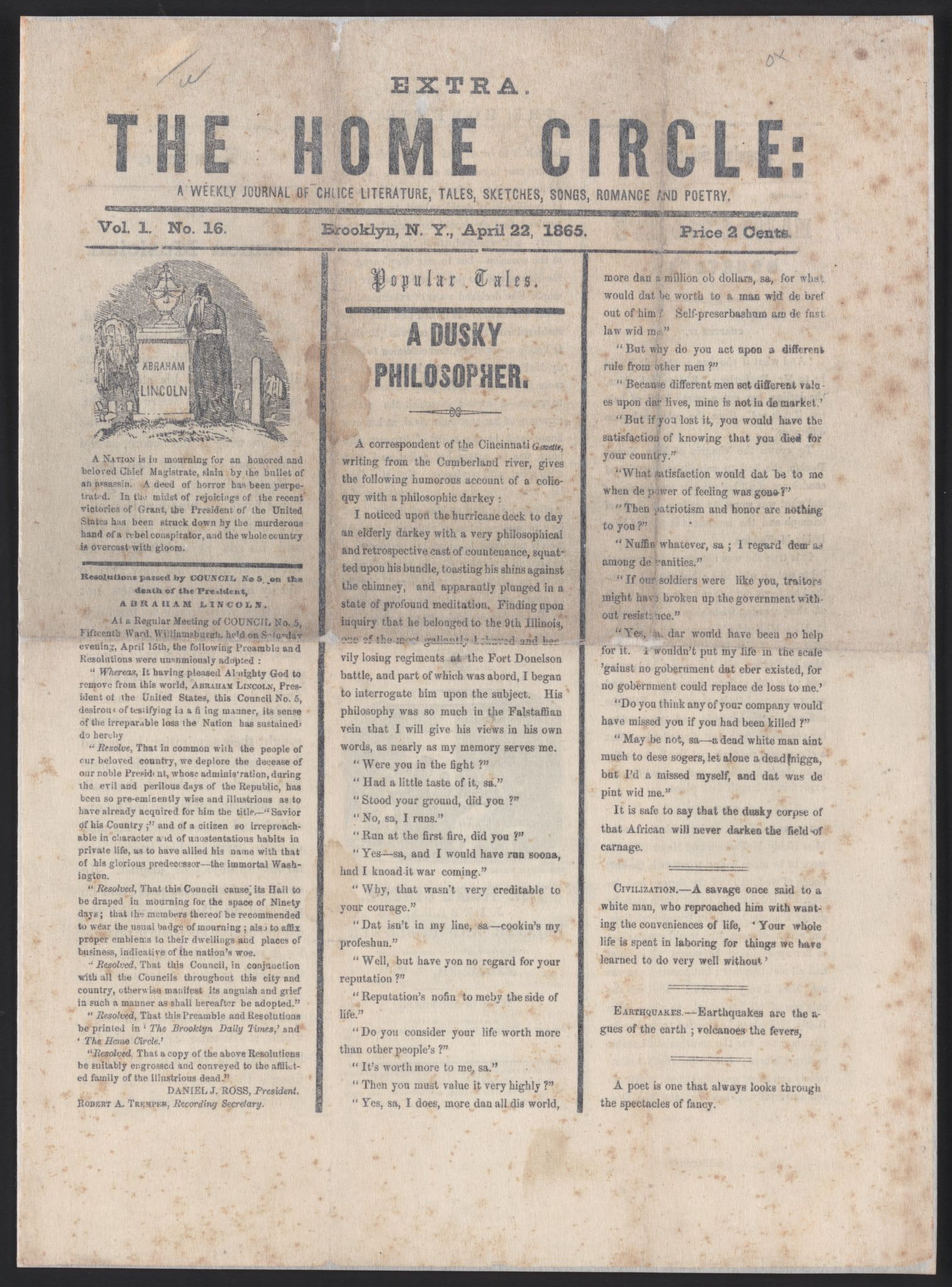
April 22, 1865 edition of Brooklyn's The Home Circle which prints the resolutions passed by the local council regarding Abraham Lincoln's death.
-
Source
Library of Congress, Alfred Whital Stern Collection of Lincolniana, portfolio 6, no. 5
-
Rights
This item is in the public domain and may be reproduced and used for any purpose, including research, teaching, private study, publication, broadcast or commercial use, with proper citation and attribution
-
Tags
-
Cite this Item
The Home Circle. "Resolutions Passed on the Death of President Lincoln". Remembering Lincoln. Web. Accessed April 5, 2026. https://rememberinglincoln.fords.org/node/761
-
Creator
The Home Circle
-
Date
April 22, 1865
from Apr. 22, 1865
Resolutions Passed on the Death of President Lincoln
-
Description
April 22, 1865 edition of Brooklyn's The Home Circle which prints the resolutions passed by the local council regarding Abraham Lincoln's death.
-
Source
Library of Congress, Alfred Whital Stern Collection of Lincolniana, portfolio 6, no. 5
-
Rights
This item is in the public domain and may be reproduced and used for any purpose, including research, teaching, private study, publication, broadcast or commercial use, with proper citation and attribution
-
Creator
The Home Circle
-
Date
April 22, 1865
from
The Nation Mourns a Father Slain
-
Full Title
The Nation Mourns a Father Slain
-
Description
Printed in Philadelphia, this broadside declares, "The nation mourns a father slain! We loved him living. We revere him dead."
-
Source
Library of Congress, Alfred Whital Stern Collection of Lincolniana, portfolio 13, no. 15
-
Rights
This item is in the public domain and may be reproduced and used for any purpose, including research, teaching, private study, publication, broadcast or commercial use, with proper citation and attribution
-
Tags
-
Cite this Item
Loag, Printer., Philadelphia, Pennsylvania. "The Nation Mourns a Father Slain". Remembering Lincoln. Web. Accessed April 5, 2026. https://rememberinglincoln.fords.org/node/760
-
Creator
Loag, Printer., Philadelphia, Pennsylvania
from
The Nation Mourns a Father Slain

-
Description
Printed in Philadelphia, this broadside declares, "The nation mourns a father slain! We loved him living. We revere him dead."
-
Source
Library of Congress, Alfred Whital Stern Collection of Lincolniana, portfolio 13, no. 15
-
Rights
This item is in the public domain and may be reproduced and used for any purpose, including research, teaching, private study, publication, broadcast or commercial use, with proper citation and attribution
-
Creator
Loag, Printer., Philadelphia, Pennsylvania
from Apr. 20, 1865
"The Great Tragedy"
-
Full Title
"The Great Tragedy"
-
Description
The Richmond Whig recounts the assassination and describes the feeling of mourning that pervaded the capital and the nation. It includes an excerpt from a witness at Ford's Theatre.
-
Source
Library of Congress, Alfred Whital Stern Collection of Lincolniana, portfolio 5
-
Rights
This item is in the public domain and may be reproduced and used for any purpose, including research, teaching , private study, publication, broadcast or commercial use, with proper citation and attribution
-
Tags
-
Cite this Item
The Richmond Whig. ""The Great Tragedy"". Remembering Lincoln. Web. Accessed April 5, 2026. https://rememberinglincoln.fords.org/node/757
-
Creator
The Richmond Whig
-
Date
April 20, 1865
from Apr. 20, 1865
"The Great Tragedy"

-
Description
The Richmond Whig recounts the assassination and describes the feeling of mourning that pervaded the capital and the nation. It includes an excerpt from a witness at Ford's Theatre.
-
Source
Library of Congress, Alfred Whital Stern Collection of Lincolniana, portfolio 5
-
Rights
This item is in the public domain and may be reproduced and used for any purpose, including research, teaching , private study, publication, broadcast or commercial use, with proper citation and attribution
-
Creator
The Richmond Whig
-
Date
April 20, 1865
from Apr. 27, 1865
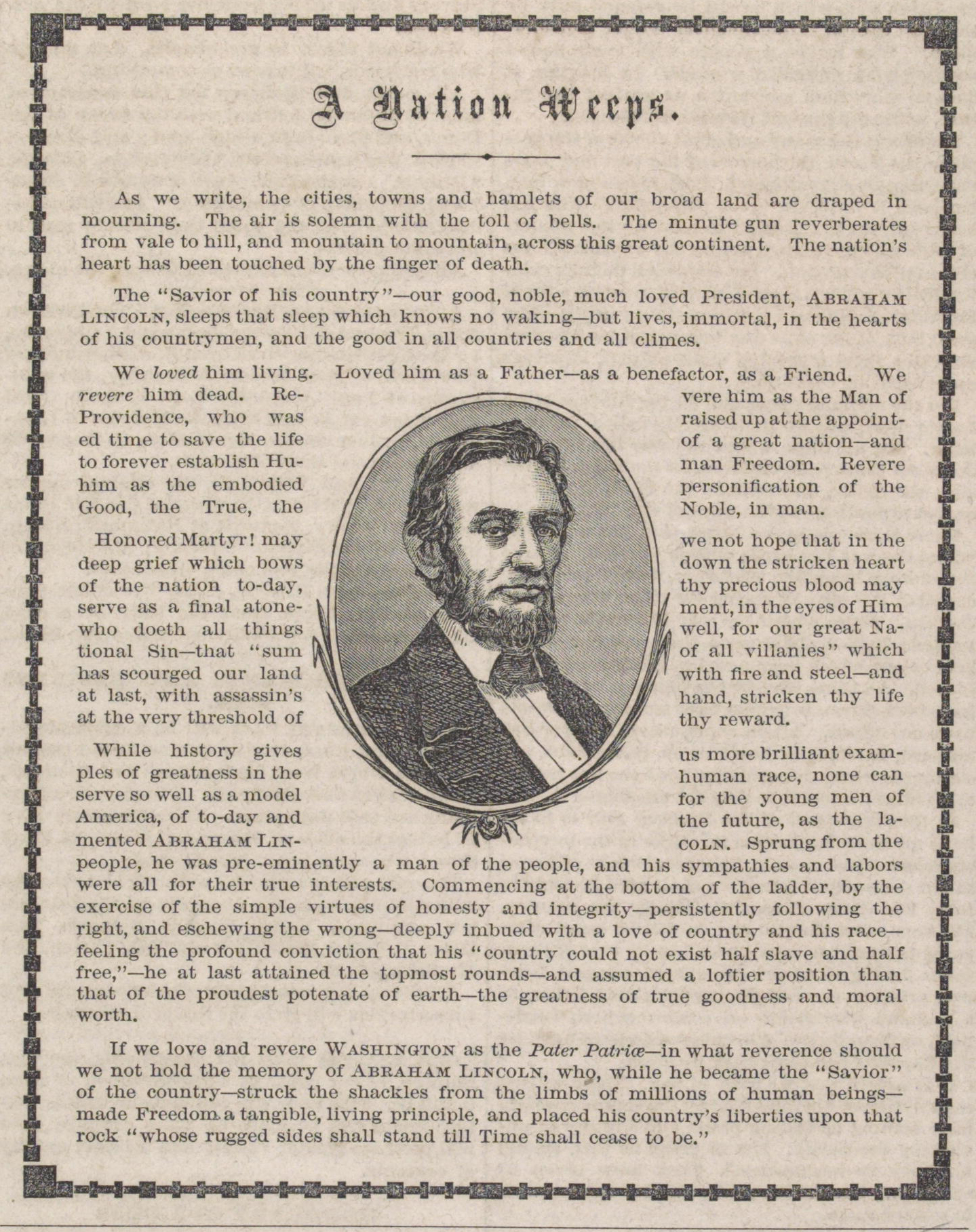
"A Nation Weeps"
-
Full Title
"A Nation Weeps"
-
Description
Chicago's Voice of the Fair prints this eulogy to Abraham Lincoln, saying "We loved him living. [...] We revere him dead."
-
Source
Library of Congress, Alfred Whital Stern Collection of Lincolniana, portfolio 7
-
Rights
This item is in the public domain and may be reproduced and used for any purpose, including research, teaching , private study, publication, broadcast or commercial use, with proper citation and attribution.
-
Tags
-
Cite this Item
Voice of the Fair. ""A Nation Weeps"". Remembering Lincoln. Web. Accessed April 5, 2026. https://rememberinglincoln.fords.org/node/756
-
Creator
Voice of the Fair
-
Date
April 27, 1865
from Apr. 27, 1865
"A Nation Weeps"
-
Description
Chicago's Voice of the Fair prints this eulogy to Abraham Lincoln, saying "We loved him living. [...] We revere him dead."
-
Source
Library of Congress, Alfred Whital Stern Collection of Lincolniana, portfolio 7
-
Rights
This item is in the public domain and may be reproduced and used for any purpose, including research, teaching , private study, publication, broadcast or commercial use, with proper citation and attribution.
-
Creator
Voice of the Fair
-
Date
April 27, 1865
from
"We Mourn a Father Slain Route"
-
Full Title
"We Mourn a Father Slain Route"
-
Description
This broadside details the route the funeral procession will take in Philadelphia.
-
Transcription
WE MOURN A FATHER SLAIN.
_________________________
ROUTE.
_________________________
The Procession will form on Broad Street, the left resting on Fitzwater Street, facing west, and move by the following route:—Up Broad to Walnut, up Walnut to Nineteenth, up Nineteenth to Arch, down Arch to Fifth, down Fifth to Walnut, and thence to the gate in Independence Square.
____________________________
A. W. AUNER’S PRINTING OFFICE,
N. E. COR. ELEVENTH & MARKET STS., Philada.
[Transcription by: Ricarda H., Dr. Susan Corbesero’s Class, Ellis School, Pittsburgh, Pennsylvania] -
Source
Library of Congress, Alfred Whital Stern Collection of Lincolniana, portfolio 16, no. 53
-
Rights
This item is in the public domain and may be reproduced and used for any purpose, including research, teaching , private study, publication, broadcast or commercial use, with proper citation and attribution
-
Tags
-
Cite this Item
A. W. Auner's Printing Office, Philadelphia, PA. ""We Mourn a Father Slain Route"". Remembering Lincoln. Web. Accessed April 5, 2026. https://rememberinglincoln.fords.org/node/755
-
Creator
A. W. Auner's Printing Office, Philadelphia, PA
from
"We Mourn a Father Slain Route"

-
Description
This broadside details the route the funeral procession will take in Philadelphia.
-
Source
Library of Congress, Alfred Whital Stern Collection of Lincolniana, portfolio 16, no. 53
-
Rights
This item is in the public domain and may be reproduced and used for any purpose, including research, teaching , private study, publication, broadcast or commercial use, with proper citation and attribution
-
Creator
A. W. Auner's Printing Office, Philadelphia, PA
from Apr. 15, 1865
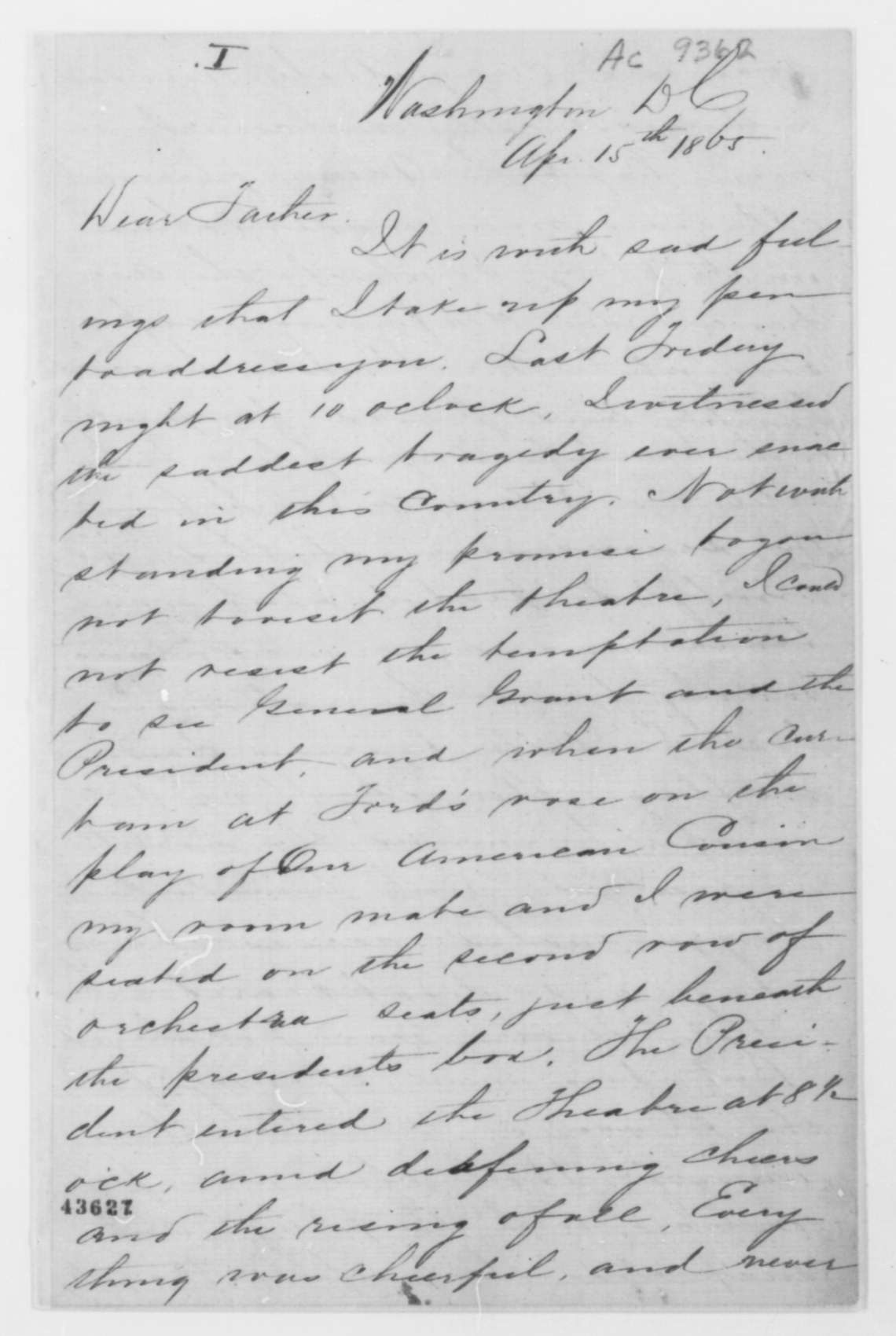
James S. Knox to his Father
-
Full Title
James S. Knox to his Father
-
Description
James S. Knox, a witness to the assassination, writes a detailed letter to his father describing the event, as well as the attacks at the Seward home, and the national feeling, saying that "the nation is aroused and terrible will be its vengeance."
-
Transcription
Ac 9360
Washington, DC
April 15, 1865
Dear Father,
It is with sad feeling that I take up my pen to address you. Last Friday night at 10 oclock, I witnessed the saddest tragedy ever was had in this country. Notwithstanding my promise to you not to visit the theatre, I cannot resist the temptation to see General Grant and the President, and when the curtain at Ford’s rose on the play of Our American Cousin my room mate and I were seated on the second row of the orchestra seats, just beneath the President’s box. The President entered the theatre at 8 ½ o’ck, amid deafening cheers and the rising of all. Everything was cheerful, and never was our magistrate more enthusiastically welcomed. Or more happy. Many pleasant allusions were made to him in the play, to which the audience gave deafening responses, while Mr. Lincoln laughed heartily and beamed frequently to the gratified people. Just after the 3rd Act, and before the scenes were shifted, a muffled pistol shot was heard, and a man sprang wildly from the national box, partially tearing down the flag, then shouting “ ‘sic semper tyrannis’, the south is avenged “ with brandished dagger, rushed across the stage and disappeared. The whole theatre was paralyzed. But two men sprang for the stage, a Mr. Stewart and myself. Both of us were familiar with the play, and suspected the fearful tragedy. We rushed after the murderer, and Mr. Stewart being familiar with the passages, reached the rear door in time to see him spring on his horse and ride off – I became lost amid the scenery and was obliged to return. My roommate had followed me and secured the murderer’s hat. The shrill cry of murder from Mrs. Lincoln first roused the horrified audience, and in an instant the uproar was terrible. The silence of death was broken by shouts of “kill him”, “hang him” and strong men wept and cursed, and tore the seats in the impotence of their anger, while Mrs. Lincoln, on her knees uttered shriek after shriek at the feet of the dying President. Finally the theatre was cleared and the President removed. Still greater was the excitement in the city. Rumors of the murder of Sec’y Seward and his son reached us as we gained the street – Mounted patrols dashed everywhere, bells tolled the alarm, and excited crowds rushed about the avenues, Despair was on every countenance, and black horror brooded over the city. Until long after midnight I was detained at Police Hd.Qrs., giving my evidence, and when I sought my room, in a distant part of the city – dark clouds had gathered in the heavens, and soldiers sternly paced their patrol. May I never see another such night. I could not sleep. I could only think, (but?) thought was weary, and in despair thought again.
Yesterday morning the President died. At 8 ½ ock, the kindest, noblest, truest heart ceased to beat, and Abraham Lincoln was dead. Let no man ever speak to me again about Southern Chivalry, or talk in sympathy with traitors. The events of last night can never be forgotten and while there is strength in my arm, I never can, never will, endure it – nor am I alone – the nation is aroused and terrible will be its new glower, Treason, pardoned, forgiven, patiently dealt with by our president, viper like, has stung the breast, that kindly treated it, and the traitor South has slain its bravest, noblest friend. Bitter, bitter will be the tears of repentance. But I cannot write of it – Andrew Johnson has been sworn, His speech was simple, “The duties now are mine, the results are God’s”. I trust he may perform his task faithfully, but, oh, for the Confidence, and the hope that we had in Lincoln, like a ship without a rudder is the nation tossed. Outwardly are we quiet, but in each heart, what horror, misgivings and despair-
But I must cease – (Lolita?) & Will R – left here Friday night. I presume by this time they are with you. By them you can learn of me better than I can write. Love to all.
Your affect son
James Knox
[Transcription by Dale Anderson.] -
Source
-
Rights
This item is in the public domain and may be reproduced and used for any purpose, including research, teaching , private study, publication, broadcast or commercial use, with proper citation and attribution
-
Tags
-
Cite this Item
James S. Knox. "James S. Knox to his Father". Remembering Lincoln. Web. Accessed April 5, 2026. https://rememberinglincoln.fords.org/node/753
-
Creator
James S. Knox
-
Date
April 15, 1865
from Apr. 15, 1865
James S. Knox to his Father
-
Description
James S. Knox, a witness to the assassination, writes a detailed letter to his father describing the event, as well as the attacks at the Seward home, and the national feeling, saying that "the nation is aroused and terrible will be its vengeance."
-
Source
-
Rights
This item is in the public domain and may be reproduced and used for any purpose, including research, teaching , private study, publication, broadcast or commercial use, with proper citation and attribution
-
Creator
James S. Knox
-
Date
April 15, 1865
from Apr. 16, 1865
"Arrest of Booth!"
-
Full Title
"Arrest of Booth!"
-
Description
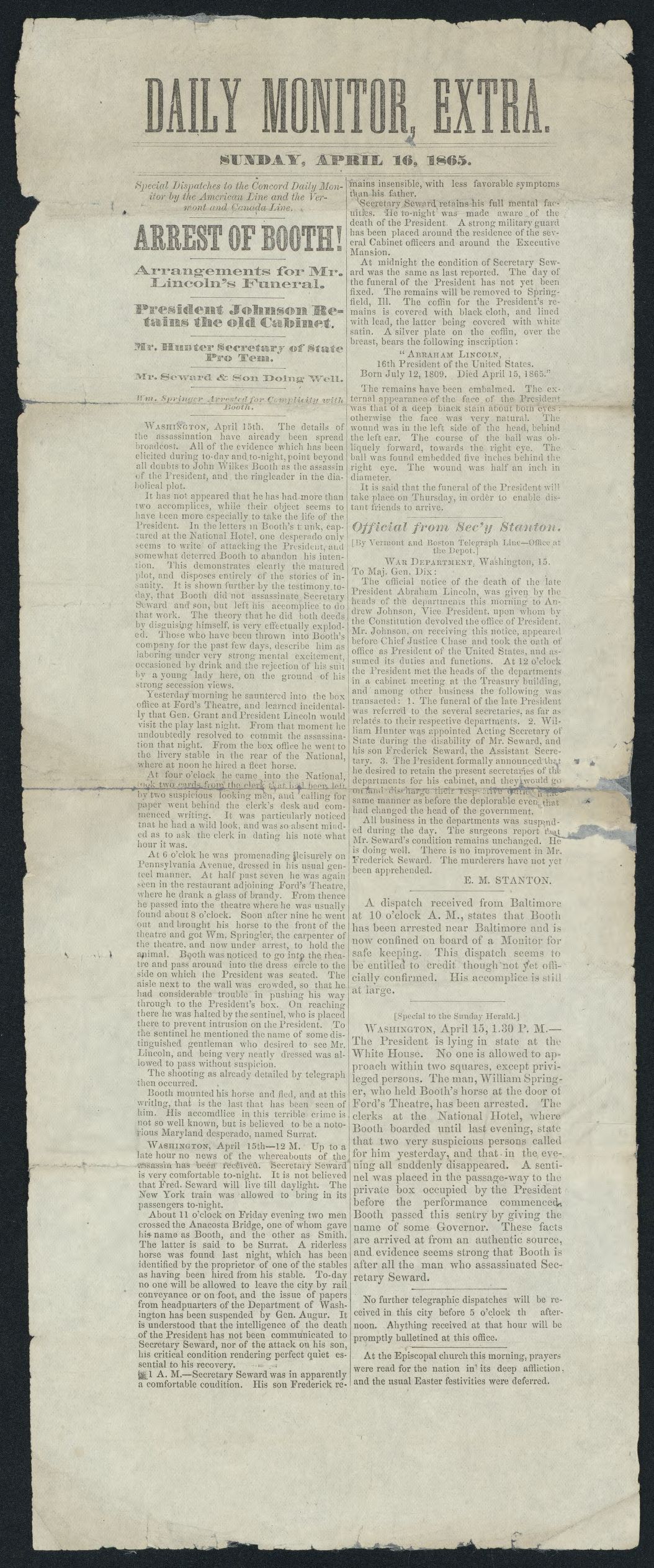
An April 16, 1865 edition of the Daily Monitor Extra from Concord, Vermont that falsely reports the arrest of John Wilkes Booth.
-
Transcription
DAILY MONITOR EXTRA
SUNDAY, APRIL 16, 1865
Special Dispatches to the Concord Daily Monitor by the American Line and the Vermont and Canada Line.
ARREST OF BOOTH!
Arrangements for Mr. Lincoln’s Funeral.
President Johnson Retains the old Cabinet.
Mr. Hunter Secretary of State Pro Tem.
Mr. Seward & Son Doing Well.
Wm. Springer Arrested for Complicity with Booth.
Washington, April 15th. The details of the assassination have already been spread broadcost. All of the evidence which has been elicited during to-day and to-night, point beyond all doubts to John Wilkes Booth as the assassin of the President, and the ringleader in the diabolical plot.
It has not appeared that he has had more than two accomplices, while their object seems to have been more especially to take the life of the President. In the letters in Booth’s trunk, captured at the National Hotel, one desperado only seems to write of attacking the President, and somewhat deterred Booth to abandon his intention. This demonstrates clearly the matured plot, and disposes entirely of the stories of insanity. It is shown further by the testimony today, that Booth did not assassinate Secretary Seward and son, but left his accomplice to do that work. The theory that he did both deeds by disguising himself, is very effectually exploded. Those who have been thrown into Booth’s company for the past few days describe him as laboring under very strong mental excitement, occasioned by drink and the rejection of his suit by a young lady here, on the ground of his strong secession views.
Yesterday morning he sauntered into the box office at Ford’s Theatre, and learned incidentally that Gen. Grant and President Lincoln would visit the play last night. From that moment he undoubtedly resolved to commit the assassination that night. From the box office he went to the livery stable in the rear of the National, where at noon he hired a fleet horse.
At four o’clock he came into the National, took two cards from the clerk that had been left by two suspicious looking men, and calling for paper went behind the clerk’s desk and commenced writing. It was particularly noticed that he had a wild look, and was so absent minded as to ask the clerk in dating his note what hour it was.
At 6 o’clok [clock] he was promenading leisurely on Pennsylvania Avenue, dressed in his usual genteel manner. At half past seven he was again seen in the restaurant adjoining Ford’s Theatre, where he drank a glass of brandy. From thence he passed into the theatre where he was usually found about 8 o’clock. Soon after nine he went out and brought his horse to the front of the theatre and got Wm. Springler, the carpenter of the theatre, and now under arrest, to hold the animal. Booth was noticed to go into the theatre and pass around into the dress circle to the side on which the President was seated. The aisle next to the wall was crowded, so that he had considerable trouble in pushing his way through to the President’s box. On reaching there he was halted by the sentinel, who is placed there to prevent intrusion on the President. To the sentinel he mentioned the name of some distinguished gentleman who desired to see Mr. Lincoln, and being very neatly dressed was allowed to pass without suspicion.
The shooting as already detailed by telegraph then occurred.
Booth mounted his horse and fled, and at this writing, that is the last that has been seen of him. His accomdlice [accomplice] in this terrible crime is not so well known, but is believed to be a notorious Maryland desperado, named Surrat [Surratt].
WASHINGTON, April 15th—12 M. Up to a late hour no news of the whereabouts of the assassin has been received. Secretary Seward is very comfortable to-night. It is not believed that Fred. Seward will live till daylight. The New York train was allowed to bring in its passengers to-night.
About 11 o’clock on Friday evening two men crossed the Anacosta [Anacostia] Bridge, one of whom gave his name as Booth, and the other as Smith. The latter is said to be Surrat. A riderless horse was found last night, which has been identified by the proprietor of one of the stables as having been hired from his stable. To-day no one will be allowed to leave the city by rail conveyance or on foot, and the issue of papers from headpuarters [headquarters] of the Department of Washington has been suspended by Gen. Augur. It is understood that the intelligence of the death of the President has not been communicated to Secretary Seward, nor of the attack on his son, his critical condition rendering perfect quiet essential to his recovery.
1 A.M.—Secretary Seward was in apparently a comfortable condition. His son Frederick remains insensible, with less favorable symptoms than his father.
Secretary Seward retains his full mental faculties. He to-night was made aware of the death of the President. A strong military guard has been placed around the residence of the several Cabinet officers and around the Executive Mansion.
At midnight the condition of Secretary Seward was the same as last reported. The day of the funeral of the President has not yet been fixed. The remains will be removed to Springfield, Ill. The coffin for the President’s remains is covered with black cloth, and lined with lead, the latter being covered with white satin. A silver plate on the coffin, over the breast, bears the following inscription:
“ABRAHAM LINCOLN
16th President of the United States.
Born July 12, 1809. Died April 15, 1865.”
The remains have been embalmed. The external appearance of the face of the President was that of a deep black stain about both eyes; otherwise the face was very natural. The wound was in the left side of the head, behind the left ear. The course of the ball was obliquely forward, towards the right eye. The ball was found embedded five inches behind the right eye. The wound was half an inch in diameter.
It is said that the funeral of the President will take place on Thursday, in order to enable distant friends to arrive.
________________________
Official from Sec’y Stanton.
[By Vermont and Boston Telegraph Line—Office at the Depot.]
WAR DEPARTMENT, Washington, 15.
To Maj. Gen. Dix:
The official notice of the death of the late President Abraham Lincoln, was given by the heads of the departments this morning to Andrew Johnson, Vice President, upon whom by the Constitution devolved the office of President. Mr. Johnson, on receiving this notice, appeared before Chief Justice Chase and took the oath of office as President of the United States, and assumed its duties and functions. At 12 o’clock the President met the heads of the departments in a cabinet meeting at the Treasury building, and among other business the following was transacted: 1. The funeral of the late President was referred to the several secretaries, as far as relates to their respective departments. 2. William Hunter was appointed Acting Secretary of State during the disability of Mr. Seward, and his son Frederick Seward, the Assistant Secretary. 3. The President formally announced that he desired to retain the present secretaries of the departments for his cabinet, and they would go on and discharge their respective duties in the same manner as before the deplorable even[t] that had changed the head of the government.
All business in the departments was suspended during the day. The surgeons report that Mr. Seward’s condition remains unchanged. He is doing well. There is no improvement in Mr. Frederick Seward. The murderers have not yet been apprehended.
E. M. STANTON
________________
A dispatch received from Baltimore at 10 o'clock A.M., states that Booth has been arrested near Baltimore and is now confined on board of a Monitor for safe keeping. This dispatch seems to be entitled to credit though not yet officially confirmed. His accomplice is still at large.
________________
[Special to the Sunday Herald.]
WASHINGTON, April 15, 1:30 P. M.—The President is lying in state at the White House. No one is allowed to approach within two squares, except privileged persons. The man, William Springer [Edman Spangler], who held Booth’s horse at the door of Ford’s Theatre, has been arrested. The clerks at the National Hotel, where Booth boarded until last evening, state that two very suspicious persons called for him yesterday, and that in the evening all suddenly disappeared. A sentinel was placed in the passage-way to the private box occupied by the President before the performance commenced. Booth passed this sentry by giving the name of some Governor. These facts are arrived at from an authentic source, and evidence seems strong that Booth is after all the man who assassinated Secretary Seward.
_____________________
No further telegraphic dispatches will be received in this city before 5 o’clock th [this] afternoon. Ahything [anything] received at that hour will be promptly bulletined at this office.
_______________________
At the Episcopal church this morning prayers were read for the nation in its deep affliction, and the usual Easter festivities were deferred.
[Transcription by: Deborah Taylor] -
Source
Library of Congress, Alfred Whital Stern Collection of Lincolniana, portfolio 3, no. 9, Stern catalog 4754
-
Rights
This item is in the public domain and may be reproduced and used for any purpose, including research, teaching, private study, publication, broadcast or commercial use, with proper citation and attribution
-
Tags
-
Cite this Item
Daily Monitor Extra. ""Arrest of Booth!"". Remembering Lincoln. Web. Accessed April 5, 2026. https://rememberinglincoln.fords.org/node/751
-
Creator
Daily Monitor Extra
-
Date
April 16, 1865
from Apr. 16, 1865
"Arrest of Booth!"
-
Description
An April 16, 1865 edition of the Daily Monitor Extra from Concord, Vermont that falsely reports the arrest of John Wilkes Booth.
-
Source
Library of Congress, Alfred Whital Stern Collection of Lincolniana, portfolio 3, no. 9, Stern catalog 4754
-
Rights
This item is in the public domain and may be reproduced and used for any purpose, including research, teaching, private study, publication, broadcast or commercial use, with proper citation and attribution
-
Creator
Daily Monitor Extra
-
Date
April 16, 1865