from May. 1, 1865
Abraham Lincoln: Memorial Print
-
Full Title
Abraham Lincoln: Memorial Print
-
Description
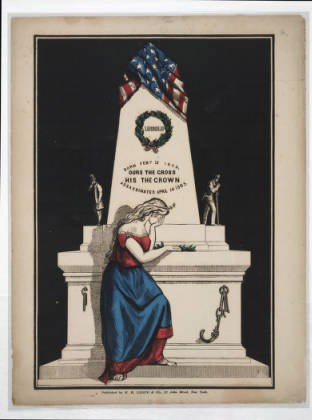
This image depicts an obelisk to President Lincoln, while Columbia looks on in a dress of blue and red, weeping at the loss of the President. An American covers the top of the obelisk while a wreath surrounds Lincoln's name and rests over the inscription: Born Feby. 12 1809/ Ours the Cross/ His the Crown/ Assassinated April 14, 1865. Additionally, broken shackles are noticeable near the base of the obelisk.
-
Source
-
Rights
Use of this item for research, teaching and private study is permitted with proper citation and attribution. Reproduction of this item for publication, broadcast or commercial use requires written permission. For permission, please contact Huntington Digital Library, San Marino, Ca.
-
Tags
-
Cite this Item
unknown. "Abraham Lincoln: Memorial Print". H. H. Lloyd & Co. . Remembering Lincoln. Web. Accessed April 3, 2026. https://rememberinglincoln.fords.org/node/824
-
Creator
unknown
-
Publisher
H. H. Lloyd & Co.
-
Date
1865
-
Dimensions
48 x 36.5 cm (18 7/8 x 14 3/8 in.)
from May. 1, 1865
Abraham Lincoln: Memorial Print
-
Description
This image depicts an obelisk to President Lincoln, while Columbia looks on in a dress of blue and red, weeping at the loss of the President. An American covers the top of the obelisk while a wreath surrounds Lincoln's name and rests over the inscription: Born Feby. 12 1809/ Ours the Cross/ His the Crown/ Assassinated April 14, 1865. Additionally, broken shackles are noticeable near the base of the obelisk.
-
Source
-
Rights
Use of this item for research, teaching and private study is permitted with proper citation and attribution. Reproduction of this item for publication, broadcast or commercial use requires written permission. For permission, please contact Huntington Digital Library, San Marino, Ca.
-
Creator
unknown
-
Publisher
H. H. Lloyd & Co.
-
Date
May 1, 1865
-
Dimensions
48 x 36.5 cm (18 7/8 x 14 3/8 in.)
from
"Lincoln Memories"
-
Full Title
"Lincoln Memories"
-
Description
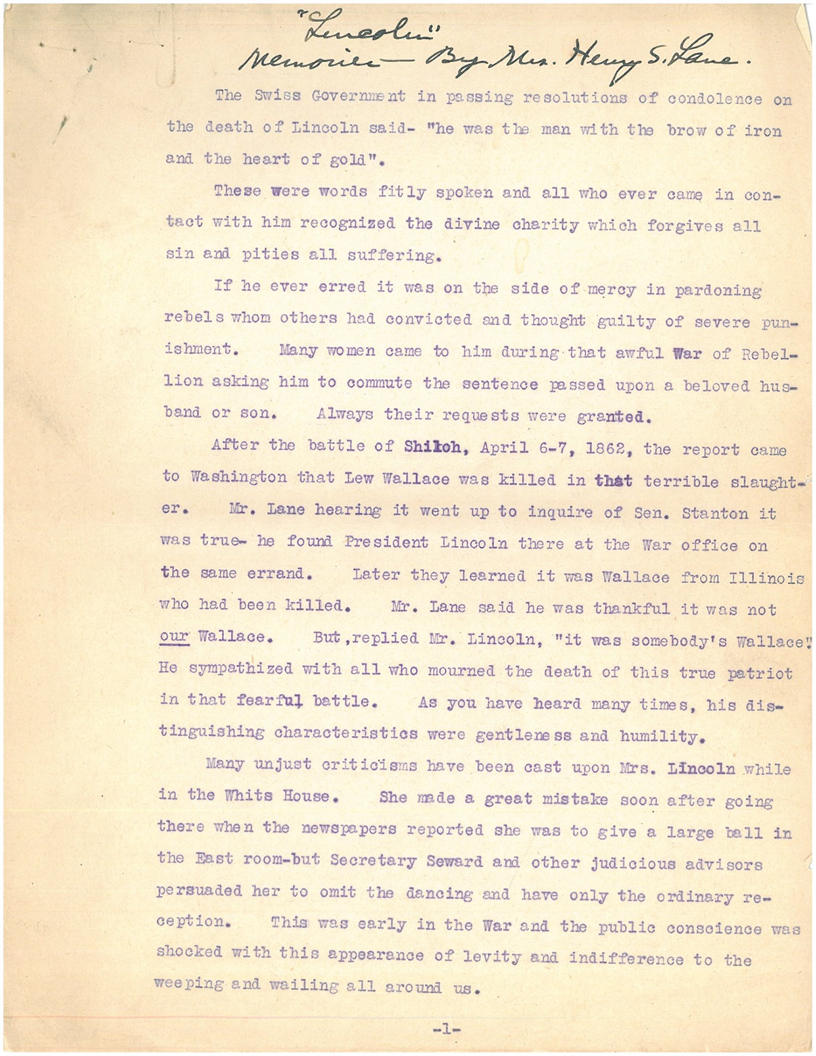
Joanna Lane remembers Abraham Lincoln in her "Lincoln memories" after his assassination.
-
Transcription
“Lincoln” Memories – By Mrs. Henry S. Lane
The Swiss Government in passing resolutions of condolence on the death of Lincoln said – “he was the man with the brow of iron and the heart of gold”.
These were words fitly spoken and all who ever came in con-tact with him recognized the divine charity which forgives all sin and pities all suffering.
If he ever erred it was on the side of mercy in pardoning rebels whom others had convicted and thought guilty of severe pun-ishment. Many women came to him during that awful War of Rebel-lion asking him to commute the sentence passed upon a beloved hus-band or son. Always their request were granted.
After the battle of Shiloh, April 6-7, 1862, the report came to Washington that Lew Wallace was killed in that terrible slaught-er. Mr. Lane hearing it went up to inquire of Sen. Stanton it was true- he found President Lincoln there at the War office on the same errand. Later they learned it was Wallace from Illinois who had been killed. Mr. Lane said he was thankful it was not our Wallace. But, replied Mr. Lincoln, “it was somebody’s Wallace.” He sympathized with all who mourned the death of this true patriot in that fearful battle. As you have heard many times, his distinguishing characteristics were gentleness and humility.
Many unjust criticisms have been cast upon Mrs. Lincoln while in the Whits House. She made a great mistake soon after going there where the newspapers reported she was to give a large ball in the East room-but Secretary Seward and other judicious advisors persuaded her to omit the dancing and have only the ordinary re-ception. This was early in the War and the public conscience was shocked with this appearance of levity and indifference to the weeping and wailing all around us.
[Transcription by Alicia B., Ford's Theatre Society.] -
Source
Montgomery County Historical Society
-
Rights
Use of this item for research, teaching, and private study is permitted with proper citation. Reproduction of the item requires our written permission for publication, broadcast or commercial use. Request for such must be made in writing, outlining in detail the items to be reproduced and requested use of the reproduction. For permission, please contact Victoria Johnston at vjohnston@lane-mchs.org.
-
Tags
-
Cite this Item
Joanna Lane. ""Lincoln Memories"". Remembering Lincoln. Web. Accessed April 3, 2026. https://rememberinglincoln.fords.org/node/822
-
Creator
Joanna Lane
from
"Lincoln Memories"
-
Description
Joanna Lane remembers Abraham Lincoln in her "Lincoln memories" after his assassination.
-
Source
Montgomery County Historical Society
-
Rights
Use of this item for research, teaching, and private study is permitted with proper citation. Reproduction of the item requires our written permission for publication, broadcast or commercial use. Request for such must be made in writing, outlining in detail the items to be reproduced and requested use of the reproduction. For permission, please contact Victoria Johnston at vjohnston@lane-mchs.org.
-
Creator
Joanna Lane
from May. 1, 1865
We mourn our loved and martyred guide!
-
Full Title
We mourn our loved and martyred guide!
-
Description
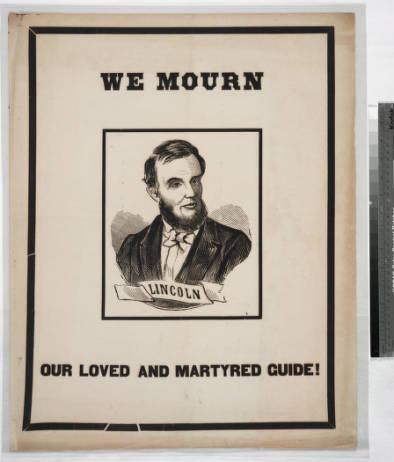
Mourning broadside published in memory of Abraham Lincoln. The rendering is of Lincoln's head and shoulders surrounded by a thick black border.
-
Source
-
Rights
Use of this item for research, teaching and private study is permitted with proper citation and attribution. Reproduction of this item for publication, broadcast or commercial use requires written permission. For permission, please contact the Huntington Library, San Marino, Ca.
-
Tags
-
Cite this Item
unknown. "We mourn our loved and martyred guide!". Remembering Lincoln. Web. Accessed April 3, 2026. https://rememberinglincoln.fords.org/node/821
-
Creator
unknown
-
Date
1865
-
Material
Woodblock
-
Dimensions
61 x 48.4 cm (24 x 19 1/16 in)
from May. 1, 1865
We mourn our loved and martyred guide!
-
Description
Mourning broadside published in memory of Abraham Lincoln. The rendering is of Lincoln's head and shoulders surrounded by a thick black border.
-
Source
-
Rights
Use of this item for research, teaching and private study is permitted with proper citation and attribution. Reproduction of this item for publication, broadcast or commercial use requires written permission. For permission, please contact the Huntington Library, San Marino, Ca.
-
Creator
unknown
-
Date
May 1, 1865
-
Material
Woodblock
-
Dimensions
61 x 48.4 cm (24 x 19 1/16 in)
from May. 4, 1865
Photograph of Lincoln's Funeral Party
-
Full Title
Photograph of Lincoln's Funeral Party
-
Description
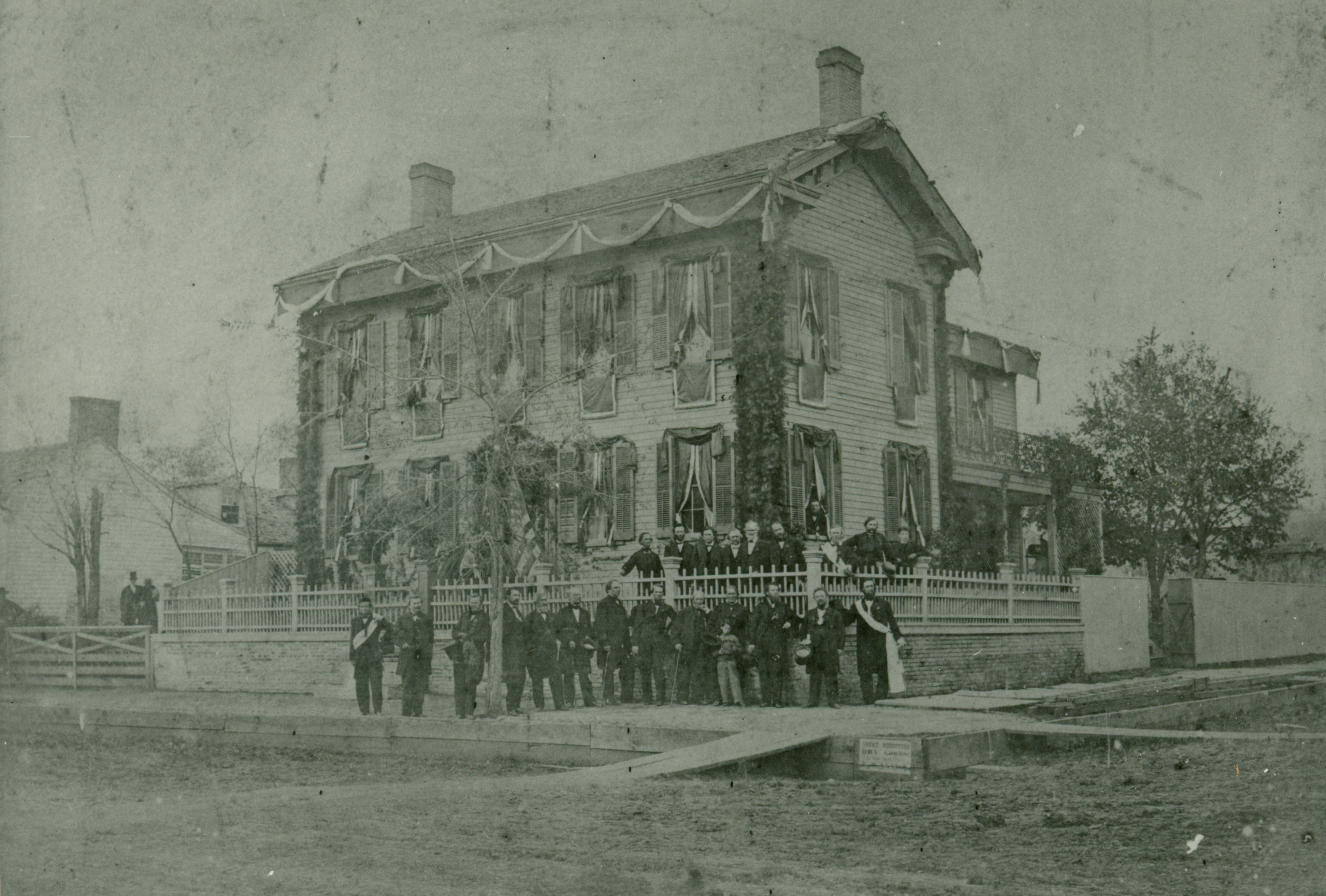
Framed photograph of President Lincoln's house in Springfield, Illinois on May 4, 1865. Photograph includes Lincoln's funeral procession dignitaries standing in front of the house in two rows. Henry Lane is in the back row of men fifth from the left.
-
Source
Montgomery County Historical Society
-
Rights
Use of this item for research, teaching, and private study is permitted with proper citation. Reproduction of the item requires our written permission for publication, broadcast or commercial use. Request for such must be made in writing, outlining in detail the items to be reproduced and requested use of the reproduction. For permission, please contact Victoria Johnston at vjohnston@lane-mchs.org.
-
Tags
-
Cite this Item
Unknown. "Photograph of Lincoln's Funeral Party ". Remembering Lincoln. Web. Accessed April 3, 2026. https://rememberinglincoln.fords.org/node/820
-
Creator
Unknown
-
Date
May 4, 1865
from May. 4, 1865
Photograph of Lincoln's Funeral Party
-
Description
Framed photograph of President Lincoln's house in Springfield, Illinois on May 4, 1865. Photograph includes Lincoln's funeral procession dignitaries standing in front of the house in two rows. Henry Lane is in the back row of men fifth from the left.
-
Source
Montgomery County Historical Society
-
Rights
Use of this item for research, teaching, and private study is permitted with proper citation. Reproduction of the item requires our written permission for publication, broadcast or commercial use. Request for such must be made in writing, outlining in detail the items to be reproduced and requested use of the reproduction. For permission, please contact Victoria Johnston at vjohnston@lane-mchs.org.
-
Creator
Unknown
-
Date
May 4, 1865
from Apr. 17, 1865
Lesson of the hour
-
Full Title
The Lesson of the hour. Justice as well as mercy.
-
Description
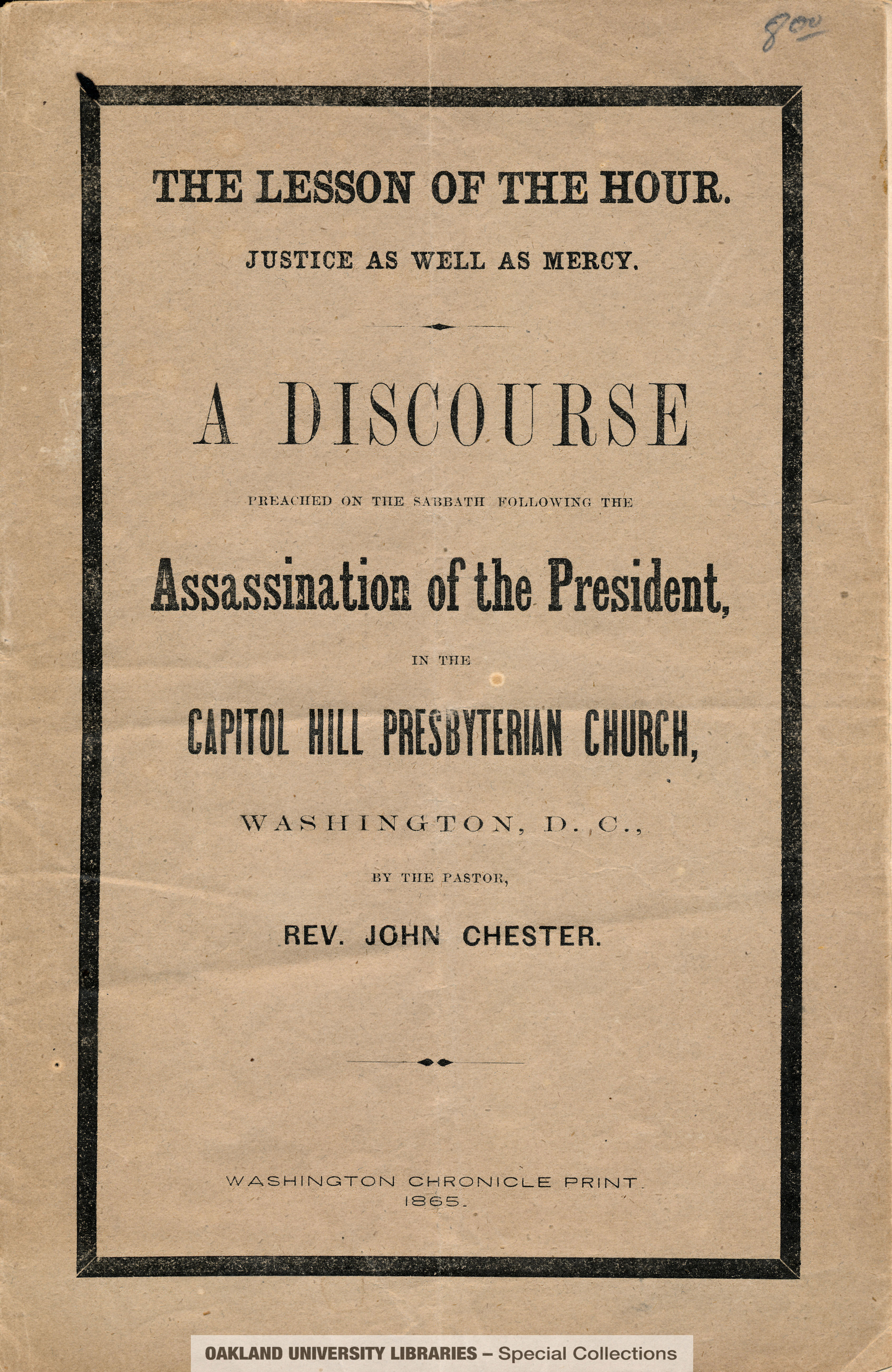
A discourse preached on the sabbath following the assassination of the President, in the Capitol Hill Presbyterian Church, Washington, D.C., by the Pastor, Rev. John Chester. 300 copies of this eulogy were distributed. The author intended it as an appeal to the consciences of all supporters of the Union.
-
Source
Springer Collection, Oakland University Special Collections
-
Rights
This item may be reproduced and used for any purpose, including research, teaching, private study, publication, broadcast, or commercial use, with proper citation and attribution.
-
Tags
-
Cite this Item
John Chester. "The Lesson of the hour. Justice as well as mercy.". Washington Chronicle Print . Remembering Lincoln. Web. Accessed April 3, 2026. https://rememberinglincoln.fords.org/node/815

-
Creator
John Chester
-
Publisher
Washington Chronicle Print
-
Date
April 17, 1865
-
Material
paper
-
Dimensions
8 3/4"h x 5 5/8"w
from Apr. 17, 1865
The Lesson of the hour. Justice as well as mercy.
-
Description
A discourse preached on the sabbath following the assassination of the President, in the Capitol Hill Presbyterian Church, Washington, D.C., by the Pastor, Rev. John Chester. 300 copies of this eulogy were distributed. The author intended it as an appeal to the consciences of all supporters of the Union.
-
Source
Springer Collection, Oakland University Special Collections
-
Rights
This item may be reproduced and used for any purpose, including research, teaching, private study, publication, broadcast, or commercial use, with proper citation and attribution.
-
Creator
John Chester
-
Publisher
Washington Chronicle Print
-
Date
April 17, 1865
-
Material
paper
-
Dimensions
8 3/4"h x 5 5/8"w
from Apr. 16, 1865
The Martyr President
-
Full Title
The Martyr President: Our Grief and Our Duty
-
Description
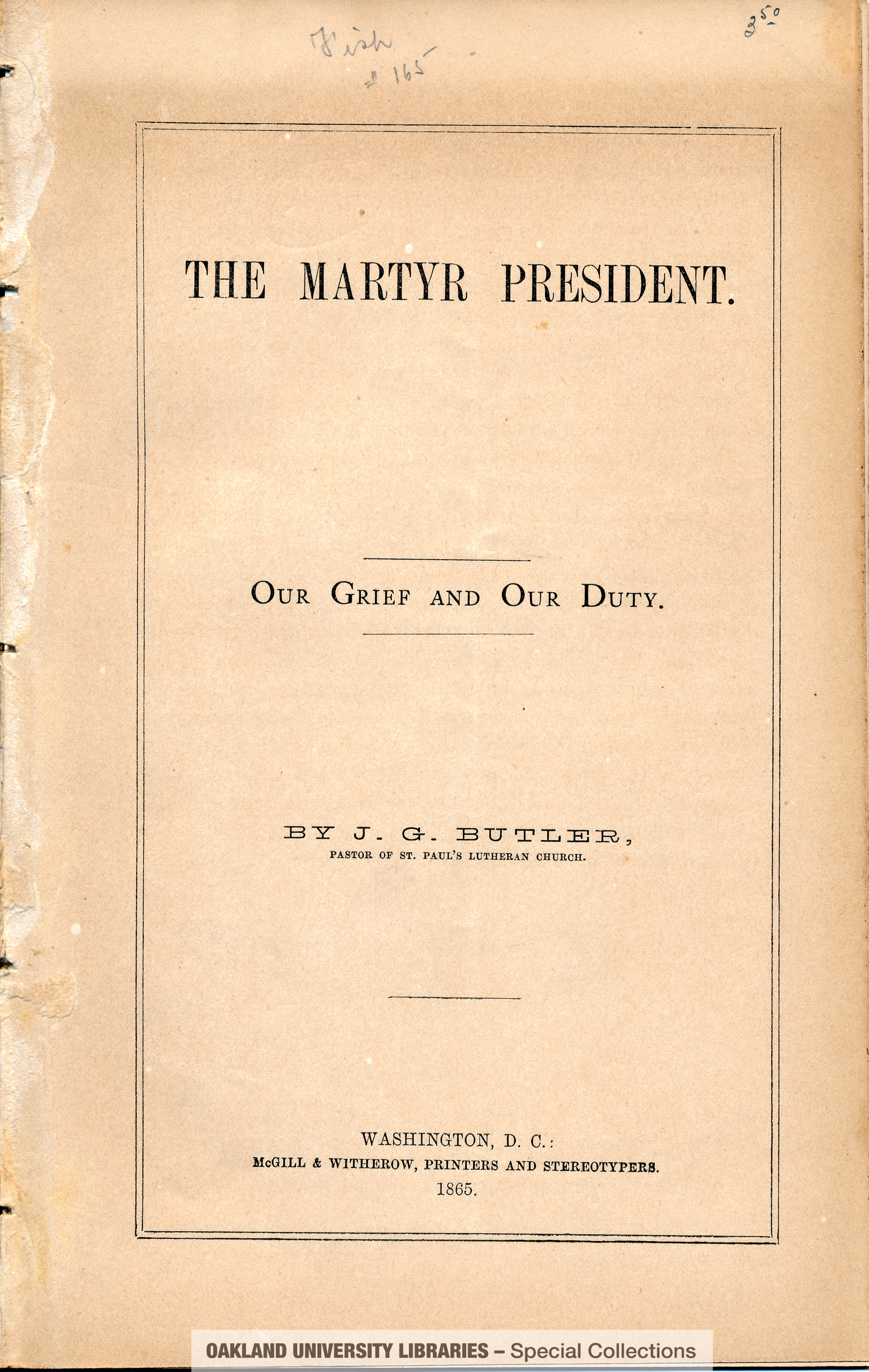
Memorial oratory delivered by J.G. Butler, Pastor of St. Paul's Church on Easter Sunday Apr. 16, 1865.
-
Source
Springer Collection, Oakland University Special Collections
-
Rights
This item may be reproduced and used for any purpose, including research, teaching, private study, publication, broadcast, or commercial use, with proper citation and attribution.
-
Tags
-
Cite this Item
J.G. Butler. "The Martyr President: Our Grief and Our Duty". McGill&Witherow. Remembering Lincoln. Web. Accessed April 3, 2026. https://rememberinglincoln.fords.org/node/814
-
Creator
J.G. Butler
-
Publisher
McGill&Witherow
-
Date
April 16, 1865
-
Material
paper
-
Dimensions
8 1/2"h x 5 1/2"w
from Apr. 16, 1865
The Martyr President: Our Grief and Our Duty
-
Description
Memorial oratory delivered by J.G. Butler, Pastor of St. Paul's Church on Easter Sunday Apr. 16, 1865.
-
Source
Springer Collection, Oakland University Special Collections
-
Rights
This item may be reproduced and used for any purpose, including research, teaching, private study, publication, broadcast, or commercial use, with proper citation and attribution.
-
Creator
J.G. Butler
-
Publisher
McGill&Witherow
-
Date
April 16, 1865
-
Material
paper
-
Dimensions
8 1/2"h x 5 1/2"w
from Dec. 15, 1865
Abraham Lincoln, a Speech
-
Full Title
Abraham Lincoln, a Speech
-
Description
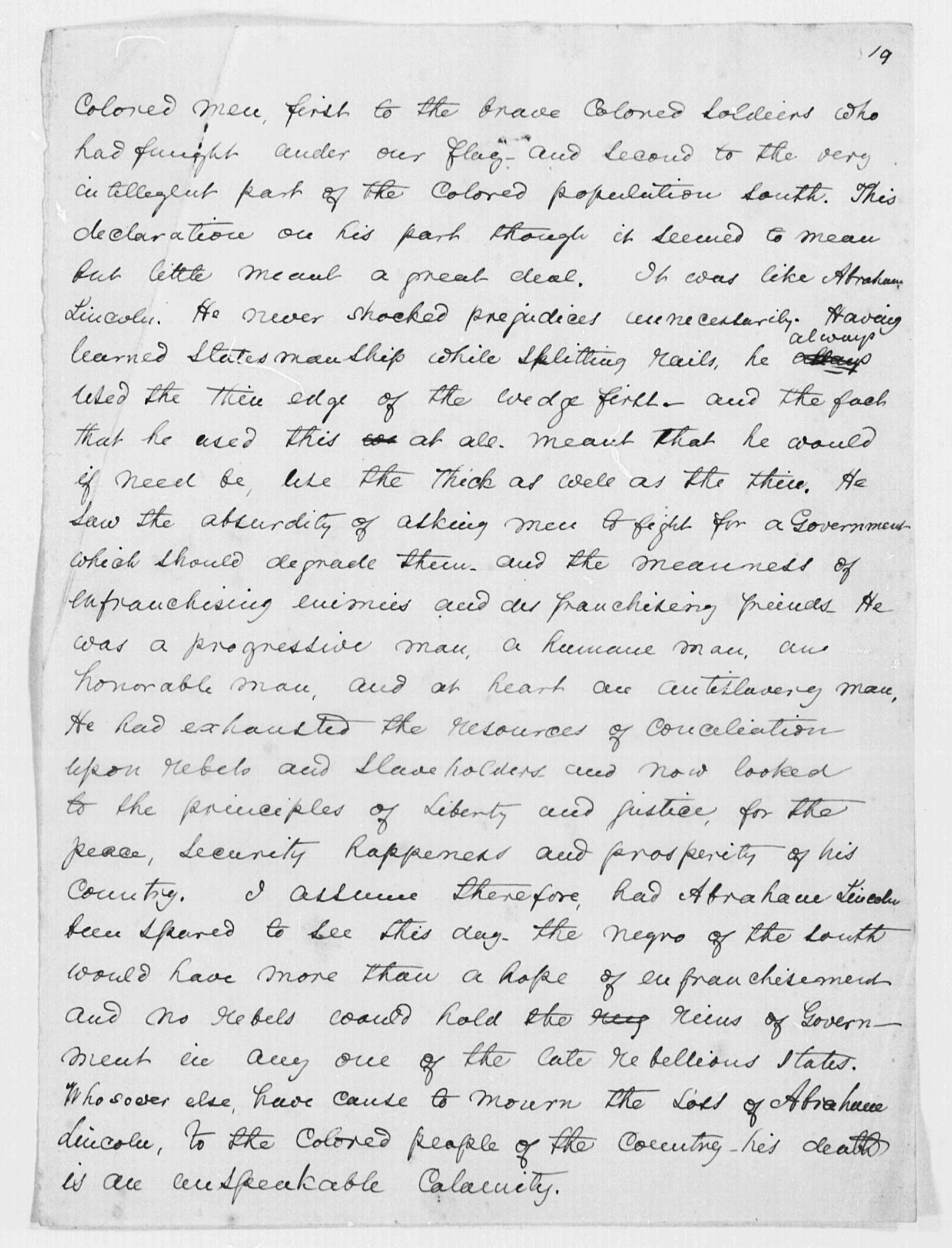
In this speech, Frederick Douglass reflected on how the outpouring of joy at the conclusion of the Civil War turned to mourning with Lincoln’s assassination. His death, according to Douglass was not only tragic, but also prevented recently freed slaves and African Americans from gaining the ear of wise and well-intentioned leader. Towards the end of his speech, Douglass pondered how life would have been different had Lincoln not perished in April, lamenting that his death was a great blow against African American rights.
-
Transcription
Colored men, first to the brave Colored Soldiers who had fought under our flag and second to the very intelligent part of the Colored population South. This declaration on his part though it seemed to mean but little meant a great deal. It was like Abraham Lincoln. He never shocked prejudices unnecessarily. Having learned Statesmanship while splitting rails, he always used the thin edge of the wedge first, and the fact that he used this at all meant that he would if need be, use the thick as well as the thin. He saw the absurdity of asking men to fight for a Government which should degrade them, and the meanness of enfranchising enemies and de-franchising friends. He was a progressive man, a humane man, an honorable man, and at heart an antislavery man. He had exhausted the resources of conciliation upon rebels and slaveholders and now looked to the principles of Liberty and justice, for the peace, security, happiness and prosperity of his Country. I assume therefore, had Abraham Lincoln been spared to see this day, the negro of the South would have more than a hope of enfranchisement and no rebels could hold the reins of Government in any one of the late rebellious States. Whosoever else have cause to mourn the loss of Abraham Lincoln, to the Colored people of the Country his death is an unspeakable calamity.
[Transcription by: Evan Laugen, Chandra Manning's class, Georgetown University]. -
Source
Frederick Douglass Papers, Manuscript Division, Library of Congress
-
Rights
This item is in the public domain and may be reproduced and used for any purpose, including research, teaching, private study, publication, broadcast or commercial use, with proper citation and attribution.
-
Tags
-
Cite this Item
Frederick Douglass. "Abraham Lincoln, a Speech". Remembering Lincoln. Web. Accessed April 3, 2026. https://rememberinglincoln.fords.org/node/812
-
Creator
Frederick Douglass
-
Date
Late December 1865
from Dec. 15, 1865
Abraham Lincoln, a Speech
-
Description
In this speech, Frederick Douglass reflected on how the outpouring of joy at the conclusion of the Civil War turned to mourning with Lincoln’s assassination. His death, according to Douglass was not only tragic, but also prevented recently freed slaves and African Americans from gaining the ear of wise and well-intentioned leader. Towards the end of his speech, Douglass pondered how life would have been different had Lincoln not perished in April, lamenting that his death was a great blow against African American rights.
-
Source
Frederick Douglass Papers, Manuscript Division, Library of Congress
-
Rights
This item is in the public domain and may be reproduced and used for any purpose, including research, teaching, private study, publication, broadcast or commercial use, with proper citation and attribution.
-
Creator
Frederick Douglass
-
Date
December 15, 1865
from Apr. 17, 1865
Proceedings of a Called Meeting
-
Full Title
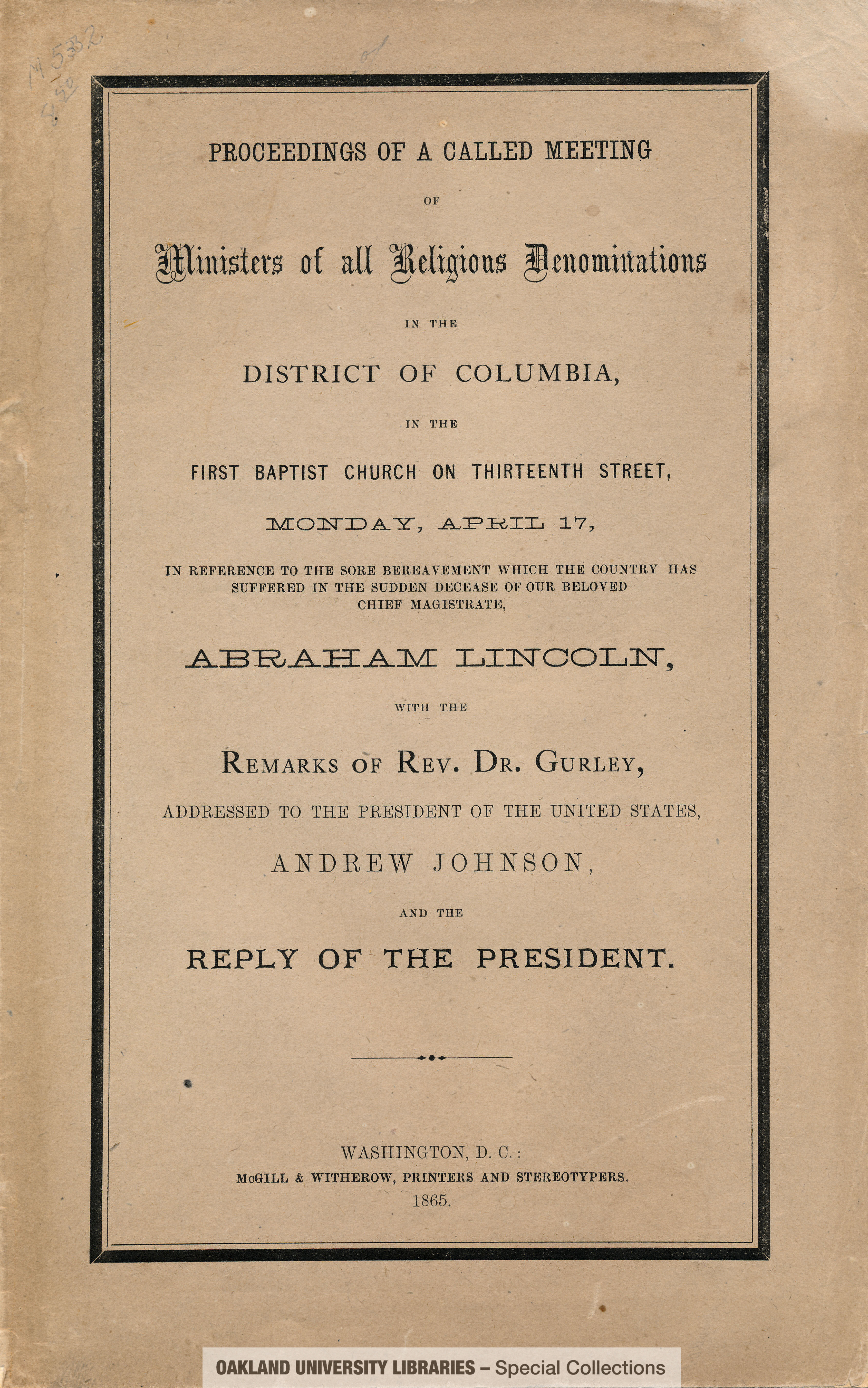
Proceedings of a called meeting of ministers of all religious denominations in the District of Columbia, in the First Baptist Church on Thirteenth Street, Monday, April 17
-
Description
Minutes of a meeting of ministers of various denominations in Washington, D.C. to organize a response to the assassination and burial of President Lincoln. Includes remarks by Rev. Gurley, who was a close friend of the Lincolns during his time as Chaplain of the United States Senate. He preached the funeral sermon at the White House on April 19.
-
Source
Springer Collection, Oakland University Special Collections
-
Rights
This item may be reproduced and used for any purpose, including research, teaching, private study, publication, broadcast, or commercial use, with proper citation and attribution.
-
Tags
-
Cite this Item
Phineas Densmore Gurley. "Proceedings of a called meeting of ministers of all religious denominations in the District of Columbia, in the First Baptist Church on Thirteenth Street, Monday, April 17". McGill & Witherow. Remembering Lincoln. Web. Accessed April 3, 2026. https://rememberinglincoln.fords.org/node/805
-
Creator
Phineas Densmore Gurley
-
Publisher
McGill & Witherow
-
Date
April 17, 1865
-
Material
paper
-
Dimensions
9" h x 5 5/8" w
from Apr. 17, 1865
Proceedings of a called meeting of ministers of all religious denominations in the District of Columbia, in the First Baptist Church on Thirteenth Street, Monday, April 17
-
Description
Minutes of a meeting of ministers of various denominations in Washington, D.C. to organize a response to the assassination and burial of President Lincoln. Includes remarks by Rev. Gurley, who was a close friend of the Lincolns during his time as Chaplain of the United States Senate. He preached the funeral sermon at the White House on April 19.
-
Source
Springer Collection, Oakland University Special Collections
-
Rights
This item may be reproduced and used for any purpose, including research, teaching, private study, publication, broadcast, or commercial use, with proper citation and attribution.
-
Creator
Phineas Densmore Gurley
-
Publisher
McGill & Witherow
-
Date
April 17, 1865
-
Material
paper
-
Dimensions
9" h x 5 5/8" w
from May. 1, 1865
Abraham Lincoln. An Horatian Ode
-
Full Title
Abraham Lincoln. An Horatian Ode
-
Description
Poem written by Richard Stoddard, a literary critic and poet, on the assassination of Lincoln. It includes a soliloquy from Macbeth.
-
Source
Springer Collection, Oakland University Special Collections
-
Rights
This item may be reproduced and used for any purpose, including research, teaching, private study, publication, broadcast, or commercial use, with proper citation and attribution.
-
Tags
-
Cite this Item
Richard Henry Stoddard. "Abraham Lincoln. An Horatian Ode". Bunce & Huntington. Remembering Lincoln. Web. Accessed April 3, 2026. https://rememberinglincoln.fords.org/node/804
-
Creator
Richard Henry Stoddard
-
Publisher
Bunce & Huntington
-
Date
1865
-
Material
paper
-
Dimensions
9 1/4" h x 6" w
from May. 1, 1865
Abraham Lincoln. An Horatian Ode
-
Description
Poem written by Richard Stoddard, a literary critic and poet, on the assassination of Lincoln. It includes a soliloquy from Macbeth.
-
Source
Springer Collection, Oakland University Special Collections
-
Rights
This item may be reproduced and used for any purpose, including research, teaching, private study, publication, broadcast, or commercial use, with proper citation and attribution.
-
Creator
Richard Henry Stoddard
-
Publisher
Bunce & Huntington
-
Date
May 1, 1865
-
Material
paper
-
Dimensions
9 1/4" h x 6" w
from Apr. 19, 1865
A Day of Mourning
-
Full Title
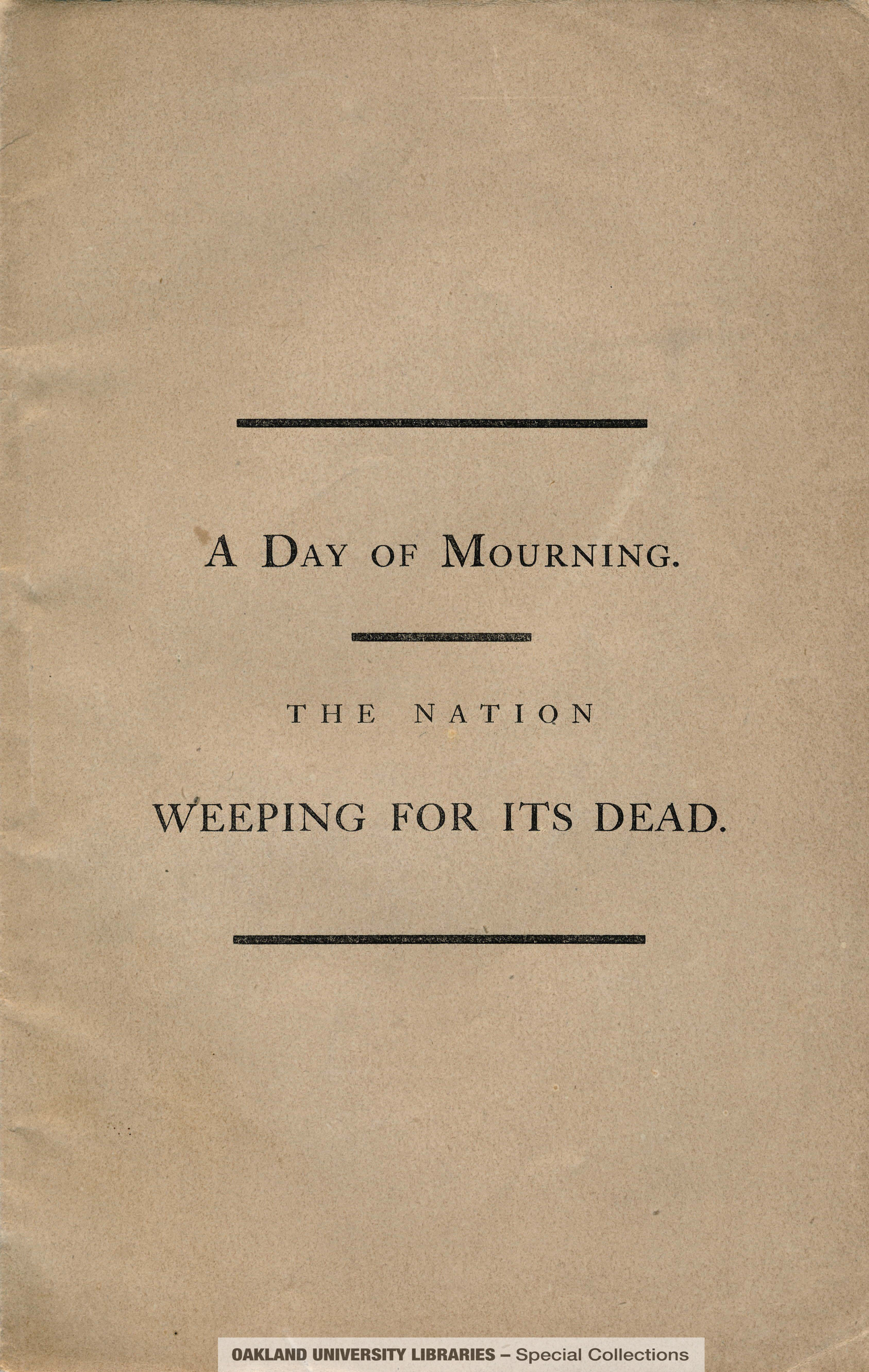
A Day of Mourning. The Nation Weeping for its Dead
-
Description
Reprint of the Springfield Republican report on several memorial events held at Springfield, Massachusetts. Contents: National mourning -- Proclamation -- President Lincoln's funeral day in Springfield -- Mayor's address -- Dr. Holland's Eulogy.
-
Source
Springer Collection, Oakland University Special Collections
-
Rights
This item may be reproduced and used for any purpose, including research, teaching, private study, publication, broadcast, or commercial use, with proper citation and attribution.
-
Tags
-
Cite this Item
Josiah Gilbert Holland. "A Day of Mourning. The Nation Weeping for its Dead". Samuel Bowles & Co.: L.J. Powers. Remembering Lincoln. Web. Accessed April 3, 2026. https://rememberinglincoln.fords.org/node/803
-
Creator
Josiah Gilbert Holland
-
Publisher
Samuel Bowles & Co.: L.J. Powers
-
Date
April 19, 1865
-
Material
paper
-
Dimensions
9"h x 5 3/4"w
from Apr. 19, 1865
A Day of Mourning. The Nation Weeping for its Dead
-
Description
Reprint of the Springfield Republican report on several memorial events held at Springfield, Massachusetts. Contents: National mourning -- Proclamation -- President Lincoln's funeral day in Springfield -- Mayor's address -- Dr. Holland's Eulogy.
-
Source
Springer Collection, Oakland University Special Collections
-
Rights
This item may be reproduced and used for any purpose, including research, teaching, private study, publication, broadcast, or commercial use, with proper citation and attribution.
-
Creator
Josiah Gilbert Holland
-
Publisher
Samuel Bowles & Co.: L.J. Powers
-
Date
April 19, 1865
-
Material
paper
-
Dimensions
9"h x 5 3/4"w