from Apr. 16, 1865
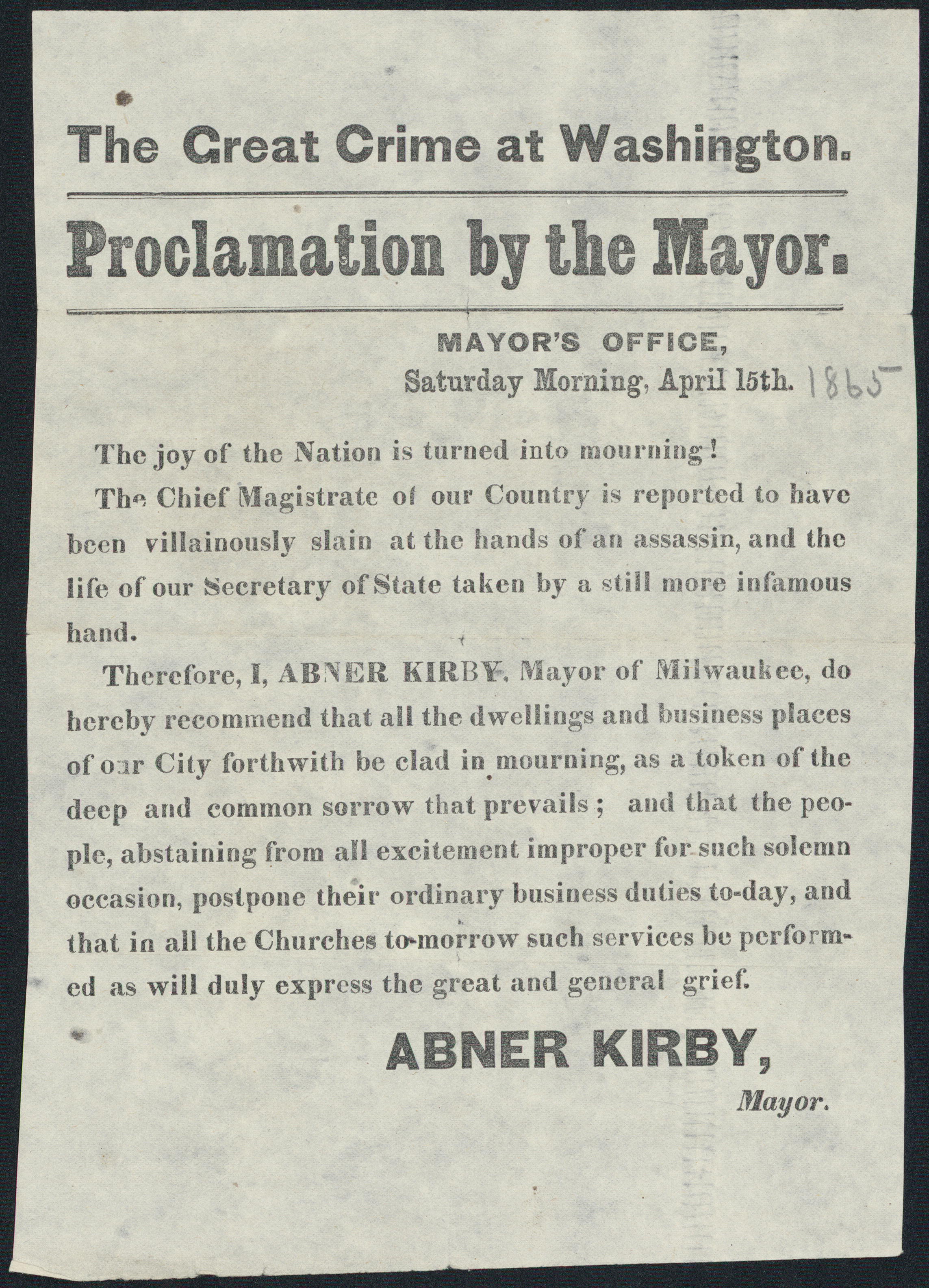
"The Great Crime at Washington"
-
Full Title
Proclamation by the Mayor of Milwaukee
-
Description
Proclamation by Mayor Abner Kirby of Milwaukee, WI. He tells of Lincoln's assassination and incorrectly claims that Secretary of Seward was also killed "by a still more infamous hand." He then recommends that "all dwellings and business places of our City forthwith be clad in mourning as a token of the deep and common sorrow that prevails."
-
Source
Library of Congress, Rare Book And Special Collections Division, Portfolio 5, no. 22, Alfred Whital Stern Collection of Lincolniana catalog 4750
-
Rights
This item is in the public domain and may be reproduced and used for any purpose, including research, teaching, private study, publication, broadcast or commercial use, with proper citation and attribution
-
Tags
-
Cite this Item
Abner Kirby. "Proclamation by the Mayor of Milwaukee". Remembering Lincoln. Web. Accessed April 7, 2026. https://rememberinglincoln.fords.org/node/727
-
Creator
Abner Kirby
-
Date
April 16, 1865
from Apr. 16, 1865
Proclamation by the Mayor of Milwaukee
-
Description
Proclamation by Mayor Abner Kirby of Milwaukee, WI. He tells of Lincoln's assassination and incorrectly claims that Secretary of Seward was also killed "by a still more infamous hand." He then recommends that "all dwellings and business places of our City forthwith be clad in mourning as a token of the deep and common sorrow that prevails."
-
Source
Library of Congress, Rare Book And Special Collections Division, Portfolio 5, no. 22, Alfred Whital Stern Collection of Lincolniana catalog 4750
-
Rights
This item is in the public domain and may be reproduced and used for any purpose, including research, teaching, private study, publication, broadcast or commercial use, with proper citation and attribution
-
Creator
Abner Kirby
-
Date
April 16, 1865
from Apr. 17, 2015
A Nation Mourns Her Martyr'd Son
-
Full Title
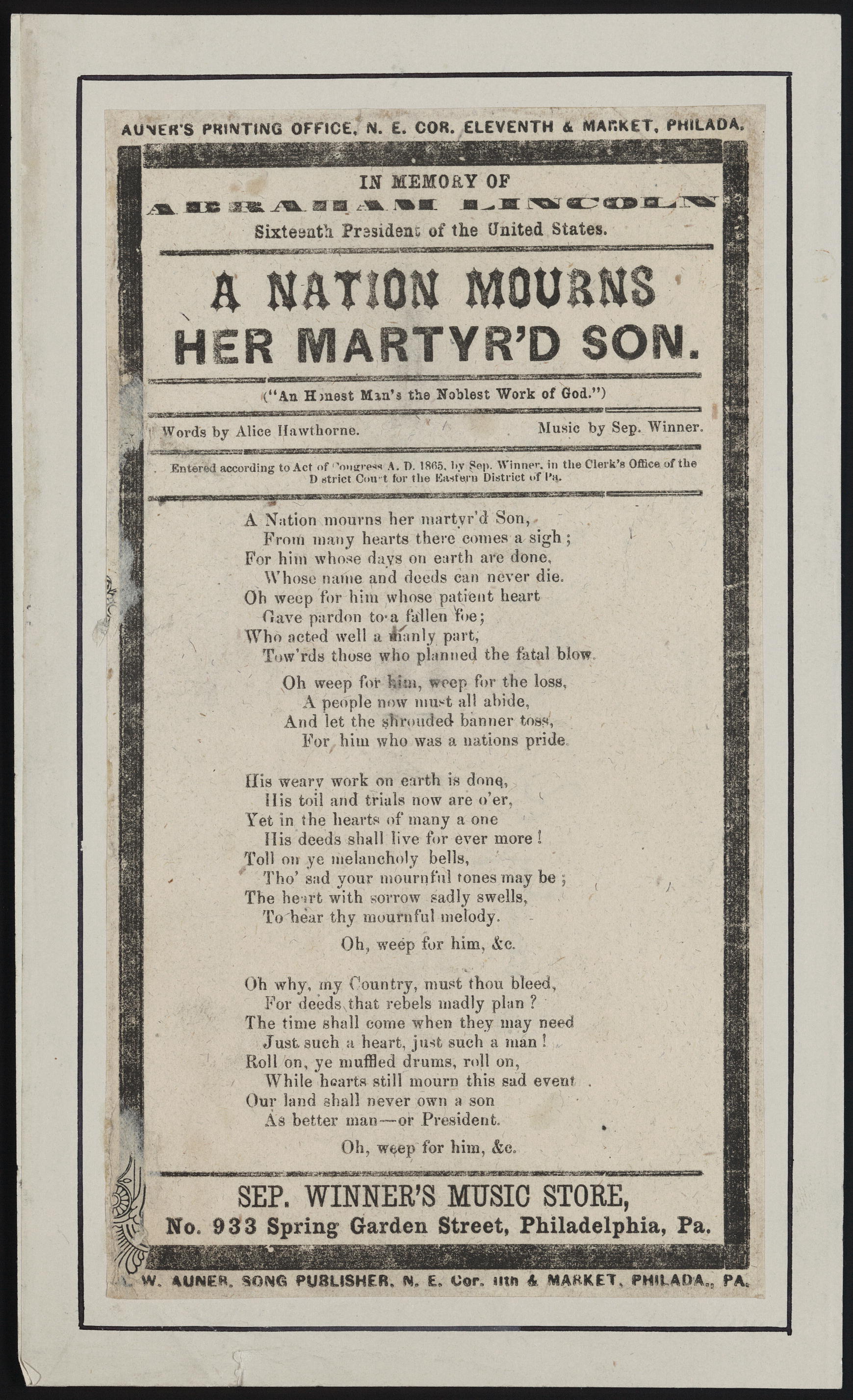
A Nation Mourns Her Martyr'd Son
-
Description
Sheet music broadside, with lyrics written by Alice Hawthorn, music composed by Septimus Winner, and published by W. Auner Song Publisher in Philadelphia
-
Source
Library of Congress, Rare Book And Special Collections Division, Portfolio 9, no. 38
-
Rights
This item is in the public domain and may be reproduced and used for any purpose, including research, teaching, private study, publication, broadcast or commercial use, with proper citation and attribution
-
Tags
-
Cite this Item
Septimus Winner (Composer); Alice Hawthorne (Lyricist). "A Nation Mourns Her Martyr'd Son". W. Auner Song Publisher. Remembering Lincoln. Web. Accessed April 7, 2026. https://rememberinglincoln.fords.org/node/726
-
Creator
Septimus Winner (Composer); Alice Hawthorne (Lyricist)
-
Publisher
W. Auner Song Publisher
-
Date
1865
from Apr. 17, 2015
A Nation Mourns Her Martyr'd Son
-
Description
Sheet music broadside, with lyrics written by Alice Hawthorn, music composed by Septimus Winner, and published by W. Auner Song Publisher in Philadelphia
-
Source
Library of Congress, Rare Book And Special Collections Division, Portfolio 9, no. 38
-
Rights
This item is in the public domain and may be reproduced and used for any purpose, including research, teaching, private study, publication, broadcast or commercial use, with proper citation and attribution
-
Creator
Septimus Winner (Composer); Alice Hawthorne (Lyricist)
-
Publisher
W. Auner Song Publisher
-
Date
April 17, 2015
from Apr. 17, 2015
Mourning Badge
-
Full Title
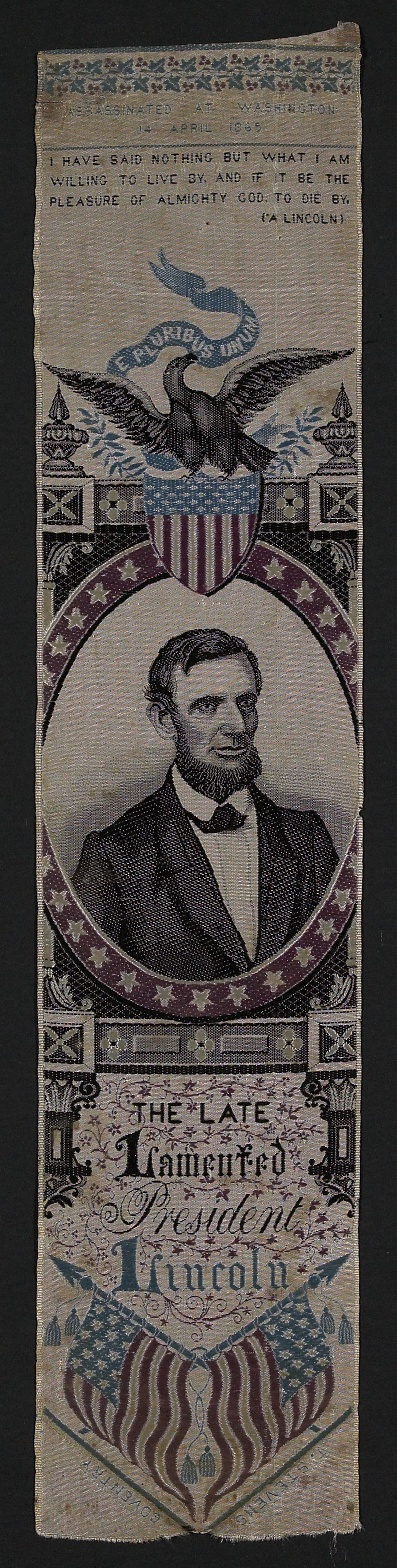
Mourning Badge made by Thomas Stevens
-
Description
Ribbon made by Thomas Stevens of Coventry, England. The text says, "Assassinated at Washington 14 April 1865" and then includes the following quote,"I have said nothing but what I am willing to live by. And if it be the pleasure of almighty god to die by. A. Lincoln."
-
Source
Library of Congress, Rare Book And Special Collections Division, Portfolio 9, no. 8
-
Rights
This item is in the public domain and may be reproduced and used for any purpose, including research, teaching, private study, publication, broadcast or commercial use, with proper citation and attribution
-
Tags
-
Cite this Item
Thomas Stevens. "Mourning Badge made by Thomas Stevens". Remembering Lincoln. Web. Accessed April 7, 2026. https://rememberinglincoln.fords.org/node/725
-
Creator
Thomas Stevens
-
Date
1865
from Apr. 17, 2015
Mourning Badge made by Thomas Stevens
-
Description
Ribbon made by Thomas Stevens of Coventry, England. The text says, "Assassinated at Washington 14 April 1865" and then includes the following quote,"I have said nothing but what I am willing to live by. And if it be the pleasure of almighty god to die by. A. Lincoln."
-
Source
Library of Congress, Rare Book And Special Collections Division, Portfolio 9, no. 8
-
Rights
This item is in the public domain and may be reproduced and used for any purpose, including research, teaching, private study, publication, broadcast or commercial use, with proper citation and attribution
-
Creator
Thomas Stevens
-
Date
April 17, 2015
from Nov. 4, 1865
"Oh Captain, My Captain"
-
Full Title
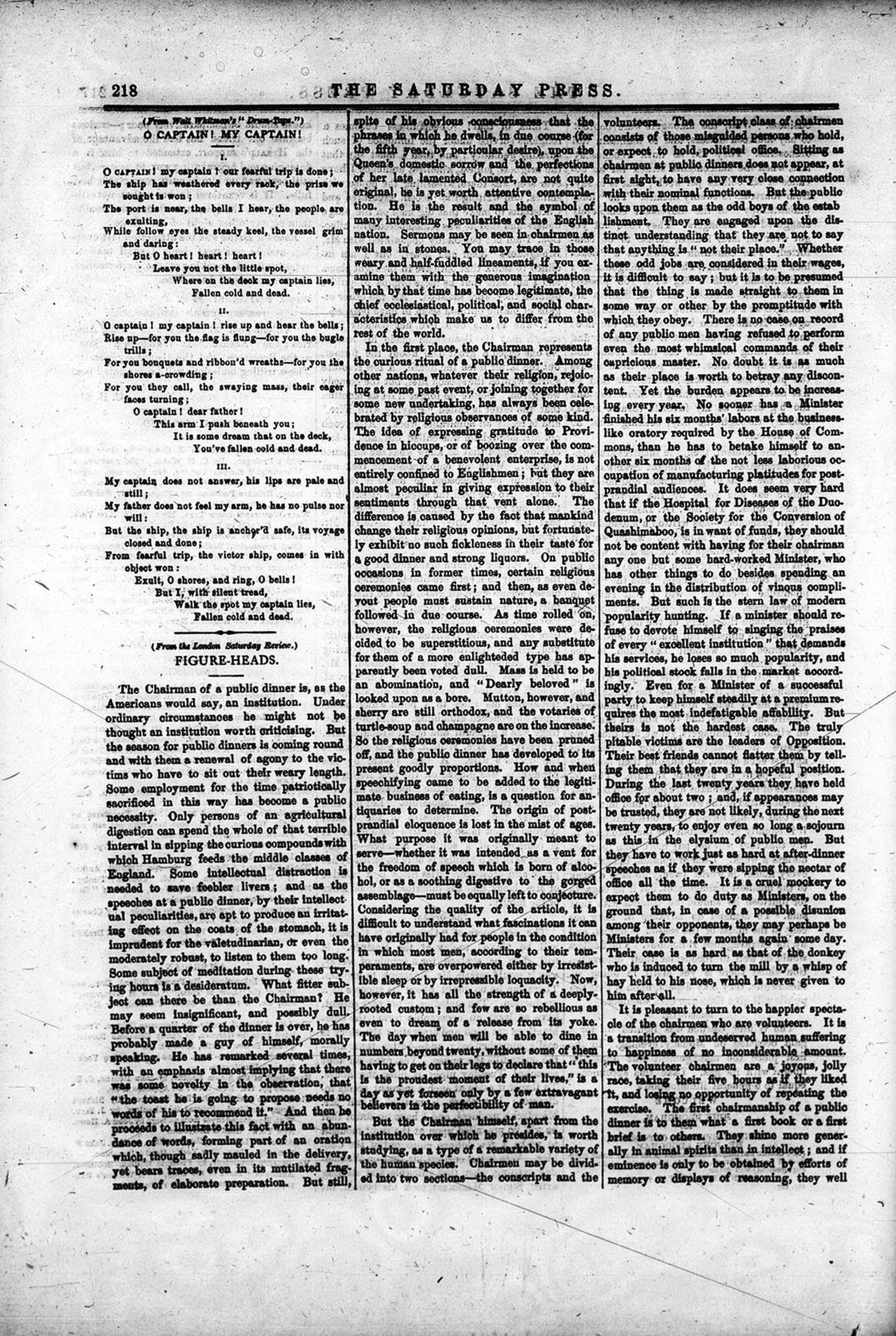
"Oh Captain, My Captain"
-
Description
The noted poet Walt Whitman composed this poem in memory of Lincoln shortly after his assassination.
-
Transcription
I.
O CAPTAIN! my captain! our fearful trip is done;
The ship has weathered every rack, the prize we sought is won;
The port is near, the bells I hear, the people are exulting,
While follow eyes the steady keel, the vessel grim and daring:
But O heart! heart! heart!
Leave you not the little spot,
Where on the deck my captain lies,
Fallen cold and dead.
II.
O captain! my captain! rise up and hear the bells;
Rise up—for you the flag is flung—for you the bugle trills;
For you bouquets and ribbon'd wreaths—for you the shores a-crowding;
For you they call, the swaying mass, their eager faces turning;
O captain! dear father!
This arm I push beneath you;
It is some dream that on the deck,
You've fallen cold and dead.
III.
My captain does not answer, his lips are pale and still;
My father does not feel my arm, he has no pulse nor will:
But the ship, the ship is anchor'd safe, its voyage closed and done;
From fearful trip, the victor ship, comes in with object won:
Exult, O shores, and ring, O bells!
But I, with silent tread,
Walk the spot my captain lies,
Fallen cold and dead. -
Source
Walt Whitman Archive
-
Rights
This item may be reproduced and used for any purpose, including research, teaching, private study, publication, broadcast or commercial use, with proper citation and attribution.
-
Tags
-
Cite this Item
Whitman, Walt. ""Oh Captain, My Captain"". New-York Saturday Press. Remembering Lincoln. Web. Accessed April 7, 2026. https://rememberinglincoln.fords.org/node/517
-
Creator
Whitman, Walt
-
Publisher
New-York Saturday Press
-
Date
November 4, 1865
from Nov. 4, 1865
"Oh Captain, My Captain"
-
Description
The noted poet Walt Whitman composed this poem in memory of Lincoln shortly after his assassination.
-
Source
Walt Whitman Archive
-
Rights
This item may be reproduced and used for any purpose, including research, teaching, private study, publication, broadcast or commercial use, with proper citation and attribution.
-
Creator
Whitman, Walt
-
Publisher
New-York Saturday Press
-
Date
November 4, 1865
from Apr. 15, 1865
"Death of the president"
-
Full Title
"Death of the president"
-
Description
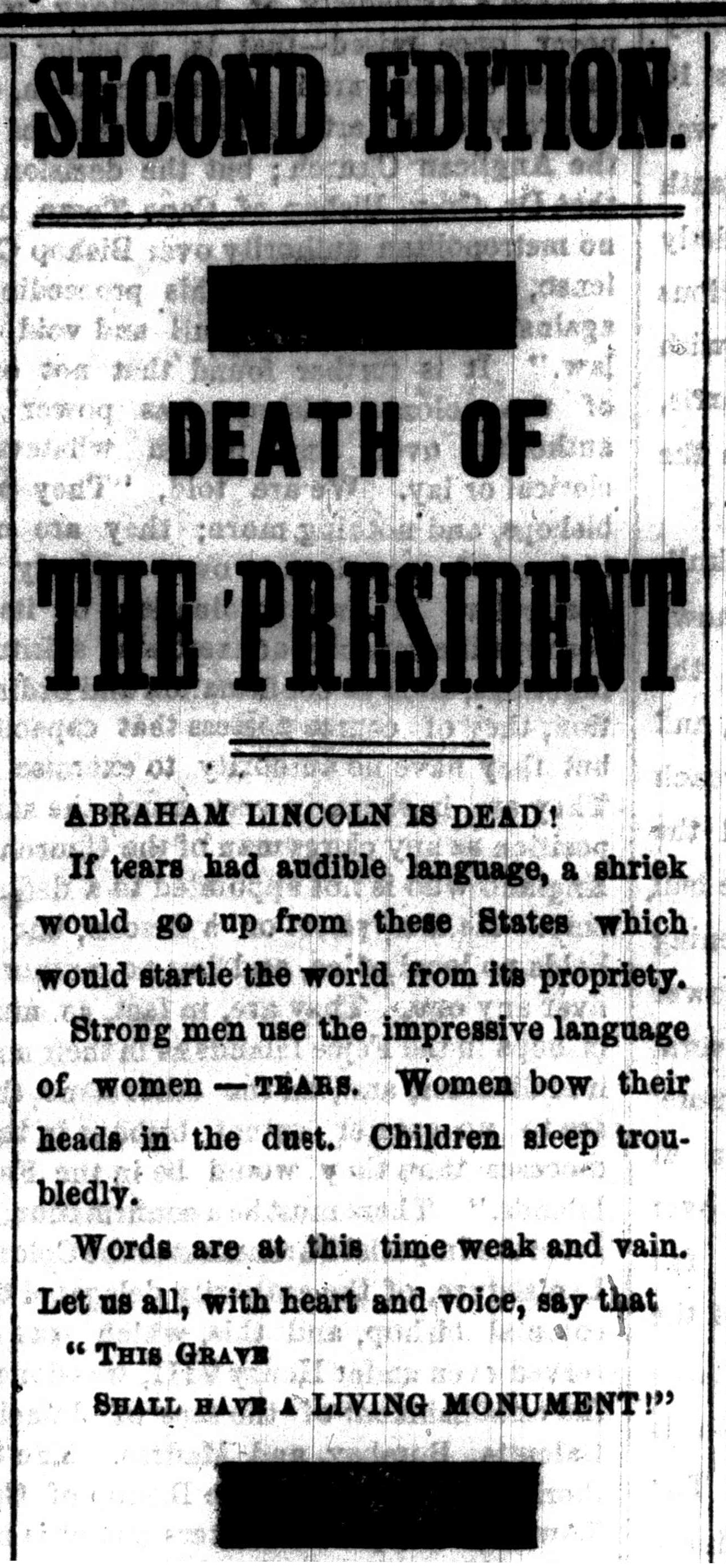
Article in the Second Edition of the Daily Morning Chronicle announcing the death of President Abraham Lincoln and commenting on the intensity of the nation's mourning.
-
Transcription
ABRAHAM LINCOLN IS DEAD!
If tears had audible language, a shriek would go up from these States which would startle the world from its propriety.
Strong men use the impressive language of women - TEARS. Women bow their heads in the dust. Children sleep troubledly.
Words are at this time weak and vain. Let us all, with heart and voice, say that
"This grave shall have a LIVING MONUMENT!" -
Source
Washingtoniana Microfilm Collection
-
Rights
This item may be reproduced and used for any purpose, including research, teaching, private study, publication, broadcast or commercial use, with proper citation and attribution.
-
Tags
-
Cite this Item
Daily Morning Chronicle. ""Death of the president"". Remembering Lincoln. Web. Accessed April 7, 2026. https://rememberinglincoln.fords.org/node/499

-
Creator
Daily Morning Chronicle
-
Date
April 15, 1865
-
Material
newspaper
from Apr. 15, 1865
"Death of the president"
-
Description
Article in the Second Edition of the Daily Morning Chronicle announcing the death of President Abraham Lincoln and commenting on the intensity of the nation's mourning.
-
Source
Washingtoniana Microfilm Collection
-
Rights
This item may be reproduced and used for any purpose, including research, teaching, private study, publication, broadcast or commercial use, with proper citation and attribution.
-
Creator
Daily Morning Chronicle
-
Date
April 15, 1865
-
Material
newspaper
from Apr. 15, 1865
Removal of the President's Body
-
Full Title
"Removal of the body of the President to the executive mansion"
-
Description
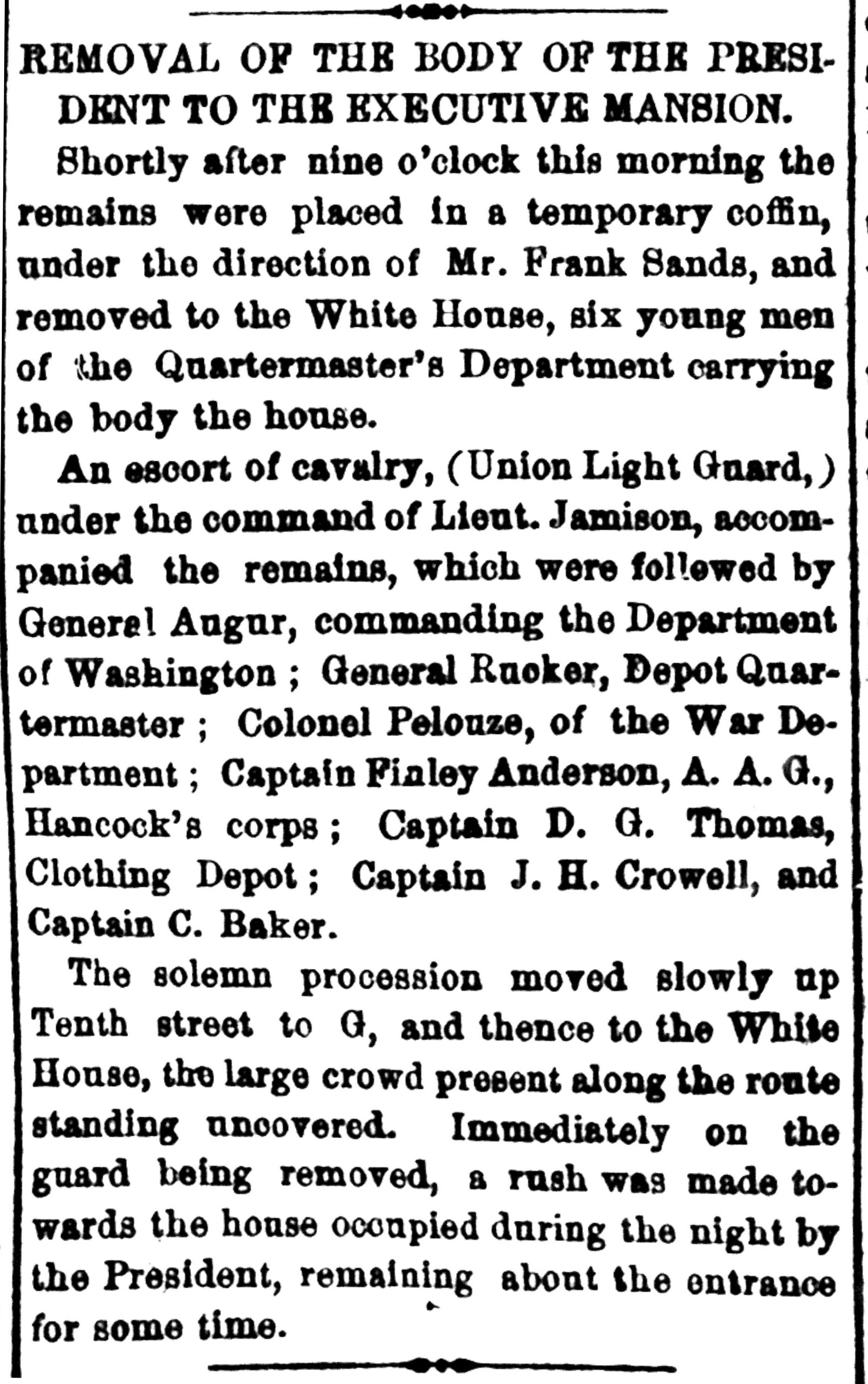
Article describing the procession accompanying President Abraham Lincoln's body from the Peterson house to the White House. The article describes the procession as escorted by Union Light Guard calvary and military officers, as well as a large crowd, which descended on the Peterson house once the President's body was removed.
-
Transcription
Removal of the body of the president to the executive mansion.
Shortly after nine o'clock this morning the remains were placed in a temporary coffin, under the direction of Mr. Frank Sands, and removed to the Whtie House, six young men of the Quartermaster's Department carrying the body the house.
An escort of cavalry, (Union Light Guard,) under the command of Lieut. Jamison, accompanied the remains, which were followed by General Augur, commanding the Department of Washington; General Rucker, Depot Quartermaster; Colonel Pelouze, of the War Department; Captain Finley Anderson, A. A. G.; Hancock's corps; Captain D. G. Thomas, Clothing Depot; Captain J. H. Crowell, and Captain C. Baker.
The solemn procession moved slowly up Tenth street to G, and thence to the White House, the large crowd present along the route standing uncovered. Immediately on the guard being removed, a rush was made towards the house occupied during the night by the President, remaining about the entrance for some time. -
Source
Washingtoniana Microfilm Collection
-
Rights
This item may be reproduced and used for any purpose, including research, teaching, private study, publication, broadcast or commercial use, with proper citation and attribution.
-
Tags
-
Cite this Item
Daily Constitutional Union. ""Removal of the body of the President to the executive mansion"". Remembering Lincoln. Web. Accessed April 7, 2026. https://rememberinglincoln.fords.org/node/498
-
Creator
Daily Constitutional Union
-
Date
April 15, 1865
-
Material
newspaper
from Apr. 15, 1865
"Removal of the body of the President to the executive mansion"
-
Description
Article describing the procession accompanying President Abraham Lincoln's body from the Peterson house to the White House. The article describes the procession as escorted by Union Light Guard calvary and military officers, as well as a large crowd, which descended on the Peterson house once the President's body was removed.
-
Source
Washingtoniana Microfilm Collection
-
Rights
This item may be reproduced and used for any purpose, including research, teaching, private study, publication, broadcast or commercial use, with proper citation and attribution.
-
Creator
Daily Constitutional Union
-
Date
April 15, 1865
-
Material
newspaper
from Apr. 17, 1865
"Meeting of Colored Citizens"
-
Full Title
"Meeting of colored citizens in honor of the emancipation in the District of Columbia - The death of our late president"
-
Description
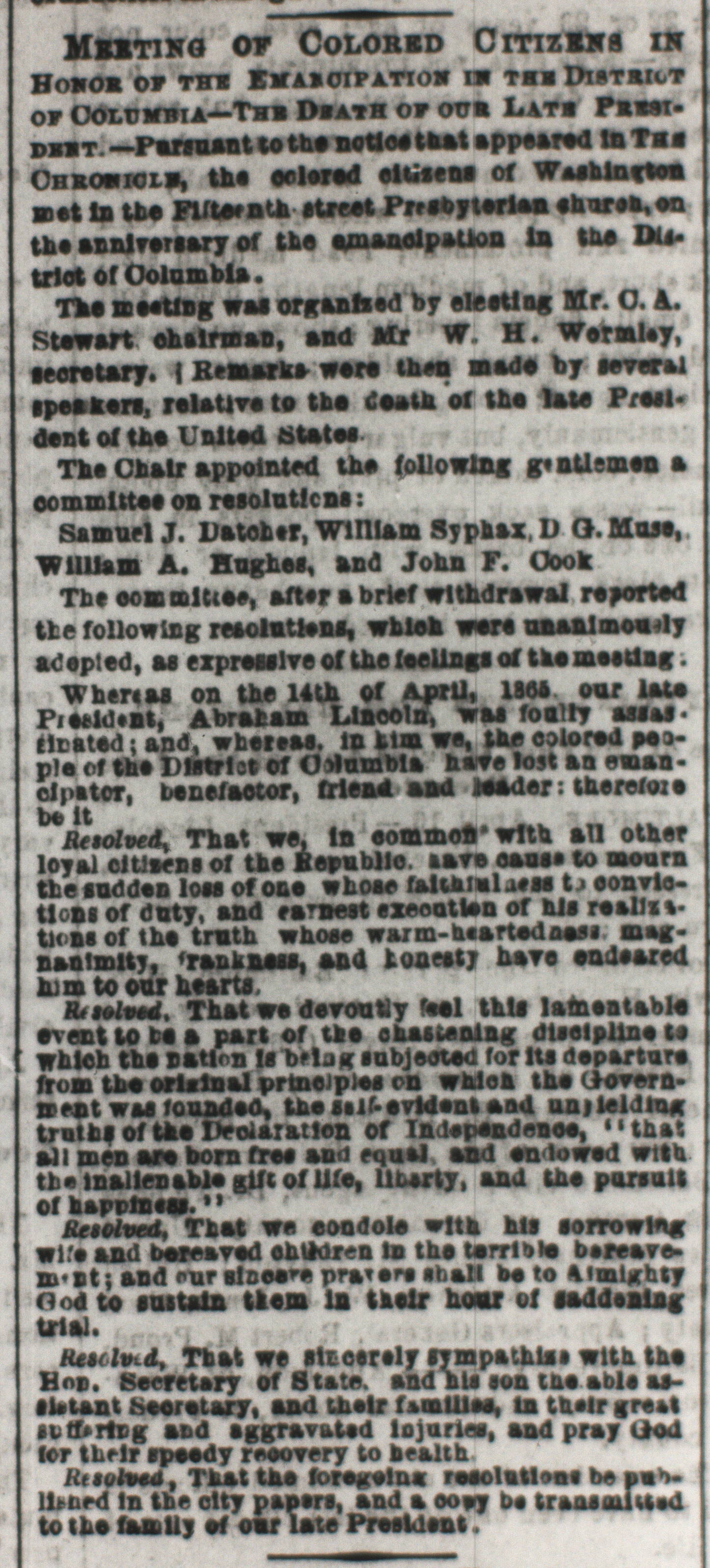
Resolutions of a meeting of colored citizens of the District of Columbia, which met on April 16, 1865, the third anniversary of emancipation in Washington, D.C. The group resolved to mourn the recent assassination of Abraham Lincoln and pay tribute to his role as emancipator. The resolution states that they believed Lincoln's should be seen as discipline for the nation's departure from the principles of equality present in the founding documents, including the Declaration of Independence. The group also sends its condolences to the Lincoln family and Willard H. Seward and his household, which were also attacked the night of the president's assassination.
-
Transcription
Meeting of colored citizens in honor of the emancipation in the District of Columbia - The death of our late president
Persuant to the notice that appeared in The Chronicle, the colored citizens of Washington met in the Fifteenth street Presbyterian church on the anniversary of the emancipation in the District of Columbia.
The meeting was organized by electing Mr. C. A. Stewart chairman, and Mr. W. H. Wormley secretary. Remarks were then made by several speakers, relative to the death of the late President of the United States.
The Chair appointed the following gentlemen a committee on resolutions:
Samuel J. Datcher, William Syphax, D. G. Muse, William A. Hughes, and John F. Cook
The committee, after a brief withdrawal reported the following resolutions, which were unanimously adopted, as expressive of the feelings of the meeting.
Whereas on the 14th of April, 1865, our late President, Abraham Lincoln, was foully assassinated; and, whereas, in him we, the colored people of the District of Columbia have lost an emancipator, benefactor, friend and leader: therefore be it
Resolved, That we, in common with all other loyal citizens of the Republic, have cause to mourn the sudden loss of one whose faithfulness to convictions of duty, and earnest execution of his realizations of the truth whose warm-heartedness, magnanimity, frankness, and honesty have endeared him to our hearts,
Resolved, That we devoutly feel this lamentable event to be a part of the chastening discipline to which the nation is being subjected for its departure from the original principles on which the Government was founded, the self-evident and unyielding truths of the Declaration of Independence, "that all men are born free and equal and endowed with the inalienable gift of life, liberty, and the pursuit of happiness."
Resolved, that we condole with his sorrowing wife and bereaved children in the terrible bereavement; and our sincree prayers shall be to Almighty God to sustain them in their hour of saddening trial.
Resolved, that we sincerely sympathize with the Hon. Secretary of State, and his son the able assistant Secretary, and their families, in their great suffering and aggravated injuries, and pray God for their speedy recovery to health.
Resolved, that the foregoing resolutions be published in the city papers, and a copy be transmitted to the family of our late president. -
Source
Washingtoniana Microfilm Collection
-
Rights
This item may be reproduced and used for any purpose, including research, teaching, private study, publication, broadcast or commercial use, with proper citation and attribution.
-
Tags
-
Cite this Item
Daily Morning Chronicle. ""Meeting of colored citizens in honor of the emancipation in the District of Columbia - The death of our late president"". Remembering Lincoln. Web. Accessed April 7, 2026. https://rememberinglincoln.fords.org/node/494
-
Creator
Daily Morning Chronicle
-
Date
April 17, 1865
-
Material
newspaper
from Apr. 17, 1865
"Meeting of colored citizens in honor of the emancipation in the District of Columbia - The death of our late president"
-
Description
Resolutions of a meeting of colored citizens of the District of Columbia, which met on April 16, 1865, the third anniversary of emancipation in Washington, D.C. The group resolved to mourn the recent assassination of Abraham Lincoln and pay tribute to his role as emancipator. The resolution states that they believed Lincoln's should be seen as discipline for the nation's departure from the principles of equality present in the founding documents, including the Declaration of Independence. The group also sends its condolences to the Lincoln family and Willard H. Seward and his household, which were also attacked the night of the president's assassination.
-
Source
Washingtoniana Microfilm Collection
-
Rights
This item may be reproduced and used for any purpose, including research, teaching, private study, publication, broadcast or commercial use, with proper citation and attribution.
-
Creator
Daily Morning Chronicle
-
Date
April 17, 1865
-
Material
newspaper
from Apr. 15, 1865
Important Order from D.C.
-
Full Title
"Important order by A. C. Richards, Superintendent of the Metropolitan Police"
-
Description
Reprinting of an official order from Washington, D.C. Metropolitan Police Department Superintendent Almarin C. Richards issued at 3 a.m. on April 15, 1865, the day after the shooting of President Abraham Lincoln's and the day of his death. The order requires all places in the city that sell liquor to be closed that day and night.
-
Transcription
Important order by A. C. Richards, Superintendent of the Metropolitan Police. The following was issued by Superintendent Richards at 3 o'clock this morning: In view of the melancholy events of last evening, I am directed to cause all places where liquor is sold to be closed during this day and night. The sergeants of he several precincts will see that this order is enforced. A. C. Richards, Superintendent.
-
Source
Washingtoniana Microfilm Collection
-
Rights
This item may be reproduced and used for any purpose, including research, teaching, private study, publication, broadcast or commercial use, with proper citation and attribution.
-
Tags
-
Cite this Item
Daily Morning Chronicle. ""Important order by A. C. Richards, Superintendent of the Metropolitan Police"". Remembering Lincoln. Web. Accessed April 7, 2026. https://rememberinglincoln.fords.org/node/489
-
Creator
Daily Morning Chronicle
-
Date
April 15, 1865
-
Material
newspaper
from Apr. 15, 1865
"Important order by A. C. Richards, Superintendent of the Metropolitan Police"

-
Description
Reprinting of an official order from Washington, D.C. Metropolitan Police Department Superintendent Almarin C. Richards issued at 3 a.m. on April 15, 1865, the day after the shooting of President Abraham Lincoln's and the day of his death. The order requires all places in the city that sell liquor to be closed that day and night.
-
Source
Washingtoniana Microfilm Collection
-
Rights
This item may be reproduced and used for any purpose, including research, teaching, private study, publication, broadcast or commercial use, with proper citation and attribution.
-
Creator
Daily Morning Chronicle
-
Date
April 15, 1865
-
Material
newspaper