from Apr. 22, 1865
Excerpts from the Letters and diary of Laura M. Towne
-
Full Title
Excerpts from the Letters and diary of Laura M. Towne
-
Description
Laura M. Towne was an abolitionist and an educator. Before the Civil War, Towne was studying medicine but was motivated to become an abolitionist after the outbreak of the Civil War. Towne volunteered when the Union captured Port Royal and other Sea Islands area of South Carolina. She and her friend, Ellen Murray, founded the Penn Center on St. Helena Island, the first school for freed slaves. Her diaries and letters from this time were edited by Rupert Sargent Holland and published in 1912.
-
Transcription
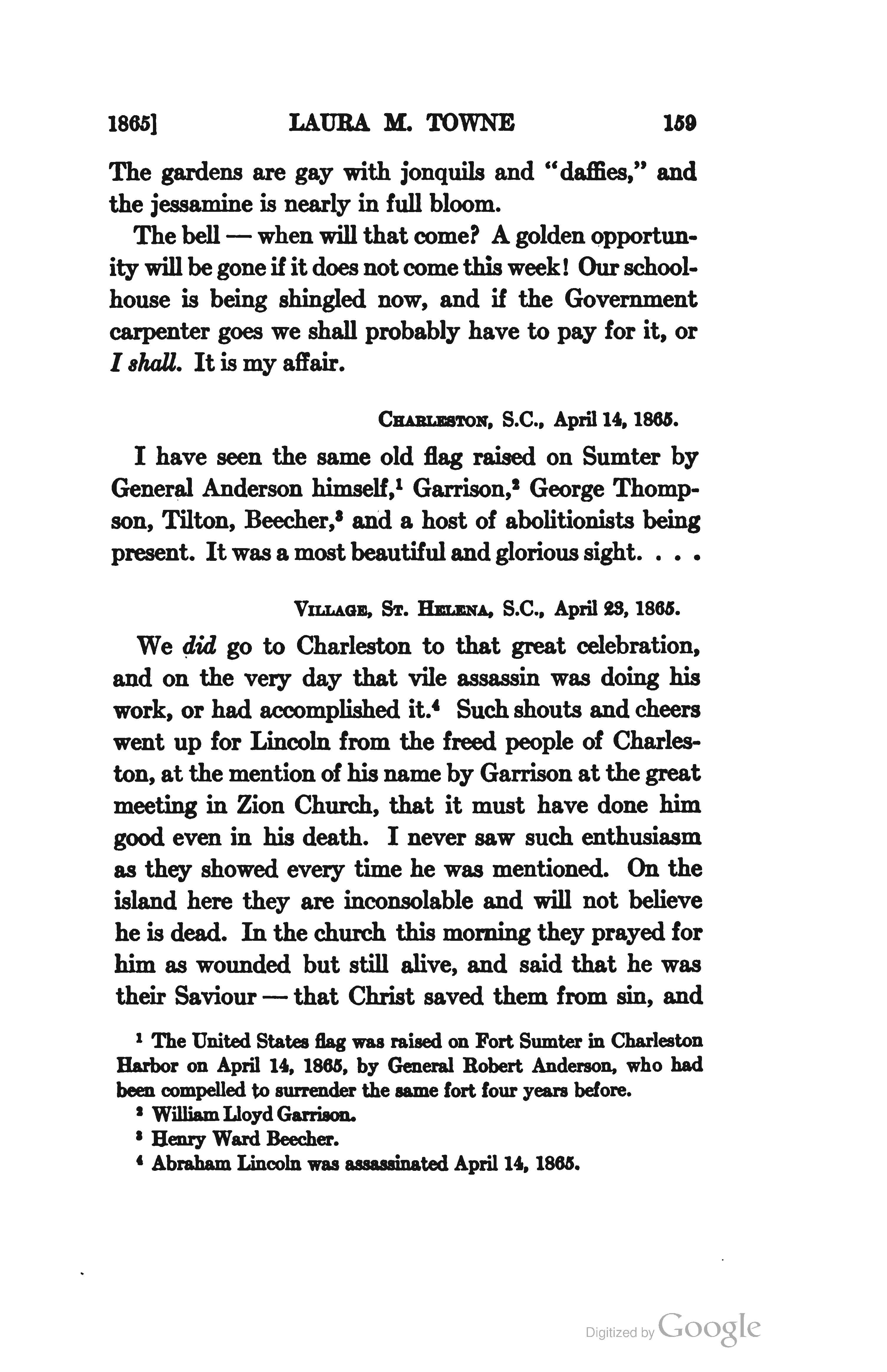
The gardens are gay with jonquils and “daffies,” and the jessamine is nearly in full bloom.
The bell — when will that come? A golden opportunity will be gone if it does not come this week! Our schoolhouse is being shingled now, and if the Government carpenter goes we shall probably have to pay for it, or I shall. It is my affair.
Charleston, S.C., April 14, 1865.
I have seen the same old flag raised on Sumter by General Anderson himself,1 Garrison,2 George Thompson, Tilton, Beecher,3 and a host of abolitionists being present. It was a most beautiful and glorious sight…
Village, St. Helena, S.C., April 23, 1865.
We did go to Charleston to that great celebration, and on the very day that vile assassin was doing his work, or had accomplished it.4 Such shouts and cheers went up for Lincoln from the freed people of Charleston, at the mention of his name by Garrison at the great meeting in Zion Church, that it must have done him good even in his death. I never saw such enthusiasm as they showed every time he was mentioned. On the island here they are inconsolable and will not believe he is dead. In the church this morning they prayed for him as wounded but still alive, and said that he was their Saviour — that Christ saved them from sin, and
1. The United States flag was raised on Fort Sumter in Charleston Harbor on April 14, 1865, by General Robert Anderson, who had been compelled to surrender the same fort four years before.
2. Willian Lloyd Garrison.
3. Henry Ward Beecher.
4. Abraham Lincoln was assassinated April 14, 1865.
----------------------------------
he from “Secesh,” and as for the vile Judas who had lifted his hand against him, they prayed the Lord the whirlwind would carry him away, and that he would melt as wax in the fervent heat, and be driven forever from before the Lord. Was n’t it the cunning of the Devil that did the deed; and they are going to prove him insane! When he was wise enough to strike the one in whom all could trust, and whose death would inevitably throw confusion and doubt into the popular mind of the North! And then to single out Seward2 in hopes that the next Secretary might embroil us with Europe and so give them another chance! It is so hard to wait a week or two before we know what comes next.
But I must tell you of our trip to Charleston. General Saxton gave us all passes, and a large party of teachers went from this island with Mr. Ruggles — good, kind, handsome fellow — to escort us. We stayed at a house kept by the former servants or slaves of Governor Aiken.
I was dreadfully seasick going up, and the day after I got there had to go to bed, and so I missed seeing many things I should have liked to visit. It stood — the house we stayed at —in the very heart of the shelled part of the city, and had ever so many balls through it. The burnt part of the town is the picture of desolation, and the detested “old sugar-house,” as the workhouse was called, looks like a giant in his lair. It was where all the slaves were whipped, and the whipping-room was made with double walls filled in with sand so that the cries could not be heard in the street. The treadmill and all
2 An attempt was also made to assassinate Secretary State Seward.
--------------------------------------------
kinds of tortures were inflicted there. I wanted to make sure of the building and asked an old black woman in that was the old sugar-house. “Dat’s it,” she said, “but it’s all played out now.” On Friday we went to Sumter, got good seats in the amphitheatre inside, near the pavilion for the speakers, and had a good opportunity to see all. I think there was not that enthusiasm in Anderson that I expected, and Henry Ward Beecher addressed himself to the “citizens of Charleston,” when there were not a dozen there. He spoke very much by note, and quite without fire.
At Sumter I bought several photographs, and send you one of the face [of the fortress] farthest from Wagner, Gregg, and our assailing forts, and consequently pretty well preserved. If you look closely you will see rows of basket-work, filled with sand, repairing a break. The whole inside of the fort is lined with them.
The next day was the grand day, however, when Wilson, Garrison, Thompson, Kelly, Tilton, and others spoke. Redpath mentioned John Brown’s name, and asked the great congregation to sing his favorite hymn, “Blow ye the Trumpet,” or “Year of Jubilee.”
I spoke to Judge Kelly afterwards and had a nice promise from him that he would send me all his speeches. We came home on Sunday and found all the missing boxes arrived,— or nearly all,— among them, mine. You do not know how intensely we all enjoy your picture—that exquisite sea-view. How could you spare me such a picture! I lie down on our sofa which faces it, and do so heartily enter into the freshness of it that it is refreshing in this hot weather. Many thanks to you.
------------------------------------------------
[The next letter refers to the death of President Lincoln.]
Saturday, April 29, 1865.
… It was a frightful blow at first. The people have refused to believe he was dead. Last Sunday the black minister of Frogmore said that if they knew the President were dead they would mourn for him, but they could not think that was the truth, and they would wait and see. We are going to-morrow to hear what further they say. One man came for clothing and seemed very indifferent about them — different from most of the people. I expressed some surprise. “Oh,” he said, “I have lost a friend. I don’t care much now about anything.” “What friend?” I asked, not really thinking for a moment. “They call him Sam,” he said; “Uncle Sam, the best friend ever I had.” Another asked me in a whisper if it were true that the “Government was dead.” Rina says she can’t sleep for thinking how sorry she is to lose “Pa Linkum.” You know they call their elders in the church—of the particular one who converted and received them in — their spiritual father, and he has the most absolute power over them. These fathers are addressed with feat and awe as “Pa Marcus,” “Pa Demas,” etc. One man said to me, “Lincoln died for we, Christ died for we, and me believe him de same mans,” that is, they are the same person.
We dressed our school-house in what black we could get, and gave a shred of crape to same of our children, who wear it sacredly. Fanny’s bonnet supplied the whole school.
[Transcription by: Grace C., Dr. Susan Corbesero’s Class, Ellis School, Pittsburgh, Pennsylvania] -
Source
-
Rights
This item is in the public domain and may be reproduced and used for any purpose, including research, teaching, private study, publication, broadcast or commercial use, with proper citation and attribution.
-
Tags
-
Cite this Item
Laura M. Towne. "Excerpts from the Letters and diary of Laura M. Towne". Cambridge, Printed at the Riverside Press,. Remembering Lincoln. Web. Accessed April 8, 2026. https://rememberinglincoln.fords.org/node/1194
-
Creator
Laura M. Towne
-
Publisher
Cambridge, Printed at the Riverside Press,
-
Date
April 22, 1865
from Apr. 22, 1865
Excerpts from the Letters and diary of Laura M. Towne
-
Description
Laura M. Towne was an abolitionist and an educator. Before the Civil War, Towne was studying medicine but was motivated to become an abolitionist after the outbreak of the Civil War. Towne volunteered when the Union captured Port Royal and other Sea Islands area of South Carolina. She and her friend, Ellen Murray, founded the Penn Center on St. Helena Island, the first school for freed slaves. Her diaries and letters from this time were edited by Rupert Sargent Holland and published in 1912.
-
Source
-
Rights
This item is in the public domain and may be reproduced and used for any purpose, including research, teaching, private study, publication, broadcast or commercial use, with proper citation and attribution.
-
Creator
Laura M. Towne
-
Publisher
Cambridge, Printed at the Riverside Press,
-
Date
April 22, 1865
from May. 1, 1865
O.J. Benham typescript diary
-
Full Title
O.J. Benham typescript diary
-
Description
The typescript copy of O.J. Benham's diary. Benham was a soldier in the Fourth Corps of the Army of the Cumberland. The diary spans February 24, 1865 to June 15, 1865, covering his time in the army. Along with his daily activities, he recorded news and rumors, including the news of the President's Assassination.
-
Source
the Duke University Libraries Digital Collections and the Duke Digital Repository
-
Rights
This item is in the public domain and may be reproduced and used for any purpose, including research, teaching, private study, publication, broadcast or commercial use, with proper citation and attribution.
-
Tags
-
Cite this Item
O.J. Benham. "O.J. Benham typescript diary". Remembering Lincoln. Web. Accessed April 8, 2026. https://rememberinglincoln.fords.org/node/1187
-
Creator
O.J. Benham
-
Date
April 1865
from May. 1, 1865
O.J. Benham typescript diary
-
Description
The typescript copy of O.J. Benham's diary. Benham was a soldier in the Fourth Corps of the Army of the Cumberland. The diary spans February 24, 1865 to June 15, 1865, covering his time in the army. Along with his daily activities, he recorded news and rumors, including the news of the President's Assassination.
-
Source
the Duke University Libraries Digital Collections and the Duke Digital Repository
-
Rights
This item is in the public domain and may be reproduced and used for any purpose, including research, teaching, private study, publication, broadcast or commercial use, with proper citation and attribution.
-
Creator
O.J. Benham
-
Date
May 1, 1865
from May. 1, 1865
Letters of Jane Grey Swisshelm
-
Full Title
Excerpts from Crusader and feminist; letters of Jane Grey Swisshelm, 1858-1865;
-
Description
Jane Grey Swisshelm a journalist was the editor of the Cloud Visiter [sic] and, afterward, the St. Cloud Democrat. The Minnesota Historical Society collected and compiled the series of articles and letters written for the St. Cloud Democrat, publishing them as a book in 1934. Her letters from late April and early May 1865, express her grief over Lincoln's death and her fear for the country's future.
-
Source
Library of Congress, General Collections and Rare Book and Special Collections Division
-
Rights
This item is in the public domain and may be reproduced and used for any purpose, including research, teaching, private study, publication, broadcast or commercial use, with proper citation and attribution.
-
Tags
-
Cite this Item
Jane Grey Swisshelm. "Excerpts from Crusader and feminist; letters of Jane Grey Swisshelm, 1858-1865;". The Minnesota Historical Society. Remembering Lincoln. Web. Accessed April 8, 2026. https://rememberinglincoln.fords.org/node/1186
-
Creator
Jane Grey Swisshelm
-
Publisher
The Minnesota Historical Society
-
Date
April-May 1865
from May. 1, 1865
Excerpts from Crusader and feminist; letters of Jane Grey Swisshelm, 1858-1865;
-
Description
Jane Grey Swisshelm a journalist was the editor of the Cloud Visiter [sic] and, afterward, the St. Cloud Democrat. The Minnesota Historical Society collected and compiled the series of articles and letters written for the St. Cloud Democrat, publishing them as a book in 1934. Her letters from late April and early May 1865, express her grief over Lincoln's death and her fear for the country's future.
-
Source
Library of Congress, General Collections and Rare Book and Special Collections Division
-
Rights
This item is in the public domain and may be reproduced and used for any purpose, including research, teaching, private study, publication, broadcast or commercial use, with proper citation and attribution.
-
Creator
Jane Grey Swisshelm
-
Publisher
The Minnesota Historical Society
-
Date
May 1, 1865
from May. 1, 1865
Journal of Elon Lee
-
Full Title
Journal of Elon Lee
-
Description
Elon Lee was a student at the Old University of Chicago in the 1860s. Lee wrote extensively in his journal and to his family about the Lincoln assassination and funeral, which he attended in Chicago
-
Source
Special Collections Research Center, University of Chicago Library
-
Rights
This item is in the public domain and may be reproduced and used for any purpose, including research, teaching, private study, publication, broadcast or commercial use, with proper citation and attribution.
-
Tags
-
Cite this Item
Elon Lee. "Journal of Elon Lee". Remembering Lincoln. Web. Accessed April 8, 2026. https://rememberinglincoln.fords.org/node/1185
-
Creator
Elon Lee
-
Date
April-May 1865
from May. 1, 1865
Journal of Elon Lee
-
Description
Elon Lee was a student at the Old University of Chicago in the 1860s. Lee wrote extensively in his journal and to his family about the Lincoln assassination and funeral, which he attended in Chicago
-
Source
Special Collections Research Center, University of Chicago Library
-
Rights
This item is in the public domain and may be reproduced and used for any purpose, including research, teaching, private study, publication, broadcast or commercial use, with proper citation and attribution.
-
Creator
Elon Lee
-
Date
May 1, 1865
from Jun. 6, 1865
A letter from Robert Todd Lincoln to Dr. Josiah G. Holland
-
Full Title
A letter from Robert Todd Lincoln to Dr. Josiah G. Holland
-
Description
A letter from Robert Todd Lincoln to Dr. Josiah G. Holland, a writer who later wrote a biography of Abraham Lincoln called the Life of Abraham Lincoln in 1866.
-
Transcription
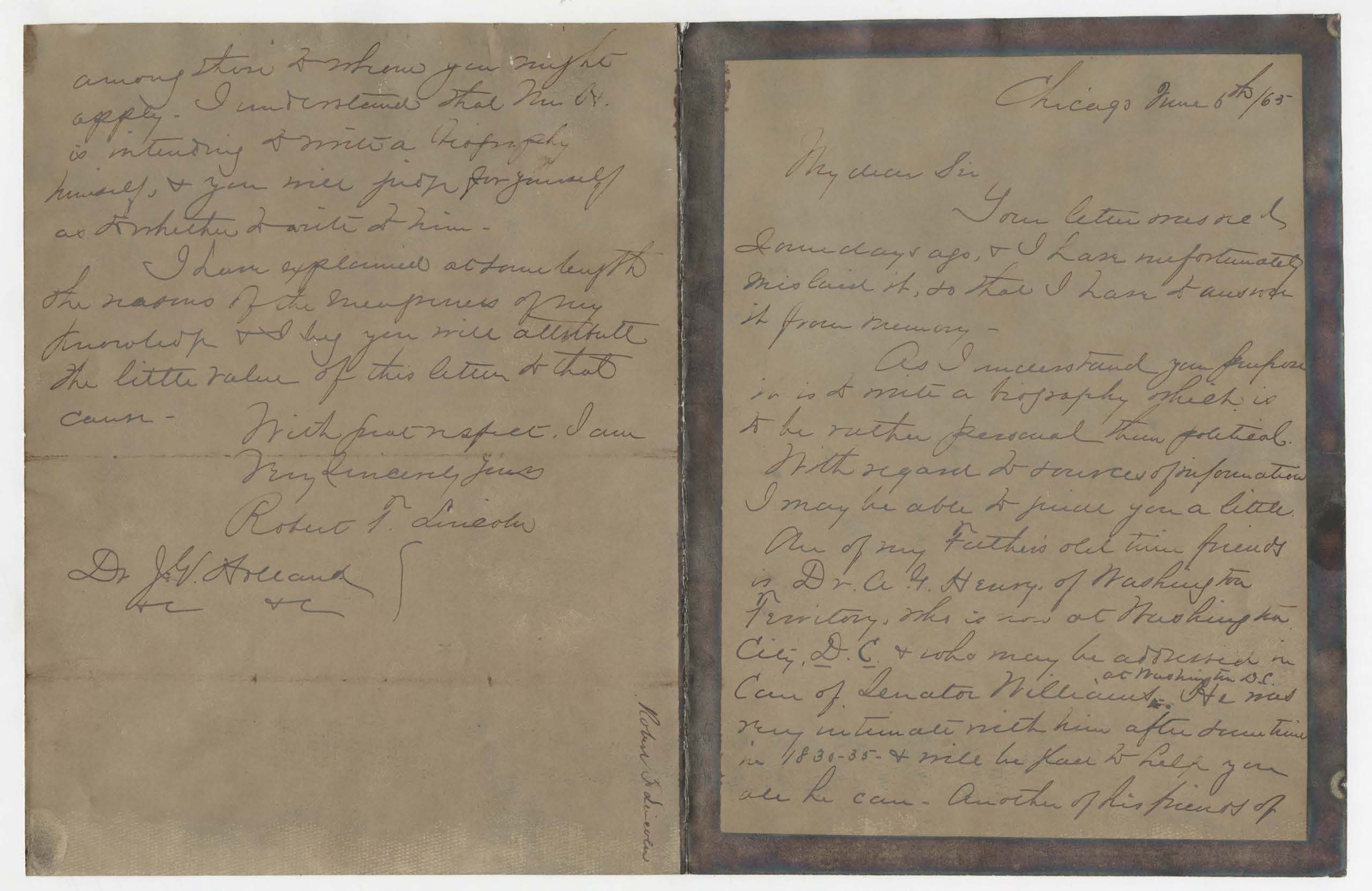
Chicago June 6th/65
My dear Sir
Your letter received
some days ago & I have unfortunately
mislaid it, so that I have to answer
it from memory.
As I understand your purpose
it is to write a biography which is
to be rather personal than political.
With regard to sources of information
I may be able to guide you a little
One of my father’s old time friends
is Dr. A. G. Henry of Washington
City, D.C. & who may be addressed in
care of Senator Williams at Washington, D.C. He was
very intimate with him after some time
in 1830-35 & will be please to help you
all he can. Another of his friends of
among those to whom you might
apply. I understand that Mr. H
is intending to write a biography
himself & you will judge for yourself
as to whether to write to him.
I have explained at some length
the reasons of the messiness of my
knowledge & I try you will attribute
the little value of this letter to that cause.
With great respect I am
Very sincerely yours
Robert T. Lincoln
Dr. J.E. Holland
&c &c
[*Robert T. Lincoln*]
[Transcription by Henry R.] -
Source
Special Collections Research Center, University of Chicago Library
-
Rights
This item is in the public domain and may be reproduced and used for any purpose, including research, teaching, private study, publication, broadcast or commercial use, with proper citation and attribution.
-
Tags
-
Cite this Item
Robert Todd Lincoln . "A letter from Robert Todd Lincoln to Dr. Josiah G. Holland". Remembering Lincoln. Web. Accessed April 8, 2026. https://rememberinglincoln.fords.org/node/1180
-
Creator
Robert Todd Lincoln
-
Date
June 6, 1865
from Jun. 6, 1865
A letter from Robert Todd Lincoln to Dr. Josiah G. Holland
-
Description
A letter from Robert Todd Lincoln to Dr. Josiah G. Holland, a writer who later wrote a biography of Abraham Lincoln called the Life of Abraham Lincoln in 1866.
-
Source
Special Collections Research Center, University of Chicago Library
-
Rights
This item is in the public domain and may be reproduced and used for any purpose, including research, teaching, private study, publication, broadcast or commercial use, with proper citation and attribution.
-
Creator
Robert Todd Lincoln
-
Date
June 6, 1865
from Dec. 4, 1865
Mary Todd Lincoln to Dr. Josiah G. Holland
-
Full Title
Mary Todd Lincoln to Dr. Josiah G. Holland
-
Description
A letter from Mary Todd Lincoln to Dr. Josiah G. Holland after receiving a copy of Holland's biography of her husband, the Life of Abraham Lincoln.
-
Transcription
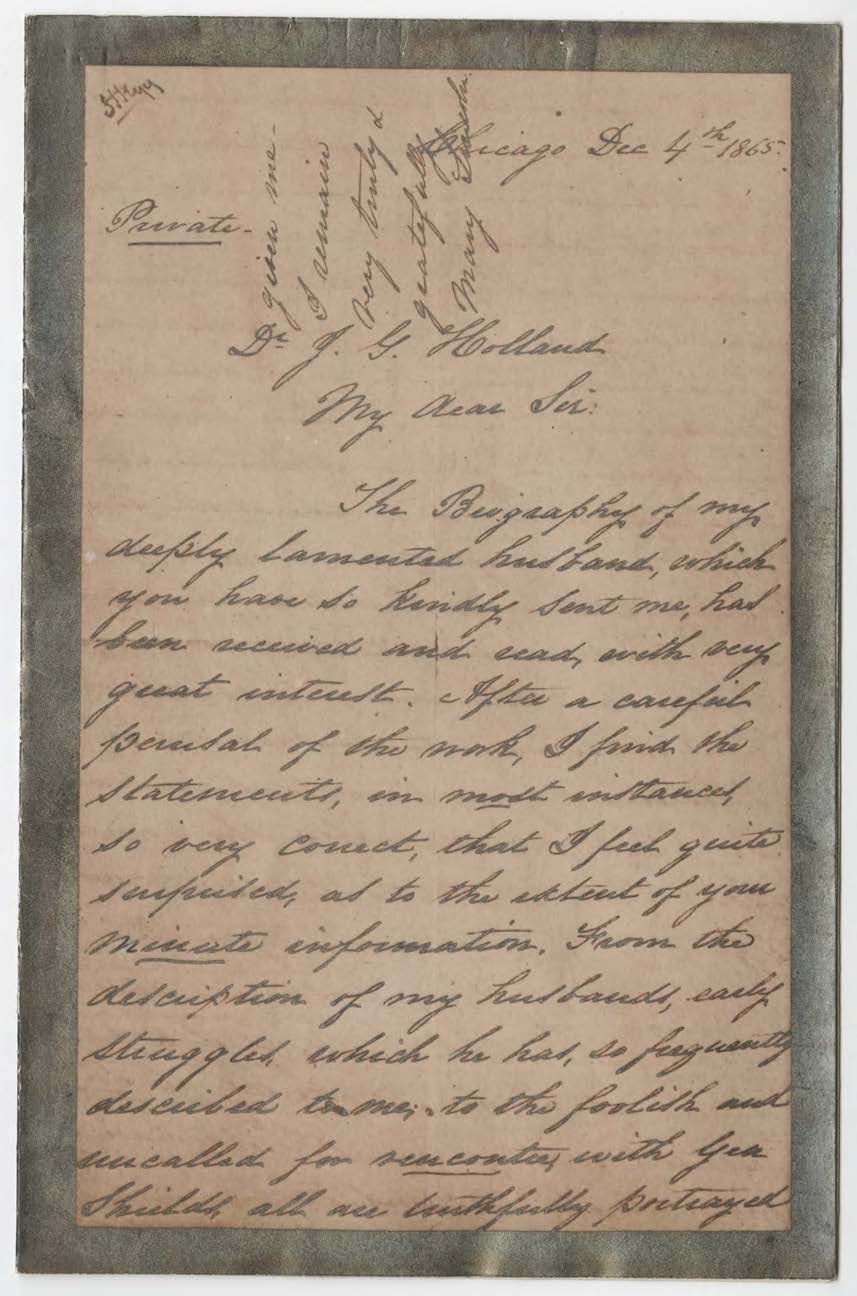
Chicago Dec 4th 1865
Private –
Dr. J. G. Holland
My dear Sir:
The Biography of my deeply lamented husband, which you have so kindly sent me, has been received and read, with very great interest. After a careful perusal of the work, I find the statements, in most instances, so very correct, that I feel quite surprised, as to the extent of your minute information. From the description of my husband, early struggles, which he has, so frequently described to me, to the foolish and uncalled for rencontre, with Gen Shields, all are truthfully portrayed.
It is exceedingly painful to me, now suffering under such an overwhelming bereavement, to recall that happy time my beloved husband had so entirely devoted himself to one, for two years before my marriage, that I doubted trespassed, many times & oft, upon his great tenderness & amiability of character. There never existed a more loving & devoted husband & such a Father, has seldom been bestowed on children. Crushed and bowed to the earth, with our great great sorrow, for the sake of my poor afflicted boys, I have to strive to live on, and comfort them, as well as I can. You are aware that with all the President’s deep feeling, he was not a demonstrative man, when he felt most deeply, he expressed the least. There are some very good persons who are inclined to magnify conversations & incidents, connected with their slight acquaintance with this great & good man. For instance, the purported conversations This last event, occurred about six months before our marriage, when, Mr. Lincoln thought he had some right to assume to be my champion, even on frivolous occasions. The poor Gent, in our little gay circle, was oftentimes, the subject of mirth & even song. And we were then surrounded by several of those, who have since been appreciated by the world. The Gent was very impulsive & on the occasion referred to, had placed himself before us, in so ridiculous a light, that the love of the ludicrous had been excited within me & I pressure, I gave vent to it, in some very silly levies. After the reconciliation between the contending parties Mr L & myself mutually agreed never to refer to it & except in an occasional light manner, between us, it was never mentioned. I am surprised at so distant a day, you should have ever heard of the circumstance.
Between the President & the Hospital nurse, it was not his nature to commit his griefs and religious feelings so fully to words & that with an entire stranger. Even between ourselves, when our deep & touching sorrows were one & the same, his expressions were few – Also the lengthy account of the lady who very wisely persisted in claiming a hospital for her State, my husband never had the time to discuss these matters, so lengthily to any person or persons-- too many of them came daily in review before him – And again, I cannot understand how strangely his temper could be at so complete a variance from what it always was, in the home circle. There he was always so gentle & kind. Before closing this long letter which I fear will weary you, ___ you get through it – allow me again to assure you of the great satisfaction the perusal of your Memoirs have given me.
I remain very truly and gratefully,
Mary Lincoln
[Transcription by Susan Brady Carr] -
Source
Special Collections Research Center, University of Chicago Library
-
Rights
This item is in the public domain and may be reproduced and used for any purpose, including research, teaching, private study, publication, broadcast or commercial use, with proper citation and attribution.
-
Tags
-
Cite this Item
Mary Todd Lincoln. "Mary Todd Lincoln to Dr. Josiah G. Holland". Remembering Lincoln. Web. Accessed April 8, 2026. https://rememberinglincoln.fords.org/node/1179
-
Creator
Mary Todd Lincoln
-
Date
December 4, 1865
from Dec. 4, 1865
Mary Todd Lincoln to Dr. Josiah G. Holland
-
Description
A letter from Mary Todd Lincoln to Dr. Josiah G. Holland after receiving a copy of Holland's biography of her husband, the Life of Abraham Lincoln.
-
Source
Special Collections Research Center, University of Chicago Library
-
Rights
This item is in the public domain and may be reproduced and used for any purpose, including research, teaching, private study, publication, broadcast or commercial use, with proper citation and attribution.
-
Creator
Mary Todd Lincoln
-
Date
December 4, 1865
from Aug. 31, 1865
A Letter from Mary Todd Lincoln to Mrs. Anson G. Henry
-
Full Title
A Letter from Mary Todd Lincoln to Mrs. Anson G. Henry
-
Description
A Letter from Mary Todd Lincoln to Mrs. Anson G. Henry. Mrs. Henry's husband was a friend of Abraham Lincoln and the Surveyor General of Washington Territory at the time of Lincoln's death. Dr. Henry died on July 30, 1865. Mary Lincoln's letter expresses her sympathy for Mrs. Henry and her own grief for the death Dr. Henry and her husband.
-
Transcription
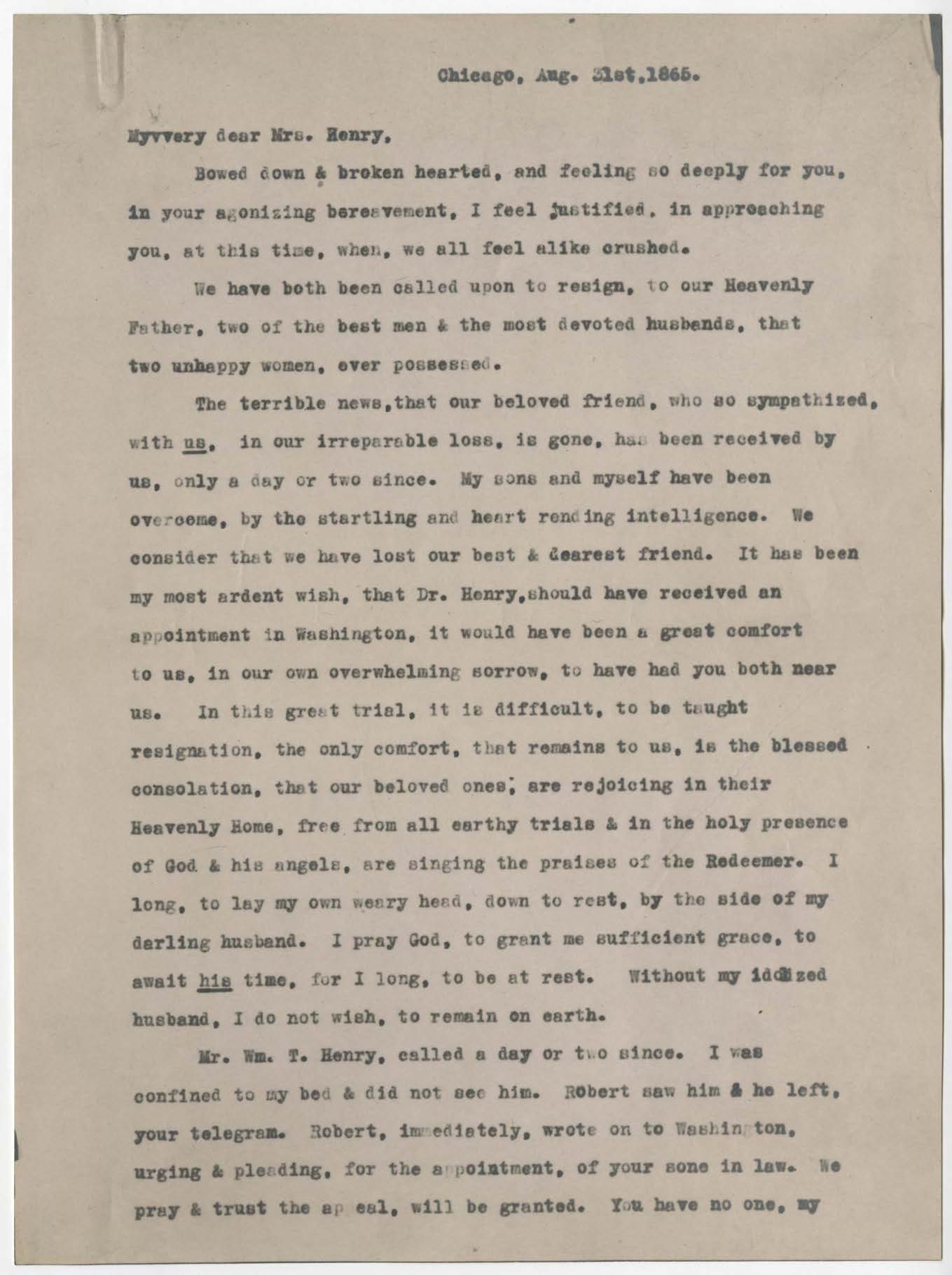
Chicago, Aug 31st 1865.
My very dear Mrs. Henry,
Bowed down and broken hearted, and feeling so deeply for you, in your agonizing bereavement, I feel justified in approaching you at this time when we all feel I’ll alike crushed.
We’ve have both been called upon to resign, to our Heavenly Father, two of the best men & the most devoted husbands that too unhappy women ever possessed.
The terrible news that our beloved friend who so sympathized with us in our irreparable loss, is gone, has been received by us, only a day or two since. My sons and myself have been overcome, by the startling and heart rendering intelligence. We consider that we have lost our best & dearest friend. It has been my most ardent wish that Dr. Henry should have received an appointment in Washington, it would have been a great comfort to us, in our own overwhelming sorrow to have had you both near us. In this great trial, it is difficult, to be taught resignation, the only comfort, that remains to us is the blessed consolation, that our beloved ones, are rejoicing in their Heavenly Home, free from all earthly trials & in the holy presence of God & his angels, are singing the praises of the Redeemer. I long, to lay my own weary head, down to rest, by the side of my darling husband. I pray God, to grant me sufficient grace, to await his time, for I long, to be at rest. Without my idolized husband, I do not wish to remain on earth.
Mr. Wm. T. Henry, called a day or two since. I was confined to my bed & did not see him. Robert saw him & he left, your telegram. Robert, immediately, wrote on to Washington, urging & pleading, for the appointment, of your son in law. We pray & trust the appeal, will be granted. You have no one, my dear friend, who could possibly feel for you, as I do, your grief is mine, in it, I am living over my own disconsolate state & the gratitude we feel for the dear Doctor’s recent sympathy, for us, in all things together with the great love, we all bore him, makes your troubles my own. How much, I wish, you lived nearer to us. We could then, weep, together over our dreary lot. The world, without my beloved husband & our best friend, is a sad and lonely place enough.
Our poor little family, would be a gloomy picture, for any one to see, who has a heart to feel. It was a great trial, to me, when Dr. Henry left here in June, that I was unable to have access to some boxes, stored in the warehouse, where was deposited a cane of my husband’s, a large family Bible & some other things design for presentation, to the Dr. So soon as I can get to them, I shall avail myself, of the first opportunity, of sending them to you. I can offer you in conclusion, of this very sad letter, my dear Mrs. Henry, very little consolation, for I am so weary & heavy laden myself, over everything, concerning us both. I trust you will write me to me, for you are very dear to me, now & ever.
With regards to your family, I remain always
Your attached friend,
Mary Lincoln.
[Transcription by Alicia B., Ford's Theatre Society, and Janet Scanlon.] -
Source
Special Collections Research Center, University of Chicago Library
-
Rights
This item is in the public domain and may be reproduced and used for any purpose, including research, teaching, private study, publication, broadcast or commercial use, with proper citation and attribution.
-
Tags
-
Cite this Item
Mary Todd Lincoln. "A Letter from Mary Todd Lincoln to Mrs. Anson G. Henry". Remembering Lincoln. Web. Accessed April 8, 2026. https://rememberinglincoln.fords.org/node/1178
-
Creator
Mary Todd Lincoln
-
Date
August 31, 1865
from Aug. 31, 1865
A Letter from Mary Todd Lincoln to Mrs. Anson G. Henry
-
Description
A Letter from Mary Todd Lincoln to Mrs. Anson G. Henry. Mrs. Henry's husband was a friend of Abraham Lincoln and the Surveyor General of Washington Territory at the time of Lincoln's death. Dr. Henry died on July 30, 1865. Mary Lincoln's letter expresses her sympathy for Mrs. Henry and her own grief for the death Dr. Henry and her husband.
-
Source
Special Collections Research Center, University of Chicago Library
-
Rights
This item is in the public domain and may be reproduced and used for any purpose, including research, teaching, private study, publication, broadcast or commercial use, with proper citation and attribution.
-
Creator
Mary Todd Lincoln
-
Date
August 31, 1865
from Apr. 19, 1865
A Letter from Dr. Anson G. Henry to his wife
-
Full Title
A Letter from Dr. Anson G. Henry to his wife
-
Description
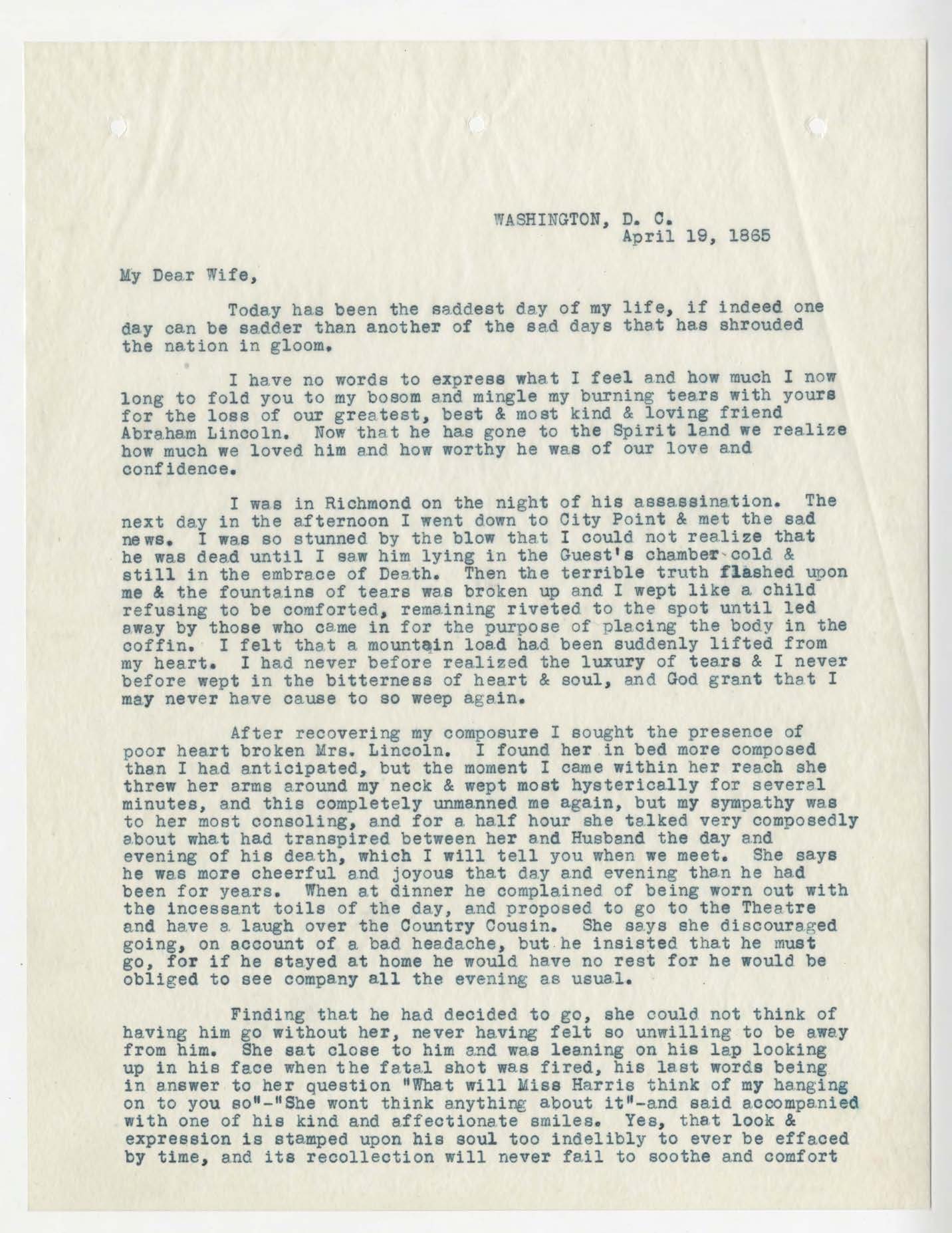
Dr. Anson G. Henry was a friend of Abraham Lincoln from Springfield who he had appointed as Surveyor General of Washington Territory during his presidency. He was in Washington following the assassination and wrote his wife about his grief and that of Mary Lincoln
-
Source
Special Collections Research Center, University of Chicago Library
-
Rights
This item is in the public domain and may be reproduced and used for any purpose, including research, teaching, private study, publication, broadcast or commercial use, with proper citation and attribution.
-
Tags
-
Cite this Item
Anson G. Henry . "A Letter from Dr. Anson G. Henry to his wife". Remembering Lincoln. Web. Accessed April 8, 2026. https://rememberinglincoln.fords.org/node/1175
-
Creator
Anson G. Henry
-
Date
April 19, 1865
from Apr. 19, 1865
A Letter from Dr. Anson G. Henry to his wife
-
Description
Dr. Anson G. Henry was a friend of Abraham Lincoln from Springfield who he had appointed as Surveyor General of Washington Territory during his presidency. He was in Washington following the assassination and wrote his wife about his grief and that of Mary Lincoln
-
Source
Special Collections Research Center, University of Chicago Library
-
Rights
This item is in the public domain and may be reproduced and used for any purpose, including research, teaching, private study, publication, broadcast or commercial use, with proper citation and attribution.
-
Creator
Anson G. Henry
-
Date
April 19, 1865
from May. 1, 1865
When Lilacs Last in the Door-Yard Blooms
-
Full Title
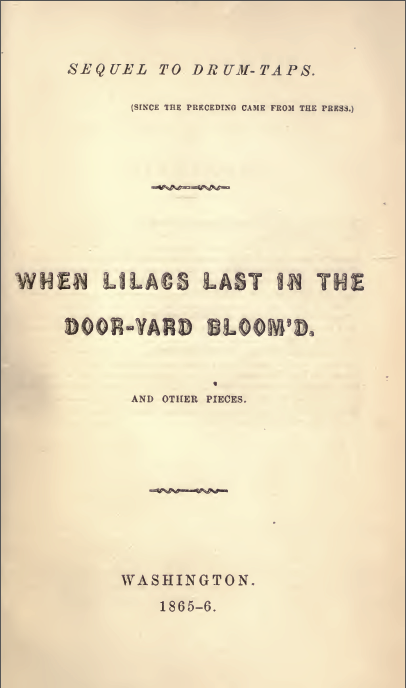
When Lilacs Last in the Door-Yard Bloom'd in the Sequel to Drum-Taps
-
Description
In 1865, Walt Whitman published Drum-Taps, a collections of poems written during the war. A sequel was published the following year, which included Oh Captain! My Captain! and When Lilacs Last in the Door-Yard Bloom'd, both written in response to the Lincoln Assassination. When Lilacs Last in the Door-Yard Bloom'd was written in the form of an elegy during the summer of 1866.
-
Source
-
Rights
This item is in the public domain and may be reproduced and used for any purpose, including research, teaching, private study, publication, broadcast or commercial use, with proper citation and attribution.
-
Tags
-
Cite this Item
Walt Whitman. "When Lilacs Last in the Door-Yard Bloom'd in the Sequel to Drum-Taps". Remembering Lincoln. Web. Accessed April 8, 2026. https://rememberinglincoln.fords.org/node/1172
-
Creator
Walt Whitman
-
Date
Summer 1865
from May. 1, 1865
When Lilacs Last in the Door-Yard Bloom'd in the Sequel to Drum-Taps
-
Description
In 1865, Walt Whitman published Drum-Taps, a collections of poems written during the war. A sequel was published the following year, which included Oh Captain! My Captain! and When Lilacs Last in the Door-Yard Bloom'd, both written in response to the Lincoln Assassination. When Lilacs Last in the Door-Yard Bloom'd was written in the form of an elegy during the summer of 1866.
-
Source
-
Rights
This item is in the public domain and may be reproduced and used for any purpose, including research, teaching, private study, publication, broadcast or commercial use, with proper citation and attribution.
-
Creator
Walt Whitman
-
Date
May 1, 1865
from May. 1, 1865
Lincoln's coffin in the City Hall, Chicago
-
Full Title
Lincoln's coffin in the City Hall, Chicago
-
Description
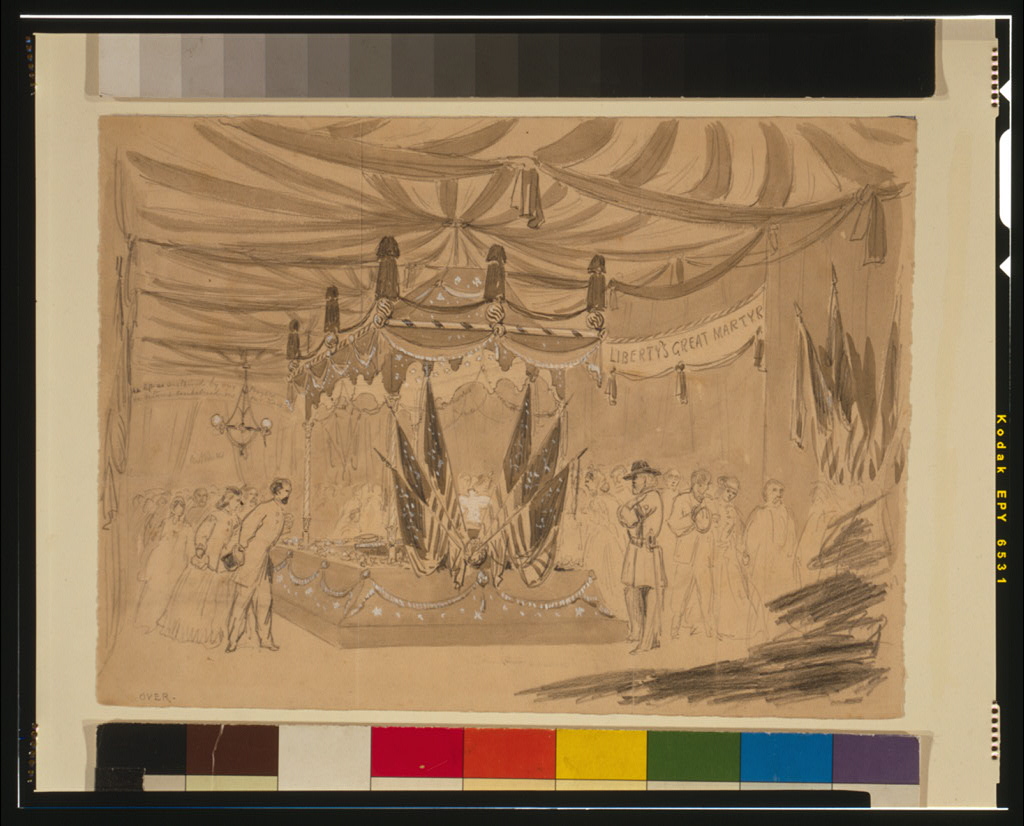
Civil War artist correspondent, William Waud, depicted Lincoln laying in state in Chicago's City Hall on May 1, 1865. It was published in Harper's Weekly on May 20, 1865.
-
Transcription
Inscribed on decorative banners within image: He left us sustained by our Prayers He returns embalmed in our tears; Liberty's great martyr.
Inscribed on verso: Catafalque in the City Hall, Chicago. The ceiling is draped black & white. The walls draped in folds all black with flag trophies at certain distances. The Catafalque is covered with black cloth & velvet all black with silver fringe & stars. Inside of d[itt]o & the pillars white with the exception of the ceiling inside the canopy which is black with white stars cut out through which the light is admitted to fall on the coffin. -
Source
Library of Congress, Prints and Photographs Division, LC-USZC4-8107
-
Rights
This item is in the public domain and may be reproduced and used for any purpose, including research, teaching, private study, publication, broadcast or commercial use, with proper citation and attribution.
-
Tags
-
Cite this Item
William Waud. "Lincoln's coffin in the City Hall, Chicago". Harper's Weekly. Remembering Lincoln. Web. Accessed April 8, 2026. https://rememberinglincoln.fords.org/node/1139
-
Creator
William Waud
-
Publisher
Harper's Weekly
-
Date
May 1, 1865
-
Material
pink-tan paper, pencil, and Chinese white, and black ink wash
-
Dimensions
25.5 x 34.5 cm
from May. 1, 1865
Lincoln's coffin in the City Hall, Chicago
-
Description
Civil War artist correspondent, William Waud, depicted Lincoln laying in state in Chicago's City Hall on May 1, 1865. It was published in Harper's Weekly on May 20, 1865.
-
Source
Library of Congress, Prints and Photographs Division, LC-USZC4-8107
-
Rights
This item is in the public domain and may be reproduced and used for any purpose, including research, teaching, private study, publication, broadcast or commercial use, with proper citation and attribution.
-
Creator
William Waud
-
Publisher
Harper's Weekly
-
Date
May 1, 1865
-
Material
pink-tan paper, pencil, and Chinese white, and black ink wash
-
Dimensions
25.5 x 34.5 cm