from May. 13, 1865
President Lincoln's Funeral Train on a Steamer
-
Full Title
President Lincoln's Funeral Train on a Steamer - Frank Leslie's Illustrated Newspaper Drawing
-
Description
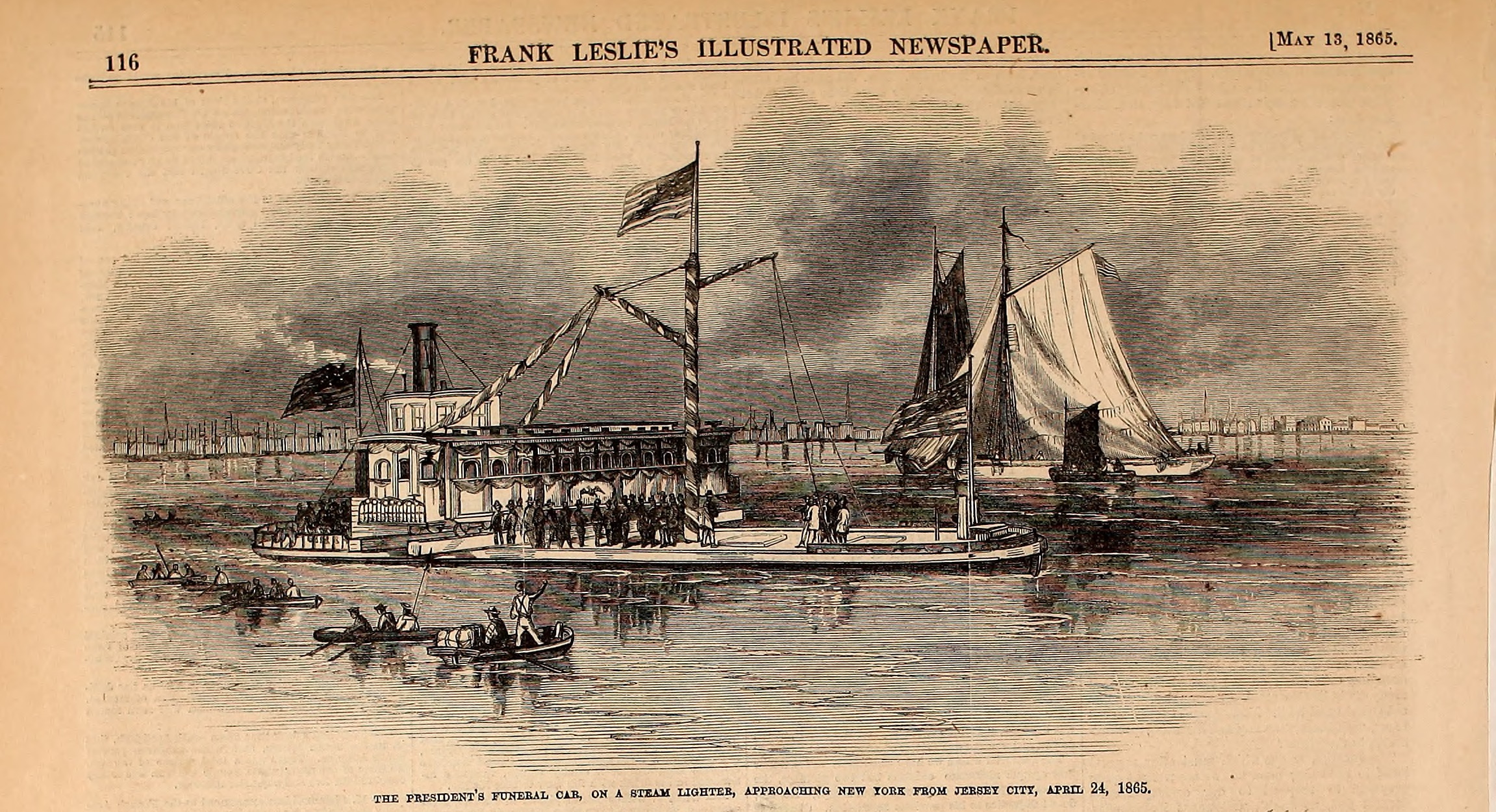
In the May 13th, 1865 edition of Frank Leslie's Illustrated Weekly newspaper, this image was printed next to an article about President Lincoln's funeral train heading to Springfield, Illinois for burial. The train carrying Lincoln’s body traveled through 180 cities and seven states on its way to Springfield. Scheduled stops for the special funeral train were published in newspapers. In ten cities, Lincoln’s casket was removed from the train for elaborate memorial services and public viewings. Millions of Americans came out to see the president and pay respects. The illustrated literary and news publication was founded in 1855 and continued until 1922. It was one of several started by publisher and illustrator Frank Leslie. Leslie was a British engraver who came to the United States in 1848. The Illustrated Weekly followed a tested and proven formula of carefully combining elements of war, politics, art, science, travel and exploration, literature and the fine arts in each issue, enhanced with between 16 and 32 illustrations. By 1897 its circulation had grown to an estimated 65,000 copies.
-
Source
Lincoln Financial Foundation Collection
-
Rights
To request rights and permissions to use Lincoln Financial Foundation Collection images in research or publications, please download our image rights permission form: https://www.lincolncollection.org/access/image-rights-permissions/.
-
Tags
-
Cite this Item
Frank Leslie. "President Lincoln's Funeral Train on a Steamer - Frank Leslie's Illustrated Newspaper Drawing". Frank Leslie. Remembering Lincoln. Web. Accessed April 5, 2026. https://rememberinglincoln.fords.org/node/1113
-
Creator
Frank Leslie
-
Publisher
Frank Leslie
-
Date
May 13, 1865
from May. 13, 1865
President Lincoln's Funeral Train on a Steamer - Frank Leslie's Illustrated Newspaper Drawing
-
Description
In the May 13th, 1865 edition of Frank Leslie's Illustrated Weekly newspaper, this image was printed next to an article about President Lincoln's funeral train heading to Springfield, Illinois for burial. The train carrying Lincoln’s body traveled through 180 cities and seven states on its way to Springfield. Scheduled stops for the special funeral train were published in newspapers. In ten cities, Lincoln’s casket was removed from the train for elaborate memorial services and public viewings. Millions of Americans came out to see the president and pay respects. The illustrated literary and news publication was founded in 1855 and continued until 1922. It was one of several started by publisher and illustrator Frank Leslie. Leslie was a British engraver who came to the United States in 1848. The Illustrated Weekly followed a tested and proven formula of carefully combining elements of war, politics, art, science, travel and exploration, literature and the fine arts in each issue, enhanced with between 16 and 32 illustrations. By 1897 its circulation had grown to an estimated 65,000 copies.
-
Source
Lincoln Financial Foundation Collection
-
Rights
To request rights and permissions to use Lincoln Financial Foundation Collection images in research or publications, please download our image rights permission form: https://www.lincolncollection.org/access/image-rights-permissions/.
-
Creator
Frank Leslie
-
Publisher
Frank Leslie
-
Date
May 13, 1865
from Jun. 10, 1865
The Funeral Catafalque at Springfield, Illinois
-
Full Title
The Funeral Catafalque at Springfield, Illinois - Frank Leslie's Illustrated Newspaper Drawing
-
Description
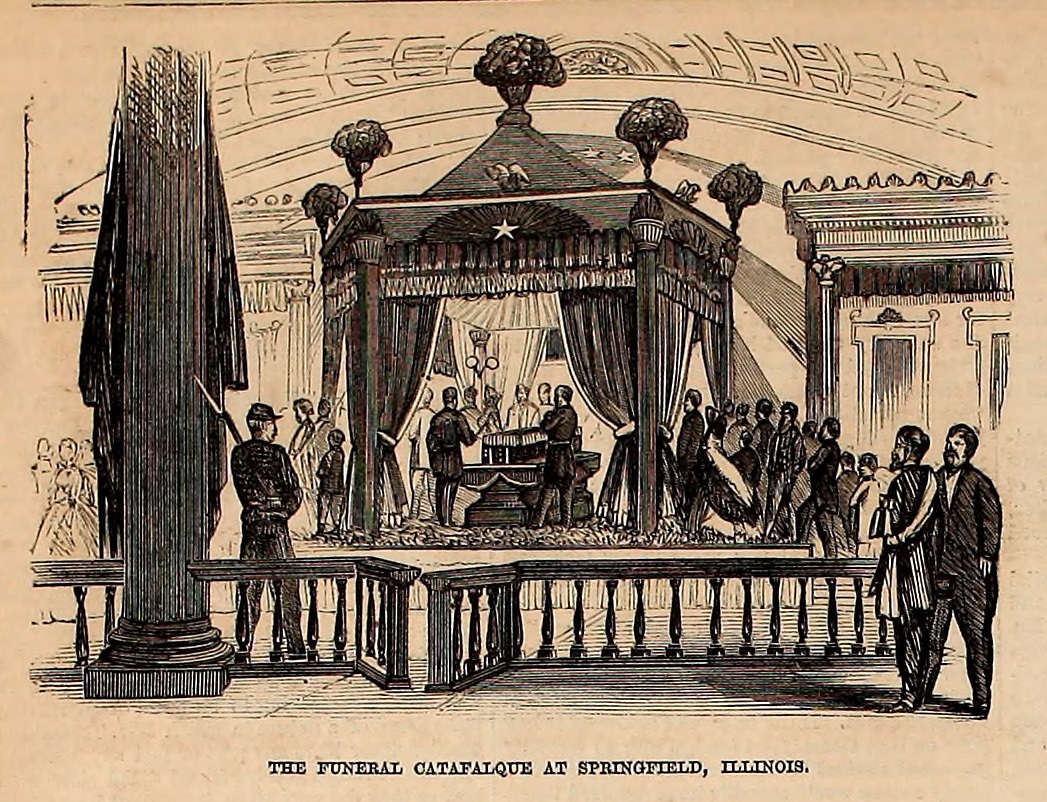
In the June 10th, 1865 edition of Frank Leslie's Illustrated Weekly newspaper, this image was printed next to an article about President Lincoln's funeral in Springfield, Illinois. It shows mourners visiting Lincoln's coffin before burial. President Lincoln was buried on May 4, 1865 at Oak Ridge Cemetery. The illustrated literary and news publication was founded in 1855 and continued until 1922. It was one of several started by publisher and illustrator Frank Leslie. Leslie was a British engraver who came to the United States in 1848. The Illustrated Weekly followed a tested and proven formula of carefully combining elements of war, politics, art, science, travel and exploration, literature and the fine arts in each issue, enhanced with between 16 and 32 illustrations. By 1897 its circulation had grown to an estimated 65,000 copies.
-
Source
Lincoln Financial Foundation Collection
-
Rights
To request rights and permissions to use Lincoln Financial Foundation Collection images in research or publications, please download our image rights permission form: https://www.lincolncollection.org/access/image-rights-permissions/.
-
Tags
-
Cite this Item
Thomas Hogan. "The Funeral Catafalque at Springfield, Illinois - Frank Leslie's Illustrated Newspaper Drawing". Frank Leslie. Remembering Lincoln. Web. Accessed April 5, 2026. https://rememberinglincoln.fords.org/node/1112
-
Creator
Thomas Hogan
-
Publisher
Frank Leslie
-
Date
June 10, 1865
from Jun. 10, 1865
The Funeral Catafalque at Springfield, Illinois - Frank Leslie's Illustrated Newspaper Drawing
-
Description
In the June 10th, 1865 edition of Frank Leslie's Illustrated Weekly newspaper, this image was printed next to an article about President Lincoln's funeral in Springfield, Illinois. It shows mourners visiting Lincoln's coffin before burial. President Lincoln was buried on May 4, 1865 at Oak Ridge Cemetery. The illustrated literary and news publication was founded in 1855 and continued until 1922. It was one of several started by publisher and illustrator Frank Leslie. Leslie was a British engraver who came to the United States in 1848. The Illustrated Weekly followed a tested and proven formula of carefully combining elements of war, politics, art, science, travel and exploration, literature and the fine arts in each issue, enhanced with between 16 and 32 illustrations. By 1897 its circulation had grown to an estimated 65,000 copies.
-
Source
Lincoln Financial Foundation Collection
-
Rights
To request rights and permissions to use Lincoln Financial Foundation Collection images in research or publications, please download our image rights permission form: https://www.lincolncollection.org/access/image-rights-permissions/.
-
Creator
Thomas Hogan
-
Publisher
Frank Leslie
-
Date
June 10, 1865
from Jun. 10, 1865
Mourners at Abraham Lincoln's Funeral in Springfield, IL
-
Full Title
Mourners at Abraham Lincoln's Funeral in Springfield, IL - Frank Leslie's Illustrated Newspaper Drawing
-
Description
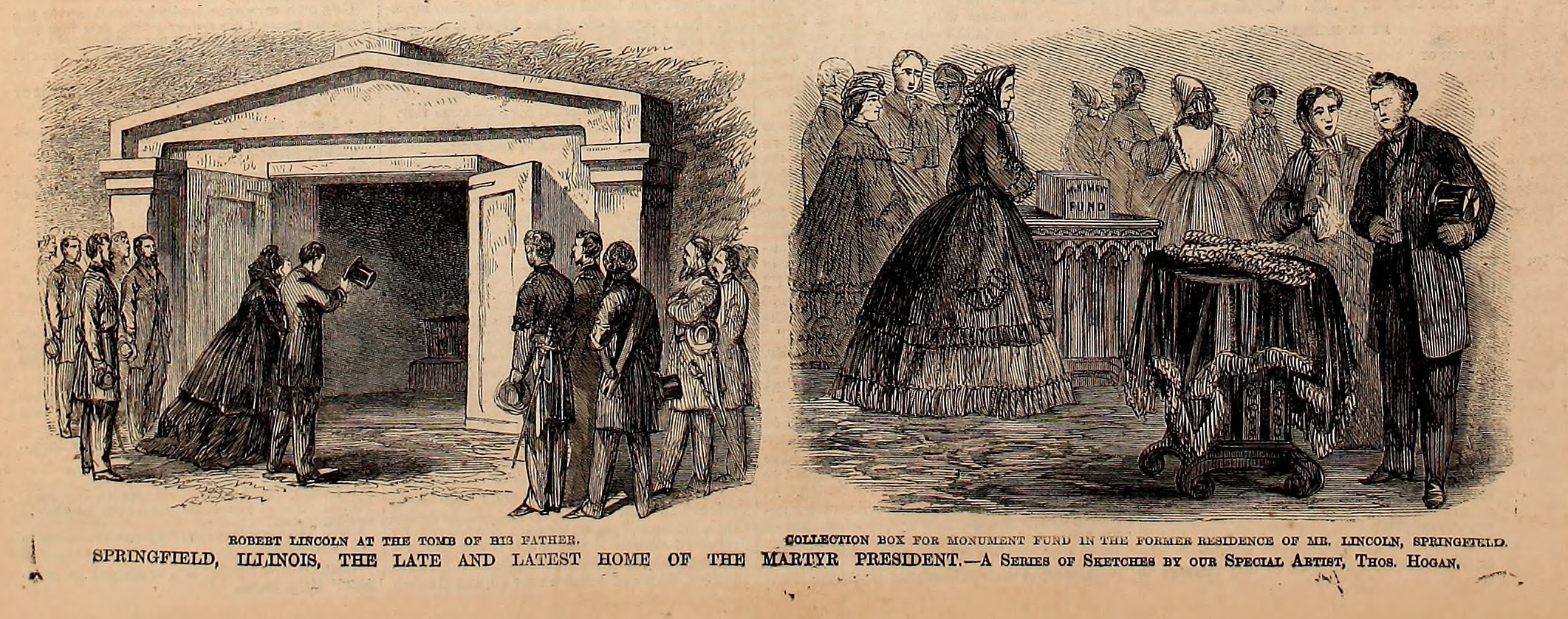
In the June 10th, 1865 edition of Frank Leslie's Illustrated Weekly newspaper, this image was printed next to an article about President Lincoln's funeral in Springfield, Illinois. It shows President Lincoln's eldest son, Robert, at his tomb and others raising money to build a memorial to President Lincoln. President Lincoln was buried on May 4, 1865 at Oak Ridge Cemetery. The illustrated literary and news publication was founded in 1855 and continued until 1922. It was one of several started by publisher and illustrator Frank Leslie. Leslie was a British engraver who came to the United States in 1848. The Illustrated Weekly followed a tested and proven formula of carefully combining elements of war, politics, art, science, travel and exploration, literature and the fine arts in each issue, enhanced with between 16 and 32 illustrations. By 1897 its circulation had grown to an estimated 65,000 copies.
-
Source
The Lincoln Financial Foundation Collection
-
Rights
To request rights and permissions to use Lincoln Financial Foundation Collection images in research or publications, please download our image rights permission form: https://www.lincolncollection.org/access/image-rights-permissions/.
-
Tags
-
Cite this Item
Thomas Hogan. "Mourners at Abraham Lincoln's Funeral in Springfield, IL - Frank Leslie's Illustrated Newspaper Drawing". Frank Leslie. Remembering Lincoln. Web. Accessed April 5, 2026. https://rememberinglincoln.fords.org/node/1111
-
Creator
Thomas Hogan
-
Publisher
Frank Leslie
-
Date
June 10, 1865
from Jun. 10, 1865
Mourners at Abraham Lincoln's Funeral in Springfield, IL - Frank Leslie's Illustrated Newspaper Drawing
-
Description
In the June 10th, 1865 edition of Frank Leslie's Illustrated Weekly newspaper, this image was printed next to an article about President Lincoln's funeral in Springfield, Illinois. It shows President Lincoln's eldest son, Robert, at his tomb and others raising money to build a memorial to President Lincoln. President Lincoln was buried on May 4, 1865 at Oak Ridge Cemetery. The illustrated literary and news publication was founded in 1855 and continued until 1922. It was one of several started by publisher and illustrator Frank Leslie. Leslie was a British engraver who came to the United States in 1848. The Illustrated Weekly followed a tested and proven formula of carefully combining elements of war, politics, art, science, travel and exploration, literature and the fine arts in each issue, enhanced with between 16 and 32 illustrations. By 1897 its circulation had grown to an estimated 65,000 copies.
-
Source
The Lincoln Financial Foundation Collection
-
Rights
To request rights and permissions to use Lincoln Financial Foundation Collection images in research or publications, please download our image rights permission form: https://www.lincolncollection.org/access/image-rights-permissions/.
-
Creator
Thomas Hogan
-
Publisher
Frank Leslie
-
Date
June 10, 1865
from May. 13, 1865
Abraham Lincoln's Coffin
-
Full Title
Abraham Lincoln's Coffin - Frank Leslie's Illustrated Newspaper Drawing
-
Description
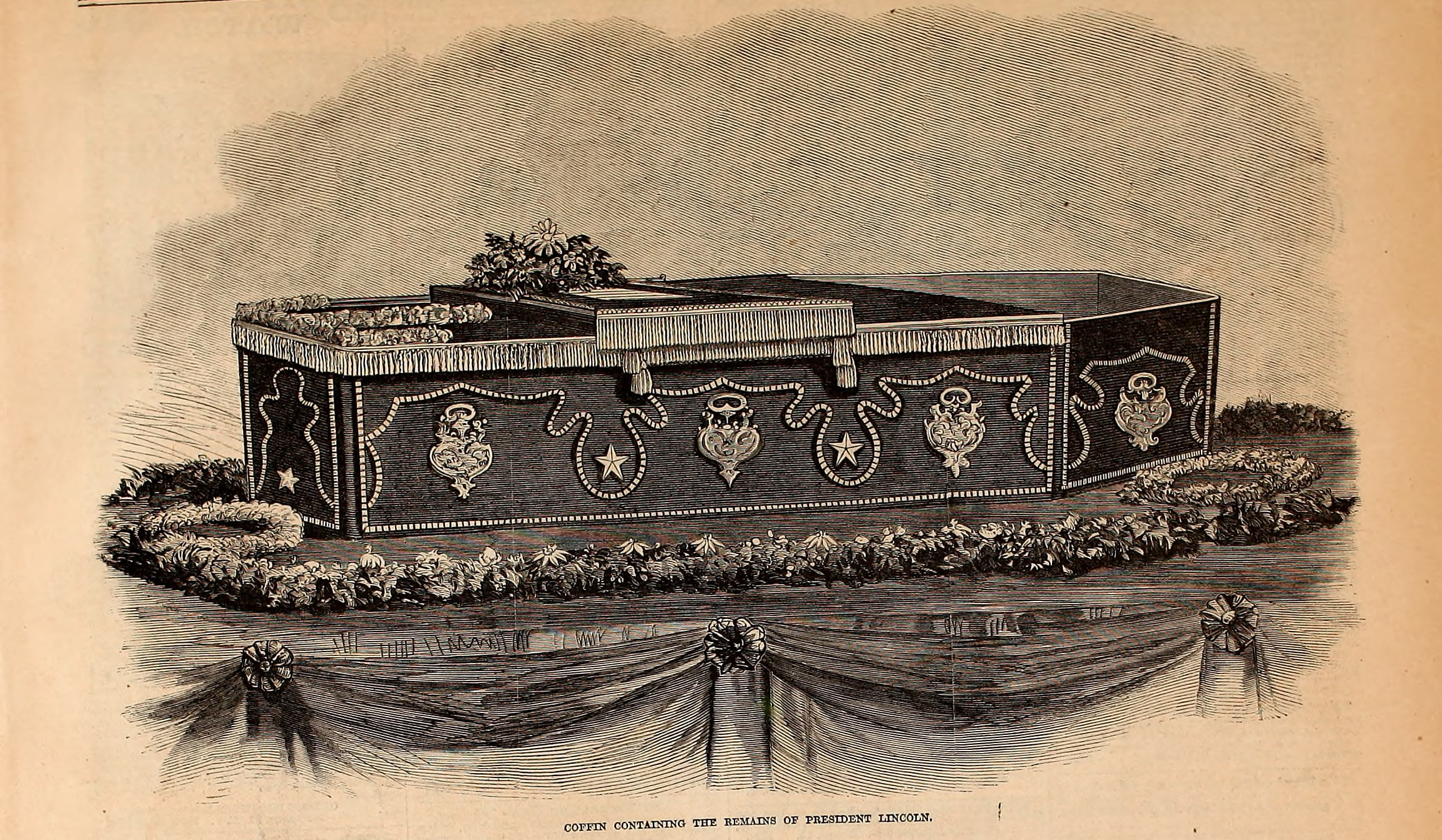
In the May 13th, 1865 edition of Frank Leslie's Illustrated Weekly newspaper, this image was printed next to an article about President Lincoln's funeral. The illustrated literary and news publication was founded in 1855 and continued until 1922. It was one of several started by publisher and illustrator Frank Leslie. Leslie was a British engraver who came to the United States in 1848. The Illustrated Weekly followed a tested and proven formula of carefully combining elements of war, politics, art, science, travel and exploration, literature and the fine arts in each issue, enhanced with between 16 and 32 illustrations. By 1897 its circulation had grown to an estimated 65,000 copies.
-
Source
The Lincoln Financial Foundation Collection
-
Rights
To request rights and permissions to use Lincoln Financial Foundation Collection images in research or publications, please download our image rights permission form: https://www.lincolncollection.org/access/image-rights-permissions/.
-
Tags
-
Cite this Item
Frank Leslie. "Abraham Lincoln's Coffin - Frank Leslie's Illustrated Newspaper Drawing". Frank Leslie. Remembering Lincoln. Web. Accessed April 5, 2026. https://rememberinglincoln.fords.org/node/1109
-
Creator
Frank Leslie
-
Publisher
Frank Leslie
-
Date
May 13, 1865
from May. 13, 1865
Abraham Lincoln's Coffin - Frank Leslie's Illustrated Newspaper Drawing
-
Description
In the May 13th, 1865 edition of Frank Leslie's Illustrated Weekly newspaper, this image was printed next to an article about President Lincoln's funeral. The illustrated literary and news publication was founded in 1855 and continued until 1922. It was one of several started by publisher and illustrator Frank Leslie. Leslie was a British engraver who came to the United States in 1848. The Illustrated Weekly followed a tested and proven formula of carefully combining elements of war, politics, art, science, travel and exploration, literature and the fine arts in each issue, enhanced with between 16 and 32 illustrations. By 1897 its circulation had grown to an estimated 65,000 copies.
-
Source
The Lincoln Financial Foundation Collection
-
Rights
To request rights and permissions to use Lincoln Financial Foundation Collection images in research or publications, please download our image rights permission form: https://www.lincolncollection.org/access/image-rights-permissions/.
-
Creator
Frank Leslie
-
Publisher
Frank Leslie
-
Date
May 13, 1865
from May. 1, 1865
Letter to Mary Todd Lincoln from Queen Victoria
-
Full Title
Letter to Mary Todd Lincoln from Queen Victoria
-
Description
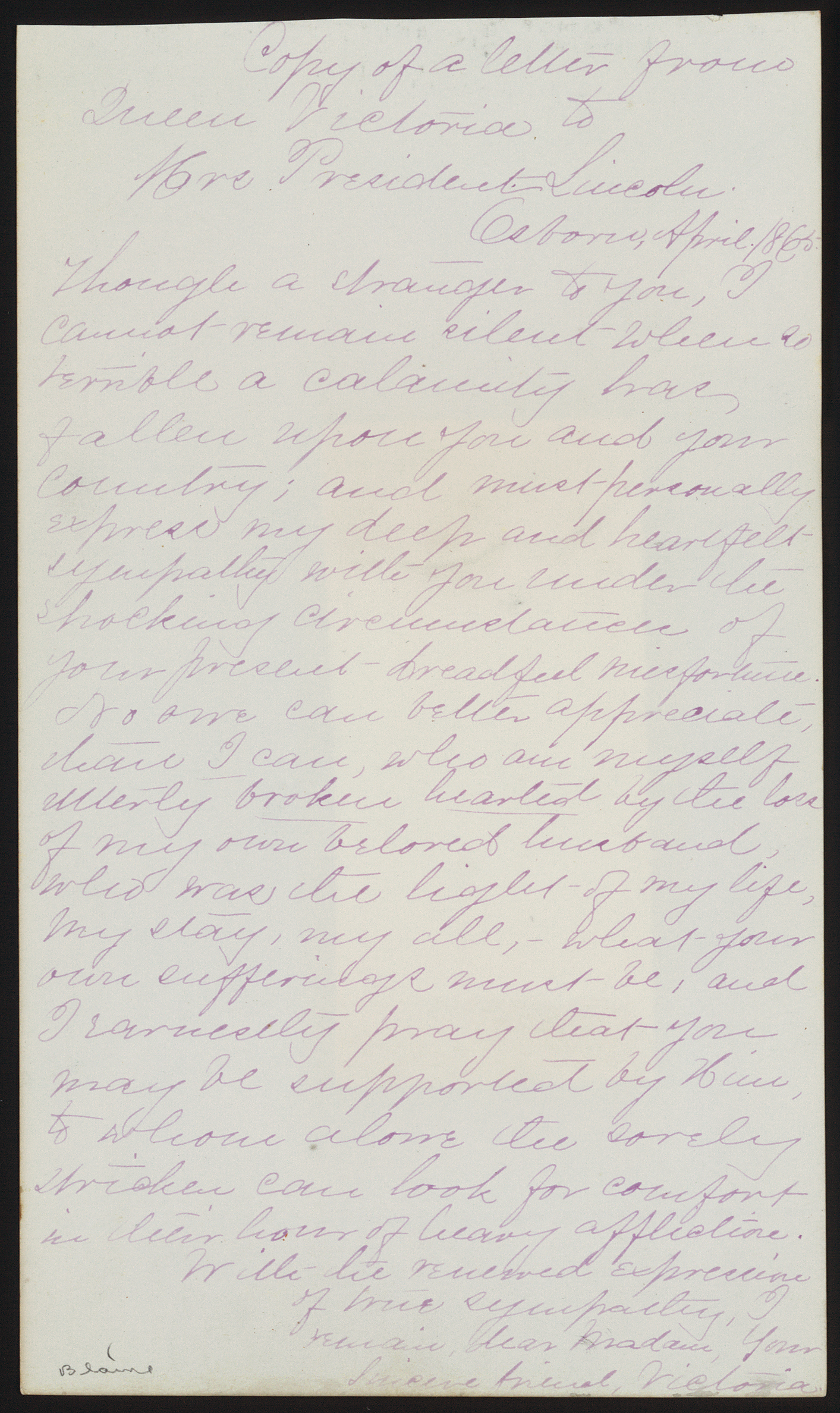
Manuscript transcription of a letter from Queen Victoria to Mrs. Abraham Lincoln, written in purple ink on white woven paper. Queen Victoria, the British monarch, wrote to Mary Lincoln after learning about the assassination of Abraham Lincoln. The two women had never met, but Queen Victoria wanted to convey her sympathies to Mrs. Lincoln because she also lost her husband in 1861 and went into intense mourning.
-
Transcription
Copy of a letter from Queen Victoria to Mrs. President Lincoln Osborne, April. 1865
Thought a stranger to you, cannot remain silent w[?] so terrible a calamity has fallen upon you and your country; and must personally express my deep and heartfelt sympathy wi[?] you under shocking circumstances of your present— dreadful misfortune. No one can better appreciate, than I can, who am myself utterly broken hearted by the loss of my own beloved husband, who was the light of my life, my stay, my all, —what your own sufferings must be, and I earnestly pray that you may be supported by Him, to whom alone the sorely stricken can look for comfort in their hour of heavy afflication.
With the renewed expression of true sympathy, I remain, dear Madam, Your sincere friend, Victoria -
Source
Library of Congress
-
Rights
This item is in the public domain and may be reproduced and used for any purpose, including research, teaching, private study, publication, broadcast or commercial use, with proper citation and attribution.
-
Tags
-
Cite this Item
Queen Victoria. "Letter to Mary Todd Lincoln from Queen Victoria". Remembering Lincoln. Web. Accessed April 5, 2026. https://rememberinglincoln.fords.org/node/1108
-
Creator
Queen Victoria
-
Date
1865
-
Dimensions
21 x 11 cm
from May. 1, 1865
Letter to Mary Todd Lincoln from Queen Victoria
-
Description
Manuscript transcription of a letter from Queen Victoria to Mrs. Abraham Lincoln, written in purple ink on white woven paper. Queen Victoria, the British monarch, wrote to Mary Lincoln after learning about the assassination of Abraham Lincoln. The two women had never met, but Queen Victoria wanted to convey her sympathies to Mrs. Lincoln because she also lost her husband in 1861 and went into intense mourning.
-
Source
Library of Congress
-
Rights
This item is in the public domain and may be reproduced and used for any purpose, including research, teaching, private study, publication, broadcast or commercial use, with proper citation and attribution.
-
Creator
Queen Victoria
-
Date
May 1, 1865
-
Dimensions
21 x 11 cm
from Apr. 14, 1865
Horatio Nelson Taft Diary, April 6-14, 1865
-
Full Title
Horatio Nelson Taft Diary, April 6-14, 1865
-
Description
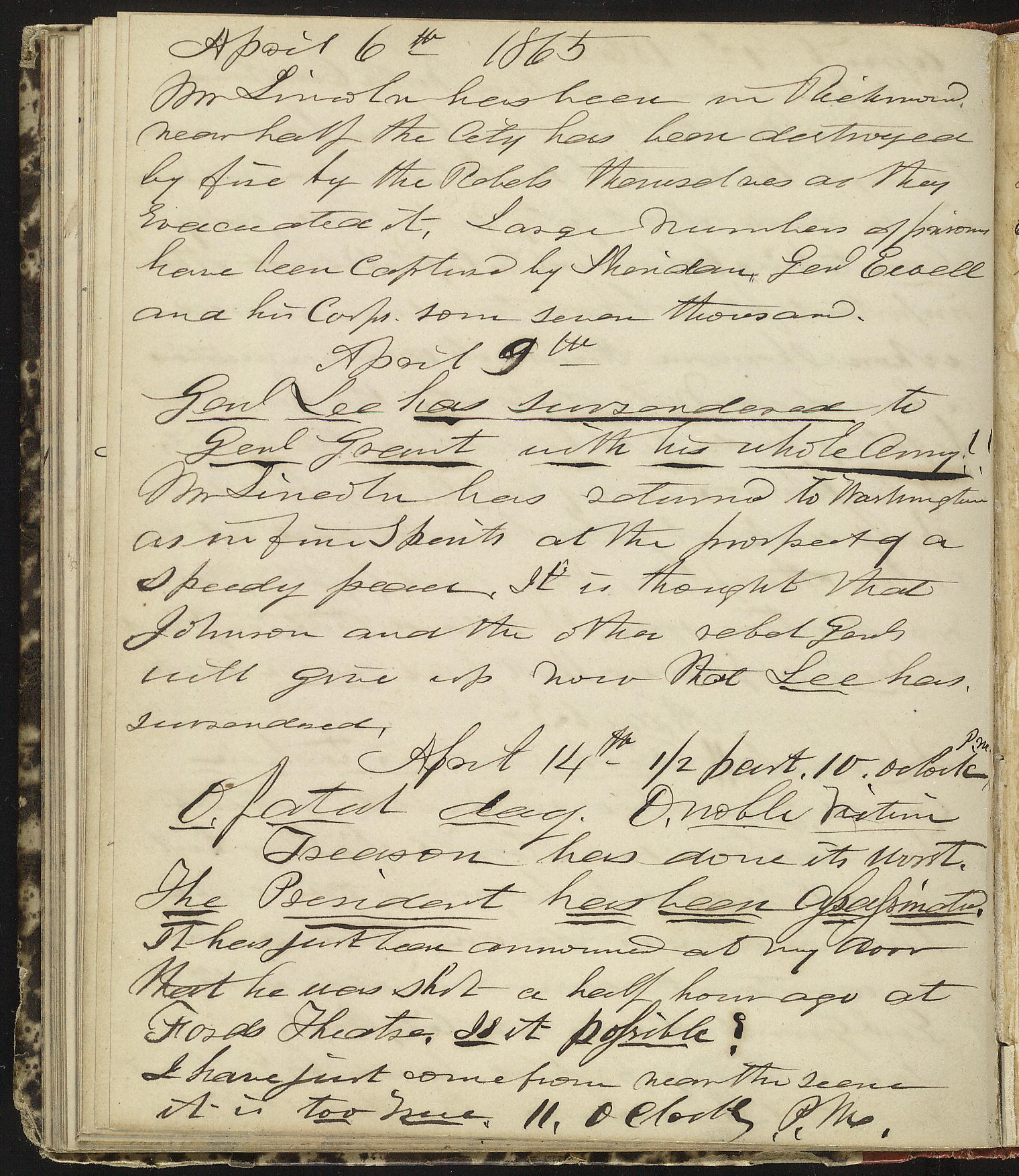
This excerpt from the diary of Horatio Nelson Taft is an insight into some of the first reactions of citizens of the Union to the death of President Lincoln. Taft, who was a patent clerk, laments Lincoln's teach and denounces the assassination as assassination at it's worst. In the entry just prior to the excerpt describing Lincoln's death, Taft described the return of Lincoln to Washington after a Union victory.
-
Transcription
April 6th 1865
Mr Lincoln has been in Richmond. Near half of the City has been destroyed by fire by the
Rebels themselves as they evacuated it. Large numbers of prisoners have been captured
by Sheridan, Genl Ewell and his Corps, some seven thousand.
April 9, 1865
Genl Lee has surrendered to Genl Grant with his whole Army!! Mr Lincoln has returned to
Washington as in fine Spirits at the prospect of a speedy peace. It is thought that Johnson
and the other rebel Genls will give up now that Lee has surrendered.
April 14th ½ past 10 o'clock P.M.
O, fatal day. O, noble Victim.
Treason has done its worst.
The President has been Assassinated.
It has just been announced at my door
that he was shot a half hour ago at Fords Theatre.
Is it possible?
I have just come from near the scene,
it is too True. 11, o'clock P.M. -
Source
memory.loc.gov
-
Rights
This item is in the public domain and may be reproduced and used for any purpose, including research, teaching, private study, publication, broadcast or commercial use, with proper citation and attribution.
-
Tags
-
Cite this Item
Horatio Nelson Taft. "Horatio Nelson Taft Diary, April 6-14, 1865". Remembering Lincoln. Web. Accessed April 5, 2026. https://rememberinglincoln.fords.org/node/1107

-
Creator
Horatio Nelson Taft
-
Date
April 6, 1865 & April 14, 1865
-
Material
bound paper with script in ink and type
from Apr. 14, 1865
Horatio Nelson Taft Diary, April 6-14, 1865
-
Description
This excerpt from the diary of Horatio Nelson Taft is an insight into some of the first reactions of citizens of the Union to the death of President Lincoln. Taft, who was a patent clerk, laments Lincoln's teach and denounces the assassination as assassination at it's worst. In the entry just prior to the excerpt describing Lincoln's death, Taft described the return of Lincoln to Washington after a Union victory.
-
Source
memory.loc.gov
-
Rights
This item is in the public domain and may be reproduced and used for any purpose, including research, teaching, private study, publication, broadcast or commercial use, with proper citation and attribution.
-
Creator
Horatio Nelson Taft
-
Date
April 14, 1865
-
Material
bound paper with script in ink and type
from Jul. 1, 1865
Phoebe Cary Poem on Lincoln's Death
-
Full Title
Phoebe Cary Poem on Lincoln's Death
-
Description
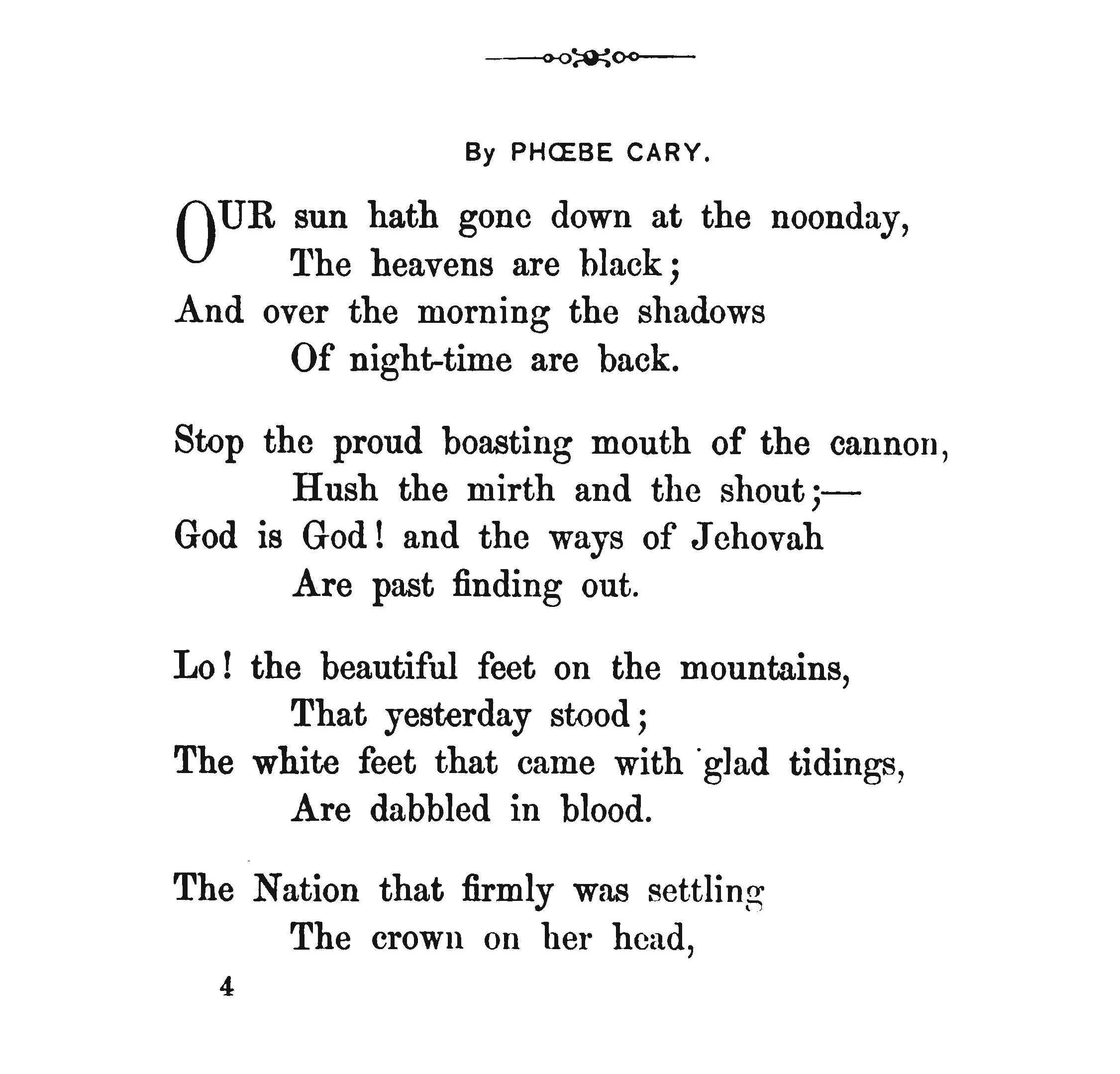
Philadelphia publishing house J.B. Lippincott & Co. compiled poetical tributes to President Lincoln in the months after his assassination. This piece, by Phoebe Cary, talks about how the mood of the country has changed from happiness for the end of the war to sadness for Lincoln's death. She goes on to describe his mercy and considerate leadership. Phoebe Cary was a well known poet and suffragette from Ohio. Later in life she moved to New York with her sister, Alice Cary, who was also a poet. During her lifetime she published two volumes of her own work.
-
Source
University of Wisconsin - Madison, Digitized by Google
-
Rights
This item is in the public domain and may be reproduced and used for any purpose, including research, teaching, private study, publication, broadcast or commercial use, with proper citation and attribution.
-
Tags
-
Cite this Item
Pheobe Cary. "Phoebe Cary Poem on Lincoln's Death". J.B. Lippincott & Co.. Remembering Lincoln. Web. Accessed April 5, 2026. https://rememberinglincoln.fords.org/node/1102
-
Creator
Pheobe Cary
-
Publisher
J.B. Lippincott & Co.
-
Date
1865
from Jul. 1, 1865
Phoebe Cary Poem on Lincoln's Death
-
Description
Philadelphia publishing house J.B. Lippincott & Co. compiled poetical tributes to President Lincoln in the months after his assassination. This piece, by Phoebe Cary, talks about how the mood of the country has changed from happiness for the end of the war to sadness for Lincoln's death. She goes on to describe his mercy and considerate leadership. Phoebe Cary was a well known poet and suffragette from Ohio. Later in life she moved to New York with her sister, Alice Cary, who was also a poet. During her lifetime she published two volumes of her own work.
-
Source
University of Wisconsin - Madison, Digitized by Google
-
Rights
This item is in the public domain and may be reproduced and used for any purpose, including research, teaching, private study, publication, broadcast or commercial use, with proper citation and attribution.
-
Creator
Pheobe Cary
-
Publisher
J.B. Lippincott & Co.
-
Date
July 1, 1865
from Jul. 1, 1865
Julia Ward Howe Poem
-
Full Title
Poetical Tribute to President Lincoln - Julia Ward Howe
-
Description
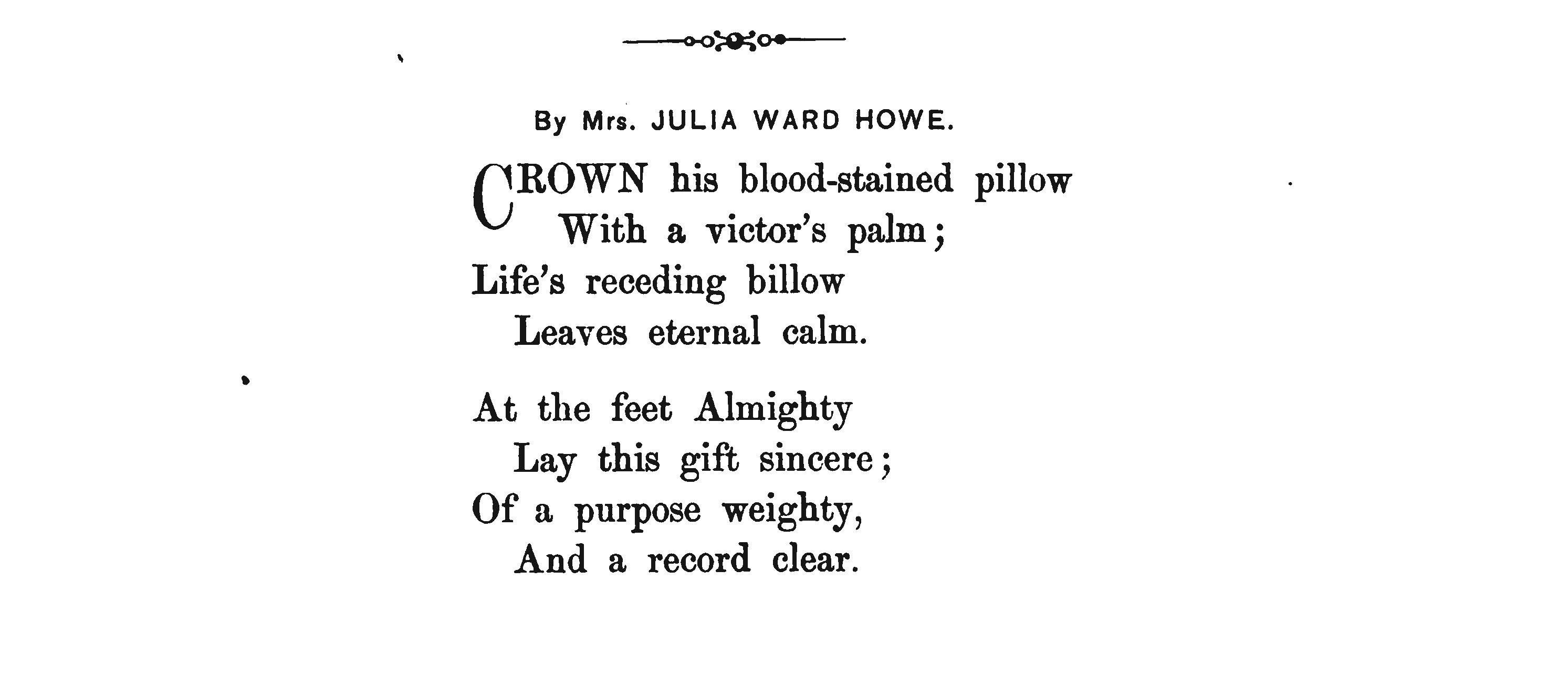
Philadelphia publishing house J.B. Lippincott & Co. compiled poetical tributes to President Lincoln in the months after his assassination. This piece, by Julia Ward Howe, talks about Lincoln's legacy and how to honor him and his contributions to the nation. Julia Ward Howe was an abolitionist, suffragette and author, most famous for writing "The Battle Hymn of the Republic," which is now one of the most famous songs of the Civil War. She was inspired to write the song after meeting with President Lincoln at the White House in November 1861.
-
Source
University of Wisconsin - Madison, Digitized by Google
-
Rights
This item is in the public domain and may be reproduced and used for any purpose, including research, teaching, private study, publication, broadcast or commercial use, with proper citation and attribution.
-
Tags
-
Cite this Item
Julia Ward Howe. "Poetical Tribute to President Lincoln - Julia Ward Howe". J.B. Lippincott & Co.. Remembering Lincoln. Web. Accessed April 5, 2026. https://rememberinglincoln.fords.org/node/1100
-
Creator
Julia Ward Howe
-
Publisher
J.B. Lippincott & Co.
-
Date
1865
from Jul. 1, 1865
Poetical Tribute to President Lincoln - Julia Ward Howe
-
Description
Philadelphia publishing house J.B. Lippincott & Co. compiled poetical tributes to President Lincoln in the months after his assassination. This piece, by Julia Ward Howe, talks about Lincoln's legacy and how to honor him and his contributions to the nation. Julia Ward Howe was an abolitionist, suffragette and author, most famous for writing "The Battle Hymn of the Republic," which is now one of the most famous songs of the Civil War. She was inspired to write the song after meeting with President Lincoln at the White House in November 1861.
-
Source
University of Wisconsin - Madison, Digitized by Google
-
Rights
This item is in the public domain and may be reproduced and used for any purpose, including research, teaching, private study, publication, broadcast or commercial use, with proper citation and attribution.
-
Creator
Julia Ward Howe
-
Publisher
J.B. Lippincott & Co.
-
Date
July 1, 1865
from Jul. 1, 1865
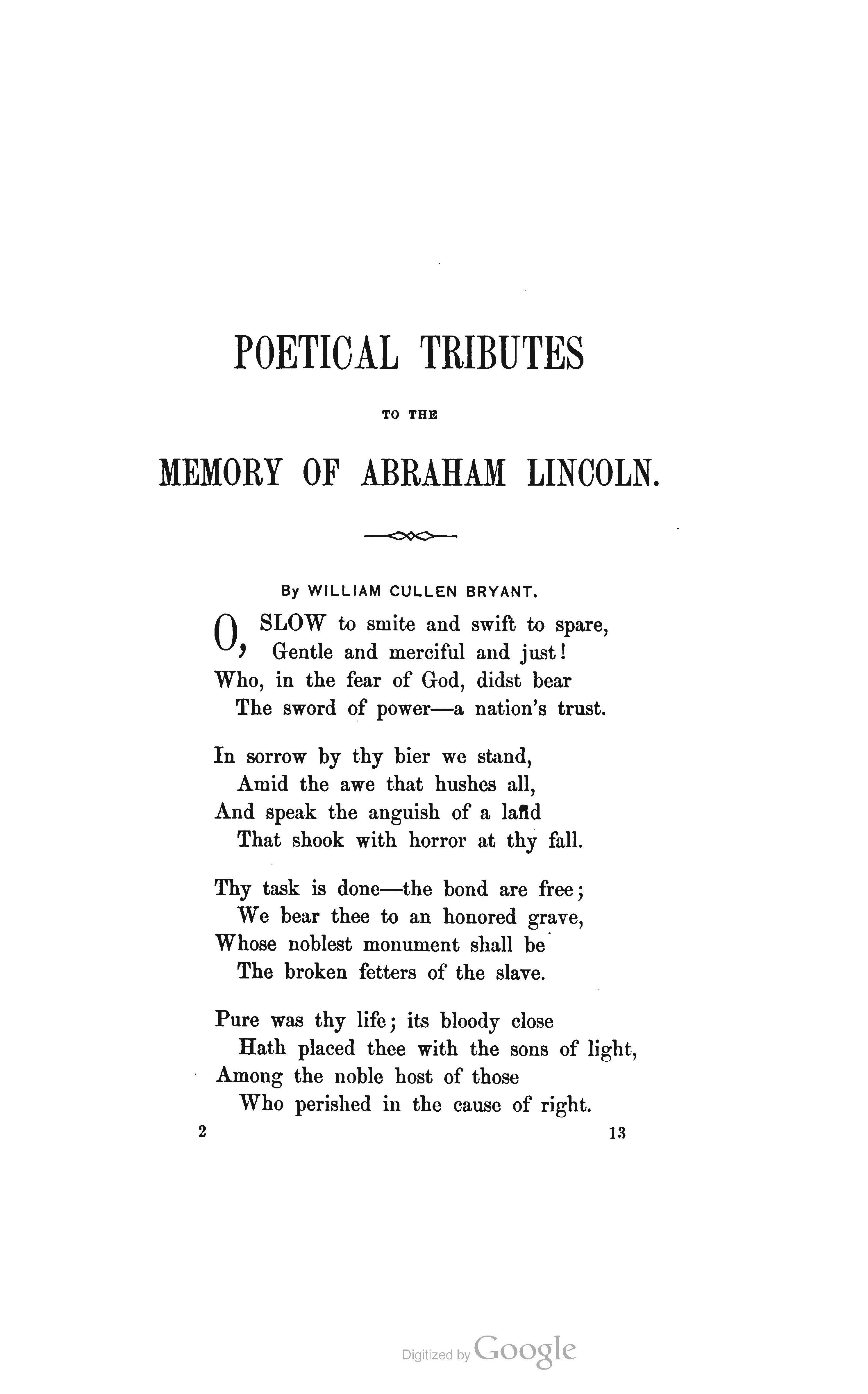
William Cullen Bryant Poem
-
Full Title
Poetical Tribute to President Lincoln - William Cullen Bryant
-
Description
Philadelphia publishing house J.B. Lippincott & Co. compiled poetical tributes to President Lincoln in the months after his assassination. This piece, by Poet William Cullen Bryant, speaks of Lincoln's life and greatest accomplishment, freeing the slave. Bryant was considered a child-prodigy, publishing his first poem at age ten and his first book when he was thirteen. He later served as editor for the New York Evening Post. He was a member of the Republican Party and actually introduced Abraham Lincoln at Cooper Union in New York when Lincoln gave his famed "Cooper Union Speech" in 1860.
-
Source
University of Wisconsin - Madison, Digitized by Google
-
Rights
This item is in the public domain and may be reproduced and used for any purpose, including research, teaching, private study, publication, broadcast or commercial use, with proper citation and attribution.
-
Tags
-
Cite this Item
William Cullen Bryant. "Poetical Tribute to President Lincoln - William Cullen Bryant". J. B. Lippincott & Co.. Remembering Lincoln. Web. Accessed April 5, 2026. https://rememberinglincoln.fords.org/node/1099
-
Creator
William Cullen Bryant
-
Publisher
J. B. Lippincott & Co.
-
Date
1865
from Jul. 1, 1865
Poetical Tribute to President Lincoln - William Cullen Bryant
-
Description
Philadelphia publishing house J.B. Lippincott & Co. compiled poetical tributes to President Lincoln in the months after his assassination. This piece, by Poet William Cullen Bryant, speaks of Lincoln's life and greatest accomplishment, freeing the slave. Bryant was considered a child-prodigy, publishing his first poem at age ten and his first book when he was thirteen. He later served as editor for the New York Evening Post. He was a member of the Republican Party and actually introduced Abraham Lincoln at Cooper Union in New York when Lincoln gave his famed "Cooper Union Speech" in 1860.
-
Source
University of Wisconsin - Madison, Digitized by Google
-
Rights
This item is in the public domain and may be reproduced and used for any purpose, including research, teaching, private study, publication, broadcast or commercial use, with proper citation and attribution.
-
Creator
William Cullen Bryant
-
Publisher
J. B. Lippincott & Co.
-
Date
July 1, 1865
from Apr. 14, 1865
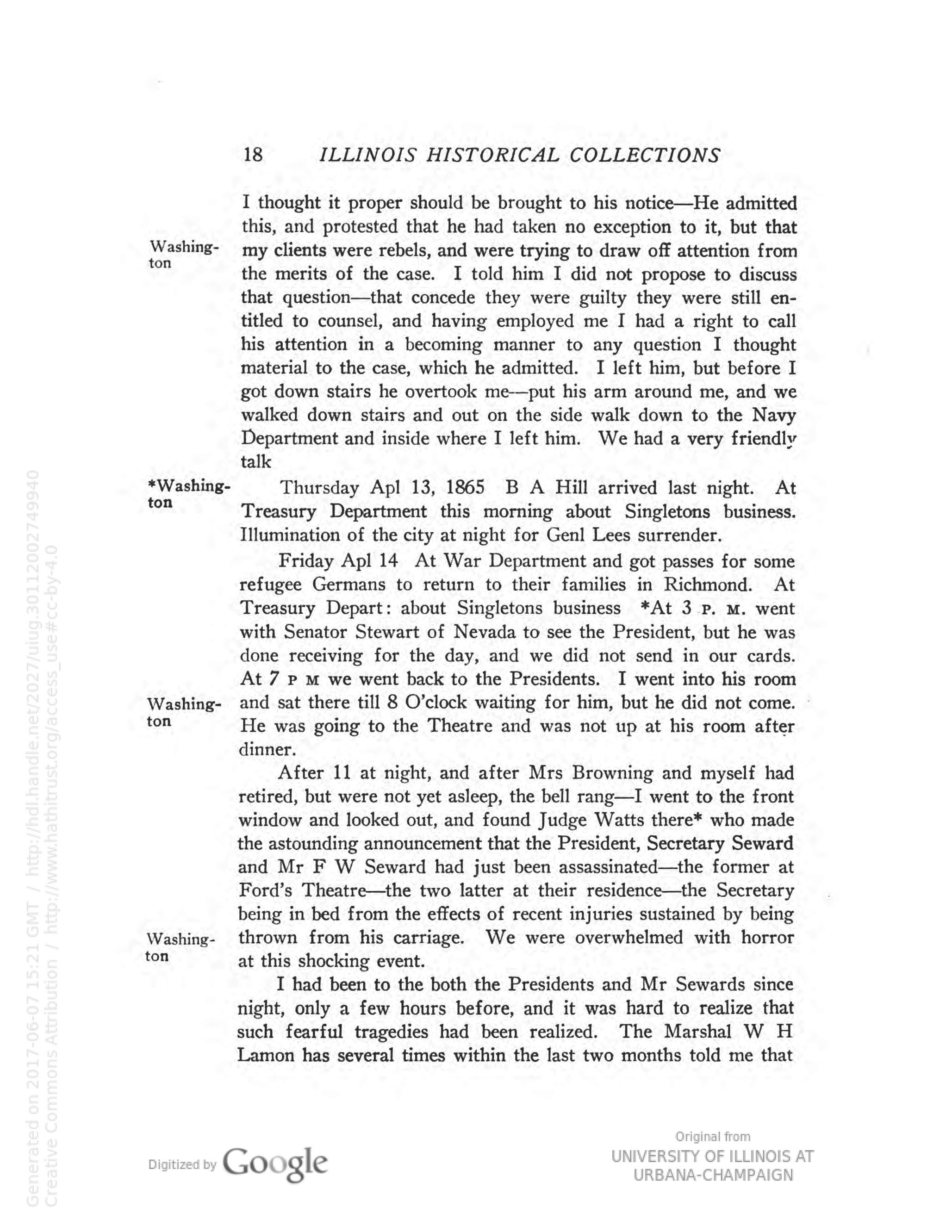
Diary of Orville Hickman Browning
-
Full Title
Diary of Orville Hickman Browning, Friend of Lincoln - Excerpts from April 14-19, 1865
-
Description
These are the diary entries of former U.S. Senator and friend of President Lincoln, Orville Hickman Browning, the day of Lincoln's assassination up to the funeral in Washington, DC on April 19, 1865. Browning discusses how he heard about the attacks and incorrectly states the Secretary of State Seward was killed. He talks about how Lincoln was the South's best ally within the government and speculates who the attacker was. Over the next few days he visits the White House and describes the body of the fallen president. These excerpts are part of the “Diary of Orville Hickman Browning Volume II: 1865-1881,” published in 1925 by the Illinois State Historical Library. Born in Kentucky in 1806, Browning moved to Quincy, Illinois to become a lawyer. Later he served as a U.S. Senator, adviser to Abraham Lincoln and Andrew Johnson, and even a cabinet minister. Browning and Lincoln became friends while serving in the state legislature; both were members of the Whig party. Browning served as an ally for Lincoln during his presidency.
-
Source
Hathi Trust Digital Library
-
Rights
The written permission of the copyright owners and/or other rights holders (such as publicity and/or privacy rights) is required for distribution, reproduction, or other use of protected items beyond that allowed by fair use or other statutory exemptions.
-
Tags
-
Cite this Item
Orville Hickman Browning. "Diary of Orville Hickman Browning, Friend of Lincoln - Excerpts from April 14-19, 1865". Illinois State Historical Library. Remembering Lincoln. Web. Accessed April 5, 2026. https://rememberinglincoln.fords.org/node/1098
-
Creator
Orville Hickman Browning
-
Publisher
Illinois State Historical Library
-
Date
April 14, 1865
-
Dimensions
22 cm.
from Apr. 14, 1865
Diary of Orville Hickman Browning, Friend of Lincoln - Excerpts from April 14-19, 1865
-
Description
These are the diary entries of former U.S. Senator and friend of President Lincoln, Orville Hickman Browning, the day of Lincoln's assassination up to the funeral in Washington, DC on April 19, 1865. Browning discusses how he heard about the attacks and incorrectly states the Secretary of State Seward was killed. He talks about how Lincoln was the South's best ally within the government and speculates who the attacker was. Over the next few days he visits the White House and describes the body of the fallen president. These excerpts are part of the “Diary of Orville Hickman Browning Volume II: 1865-1881,” published in 1925 by the Illinois State Historical Library. Born in Kentucky in 1806, Browning moved to Quincy, Illinois to become a lawyer. Later he served as a U.S. Senator, adviser to Abraham Lincoln and Andrew Johnson, and even a cabinet minister. Browning and Lincoln became friends while serving in the state legislature; both were members of the Whig party. Browning served as an ally for Lincoln during his presidency.
-
Source
Hathi Trust Digital Library
-
Rights
The written permission of the copyright owners and/or other rights holders (such as publicity and/or privacy rights) is required for distribution, reproduction, or other use of protected items beyond that allowed by fair use or other statutory exemptions.
-
Creator
Orville Hickman Browning
-
Publisher
Illinois State Historical Library
-
Date
April 14, 1865
-
Dimensions
22 cm.