from Apr. 20, 1865
Mayor's Proclamation on the Death of Abraham Lincoln - Brownville, Nebraska
-
Full Title
Brownville, Nebraska Territory Mayor's Proclamation on the Death of Abraham Lincoln
-
Description
The newly elected Mayor of Brownville, Nebraska Territory, Charles G. Dorsey, made a proclamation on the death of Abraham Lincoln, which was published in the Nebraska Advertiser the week after the President's death. The town of Brownville heard about Lincoln's death almost immediately. The city of Brownville was only about 10 years old at the time of Lincoln's assassination. The Nebraska Advertiser was founded in 1856 by a recent resident, Robert Wilkinson Furnas. Fumas was opposed to slavery and those views were often illustrated in the newspaper.
-
Source
-
Rights
This item is in the public domain and may be reproduced and used for any purpose, including research, teaching, private study, publication, broadcast or commercial use, with proper citation and attribution.
-
Tags
-
Cite this Item
Nebraska Advertiser. "Brownville, Nebraska Territory Mayor's Proclamation on the Death of Abraham Lincoln". Robert Wilkinson Furnas. Remembering Lincoln. Web. Accessed April 5, 2026. https://rememberinglincoln.fords.org/node/1097
-
Creator
Nebraska Advertiser
-
Publisher
Robert Wilkinson Furnas
-
Date
April 20, 1865
from Apr. 20, 1865
Brownville, Nebraska Territory Mayor's Proclamation on the Death of Abraham Lincoln

-
Description
The newly elected Mayor of Brownville, Nebraska Territory, Charles G. Dorsey, made a proclamation on the death of Abraham Lincoln, which was published in the Nebraska Advertiser the week after the President's death. The town of Brownville heard about Lincoln's death almost immediately. The city of Brownville was only about 10 years old at the time of Lincoln's assassination. The Nebraska Advertiser was founded in 1856 by a recent resident, Robert Wilkinson Furnas. Fumas was opposed to slavery and those views were often illustrated in the newspaper.
-
Source
-
Rights
This item is in the public domain and may be reproduced and used for any purpose, including research, teaching, private study, publication, broadcast or commercial use, with proper citation and attribution.
-
Creator
Nebraska Advertiser
-
Publisher
Robert Wilkinson Furnas
-
Date
April 20, 1865
from May. 13, 1865
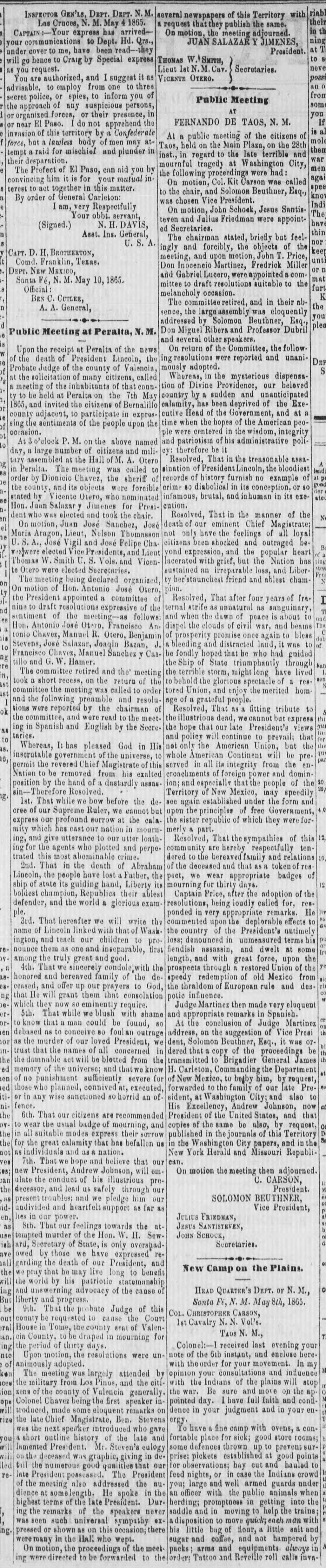
Public Meeting at Peralta, NM - Resolution on the Death of President Lincoln
-
Full Title
Public Meeting at Peralta, NM - Resolution on the Death of President Lincoln, Santa Fe Weekly
-
Description
In May 1865, the Santa Fe Weekly Gazette published a summary of a meeting organized by the Probate Judge of Peralta, New Mexico. Peralta was named for the founder of Santa Fe, Don Pedro de Peralta, between 1607 and 1610. Both citizens of the county and Union military were present for the meeting to draft nine resolutions on the death of President Abraham Lincoln. The citizens expressed their sorrow and pledged their loyalty to the new president, Andrew Johnson. The resolutions were read in both Spanish and English. The meeting precedings were then sent to several newspapers throughout the territory, including the Santa Fe Weekly Gazette. The Santa Fe Weekly Gazette was in publication from April 1851 to September 1869 and was the most successful paper in the area up until that point, serving the capital of the province of New Mexico. The city had a population of about 4,500 by 1850. While in publication, the paper supported both Democratic and Republican causes. The paper's motto was "Independent in all things - neutral in nothing."
-
Source
Library of Congress Chronicling America
-
Rights
This item is in the public domain and may be reproduced and used for any purpose, including research, teaching, private study, publication, broadcast or commercial use, with proper citation and attribution.
-
Tags
-
Cite this Item
Santa Fe Weekly Gazette. "Public Meeting at Peralta, NM - Resolution on the Death of President Lincoln, Santa Fe Weekly". James L. Collins. Remembering Lincoln. Web. Accessed April 5, 2026. https://rememberinglincoln.fords.org/node/1095
-
Creator
Santa Fe Weekly Gazette
-
Publisher
James L. Collins
-
Date
May 13, 1865
from May. 13, 1865
Public Meeting at Peralta, NM - Resolution on the Death of President Lincoln, Santa Fe Weekly
-
Description
In May 1865, the Santa Fe Weekly Gazette published a summary of a meeting organized by the Probate Judge of Peralta, New Mexico. Peralta was named for the founder of Santa Fe, Don Pedro de Peralta, between 1607 and 1610. Both citizens of the county and Union military were present for the meeting to draft nine resolutions on the death of President Abraham Lincoln. The citizens expressed their sorrow and pledged their loyalty to the new president, Andrew Johnson. The resolutions were read in both Spanish and English. The meeting precedings were then sent to several newspapers throughout the territory, including the Santa Fe Weekly Gazette. The Santa Fe Weekly Gazette was in publication from April 1851 to September 1869 and was the most successful paper in the area up until that point, serving the capital of the province of New Mexico. The city had a population of about 4,500 by 1850. While in publication, the paper supported both Democratic and Republican causes. The paper's motto was "Independent in all things - neutral in nothing."
-
Source
Library of Congress Chronicling America
-
Rights
This item is in the public domain and may be reproduced and used for any purpose, including research, teaching, private study, publication, broadcast or commercial use, with proper citation and attribution.
-
Creator
Santa Fe Weekly Gazette
-
Publisher
James L. Collins
-
Date
May 13, 1865
from Apr. 20, 1865
Letter from William H. Kesler, 3rd Missouri Cavalry
-
Full Title
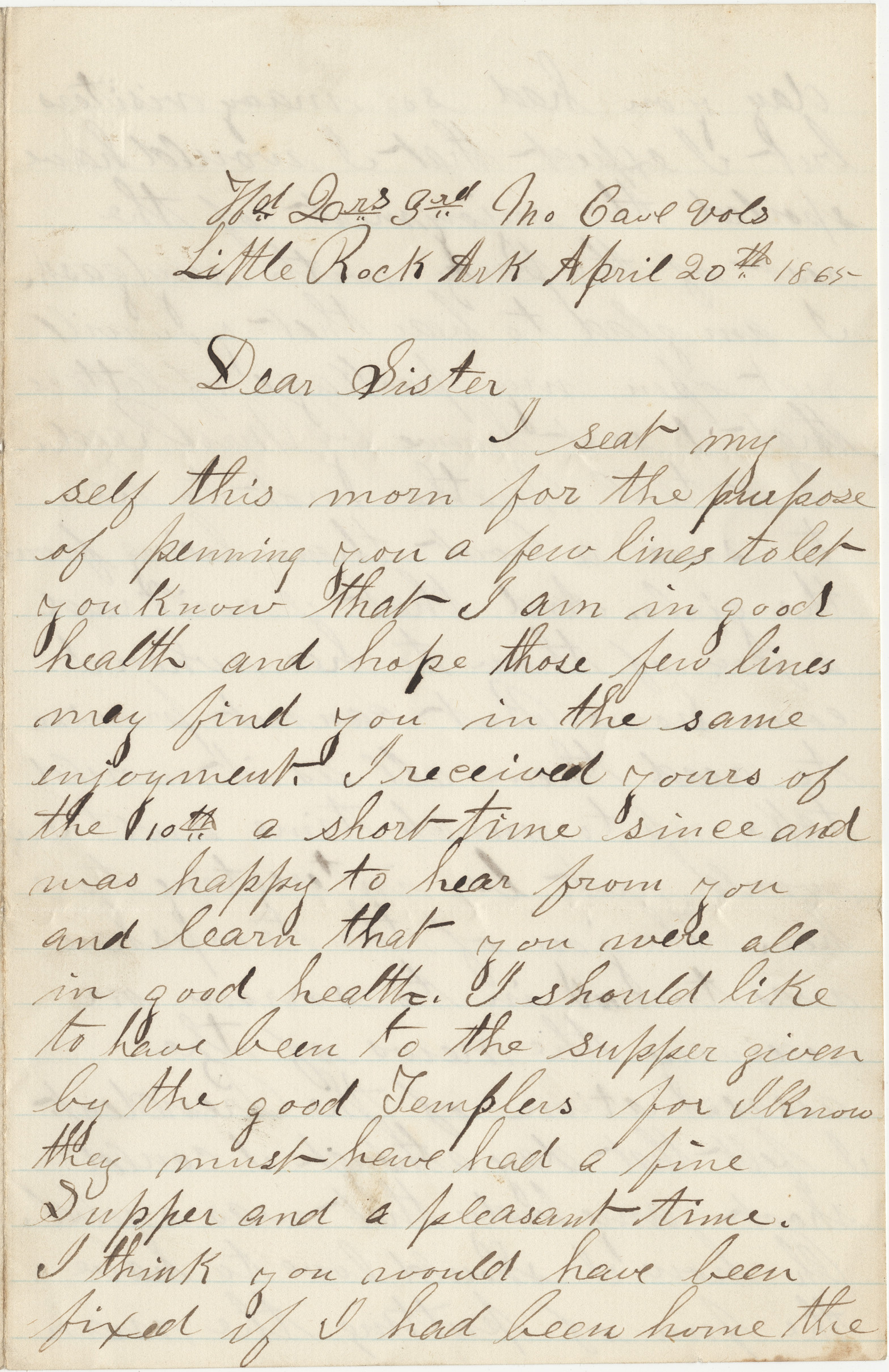
Letter from William H. Kesler, 3rd Missouri Cavalry, to his sister Rose Ann Kesler
-
Description
A letter from William H. Kesler to his sister Rose Ann Kesler in late April 1865. He writes to her about hearing of the assassination, his sorrow and anger toward the assassin. At the beginning of the Civil War, William H. Kesler resided in Champaign, Illinois but joined the Missouri volunteer units after the quota was reached in his home state. He served in the 3rd Missouri Calvary from January 1862 - June 1865. He joined Company D, which was captained by John H. Reed and composed of men from both Missouri and Illinois. As part of a Union cavalry brigade, the 3rd Missouri Cavalry marched into Arkansas in August 1863, and was part of the force which captured the state capital at Little Rock on September 10th of that year. He spent much of the rest of the war in the Little Rock area and returned home in June of 1865.
-
Transcription
Little Rock Ark April 20th 1865
Dear Sister I seat my self this morn for the purpose of penning you a few lines to let you know that I am in good health and hope those few lines may find you in the same enjoyment. I received yours of the 10th a short time since and was happy to hear from you and learn that you were all in good health. I should like to have been to the Supper given by the good Templers for I know they must have had a fine Supper and a pleasant time. I think you would have been fixed if I had been home the day you had so many visiters but I expect that I would have spoiled the enjoyment of the rest of the party with my (gass). I am glad to hear that you will not open my package of letters that I sent home by Mrs Reed. But tell Mother not to be to sure a bout them being from the girls. And that I will read a few of them to her when I come home. But can not promise to read them all as it would take up to much time and then would not be interesting to her. The joy of the troops here was turned in to sorrow on receiving the news of the assassination of the President. I felt that day a though I could shoot any body that was a rebel. Oh how I should love to have the fun of putting the man to death that Killed the President. My feelings were such that I could have cut him up in inch peaces. But never mind the soldiers of the North will avenge his death with a thousand lives. I want to see this war closed now. For the feelings of the Soldiers now toward the south is not very friendly sure. I Expressed $100.00 One Hundred Dollars home a few days a go by parkers Express. I have nothing of importance to write so I will close hoping to hear from you soon. I remain as ever your Affectionate Brother Will
P.S. please Write soon And excuse mistakes Will
I am going to send you a painting of the hospital at Little Rock. Which I want you to Keep clean and nice untill I come home. Will -
Source
The State Historical Society of Missouri
-
Rights
This item is in the public domain and may be reproduced and used for any purpose, including research, teaching, private study, publication, broadcast or commercial use, with proper citation and attribution.
-
Tags
-
Cite this Item
William H. Kesler. "Letter from William H. Kesler, 3rd Missouri Cavalry, to his sister Rose Ann Kesler". The State Historical Society of Missouri. Remembering Lincoln. Web. Accessed April 5, 2026. https://rememberinglincoln.fords.org/node/1094
-
Creator
William H. Kesler
-
Publisher
The State Historical Society of Missouri
-
Date
April 20, 1865
from Apr. 20, 1865
Letter from William H. Kesler, 3rd Missouri Cavalry, to his sister Rose Ann Kesler
-
Description
A letter from William H. Kesler to his sister Rose Ann Kesler in late April 1865. He writes to her about hearing of the assassination, his sorrow and anger toward the assassin. At the beginning of the Civil War, William H. Kesler resided in Champaign, Illinois but joined the Missouri volunteer units after the quota was reached in his home state. He served in the 3rd Missouri Calvary from January 1862 - June 1865. He joined Company D, which was captained by John H. Reed and composed of men from both Missouri and Illinois. As part of a Union cavalry brigade, the 3rd Missouri Cavalry marched into Arkansas in August 1863, and was part of the force which captured the state capital at Little Rock on September 10th of that year. He spent much of the rest of the war in the Little Rock area and returned home in June of 1865.
-
Source
The State Historical Society of Missouri
-
Rights
This item is in the public domain and may be reproduced and used for any purpose, including research, teaching, private study, publication, broadcast or commercial use, with proper citation and attribution.
-
Creator
William H. Kesler
-
Publisher
The State Historical Society of Missouri
-
Date
April 20, 1865
from Apr. 15, 1865
A Proclamation by Rhode Island Governor
-
Full Title
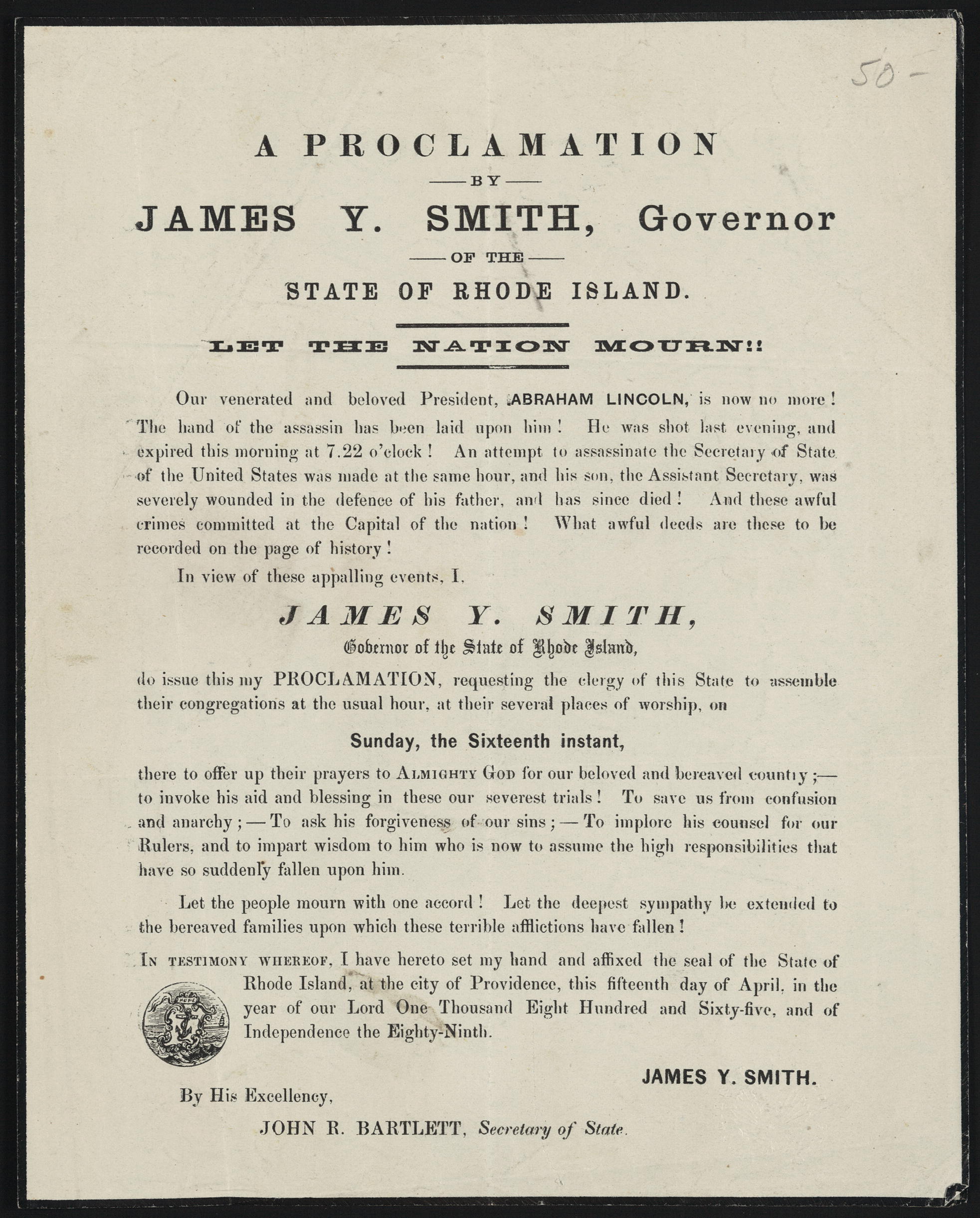
A Proclamation by James Youngs Smith, Governor of the State of Rhode Island
-
Description
James Youngs Smith, the 29th Governor of Rhode Island, issued a proclamation on the day of Abraham Lincoln's assassination asking the clergy of Rhode Island to commemorate the President and pray for the country during the upcoming Sunday services. Born in Groton, Connecticut in 1809, Smith moved to Providence, Rhode Island at the age of 16 to work for a lumber business. Later in life he bought mills in both Connecticut and Rhode Island. He served three terms as Governor of Rhode Island as a Republican before declining to run for a fourth term. He served throughout the Civil War and was able to fill the state's troop quota through voluntary enlistment because the citizens of Rhode Island opposed drafting soldiers. Smith married Emily Brown, the daughter of a cotton manufacturer from Massachusetts and had three children.
-
Source
Library of Congress, Rare Book And Special Collections Division
-
Rights
Transmission or reproduction of protected items beyond that allowed by fair use requires the written permission of the copyright owners.
-
Tags
-
Cite this Item
James Y. Smith. "A Proclamation by James Youngs Smith, Governor of the State of Rhode Island". Rhode Island, Governor. Remembering Lincoln. Web. Accessed April 5, 2026. https://rememberinglincoln.fords.org/node/1093
-
Creator
James Y. Smith
-
Publisher
Rhode Island, Governor
-
Date
April 15, 1865
-
Material
Printed on page [1] of a single-folded sheet.
-
Dimensions
21 cm.
from Apr. 15, 1865
A Proclamation by James Youngs Smith, Governor of the State of Rhode Island
-
Description
James Youngs Smith, the 29th Governor of Rhode Island, issued a proclamation on the day of Abraham Lincoln's assassination asking the clergy of Rhode Island to commemorate the President and pray for the country during the upcoming Sunday services. Born in Groton, Connecticut in 1809, Smith moved to Providence, Rhode Island at the age of 16 to work for a lumber business. Later in life he bought mills in both Connecticut and Rhode Island. He served three terms as Governor of Rhode Island as a Republican before declining to run for a fourth term. He served throughout the Civil War and was able to fill the state's troop quota through voluntary enlistment because the citizens of Rhode Island opposed drafting soldiers. Smith married Emily Brown, the daughter of a cotton manufacturer from Massachusetts and had three children.
-
Source
Library of Congress, Rare Book And Special Collections Division
-
Rights
Transmission or reproduction of protected items beyond that allowed by fair use requires the written permission of the copyright owners.
-
Creator
James Y. Smith
-
Publisher
Rhode Island, Governor
-
Date
April 15, 1865
-
Material
Printed on page [1] of a single-folded sheet.
-
Dimensions
21 cm.
from Jan. 1, 1929
"Long, Long Ago" by Clara Clough Lenroot
-
Full Title
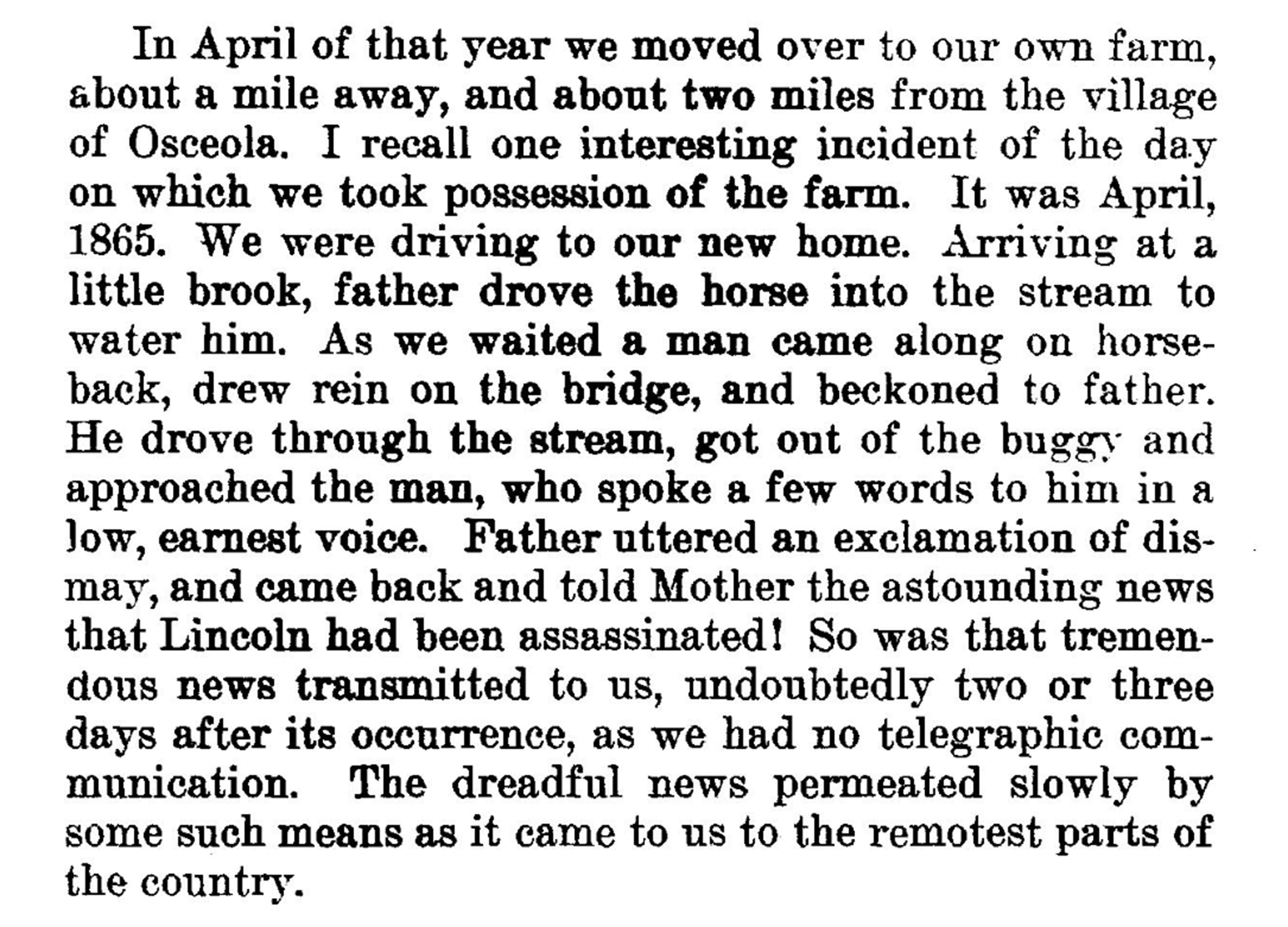
"Long, Long Ago" - Memoir of Clara Clough Lenroot, Childhood in Wisconsin
-
Description
Born in 1857, Clara Clough Lenroot was less than 10 years old when President Lincoln was assassinated. This excerpt, from her memoir "Long, Long Ago" published in 1929, highlights her family's reaction to the news as they were moving to their new home in the wilderness outside of Osceola Mills, Wisconsin. Her father, Solon H. Clough, was a lawyer from Fulton, New York who hoped to find fortune out West in the early 1860s. Later in life, Clara married Irvine Lenroot who served in the U.S. House of Representatives from 1909 to 1918 and in the U.S. Senate from 1918 to 1927. Throughout the 1930s their daughter Katharine fought to regulate child labor laws and successfully lobbied for the Fair Labor Standards Act of 1938, which also established a national minimum wage. Katharine also served as third Chief of the United States Children's Bureau.
-
Transcription
In April of that year we moved over to our own farm, about a mile away, and about two miles away from the village of Osceola. I recall one interesting incident of the day on which we took possession of the farm. It was April, 1865. We were driving to our new home. Arriving at a little brook, father drove the horse into the stream to water him. As we waited a man came along on horseback, drew rein on the bridge, and beckoned to father. He drove through the stream, got out of the buggy and approached the man, who spoke a few words to him in a low, earnest voice. Father uttered an exclamation of dismay, and came back and told Mother the astounding news that Lincoln had been assassinated! So was that tremendous news transmitted to us, undoubtedly two or three days after its occurrence, as we had no telegraphic communication. The dreadful news permeated slowly by some such means as it came to us to the remotest parts of the country.
We rode on in silence. We little girls sensed the fact that calamity had overtaken our world. We were hushed by the sorrow in our parents’ faces, and asked no questions. In sad silence we approached the farmhouse that was to be our home, an event which we had anticipated with tremendous excitement and curiosity. Arrived at the little home, father and mother made some pretence of arranging the household goods, but mother soon seated herself upon a bench outside the kitchen door, and tears ran down her face. Father came and sat beside her, wiping his own eyes, and took her hand in his. We children stood around, more and more impressed by their grief. Little was done towards settling the new home that day.
(In sharp contrast to the slow progress of the news of Lincoln’s assassination came the news of President Harding’s death in 1923 to a rural camp in the midst of the pine forest. There a radio set had been installed. Mrs. Claude Luse, alone in her camp near Gordon, Wisconsin, children and maid in bed, was listening to a fine concert being radioed from the Drake Hotel in Chicago. A singer had just begun a solo. She had sung but a few words when the music stopped and a voice said, “We have just had word that President Harding died in San Francisco ten minutes ago; stand by for confirmation.” In a few seconds the statement was confirmed. Mrs. Luse’s neighbor, Mr. Gallaher, starting to town early the next morning, carried the news with him along the route.)
[Transcription by: Kyra S., Dr. Susan Corbesero’s Class, Ellis School, Pittsburgh, Pennsylvania] -
Source
Library of Congress, General Collections and Rare Book and Special Collections Division
-
Rights
The written permission of the copyright owners and/or other rights holders (such as publicity and/or privacy rights) is required for distribution, reproduction, or other use of protected items beyond that allowed by fair use or other statutory exemptions.
-
Tags
-
Cite this Item
Clara Clough Lenroot. ""Long, Long Ago" - Memoir of Clara Clough Lenroot, Childhood in Wisconsin". Badger Printing Company. Remembering Lincoln. Web. Accessed April 5, 2026. https://rememberinglincoln.fords.org/node/1092
-
Creator
Clara Clough Lenroot
-
Publisher
Badger Printing Company
-
Date
1929
-
Dimensions
24 cm.
from Jan. 1, 1929
"Long, Long Ago" - Memoir of Clara Clough Lenroot, Childhood in Wisconsin
-
Description
Born in 1857, Clara Clough Lenroot was less than 10 years old when President Lincoln was assassinated. This excerpt, from her memoir "Long, Long Ago" published in 1929, highlights her family's reaction to the news as they were moving to their new home in the wilderness outside of Osceola Mills, Wisconsin. Her father, Solon H. Clough, was a lawyer from Fulton, New York who hoped to find fortune out West in the early 1860s. Later in life, Clara married Irvine Lenroot who served in the U.S. House of Representatives from 1909 to 1918 and in the U.S. Senate from 1918 to 1927. Throughout the 1930s their daughter Katharine fought to regulate child labor laws and successfully lobbied for the Fair Labor Standards Act of 1938, which also established a national minimum wage. Katharine also served as third Chief of the United States Children's Bureau.
-
Source
Library of Congress, General Collections and Rare Book and Special Collections Division
-
Rights
The written permission of the copyright owners and/or other rights holders (such as publicity and/or privacy rights) is required for distribution, reproduction, or other use of protected items beyond that allowed by fair use or other statutory exemptions.
-
Creator
Clara Clough Lenroot
-
Publisher
Badger Printing Company
-
Date
January 1, 1929
-
Dimensions
24 cm.
from Apr. 23, 1865
Patriotic Club of Mexico
-
Full Title
Patriotic Club of Mexico
-
Description
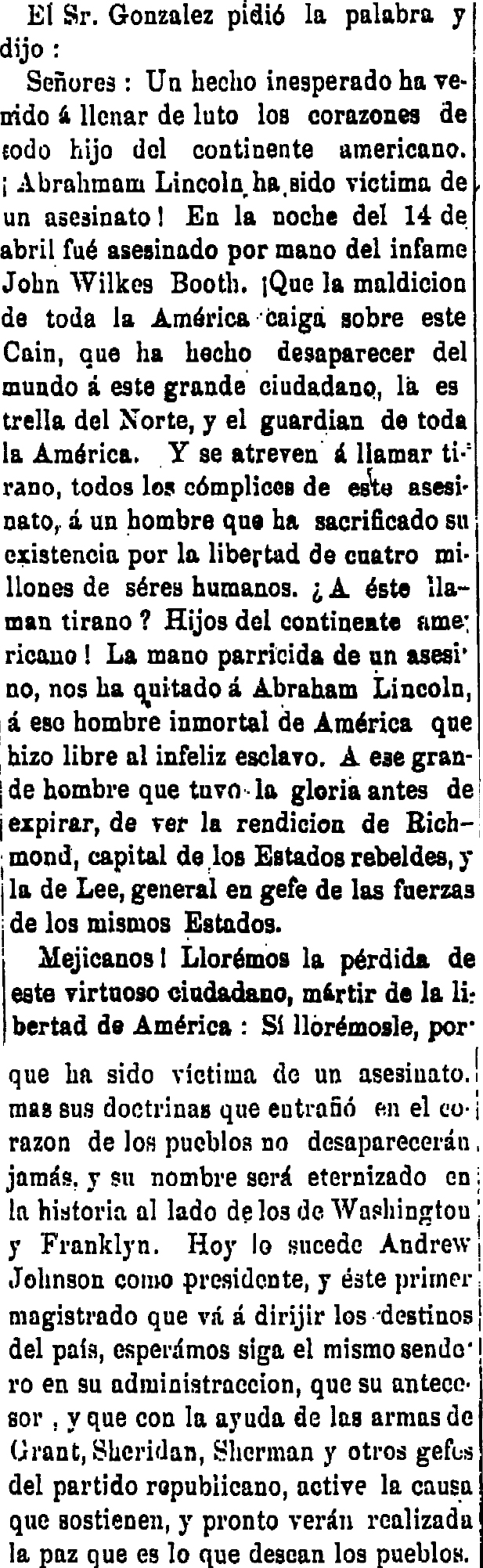
On April 23, 1865, the Patriotic Club of Mexico called a special meeting of it's members in the mining town of Virginia City, Nevada. Latinos across the West who had supported Lincoln and the Union cause were shocked, and they gathered to reflect on the assassination and it's international impact. Meetings were often organized around "juntas patrioticas", patriotic assemblies of Latinos formed in the aftermath of the 1862 French invasion of Mexico. This is an excerpt from a speech given by Rafael H. Gonzalez, a member of the club, who shares his lament for the assassination of Abraham Lincoln and uncertainty about the nation's future.
-
Transcription
Mr. Gonzalez requested the floor and said:
Gentlemen: An unexpected event has come to fill with grief the hearts of every son of America. Abraham Lincoln has become a victim of assassination! On the night of April 14, he was assassinated by the hand of the villainous John Wilkes Booth. May the curse of all the Americas fall on this Cain for this evil of taking from the world this great citizen, the Northern Star, and the guardian angel of all the Americas. To dare call tyrants, all the accomplices of this assassination, of a man who sacrificed his existence for the liberty of 4 million human beings. Do you call this tyranny? Sons of America! The parricidal hand of an assassin has taken Abraham Lincoln, that immortal man of America who freed the miserable slaves. That great man had the glory, before he expired, to see the surrender of Richmond, capital of the Rebel states, and Lee, general of those forces.
Mexicans! Let us cry for the loss of this virtuous citizen, martyr for the liberty of America. Let us cry because he has become the victim of an assassin. His teachings engraved upon the hearts of the people shall never disappear, and his name shall eternally live in history alongside Washington and Franklin. Now succeeded by Andrew Johnson as president, and this first magistrate that will direct the destiny of this country, we hope he follows the same path with his administration that his predecessor, and with the help of Grant, Sheridan, Sherman, and other members of the Republican party, mobilize the movement they uphold, and soon they will realize the peace the people desire.
-
Rights
TY - NEWS N1 - Provider: NewsBank/Readex, Database: America's Historical Newspapers, SQN: 11ED162540E86FE8 TI - Club Patriotico Mejicano De Virginia City, Estado De Nevada PY - 1865/04/28 JF - Voz del Nuevo Mundo JA - El Nuevo Mundo SP - 1 CP - San Francisco, California ER -
-
Tags
-
Cite this Item
Club Patriotico Mejicano. "Patriotic Club of Mexico". Voz del Nuevo Mundo. Remembering Lincoln. Web. Accessed April 5, 2026. https://rememberinglincoln.fords.org/node/1086

-
Creator
Club Patriotico Mejicano
-
Publisher
Voz del Nuevo Mundo
-
Date
Friday April 28, 1865
from Apr. 23, 1865
Patriotic Club of Mexico
-
Description
On April 23, 1865, the Patriotic Club of Mexico called a special meeting of it's members in the mining town of Virginia City, Nevada. Latinos across the West who had supported Lincoln and the Union cause were shocked, and they gathered to reflect on the assassination and it's international impact. Meetings were often organized around "juntas patrioticas", patriotic assemblies of Latinos formed in the aftermath of the 1862 French invasion of Mexico. This is an excerpt from a speech given by Rafael H. Gonzalez, a member of the club, who shares his lament for the assassination of Abraham Lincoln and uncertainty about the nation's future.
-
Rights
TY - NEWS N1 - Provider: NewsBank/Readex, Database: America's Historical Newspapers, SQN: 11ED162540E86FE8 TI - Club Patriotico Mejicano De Virginia City, Estado De Nevada PY - 1865/04/28 JF - Voz del Nuevo Mundo JA - El Nuevo Mundo SP - 1 CP - San Francisco, California ER -
-
Creator
Club Patriotico Mejicano
-
Publisher
Voz del Nuevo Mundo
-
Date
April 23, 1865
from May. 1, 1865
The President's grave
-
Full Title
The President's grave
-
Description
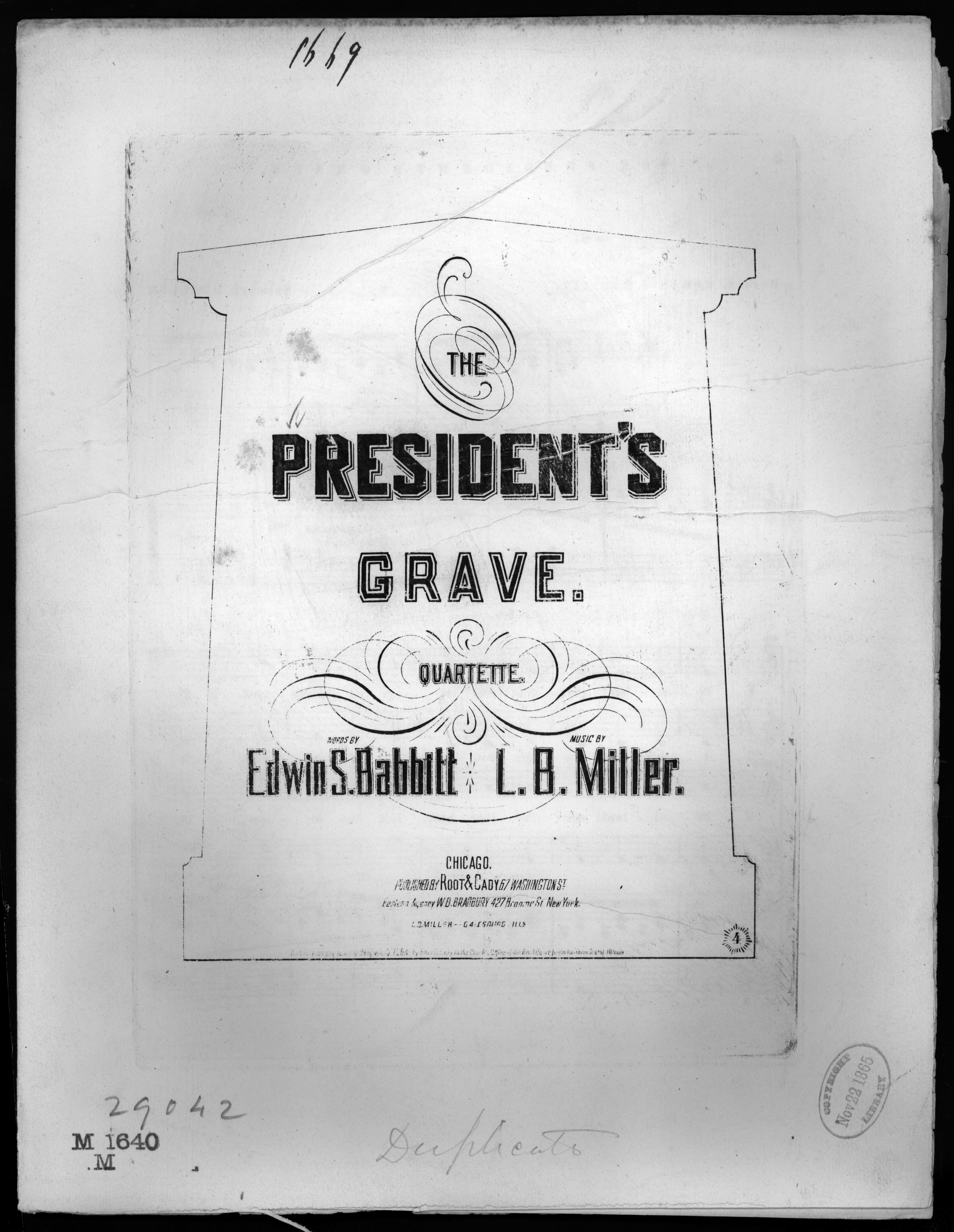
Work for vocal quartet and piano associated with the Union side. Part of the Library of Congress Civil War Sheet Music Collection.
-
Transcription
Verse 1
Be silent! there cometh on spirit wings sped,
The wail of a nation in grief for the dead;
The strong and the mighty, from glory and light,
Hath waned in his brightness and left us in night;
The proud eagle banners all droopingly wave,
And the wild wings are hushed round the President's grave.
And the wild winds are hushed round the President's grave.
Verse 2
A deep brooding sorrow comes over the heart
A moan like the tempest, when summers depart,
A gushing of anguish, unbroken and still,
As tolleth the requiem o'er valley and hill;
The sun that rose bright o'er the free and the brave
Now is setting in gloom o'er the President's grave.
Now is setting in gloom o'er the President's grave.
Verse 3
Be silent! our father hath laid him to rest,
A hero of battles hath yielded his crest,
A statesman hath fallen, his counsels are o'er,
His firmness and wisdom shall guide us no more:
Let cannon boom forth and the banners all wave,
While we mingle our tears o'er the President's grave.
While we mingle our tears o'er the President's grave.
-
Source
-
Rights
Public Domain. Suggested credit line: Civil War Sheet Music Collection, Library of Congress, Music Division.
-
Tags
-
Cite this Item
Miller, L. B. (composer); Babbitt, Edwin S. (lyricist). "The President's grave". Chicago: Root & Cady, 1865. Remembering Lincoln. Web. Accessed April 5, 2026. https://rememberinglincoln.fords.org/node/1035

-
Creator
Miller, L. B. (composer); Babbitt, Edwin S. (lyricist)
-
Publisher
Chicago: Root & Cady, 1865
-
Date
1865
-
Material
Sheet Music
from May. 1, 1865
The President's grave
-
Description
Work for vocal quartet and piano associated with the Union side. Part of the Library of Congress Civil War Sheet Music Collection.
-
Source
-
Rights
Public Domain. Suggested credit line: Civil War Sheet Music Collection, Library of Congress, Music Division.
-
Creator
Miller, L. B. (composer); Babbitt, Edwin S. (lyricist)
-
Publisher
Chicago: Root & Cady, 1865
-
Date
May 1, 1865
-
Material
Sheet Music
from May. 1, 1865
Lincoln's grave
-
Full Title
Lincoln's grave
-
Description
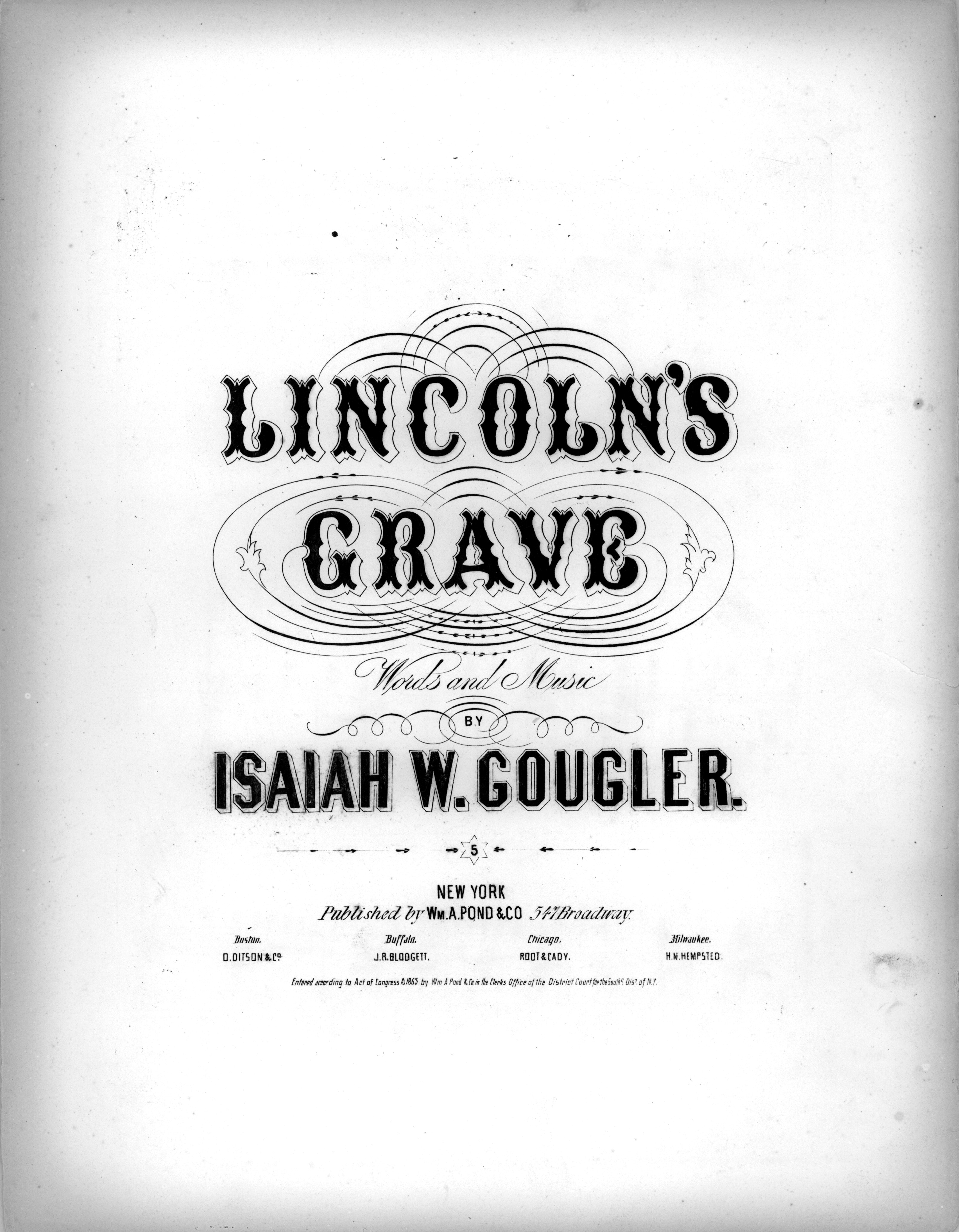
Song for high voice and piano that comments describes President Lincoln as a "martyr of freedom." Sheet music from the Alfred Whital Stern Collection of Lincolniana, Library of Congress Rare Book and Special Collections Division. Associated with the Union side.
-
Transcription
Verse 1
Far out on the plains of the beautiful west,
Whose glory and wonder Columbia adorn,
The martyr of freedom in triumph shall rest,
To bless all the living and all yet unborn;
The hand that hath slain him, how vile, O how vile!
To mar that fair visage so kind and so true!
No more shall assail him whose heart knew no guile,
But wither and perish a doom justly due.
But wither and perish a doom justly due.
Verse 2
O shade of the blessed, a nation in tears,
In sorrow and sadness its loss must deplore,
The God who hath led thee will quell all our fears,
His goodness that gave thee we still will adore;
Sweet peace, gentle sleeper, thy spirit attend,
While men, yes while angels thy praises shall sing,
Against thy blest mem'ry O who dare offend!
And not to its altar his best off'rings bring.
Verse 3
O spirit undying for death none the less,
But like Him who died that the earth might rejoice,
Thou risest victorious the nations to bless;
The bondman's delivrer, America's choice,
The hand that hath slain thee, how vile, O how vile!
To mar thy fair visage, so kind and so true,
No more shall assail thee whose heart knew no guile,
But wither and perish a doom justly due. -
Source
Sheet Music from the Alfred Whital Stern Collection of Lincolniana
-
Rights
Public Domain. Suggested credit line: Alfred Whital Stern Collection of Lincolniana, Library of Congress, Rare Book and Special Collections Division.
-
Tags
-
Cite this Item
Gougler, Isaiah W. (composer & lyricist). "Lincoln's grave". New York: Wm. A. Pond & Co., ca. 1865. Remembering Lincoln. Web. Accessed April 5, 2026. https://rememberinglincoln.fords.org/node/1034
-
Creator
Gougler, Isaiah W. (composer & lyricist)
-
Publisher
New York: Wm. A. Pond & Co., ca. 1865
-
Date
ca. 1865
-
Material
Sheet Music
from May. 1, 1865
Lincoln's grave
-
Description
Song for high voice and piano that comments describes President Lincoln as a "martyr of freedom." Sheet music from the Alfred Whital Stern Collection of Lincolniana, Library of Congress Rare Book and Special Collections Division. Associated with the Union side.
-
Source
Sheet Music from the Alfred Whital Stern Collection of Lincolniana
-
Rights
Public Domain. Suggested credit line: Alfred Whital Stern Collection of Lincolniana, Library of Congress, Rare Book and Special Collections Division.
-
Creator
Gougler, Isaiah W. (composer & lyricist)
-
Publisher
New York: Wm. A. Pond & Co., ca. 1865
-
Date
May 1, 1865
-
Material
Sheet Music
from May. 1, 1865
Requiem march in honor of President Lincoln
-
Full Title
Requiem march in honor of President Lincoln
-
Description
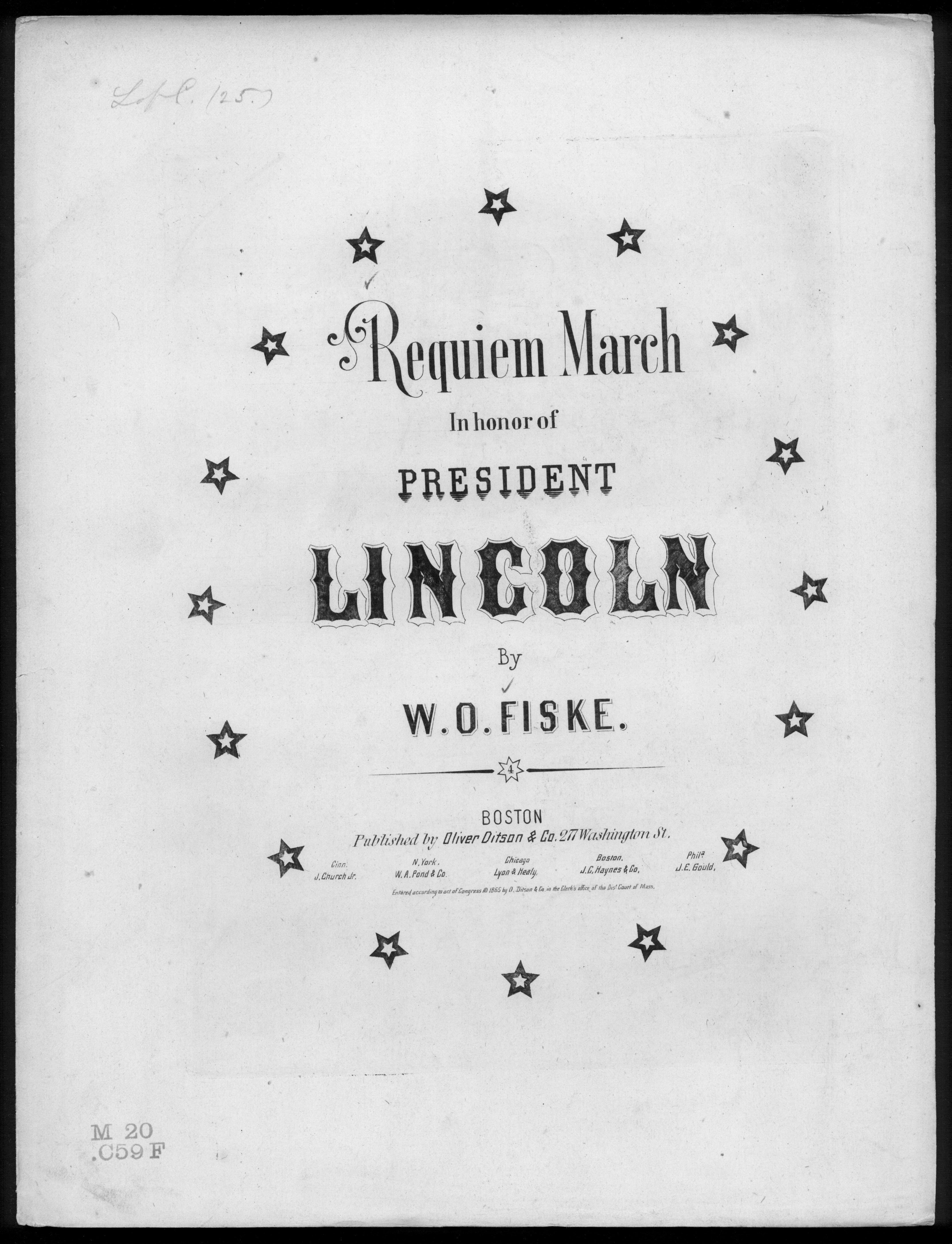
This is sheet music for President Lincoln's funeral march for solo piano. The title on the cover page is "Requiem March In honor of President Lincoln," while the first page of music lists the title as "President Lincoln's funeral march." A requiem is traditionally in a minor key and imitates the solemn, slow pace of a funeral procession. This piece is part of the Library of Congress Civil War Sheet Music Collection, associated with the Union side. Probably a third of the entire U.S. population at the time, out of a total of 31 million, participated in some kind of memorial commemoration for Lincoln. Roughly 150,000 people were present at Lincoln's funeral in Springfield.
-
Source
-
Rights
Public Domain. Suggested credit line: Civil War Sheet Music Collection, Library of Congress, Music Division.
-
Tags
-
Cite this Item
Fiske, W. O.. "Requiem march in honor of President Lincoln". Boston: Oliver Ditson & Co., 1865. Remembering Lincoln. Web. Accessed April 5, 2026. https://rememberinglincoln.fords.org/node/1033
-
Creator
Fiske, W. O.
-
Publisher
Boston: Oliver Ditson & Co., 1865
-
Date
1865
-
Material
Sheet Music
from May. 1, 1865
Requiem march in honor of President Lincoln
-
Description
This is sheet music for President Lincoln's funeral march for solo piano. The title on the cover page is "Requiem March In honor of President Lincoln," while the first page of music lists the title as "President Lincoln's funeral march." A requiem is traditionally in a minor key and imitates the solemn, slow pace of a funeral procession. This piece is part of the Library of Congress Civil War Sheet Music Collection, associated with the Union side. Probably a third of the entire U.S. population at the time, out of a total of 31 million, participated in some kind of memorial commemoration for Lincoln. Roughly 150,000 people were present at Lincoln's funeral in Springfield.
-
Source
-
Rights
Public Domain. Suggested credit line: Civil War Sheet Music Collection, Library of Congress, Music Division.
-
Creator
Fiske, W. O.
-
Publisher
Boston: Oliver Ditson & Co., 1865
-
Date
May 1, 1865
-
Material
Sheet Music
from May. 1, 1865
Lincoln's funeral march
-
Full Title
Lincoln's funeral march: as played by Menter's Band
-
Description
Funeral march for solo piano. The composer dedicated this work "to the nation" and it was composed "in commemoration of Abraham Lincoln, President of the United States, The Savior of His Country." Part of the Library of Congress Civil War Sheet Music Collection, associated with the Union side.
-
Source
-
Rights
Public Domain. Suggested credit line: Civil War Sheet Music Collection, Library of Congress, Music Division.
-
Tags
-
Cite this Item
Hess, Charles. "Lincoln's funeral march: as played by Menter's Band". Cincinnati: A. C. Peters & Bro., 1865. Remembering Lincoln. Web. Accessed April 5, 2026. https://rememberinglincoln.fords.org/node/1032
-
Creator
Hess, Charles
-
Publisher
Cincinnati: A. C. Peters & Bro., 1865
-
Date
1865
-
Material
Sheet Music
from May. 1, 1865
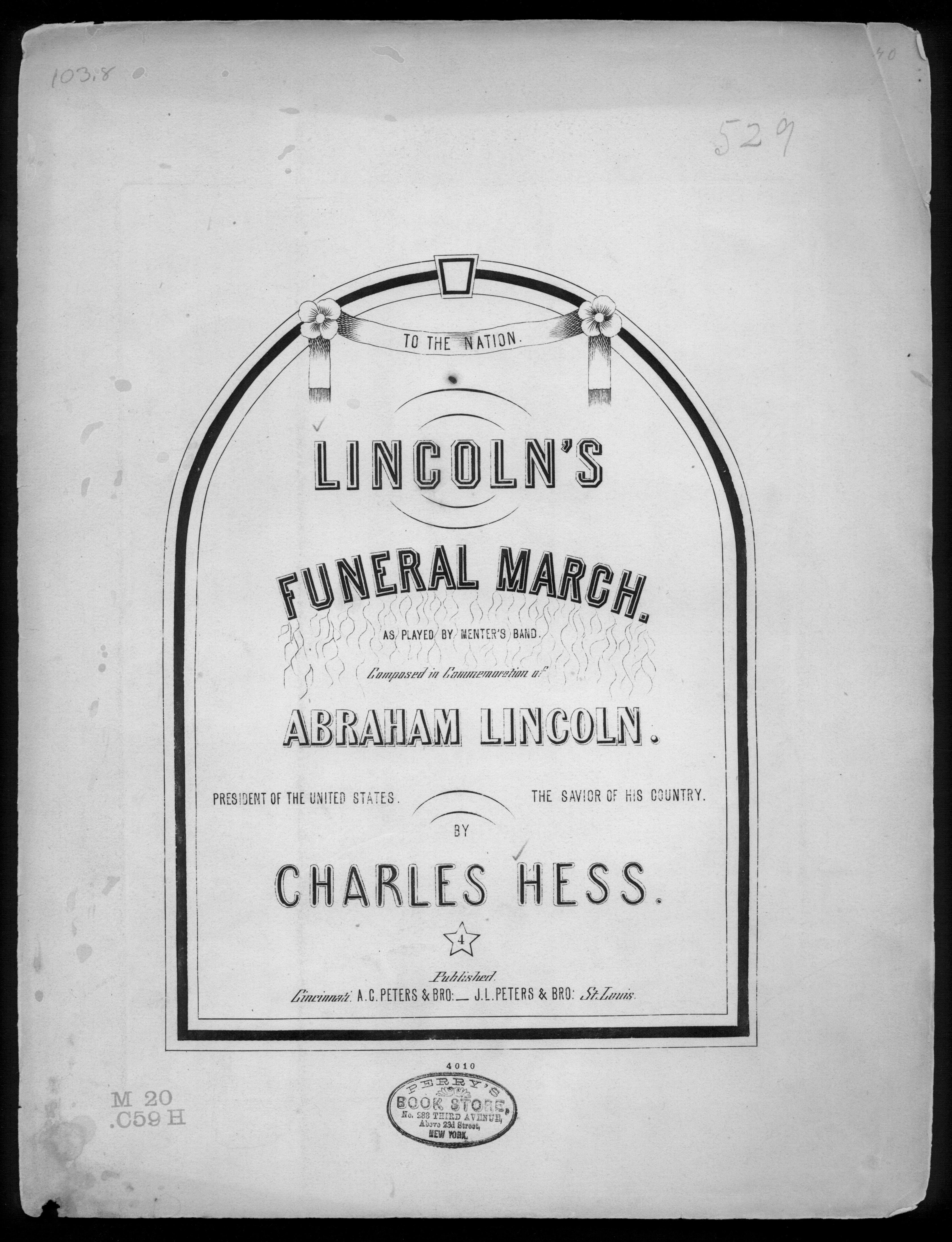
Lincoln's funeral march: as played by Menter's Band
-
Description
Funeral march for solo piano. The composer dedicated this work "to the nation" and it was composed "in commemoration of Abraham Lincoln, President of the United States, The Savior of His Country." Part of the Library of Congress Civil War Sheet Music Collection, associated with the Union side.
-
Source
-
Rights
Public Domain. Suggested credit line: Civil War Sheet Music Collection, Library of Congress, Music Division.
-
Creator
Hess, Charles
-
Publisher
Cincinnati: A. C. Peters & Bro., 1865
-
Date
May 1, 1865
-
Material
Sheet Music