from May. 1, 1865
Death of Abraham Lincoln, April 15th 1865
-
Full Title
Death of Abraham Lincoln, April 15th 1865
-
Description
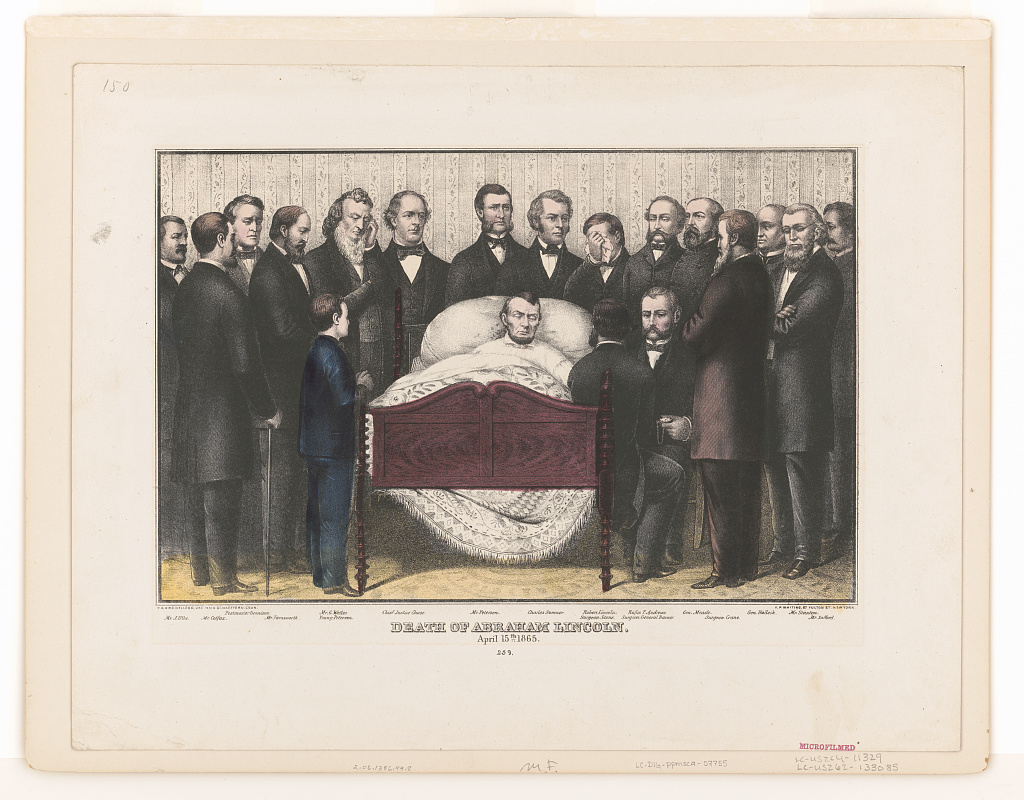
This lithograph depiction of Lincoln's death was created by the Hartford Lithograph company, E.B. & E.C. Kellogg. It shows a large group of men surrounding Lincoln on his deathbed. Each man is identified on the bottom of the print.
-
Source
Library of Congress Prints and Photographs Division, LC-DIG-ppmsca-07755
-
Rights
This item is in the public domain and may be reproduced and used for any purpose, including research, teaching, private study, publication, broadcast or commercial use, with proper citation and attribution.
-
Tags
-
Cite this Item
E.B. & E.C. Kellogg. " Death of Abraham Lincoln, April 15th 1865". E.B. & E.C. Kellogg. Remembering Lincoln. Web. Accessed April 5, 2026. https://rememberinglincoln.fords.org/node/1134
-
Creator
E.B. & E.C. Kellogg
-
Publisher
E.B. & E.C. Kellogg
-
Date
1865
from May. 1, 1865
Death of Abraham Lincoln, April 15th 1865
-
Description
This lithograph depiction of Lincoln's death was created by the Hartford Lithograph company, E.B. & E.C. Kellogg. It shows a large group of men surrounding Lincoln on his deathbed. Each man is identified on the bottom of the print.
-
Source
Library of Congress Prints and Photographs Division, LC-DIG-ppmsca-07755
-
Rights
This item is in the public domain and may be reproduced and used for any purpose, including research, teaching, private study, publication, broadcast or commercial use, with proper citation and attribution.
-
Creator
E.B. & E.C. Kellogg
-
Publisher
E.B. & E.C. Kellogg
-
Date
May 1, 1865
from Apr. 15, 1865
Letter from "Mary" to "Sister"
-
Full Title
Letter from "Mary" to "Sister"
-
Description
In this Letter a young woman, Mary, living in Washington, D.C. writes her sister, expressing her grief over Lincoln's assassination and tells of the atmosphere of mourning in the city. She goes on to relate her own account of the night of the assassination.
-
Transcription
Saturday Morning
Washington April 15th 1865
My Dear Sister
Long ere this reaches you the news of the Nations terrible calamity will have flashed to the remotest corner of the United States of the dastardly murder of our dearly beloved President not in Richmond among his enemies but in Washington and among his avowed friends. The heart of the an nation throbs with greif at a loss it cannot soon repair but if you could look into the faces of those here today you would see that he was loved most dearly by those who knew him best. I have just passed in sight of the house where little less than an hour ago the nations heart and life ceased to beat for its welfare. Oh the agony depicted on the faces of that crowd. Men actualy tearing their hair from very greif and agony. The state of feeling is such that it is impossible to tell what it may lead to after what is past it is not safe to judge what a day may bring forth. The streets are patroled to keep the people (and its not the roughs) from assasinating every known simpathizer with the rebelion. The whole city is being draped in the heaviest mourning the bells are tolling and every-thing and every-body wears the sadest aspect a human eye ever looked upon.
I was at Grovers Theatre at the time this desperately wicked act was perpetrated at Fords. The alarm was given and instantly the people rushed to the doors supposing the building was on fire people were thrown down stairs and the wildest confusion prevailed. I was never more frightend in my life yet I stood back thinking it was as well to stand my chance of escaping the fire as to be killed in the dense crowd when the excitement had subsided the audience took their seats without knowing what had occured and the play went on for about 15 minutes when the manager came forward and announced that the President had been assasinated and a scene ensued beyond description strong men wept like little children it was a scene which I shall remember to my latest breath. there were few pillows that were not wet with tears of true sorrow while none were visited with sleep, of those who knew of it words would fail to express the horror and indignation which pervades the entire community
What a change in one short day. Yesterday all was bright and joyous today, gloom and sorrow cover a nation.
Yesterday was a lovely day, today is dark and cloudy. It seems as if the sun refused to shine on the dark deed.
I must close for I am nervous and hardly know how I have written what I have. I have changed my boarding place so you must direct to the pension Office give my love to Mother write me if she is not well for I have felt worried since her last letter she wrote so sadly. write soon. from yours
Off, Mary
-
Source
National Park Service, Ford's Theatre National Historic Site
-
Rights
This item is in the public domain and may be reproduced and used for any purpose, including research, teaching, private study, publication, broadcast or commercial use, with proper citation and attribution.
-
Tags
-
Cite this Item
Mary . "Letter from "Mary" to "Sister"". Remembering Lincoln. Web. Accessed April 5, 2026. https://rememberinglincoln.fords.org/node/1131
-
Creator
Mary
-
Date
April 15, 1865
from Apr. 15, 1865
Letter from "Mary" to "Sister"

-
Description
In this Letter a young woman, Mary, living in Washington, D.C. writes her sister, expressing her grief over Lincoln's assassination and tells of the atmosphere of mourning in the city. She goes on to relate her own account of the night of the assassination.
-
Source
National Park Service, Ford's Theatre National Historic Site
-
Rights
This item is in the public domain and may be reproduced and used for any purpose, including research, teaching, private study, publication, broadcast or commercial use, with proper citation and attribution.
-
Creator
Mary
-
Date
April 15, 1865
from Apr. 25, 1865
Sir Charles Hastings Doyle to Ulysses S. Grant
-
Full Title
Sir Charles Hastings Doyle to Ulysses S. Grant
-
Description
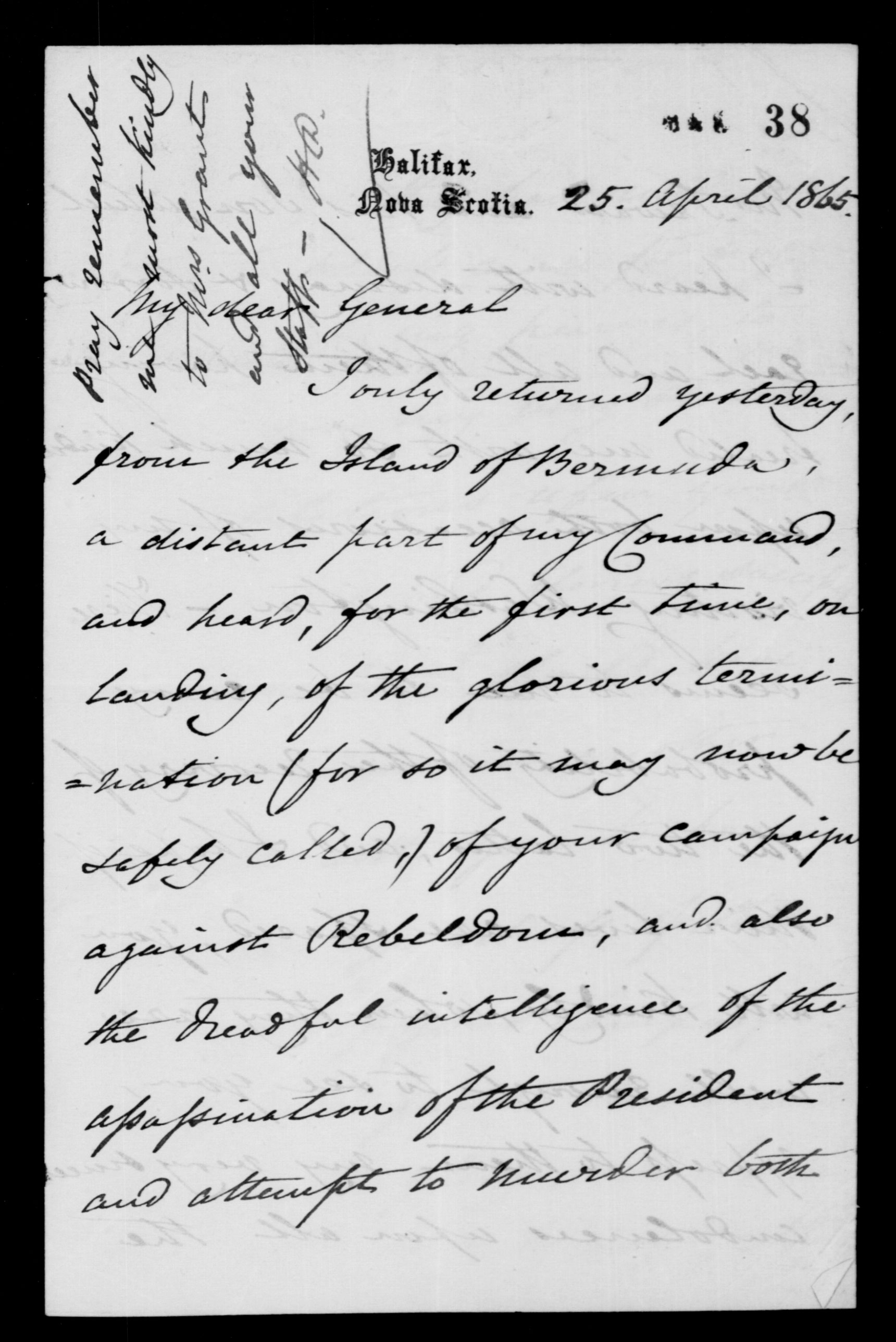
In this letter from Sir Charles Hastings Doyle, a friend of Ulysses S. Grant and major-general in command of British troops in the Atlantic area, Doyle expresses his sorrow over the assassination of Lincoln. Doyle also goes on to thank Grant for his hospitality while visiting him in Center Point, Virginia and invites Grant and his wife to visit his home in Halifax, Nova Scotia.
-
Transcription
Pray remember me most kindly to Mrs. Grant and all of your staff.
Halifax, Nova Scotia
April 25th, 1865
My Dear General,
I only returned yesterday from the Island of Bermuda, a distant part of my command, and heard, for the first time, on landing, of the glorious termination(for so it may now be called,) of your campaign against Rebeldom, and also the dreadful intelligence of the assassination of the President and attempts to murder both Mr. Seward and his son, which I heard with dismay and sorrow. Each and all of them having treated me with so much kindness upon both occasions of my visiting Washington - There seems to me to be every probability of the recovery of the two latter, and I hope if their lives are spared, you will kindly, when they are well enough to see you, express to them my very sincere condolences upon all the sufferings they have undergone but, the chief cause for my taking up my pen is, to offer you my very sincere congratulations upon your continuous and glorious successes, How much I should have liked to remain another fortnight with you to have been an eye witness of this wind up of your Campaign. You have gained imperishable honor and glory, and I hope you will live to enjoy them for many a long year to come - In conclusion I have only to remind you of your promise to pay me a visit, and to bring Mrs. Grant with you, that I may have an opportunity of repaying, in part at any rate, the kindness and hospitality you so obligingly bestowed upon me - I hope, the campaign being now over, there can be no doubt of your being able to carry your promise into effect - when you are able to make up your mind upon the subject you must let me know, that I may not be absent from home when you come
-Yours Sincerely Hastings Doyle General -
Source
-
Rights
This item is in the public domain and may be reproduced and used for any purpose, including research, teaching, private study, publication, broadcast or commercial use, with proper citation and attribution.
-
Tags
-
Cite this Item
Sir Charles Hastings Doyle. "Sir Charles Hastings Doyle to Ulysses S. Grant". Remembering Lincoln. Web. Accessed April 5, 2026. https://rememberinglincoln.fords.org/node/1130
-
Creator
Sir Charles Hastings Doyle
-
Date
April 25, 1865
from Apr. 25, 1865
Sir Charles Hastings Doyle to Ulysses S. Grant
-
Description
In this letter from Sir Charles Hastings Doyle, a friend of Ulysses S. Grant and major-general in command of British troops in the Atlantic area, Doyle expresses his sorrow over the assassination of Lincoln. Doyle also goes on to thank Grant for his hospitality while visiting him in Center Point, Virginia and invites Grant and his wife to visit his home in Halifax, Nova Scotia.
-
Source
-
Rights
This item is in the public domain and may be reproduced and used for any purpose, including research, teaching, private study, publication, broadcast or commercial use, with proper citation and attribution.
-
Creator
Sir Charles Hastings Doyle
-
Date
April 25, 1865
from Jul. 4, 1865
Condolences from the Governor of the State of Tabasco, Mexico
-
Full Title
Condolences from the Governor of the State of Tabasco, Mexico
-
Description
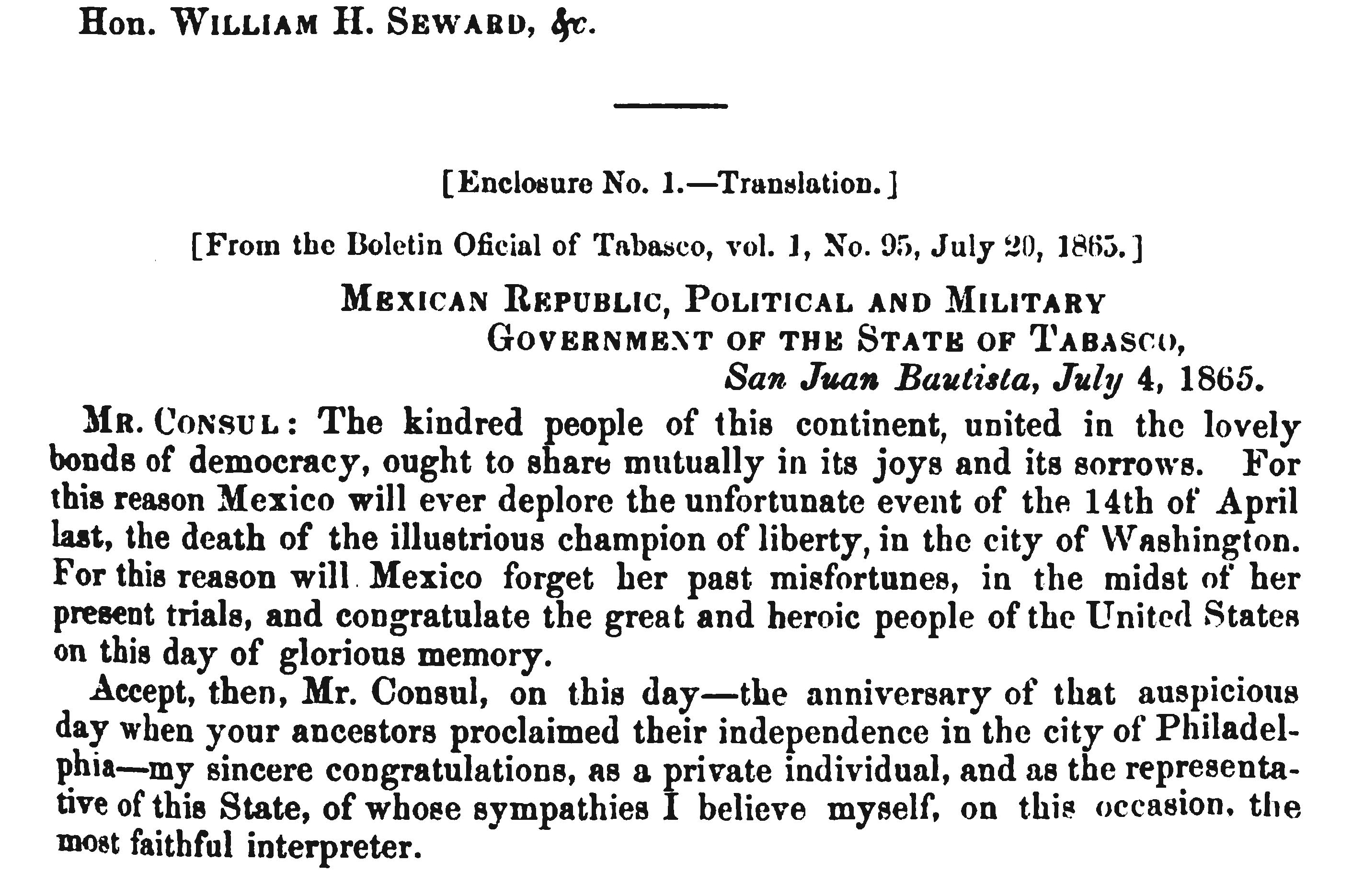
This is a condolence letter from the governor of the State of Tabasco in Southern Mexico. The letter expresses how sad the Mexican government is because of the death of President Lincoln, but they also congratulate the government on winning the American Civil War. The letter discusses the importance of July 4, America's Independence Day, and the country's dedication to freedom and liberty. During the 1860s, Mexico was also in the midst of war. Benito Juarez served as President in Mexico until 1863, when French forces invaded Mexico during the "French Intervention" which began in 1861. The French, backed by conservatives and nobility in Mexico, tried to overthrow Mexican President Benito Juarez. Allies of Juarez fled to New York City, considered a safe haven by Mexican liberals. Juarez set up his government in exile in northern Mexico, in Chihuahua City. This letter tries to solidify the relationship between the exiled government and the American government by reinforcing their shared beliefs and good will.
-
Source
Google Books
-
Rights
This item is in the public domain and may be reproduced and used for any purpose, including research, teaching, private study, publication, broadcast or commercial use, with proper citation and attribution.
-
Tags
-
Cite this Item
G. Mendez. "Condolences from the Governor of the State of Tabasco, Mexico ". Government Printing Office. Remembering Lincoln. Web. Accessed April 5, 2026. https://rememberinglincoln.fords.org/node/1125
-
Creator
G. Mendez
-
Publisher
Government Printing Office
-
Date
July 4, 1865
from Jul. 4, 1865
Condolences from the Governor of the State of Tabasco, Mexico
-
Description
This is a condolence letter from the governor of the State of Tabasco in Southern Mexico. The letter expresses how sad the Mexican government is because of the death of President Lincoln, but they also congratulate the government on winning the American Civil War. The letter discusses the importance of July 4, America's Independence Day, and the country's dedication to freedom and liberty. During the 1860s, Mexico was also in the midst of war. Benito Juarez served as President in Mexico until 1863, when French forces invaded Mexico during the "French Intervention" which began in 1861. The French, backed by conservatives and nobility in Mexico, tried to overthrow Mexican President Benito Juarez. Allies of Juarez fled to New York City, considered a safe haven by Mexican liberals. Juarez set up his government in exile in northern Mexico, in Chihuahua City. This letter tries to solidify the relationship between the exiled government and the American government by reinforcing their shared beliefs and good will.
-
Source
Google Books
-
Rights
This item is in the public domain and may be reproduced and used for any purpose, including research, teaching, private study, publication, broadcast or commercial use, with proper citation and attribution.
-
Creator
G. Mendez
-
Publisher
Government Printing Office
-
Date
July 4, 1865
from May. 16, 1865
Department of Foreign Relations and Government - Mexican Response to Lincoln Assassination
-
Full Title
Department of Foreign Relations and Government - Mexican Response to Lincoln Assassination
-
Description
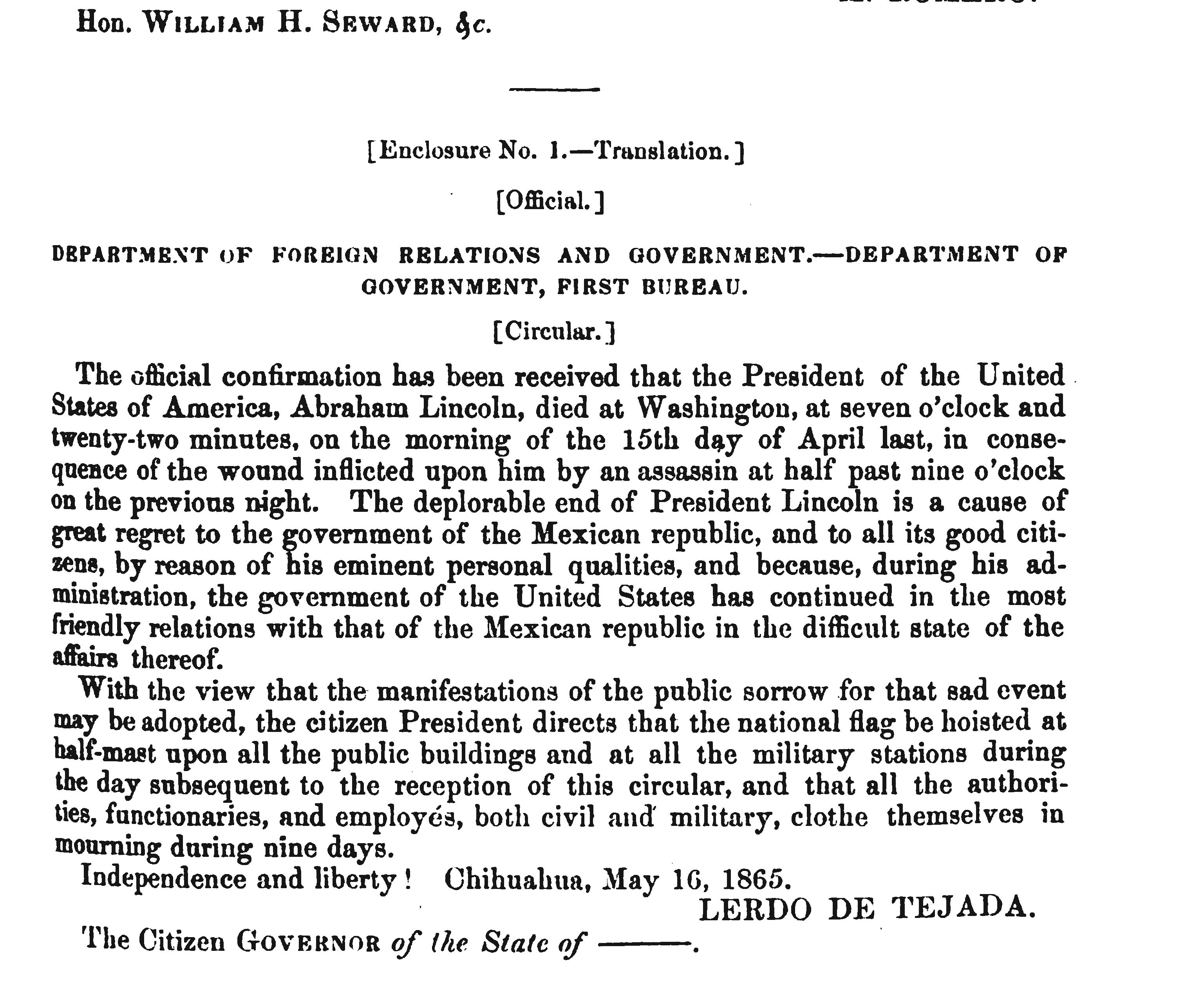
In this official letter from the exiled Mexican government, Sebastián Lerdo de Tejada, the minister of foreign affairs, notifies the United States of their remorse for the death of President Abraham Lincoln. The letter says the Mexican government will fly flags at half mast and wear mourning attire for nine days to honor Abraham Lincoln. Lerdo de Tejada served as second in command to exiled Mexican President Benito Juarez during the "French Intervention" which began in 1861. The French, backed by conservatives and nobility in Mexico, tried to overthrow Mexican President Benito Juarez. Juarez set up his government in exile in northern Mexico, in Chihuahua City, and eventually won the war in 1867.
-
Transcription
Hon. William H. Seward, &c.
_____
[Enclosure No. 1. – Translation.]
[Official.]
DEPARTMENT OF FOREIGN RELATIONS AND GOVERNMENT—DEPARTMENT OF GOVERNMENT, FIRST BUREAU.
[Circular.]
The official confirmation has been received that the President of the United States of America, Abraham Lincoln, died at Washington, at seven o’clock and twenty-two minutes, on the morning of the 15th day of April last, in consequence of the wound inflicted upon him by an assassin at half past nine o’clock on the previous night. The deplorable end of President Lincoln is a cause of great regret to the government of the Mexican republic, and to all its good citizens, by reason of his eminent personal qualities and because, during his administration, the government of the United States has continued in the most friendly relations with that of the Mexican republic in the difficult state of affairs thereof.
With the view that the manifestations of the public sorrow for that end event may be adopted, the citizen President directs that the national flag be hoisted at half-mast upon all the public buildings and at all the military stations during the day subsequent to the reception of this circular, and that all the authorities, functionaries, and employés, both civil and military, clothe themselves in mourning during nine days.
Independence and liberty! Chihuahua, May 16, 1865.
LERDO DE TEJADA
The Citizen Governor of the State of ——— .
[Transcription by: Ricarda H., Dr. Susan Corbesero’s Class, Ellis School, Pittsburgh, Pennsylvania] -
Source
Google Books
-
Rights
This item is in the public domain and may be reproduced and used for any purpose, including research, teaching, private study, publication, broadcast or commercial use, with proper citation and attribution.
-
Tags
-
Cite this Item
Sebastián Lerdo de Tejada. "Department of Foreign Relations and Government - Mexican Response to Lincoln Assassination". Government Printing Office. Remembering Lincoln. Web. Accessed April 5, 2026. https://rememberinglincoln.fords.org/node/1124
-
Creator
Sebastián Lerdo de Tejada
-
Publisher
Government Printing Office
-
Date
May 16, 1865
from May. 16, 1865
Department of Foreign Relations and Government - Mexican Response to Lincoln Assassination
-
Description
In this official letter from the exiled Mexican government, Sebastián Lerdo de Tejada, the minister of foreign affairs, notifies the United States of their remorse for the death of President Abraham Lincoln. The letter says the Mexican government will fly flags at half mast and wear mourning attire for nine days to honor Abraham Lincoln. Lerdo de Tejada served as second in command to exiled Mexican President Benito Juarez during the "French Intervention" which began in 1861. The French, backed by conservatives and nobility in Mexico, tried to overthrow Mexican President Benito Juarez. Juarez set up his government in exile in northern Mexico, in Chihuahua City, and eventually won the war in 1867.
-
Source
Google Books
-
Rights
This item is in the public domain and may be reproduced and used for any purpose, including research, teaching, private study, publication, broadcast or commercial use, with proper citation and attribution.
-
Creator
Sebastián Lerdo de Tejada
-
Publisher
Government Printing Office
-
Date
May 16, 1865
from May. 11, 1865
Mexican President Benito Juarez Response to the Lincoln Assassination
-
Full Title
Mexican President Benito Juarez Response to the Lincoln Assassination
-
Description
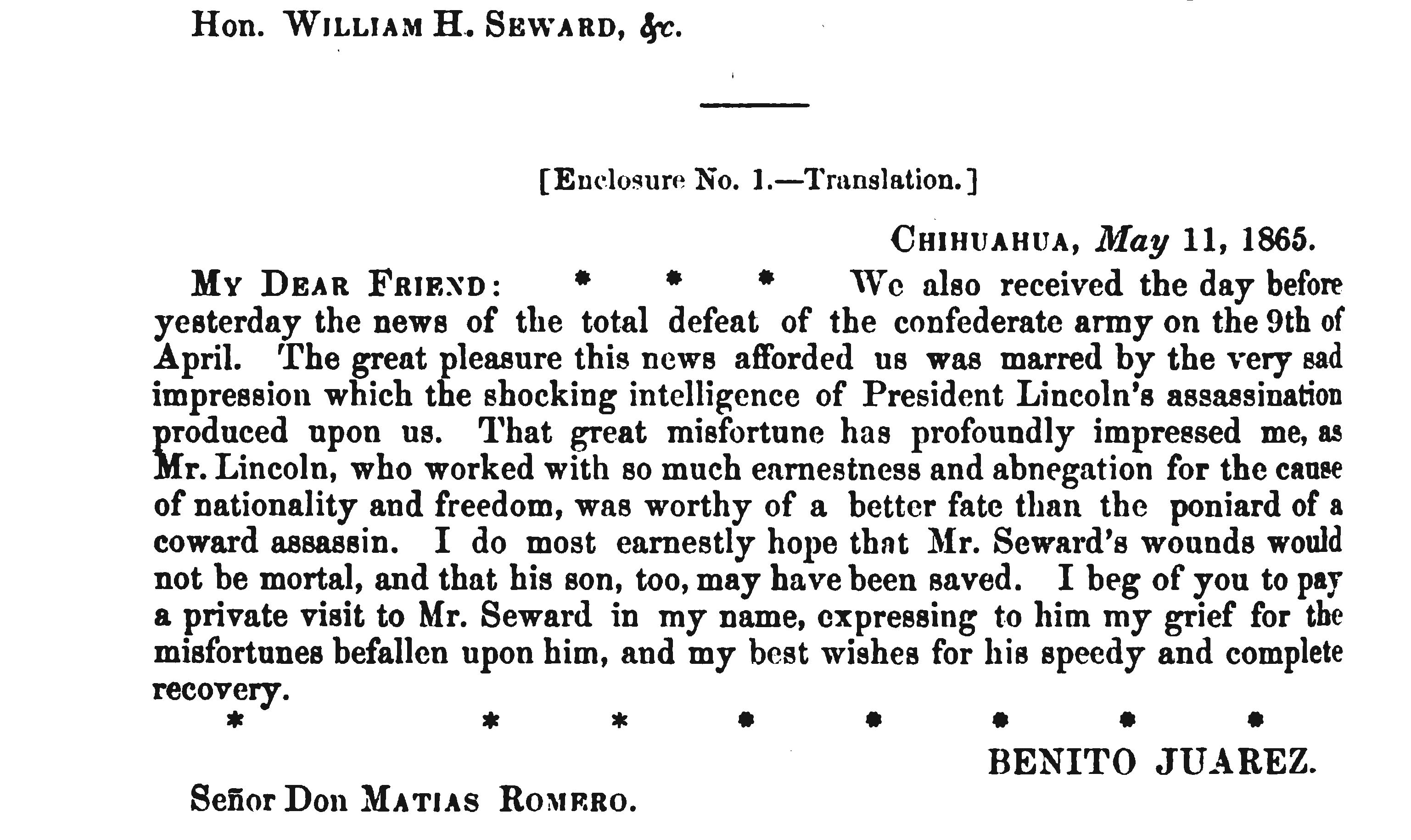
This is a condolence letter from the exiled Mexican President Benito Juarez. In the letter Juarez mourns the loss of Abraham Lincoln and also hopes that the U.S. Secretary of State and his son recover from their wounds. On the night of President's assassination, U.S. Secretary of State William Seward was also attacked. He was stabbed repeatedly in his home by conspirator Lewis Powell. Eventually Seward recovered from his wounds. Benito Juarez served as President in Mexico until 1863, when French forces invaded Mexico during the "French Intervention" which began in 1861. The French, backed by conservatives and nobility in Mexico, tried to overthrow Mexican President Benito Juarez. Allies of Juarez fled to New York City, considered a safe haven by Mexican liberals. Juarez set up his government in exile in northern Mexico, in Chihuahua City.
-
Transcription
Hon. William H. Seward, &c.
_____
[Enclosure No. 1. – Translation.]
Chihuahua, May 11, 1865.
My Dear Friend …
We also received the day before yesterday the news of the total defeat of the confederate army on the 9th of April. The great pleasure this news afforded us was marred by the very sad impression which the shocking intelligence of President Lincoln’s assassination produced upon us. That great misfortune has profoundly impressed me, as Mr. Lincoln, who worked with so much earnestness and abnegation for the cause of nationality and freedom was worthy of a better fate than the poniard of a coward assassin. I do most earnestly hope that Mr. Seward’s wounds would not be mortal, and that his son too, may have been saved. I beg of you to pay a private visit to Mr. Seward in my name, expressing to him my grief for the misfortunes befallen upon him, and my best wishes for his speedy and complete recovery.
Benito Juarez
Senor Don Matias Rombro
[Transcription by: Ricarda H., Dr. Susan Corbesero’s Class, Ellis School, Pittsburgh, Pennsylvania]
-
Source
Google Books
-
Rights
This item is in the public domain and may be reproduced and used for any purpose, including research, teaching, private study, publication, broadcast or commercial use, with proper citation and attribution.
-
Tags
-
Cite this Item
Benito Juarez. "Mexican President Benito Juarez Response to the Lincoln Assassination". Government Printing Office. Remembering Lincoln. Web. Accessed April 5, 2026. https://rememberinglincoln.fords.org/node/1123
-
Creator
Benito Juarez
-
Publisher
Government Printing Office
-
Date
May 11, 1865
from May. 11, 1865
Mexican President Benito Juarez Response to the Lincoln Assassination
-
Description
This is a condolence letter from the exiled Mexican President Benito Juarez. In the letter Juarez mourns the loss of Abraham Lincoln and also hopes that the U.S. Secretary of State and his son recover from their wounds. On the night of President's assassination, U.S. Secretary of State William Seward was also attacked. He was stabbed repeatedly in his home by conspirator Lewis Powell. Eventually Seward recovered from his wounds. Benito Juarez served as President in Mexico until 1863, when French forces invaded Mexico during the "French Intervention" which began in 1861. The French, backed by conservatives and nobility in Mexico, tried to overthrow Mexican President Benito Juarez. Allies of Juarez fled to New York City, considered a safe haven by Mexican liberals. Juarez set up his government in exile in northern Mexico, in Chihuahua City.
-
Source
Google Books
-
Rights
This item is in the public domain and may be reproduced and used for any purpose, including research, teaching, private study, publication, broadcast or commercial use, with proper citation and attribution.
-
Creator
Benito Juarez
-
Publisher
Government Printing Office
-
Date
May 11, 1865
from Apr. 15, 1865
Condolences from the Mexican Club of New York
-
Full Title
Condolences from the Mexican Club of New York to Secretary of State William Seward
-
Description
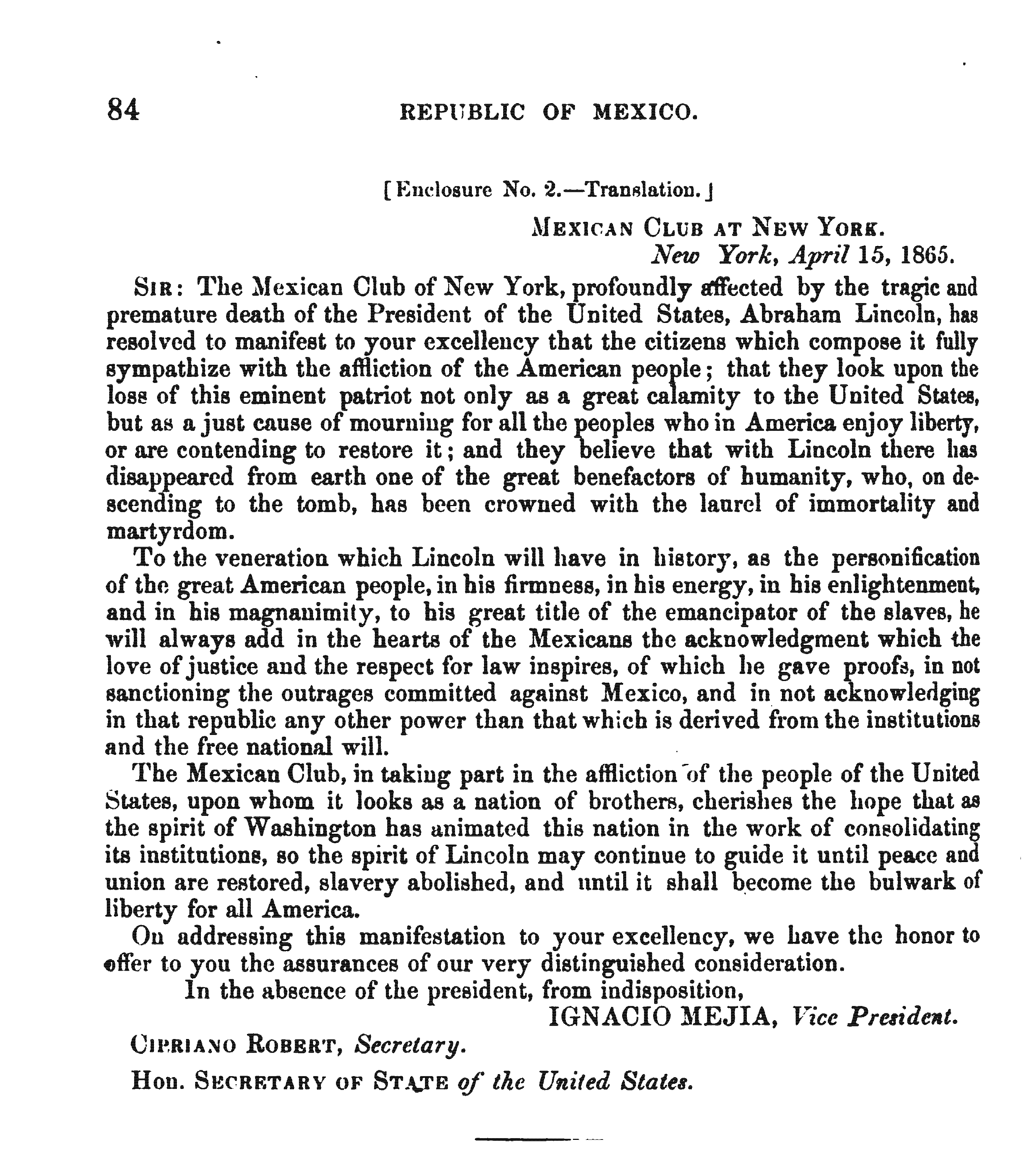
This is a condolence letter from the Vice President of the Mexican Club of New York to the U.S. Secretary of State William Seward after news of Abraham Lincoln's assassination reached New York. The letter talks about how important President Lincoln was to the ideals of liberty and freedom in the United States and reaffirms Mexico's commitment to their friendship with the country. The Mexican Club of New York was created in 1864, as exiles from the Mexican government fled Mexico during the French Intervention, which began in 1861. The French, backed by conservatives and nobility in Mexico tried to overthrow Mexican President Benito Juarez. Allies of Juarez fled to New York City, considered a safe haven by Mexican liberals. U.S. Secretary of State William Seward quietly supported the work of the Club but refused to promise too more nor interfere with the war in Mexico. The Club's president, Benito Quijano, had died in early 1865 and at the time of Abraham Lincoln's death a new successor had not been chosen.
-
Transcription
Republic of Mexico
[Enclosure No. 2 – Translation.]
Mexican Club at New York.
New York, April 15, 1865.
Sir: The Mexican Club of New York, profoundly affected by the tragic and premature death of the President of the United States, Abraham Lincoln, has resolved to manifest to your excellency that the citizens which compose it fully sympathize the affliction of the American people; that they look upon the loss of this eminent patriot not only as a great calamity to the United States, but as a just cause of mourning for all the peoples who in America enjoy liberty, or are contending to restore it; and they believe that with Lincoln there has disappeared from earth one of the great benefactors of humanity, who, on descending to the tomb, has been crowned with the laurel of immortality and martyrdom.
To the veneration which Lincoln will have in history, as the personification of the great American people, in his firmness, in his energy, in his enlightenment, and in his magnanimity, to his great title of the emancipator of the slaves, he will always add in the hearts of the Mexicans the acknowledgement which the love of justice and the respect for law inspires, of which he gave proofs, in not sanctioning the outrages committed against Mexico, and in not acknowledging in that republic any other power than that which is derived from the institutions and the free national will.
The Mexican Club, in taking part in the affliction of the people of the United States, upon whom it looks as a nation of brothers, cherishes the hope that as the spirit of Washington has animated this nation in the work of consolidating its institutions, so the spirit of Lincoln may continue to guide it until peace and union are restored, slavery abolished, and until it shall become the bulwark of liberty for all America.
On addressing this manifestation to your excellency, we have the honor to offer to you the assurances of our very distinguished consideration.
In absence of the president, from indisposition,
IGNACIO MEJIA, Vice President.
CIPRIANO ROBERT, Secretary.
Hon. Secretary of State of the United States.
[Transcription by: Ricarda H., Dr. Susan Corbesero’s Class, Ellis School, Pittsburgh, Pennsylvania] -
Source
Google Books
-
Rights
This item is in the public domain and may be reproduced and used for any purpose, including research, teaching, private study, publication, broadcast or commercial use, with proper citation and attribution.
-
Tags
-
Cite this Item
Ignacio Mejia. "Condolences from the Mexican Club of New York to Secretary of State William Seward". Government Printing Office. Remembering Lincoln. Web. Accessed April 5, 2026. https://rememberinglincoln.fords.org/node/1122
-
Creator
Ignacio Mejia
-
Publisher
Government Printing Office
-
Date
April 15, 1865
from Apr. 15, 1865
Condolences from the Mexican Club of New York to Secretary of State William Seward
-
Description
This is a condolence letter from the Vice President of the Mexican Club of New York to the U.S. Secretary of State William Seward after news of Abraham Lincoln's assassination reached New York. The letter talks about how important President Lincoln was to the ideals of liberty and freedom in the United States and reaffirms Mexico's commitment to their friendship with the country. The Mexican Club of New York was created in 1864, as exiles from the Mexican government fled Mexico during the French Intervention, which began in 1861. The French, backed by conservatives and nobility in Mexico tried to overthrow Mexican President Benito Juarez. Allies of Juarez fled to New York City, considered a safe haven by Mexican liberals. U.S. Secretary of State William Seward quietly supported the work of the Club but refused to promise too more nor interfere with the war in Mexico. The Club's president, Benito Quijano, had died in early 1865 and at the time of Abraham Lincoln's death a new successor had not been chosen.
-
Source
Google Books
-
Rights
This item is in the public domain and may be reproduced and used for any purpose, including research, teaching, private study, publication, broadcast or commercial use, with proper citation and attribution.
-
Creator
Ignacio Mejia
-
Publisher
Government Printing Office
-
Date
April 15, 1865
from Apr. 19, 1865
The Feeling in Canada
-
Full Title
The Feeling in Canada
-
Description
In this article the emotions of the nation following the death of Abraham Lincoln can be seen in great detail. The aspects of his noble character that won over the public are also mentioned frequently. There is even discussion of why the assassin committed this horrendous deed before questioning why John James Booth killed assassinated the president. His mental health is also questioned
-
Transcription
THE FEELING IN CANADA
________
Opinion of the Leading Canadian Journal—The Deep Regard and Affection Felt forThe President—The Secessionists Carousing in Honor of the Assassin—A Plea for The Murderer—His Crime Justified.
From the Toronto Globe.
ABRAHAM LINCOLN.
At twenty-two minutes after seven o’clock, on Saturday morning, about nine hours after he had received the shot of the assassin, ABRAHAM LINCOLN drew his last breath, surrounded by the members of his family, his Cabinet, and leading political and personal friends. His death would, under any circumstances, have produced an extraordinary sensation, but accompanied by murderous violence, the feeling which has been created has been the most intense. No single event of the present century in America can at all compare with it in effect on the popular mind, and we think that in England the shock will be nearly as deeply felt. The grief which is expressed has two very distinct origins, the stronger of which seems to arise from personal sympathy and regard for the deceased. We hear in all quarters the strongest expressions of admiration of the character of Mr. LINCOLN, and deep sorrow that his noble career should have been brought to an untimely end. His simplicity of charafter [character[, his straightforward honesty, his kindliness, even his bluntness of manner, seem to have won the popular heart, even among a foreign, and, in matter of opinion, a hostile nation. We may judge by that fact of his popularity among the citizens of the Northern States. Almost all of us feel as if we had suffered a personal loss. Mr. LINCOLN is spoken of in the same terms as are used toward a familiar friend. All mourn his untimely fate. He had risen by industry, ability and integrity to the great position of Chief Magistrate of his country. He found it in the most imminent danger, and his power to control the elements which were sweeping over the land were far from generally acknowledged. He was regarded with fear and trembling by the friends of his government, and with contempt by his opponents. But steadily he made his way. He was not the best man who could have been imagined for the post of Chief Magistrate in a great civil war. He had not the commanding force which infuses energy into all around him, and his public appearances were often lacking in dignity. But he was sagacious, patient, prudent, courageous, honest and candid. If he did not inspire great Generals, he gave every man in the army an opportunity of developing the talents within him. He recognized merit and rewarded it. He placed confidence, as a rdle [rule], where it was due, and he had his reward in great military successes. Some say that he has been cut off at a favorable moment for his reputation but we cannot accept this view. It seems to us that he had gone through his worst trials, that his patience, sagacity and honesty would have borne even better fruits in the settlement of the affairs of the South than during the wild commotion of the war. He has been cut off at a time when, certainly, he had accomplished a great deal, but leaving much undone which he was well qualified to do. A naturally strong man, of only fifty-six, he might have hope to live many years after finishing his work as President, in the enjoyment of the respect and admiration justly due to one who had saved the life of his country. He will be held, we think, by Americans, if not equal to WASHINGTON, second to none but he. But he had not the gratification of his great predecessor, of seeing his work completed and enjoying for a long period the gratitude of his countrymen and the admiration of strangers. There are few so hard of heart as to not shed a tear over the sudden and bloody termination of so bright a career. As great as WASHINGTON in many moral and mental qualities, his genial character was calculated to win far more popular sympathy than his predecessor. Ability and honesty all admire, but when to them are added kindliness, simplicity, and freedom from selfishness, haughtiness and pride in high position, they win love as well as respect.
THE MURDER JUSTIFIED
From the Toronto Leader
A man may, on the spur of the moment, be so maddened with rage as to strike another down to the earth; but if the accounts which come to us of this distressing affair are correct, the attack upon both Mr. LINCOLN’s and Mr. SEWARD’s lives were concocted some time prior to the inauguration ceremony on the 4th of March, and only failed of accomplishment because one of the parties in the plot lost heart to carry out the scheme at that time. Would that he had never found it again! The act was not committed without due time for reflection as to its awful nature. For over a month the plan remained unacted upon in the bosom of its author, and time seems but to have added to the burning desire to carry it out. There must have been a strong feeling on the part of the person who committed the crime that a grievous wrong had been done, either to himself or to his country, by the President or the government he represented. Had a Southern man, during the four years of the war, taken the life of the President, there would be no difficulty in tracing it to a cause. We cannot so soon forget the numberless acts of wickedness committed in the South by the servants and emissaries of the Northern Government; the beautiful homesteads leveled to the ground with demoniacal fury; the fair women violated by a ribald soldiery; the brave men shot down in the coldest blood on the insane plea of retaliation—all this and much more is still fresh in our memories, and serve to remind us that if the assassination had been committed in the heat of the war by a Southern man, who had so much to drive him to desperation, a reason for his conduct could readily be found. In the present instance these considerations do not help us to discover the cause of the assassination. That the deed was committed by JOHN WILKES BOOTH, a brother of EDWIN BOOTH, the celebrated actor of the present day, there seems to be little doubt. But why should he make himself the champion of the Southern people or the Southern cause? He must have been goaded almost to the verge of madness. No man of ordinary nerve or trivial impulse could have jumped into a private box at the theatre, as he did, calmly shoot down the object of his wrath, then spring on the stage uttering words which serve to give a clue to the act of assassination, and ultimately find his way through the theatre to a place of escape. The man who could have done all this, must have considered that his chances of escape were very few indeed, and that, if need were, he was ready to give up his own life for that which he had taken. There is desperation in such a thought—such a desperation as is caused by a deep consciousness of wrong-doing on the part of the persons against whom it is conceived.
The feeling in Montreal
MONTREAL, Tuesday, April 18.
The following proclamation has been issued by the Mayor of Montreal:
PROCLAMATION.
Whereas Wednesday next, the 19th of April inst., at noon, has been fixed upon for the funeral ceremonies of the Chief Magistrate of the United States, the undersigned, Mayor of the City of Montreal, respectfully invites the citizens generally to close their places of business from 12 o’clock noon on that day, as a tribute of respect to the memory of the late President of the United States, and of sympathy with the bereaved members of his family, and also as an expression of the deep sorrow and horror felt by the citizens of Montreal at the atrocious crime by which the President came to an untimely death.
(Signed) J. L. BEAUDRY, Mayor
Arrival of Gen. Lee in Richmond.
The Richmond Whig of yesterday says:
Gen. R. E. LEE arrived in this city about 3 o’clock Saturday evening, attended by five members of his staff. He rode into the city over the pontoon bridge at the foot of Seventeenth-street, and thence up Main-street to his residence on Franklin-street between Seventh and Eighth-streets.
[Transcription by: Deborah Taylor.] -
Source
THE FEELING IN CANADA. (1865, Apr 19). New York Times (1857-1922) Retrieved from http://blume.stmarytx.edu:2048/login?url=https://search.proquest.com/docview/92001549?accountid=7076
-
Rights
This item is in the public domain and may be reproduced and used for any purpose, including research, teaching, private study, publication, broadcast or commercial use, with proper citation and attribution.
-
Tags
-
Cite this Item
Toronto Globe . "The Feeling in Canada". New York Times. Remembering Lincoln. Web. Accessed April 5, 2026. https://rememberinglincoln.fords.org/node/1120

-
Creator
Toronto Globe
-
Publisher
New York Times
-
Date
April 19, 1865
from Apr. 19, 1865
The Feeling in Canada

-
Description
In this article the emotions of the nation following the death of Abraham Lincoln can be seen in great detail. The aspects of his noble character that won over the public are also mentioned frequently. There is even discussion of why the assassin committed this horrendous deed before questioning why John James Booth killed assassinated the president. His mental health is also questioned
-
Source
THE FEELING IN CANADA. (1865, Apr 19). New York Times (1857-1922) Retrieved from http://blume.stmarytx.edu:2048/login?url=https://search.proquest.com/docview/92001549?accountid=7076
-
Rights
This item is in the public domain and may be reproduced and used for any purpose, including research, teaching, private study, publication, broadcast or commercial use, with proper citation and attribution.
-
Creator
Toronto Globe
-
Publisher
New York Times
-
Date
April 19, 1865
from May. 20, 1865
President Lincoln's Funeral Service in Chicago, IL
-
Full Title
President Lincoln's Funeral Service in Chicago, IL - Frank Leslie's Illustrated Newspaper Drawing
-
Description
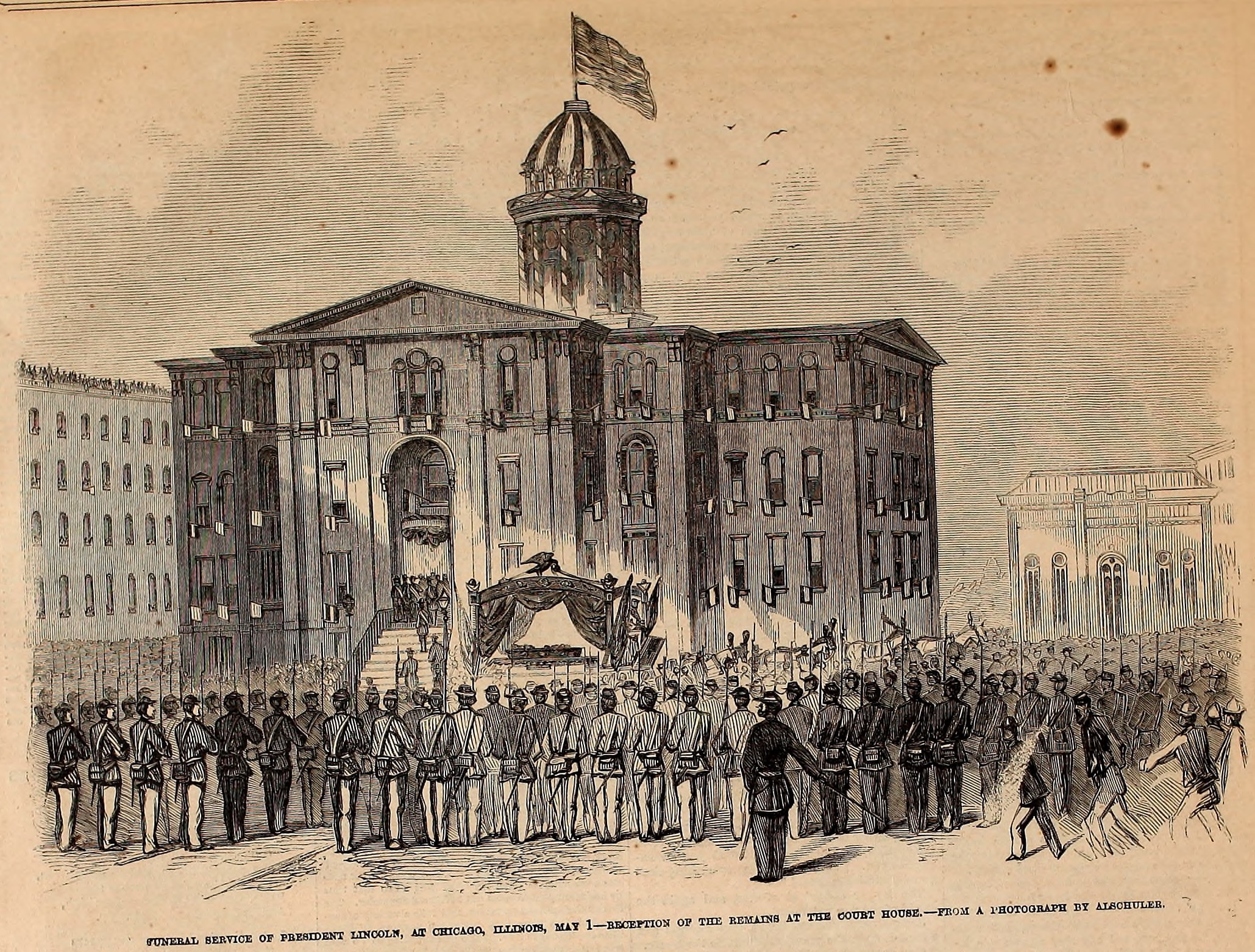
In the May 20th, 1865 edition of Frank Leslie's Illustrated Weekly newspaper, this image was printed next to an article about President Lincoln's funeral train heading to Springfield, Illinois for burial. The train carrying Lincoln’s body traveled through 180 cities and seven states on its way to Springfield. Scheduled stops for the special funeral train were published in newspapers. In ten cities, Lincoln’s casket was removed from the train for elaborate memorial services and public viewings. This image depicts the funeral procession for President Lincoln in Chicago. The illustrated literary and news publication was founded in 1855 and continued until 1922. It was one of several started by publisher and illustrator Frank Leslie. Leslie was a British engraver who came to the United States in 1848. The Illustrated Weekly followed a tested and proven formula of carefully combining elements of war, politics, art, science, travel and exploration, literature and the fine arts in each issue, enhanced with between 16 and 32 illustrations. By 1897 its circulation had grown to an estimated 65,000 copies.
-
Source
Lincoln Financial Foundation Collection
-
Rights
To request rights and permissions to use Lincoln Financial Foundation Collection images in research or publications, please download our image rights permission form: https://www.lincolncollection.org/access/image-rights-permissions/.
-
Tags
-
Cite this Item
Frank Leslie. "President Lincoln's Funeral Service in Chicago, IL - Frank Leslie's Illustrated Newspaper Drawing". Frank Leslie. Remembering Lincoln. Web. Accessed April 5, 2026. https://rememberinglincoln.fords.org/node/1117
-
Creator
Frank Leslie
-
Publisher
Frank Leslie
-
Date
May 20, 1865
from May. 20, 1865
President Lincoln's Funeral Service in Chicago, IL - Frank Leslie's Illustrated Newspaper Drawing
-
Description
In the May 20th, 1865 edition of Frank Leslie's Illustrated Weekly newspaper, this image was printed next to an article about President Lincoln's funeral train heading to Springfield, Illinois for burial. The train carrying Lincoln’s body traveled through 180 cities and seven states on its way to Springfield. Scheduled stops for the special funeral train were published in newspapers. In ten cities, Lincoln’s casket was removed from the train for elaborate memorial services and public viewings. This image depicts the funeral procession for President Lincoln in Chicago. The illustrated literary and news publication was founded in 1855 and continued until 1922. It was one of several started by publisher and illustrator Frank Leslie. Leslie was a British engraver who came to the United States in 1848. The Illustrated Weekly followed a tested and proven formula of carefully combining elements of war, politics, art, science, travel and exploration, literature and the fine arts in each issue, enhanced with between 16 and 32 illustrations. By 1897 its circulation had grown to an estimated 65,000 copies.
-
Source
Lincoln Financial Foundation Collection
-
Rights
To request rights and permissions to use Lincoln Financial Foundation Collection images in research or publications, please download our image rights permission form: https://www.lincolncollection.org/access/image-rights-permissions/.
-
Creator
Frank Leslie
-
Publisher
Frank Leslie
-
Date
May 20, 1865
from May. 20, 1865
President Lincoln's Funeral Service in Chicago, IL
-
Full Title
President Lincoln's Funeral Service in Chicago, IL - Frank Leslie's Illustrated Newspaper Drawing
-
Description
In the May 20th, 1865 edition of Frank Leslie's Illustrated Weekly newspaper, this image was printed next to an article about President Lincoln's funeral train heading to Springfield, Illinois for burial. The train carrying Lincoln’s body traveled through 180 cities and seven states on its way to Springfield. Scheduled stops for the special funeral train were published in newspapers. In ten cities, Lincoln’s casket was removed from the train for elaborate memorial services and public viewings. This image depicts the funeral procession for President Lincoln in Chicago. The illustrated literary and news publication was founded in 1855 and continued until 1922. It was one of several started by publisher and illustrator Frank Leslie. Leslie was a British engraver who came to the United States in 1848. The Illustrated Weekly followed a tested and proven formula of carefully combining elements of war, politics, art, science, travel and exploration, literature and the fine arts in each issue, enhanced with between 16 and 32 illustrations. By 1897 its circulation had grown to an estimated 65,000 copies.
-
Source
Lincoln Financial Foundation Collection
-
Rights
To request rights and permissions to use Lincoln Financial Foundation Collection images in research or publications, please download our image rights permission form: https://www.lincolncollection.org/access/image-rights-permissions/.
-
Tags
-
Cite this Item
Thomas Hogan. "President Lincoln's Funeral Service in Chicago, IL - Frank Leslie's Illustrated Newspaper Drawing". Frank Leslie. Remembering Lincoln. Web. Accessed April 5, 2026. https://rememberinglincoln.fords.org/node/1115
-
Creator
Thomas Hogan
-
Publisher
Frank Leslie
-
Date
May 20, 1865
from May. 20, 1865
President Lincoln's Funeral Service in Chicago, IL - Frank Leslie's Illustrated Newspaper Drawing
-
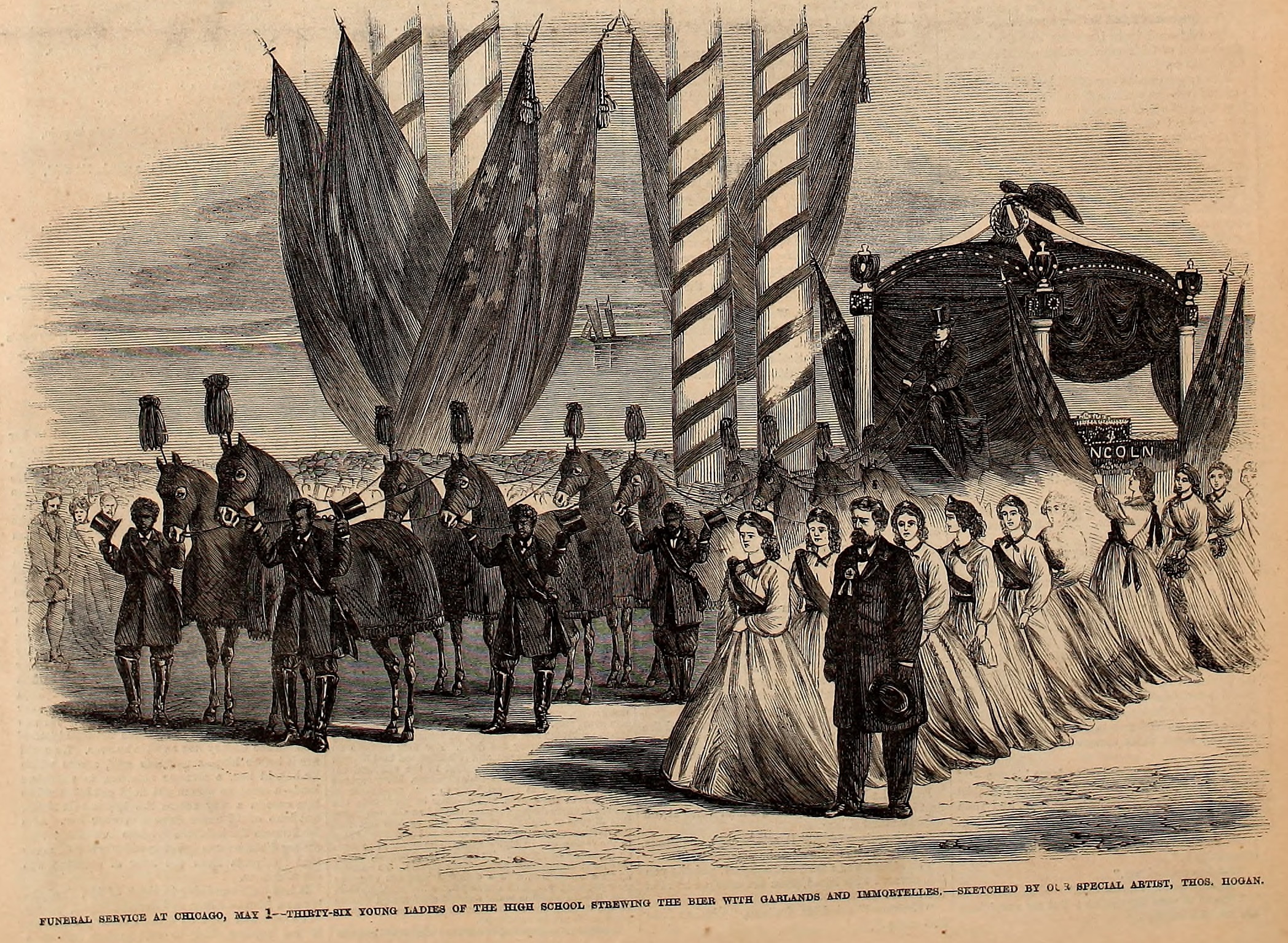
Description
In the May 20th, 1865 edition of Frank Leslie's Illustrated Weekly newspaper, this image was printed next to an article about President Lincoln's funeral train heading to Springfield, Illinois for burial. The train carrying Lincoln’s body traveled through 180 cities and seven states on its way to Springfield. Scheduled stops for the special funeral train were published in newspapers. In ten cities, Lincoln’s casket was removed from the train for elaborate memorial services and public viewings. This image depicts the funeral procession for President Lincoln in Chicago. The illustrated literary and news publication was founded in 1855 and continued until 1922. It was one of several started by publisher and illustrator Frank Leslie. Leslie was a British engraver who came to the United States in 1848. The Illustrated Weekly followed a tested and proven formula of carefully combining elements of war, politics, art, science, travel and exploration, literature and the fine arts in each issue, enhanced with between 16 and 32 illustrations. By 1897 its circulation had grown to an estimated 65,000 copies.
-
Source
Lincoln Financial Foundation Collection
-
Rights
To request rights and permissions to use Lincoln Financial Foundation Collection images in research or publications, please download our image rights permission form: https://www.lincolncollection.org/access/image-rights-permissions/.
-
Creator
Thomas Hogan
-
Publisher
Frank Leslie
-
Date
May 20, 1865